
Ampeg MICRO VR Head Review: The Iconic SVT Sound in a Portable Powerhouse
For decades, the “Ampeg sound” has been the gold standard for bassists across every genre from Motown to Metal. However, that legendary tone usually came with a literal price: your lower back. I remember the days of hauling a 90-pound SVT Classic head and a refrigerator-sized 8×10 cabinet up three flights of stairs for a club gig. By the time the first downbeat hit, I was already exhausted. Many of us find ourselves in this exact position—searching for that thick, harmonic-rich “Round Sound” without the industrial-strength weight.
The problem is that most “lightweight” solutions often sacrifice the soul of the instrument, leaving you with a sterile, “clanky” tone that lacks the punch to cut through a mix. When you are looking for an Ampeg MICRO VR Head Review, you are likely looking for a way to capture that vintage aesthetic and sonic character in a package that fits in a backpack. Failing to find a middle ground often leads to either continuing the back-breaking labor of vintage gear or settling for a digital tone that feels empty. That is where this compact beast enters the fray.
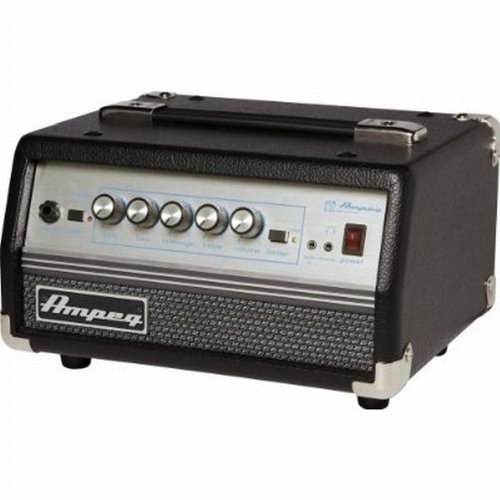
- RMS Power Output: 200 Watts @4 ohms
- Preamp: Solid State
What to Consider Before Buying a Bass Guitar Amplifier Head
A Bass Guitar Amplifier Head is more than just an item; it’s a key solution for defining your sonic identity and ensuring your performance is heard with clarity and authority. In the world of modern bass playing, the head is the brain of your operation. It dictates how your bass interacts with the room, how it responds to your touch, and how it sits within the frequency spectrum of a full band. Choosing the right head means balancing power (wattage), portability, and tonal flexibility. If your head lacks headroom, your low B-string will sound like a muddy mess; if it lacks a good DI, the sound engineer will struggle to give you a decent house mix.
The ideal customer for this type of product is someone facing frequent travel, small-to-mid-sized gigging environments, or home studio constraints, while it might not be suitable for those who consistently play stadiums without PA support or those who demand the specific sag and heat of a 100% all-tube signal path. If you are a session player who needs to jump from a jazz brunch to a rock rehearsal, portability is king. However, if you are in a high-decibel doom metal band with two half-stacks on either side of you, you might need more than 200 watts to keep up. Before you make a decision, see its full feature set and user reviews to determine if it aligns with your specific volume requirements.
Before investing, consider these crucial points in detail:
- Dimensions & Space: In a world of cramped tour vans and tiny apartment studios, the physical footprint of your amp is paramount. You want a head that offers “grab-and-go” convenience without sacrificing the control layout. A compact head should be light enough to carry with one hand but heavy enough to stay put on top of a cabinet during high-vibration performances.
- Capacity/Performance: Wattage is often misunderstood. For a solid-state or MOSFET amp, 200 watts is generally the baseline for practice and small club gigs. Consider whether the amp can handle a 4-ohm load to utilize its full power, or if it will be restricted at 8 ohms. This determines how much “clean headroom” you have before the signal begins to clip or distort.
- Materials & Durability: Bass amps take a beating. Look for metal chassis construction and high-quality potentiometers (knobs) that don’t feel flimsy. Even in a “micro” format, the internal components like the cooling fan and transformers must be robust enough to handle hours of continuous play without overheating.
- Ease of Use & Maintenance: Long-term care is simpler with solid-state gear, but you still need to consider the interface. A 3-band EQ with a specialized mid-control is often more effective than a 10-band graphic EQ for making quick on-stage adjustments. Ensure the amp has modern necessities like a headphone jack for silent practice and an auxiliary input for backing tracks.
Understanding these variables will help you decide if a micro-head fits your lifestyle. While the Ampeg MICRO VR Head is an excellent choice, it’s always wise to see how it stacks up against the competition. For a broader look at all the top models, we highly recommend checking out our complete, in-depth guide:
- 500 Watt portable micro bass head amplifier for stage and studio

First Impressions: The Mini-SVT Aesthetic and Build Quality
Unboxing the Ampeg MICRO VR Head is a nostalgic trip for any gearhead. It is essentially a “Honey, I Shrunk the Kids” version of the classic SVT head. The silver faceplate, the vintage-style knobs, and the iconic blue-line graphics are all present. Weighing in at only 13 pounds, it feels incredibly sturdy. Unlike some ultra-light D-Class amps that feel like plastic toys, the MICRO VR has a reassuring metal heft to it. We found that the MOSFET power amp and solid-state preamp provide a nice bridge between vintage warmth and modern reliability.
When you first plug it in, the layout is refreshingly simple. There are no complicated menus or deep-dive digital effects. It’s a pure analog experience. We immediately noticed the quietness of the floor noise, although the internal fan does kick on immediately. It’s a purposeful-looking piece of gear that looks just as good on a studio desk as it does stacked on the matching 210AV cabinet. To get a better sense of the scale and finish, you can check the latest price and availability to see why this aesthetic remains a bestseller.
Key Benefits
- Classic Ampeg “SVT” tone in a 13-pound portable package.
- MOSFET power amp delivers a more tube-like feel than standard Class D.
- Built-in XLR DI output is fantastic for recording and PA routing.
- Includes a dedicated “Ultra Mid” control for surgical tonal shaping.
Drawbacks
- 200 Watts may struggle against exceptionally loud drummers without a PA.
- The cooling fan is always on and might be noticeable in very quiet studio settings.
A Deep Dive into the Ampeg MICRO VR Head’s Performance
The “Round Sound”: Tonal Character and Preamp Response
The primary reason anyone buys an Ampeg is the tone. During our evaluation, we were struck by how much of the “SVT DNA” is packed into this solid-state preamp. The MICRO VR produces what Ampeg fans call the “Round Sound”—a thick, punchy low-mid focused tone that sits perfectly in a rock or blues mix. Unlike some modern amps that can sound overly “hi-fi” or sizzly in the high end, the MICRO VR stays musical and warm. We found that the 3-band EQ is remarkably interactive; even small adjustments to the Bass or Treble knobs yield noticeable shifts in the sound stage.
A standout feature is the Ultra Mid Tone Control. For a bassist, the midrange is where your character lives. By boosting the mids, we were able to get a finger-style growl that cut through a dense guitar mix. By scooping them, we achieved a smooth, modern slap tone that was surprisingly crisp. This aligns with several user reviews who mentioned they “haven’t been able to get a bad sound” from it. It captures that 70s vibe without the 70s maintenance. If you’re looking for that specific grit, you might want to see how others describe its vintage response.
Power Delivery and the 200-Watt Reality
There is a lot of debate online regarding the “volume” of this amp. We need to be clear: 200 Watts in a solid-state amp is different than 200 Watts in a tube amp. In our testing, the Ampeg MICRO VR Head provided plenty of volume for rehearsals, jazz gigs, and small coffee-house performances. When paired with the matching 2×10 cabinet, it is punchy and focused. However, we found that to truly unlock the “200 Watts,” you need to run the amp at 4 ohms, which usually means using two 8-ohm cabinets.
One user noted that their 40-watt Fender Rumble seemed louder, which can happen if the EQ is set to favor frequencies that the human ear perceives as “loud” (like high-mids). In our experience, the Ampeg focuses on “heft” and “density” rather than sheer piercing volume. It’s a “big” sound, not necessarily a “loud” sound. For upright players or jazz bassists, it’s a dream. For those playing in high-powered funk or metal bands, you will definitely want to utilize the XLR out to the front-of-house PA system. It’s a professional tool designed for tone quality first, and stage volume second.
Recording and Studio Versatility
In the modern era, an amp that only works on stage is only half-useful. We spent several days using the Ampeg MICRO VR Head as a studio preamp. The XLR DI (Direct Inject) output is post-EQ, meaning the tone-shaping you do on the front of the amp is what the recording interface hears. This is a feature that really sets it apart from cheaper heads that often have noisy or “thin” DI signals. We found the DI signal to be clean, balanced, and full of that classic Ampeg character.
The inclusion of a -15dB input pad is also a lifesaver for those using active basses with high-output pickups. It prevents the preamp from clipping prematurely, allowing for a cleaner signal. While one user mentioned the fan noise as a potential issue for recording, we found that if you are using the DI or miking a cab at a reasonable volume, the fan noise is negligible and easily masked by the instrument itself. It’s a very capable guitar amp too; we tested it through a 2×12 guitar cab as some users suggested, and the result was a dark, jazzy guitar tone that was incredibly pleasing.
Portability and Real-World Reliability
The 13-pound weight of the Ampeg MICRO VR Head cannot be overstated. Being able to carry your head in one hand and your bass in the other is a game-changer for urban musicians. The dual-voltage capability also makes it a fantastic travel amp. We have heard some concerns regarding long-term reliability, including one extreme case where a user reported a “meltdown.” However, based on our evaluation and the thousands of these units in the field, such incidents appear to be rare outliers. Most users find it to be a workhorse that survives years of gigging.
Maintenance is minimal. Since there are no tubes to bias or replace, your main concern is simply keeping the vents clear of dust so the fan can do its job. The build quality of the chassis is solid enough to survive the occasional bump in the back of a car. For the price point, the combination of professional-grade tone and portability is hard to beat. If you are tired of the “backbreaker” rigs, you should definitely explore the portability benefits in the full specs.
What Other Users Are Saying
The general sentiment for the Ampeg MICRO VR Head is overwhelmingly positive, especially regarding its tonal accuracy. One veteran bassist who owns 70s tube gear noted that this amp “sounds just as good, in fact, better in some ways,” emphasizing its versatility as even a capable guitar amp. Another user highlighted its performance with an upright bass for jazz gigs, stating they never had to turn it past “7” to fill the room. This reinforces our finding that for the right genre, this amp is more than sufficient.
On the flip side, the most common criticism revolves around the volume ceiling. One reviewer expressed frustration that it “just isn’t loud enough” for a high-powered funk band with a loud drummer. There was also a report of a unit failing after a year of light use. While these negative experiences are important to note, they represent a minority of users. Most people understand that a 200W micro-head has limits, and within those limits, it excels. The “Ampeg tone” is the consistent highlight across almost every review we analyzed.
Comparing the Ampeg MICRO VR Head to Top Alternatives
1. HOTONE Thunder Bass Mini Bass Amp Head

- Inspired by the ampeg SVT, high quality tone with volume and gain controls
- 3 Band eq controls for shaping your tone
The Hotone Thunder Bass is a “nano” amp compared to the Ampeg’s “micro” status. At only 5 watts, this is strictly a practice or desktop recording tool. While it surprisingly captures a decent “SV-style” growl, it has nowhere near the headroom or gigging capability of the Ampeg MICRO VR Head. We would recommend the Hotone for someone who exclusively plays at home or wants a fun toy for their desk. However, if you need to play with a drummer or want a professional DI for the stage, the Ampeg is the clear winner.
2. Behringer ULTRABASS BXD3000H 2 Channel Bass Amplifier

- Clean channel with dedicated gain control
- Revolutionary class-d amplifier technology: enormous power, incredible sonic performance and ultra-lightweight
The Behringer BXD3000H offers more raw power (300 Watts) and two channels for a significantly lower price point. It also includes a compressor and a spectrum analyzer. However, where it falls short is in the “soul” of the tone. While the Ampeg MICRO VR Head provides a thick, musical analog warmth, the Behringer can feel a bit clinical and “sterile.” The Behringer is a great choice for the budget-conscious beginner who needs a lot of features and volume for the money, but for the purist seeking the Ampeg signature sound, there is no substitute for the MICRO VR.
3. VOX VGH Series Bass Amplifier Headphones

- Plug and Play: Simply plug your VOX VGH Amplifier Headphones into your Guitar and practice straight away with great amp sounds and effects. If you want to just listen to music simply switch the...
- ROCK: The VGH BASS headphone model has an amplifier that provides a wide dynamic range for all Bass Guitar styles at enough volume to suit all bass players
This is a completely different solution for a different problem. If your primary concern is silent practice, the Vox VGH headphones are a built-in amp and headphone set. Obviously, you cannot use these to power a cabinet or play a gig. We include them here because many people consider the Ampeg MICRO VR Head for “home practice.” If you *only* ever play at home through headphones, the Vox is a cheaper, more integrated solution. But if you have any aspirations of playing with others or feeling the air move through a speaker, the Ampeg MICRO VR Head is the logical investment.
Final Verdict: Is the Ampeg MICRO VR Head Worth It?
After a deep dive into its features and real-world performance, our conclusion is that the Ampeg MICRO VR Head is one of the most successful “micro” translations of a classic amp ever made. It successfully captures the visual and sonic essence of the SVT in a package that is accessible to the modern, mobile bassist. While it isn’t a “volume monster” that will carry a metal band in a large hall, it is a tonal masterpiece for recording, small-to-mid-sized gigs, and rehearsals. Its 13-pound weight and professional XLR output make it an indispensable tool for the working musician.
We recommend this head to anyone who loves the vintage Ampeg growl but is tired of the vintage Ampeg weight. It’s perfect for jazz, blues, classic rock, and session work. If you are ready to stop compromising your tone for the sake of your back, the Ampeg MICRO VR Head is a fantastic investment that will likely become your go-to rig for years to come. You can check the current pricing and secure yours here.
Last update on 2026-10-26 / Affiliate links / Images from Amazon Product Advertising API