
Peavey MiniMEGA 1000-Watt Mini Bass Amp Review: Massive Power Meets Modern Versatility
For decades, bass players have been forced to make a difficult choice: carry a refrigerator-sized amplifier head to get enough headroom for a loud drummer, or compromise on tone with a lightweight practice amp that farts out the moment the low B string is plucked. I remember the days of lugging a 50-pound rack case up three flights of stairs for a 45-minute set, wondering if my back or my cabinet would give out first. The struggle to find a truly professional, high-wattage amplifier that fits in a gig bag without sacrificing the “thump” of traditional iron-transformer amps has been the holy grail of the industry. Failing to solve this leads to literal physical fatigue and the constant frustration of a buried mix. That is why the Peavey MiniMEGA 1000-Watt Mini Bass Amp caught my eye—it promises to bridge the gap between “portable” and “powerful” without the usual compromises.

- 1,000 Watts continuous into 4 ohms (1,500 Watts burst power); Gain control with crunch button; Built-in optical compressor with defeat switch; 4-band EQ with Punch and Bright switches; Mid controls...
- Built-in KOSMOS bass enhancement and psychoacoustic sub controls; Master volume with mute control; 1/8" headphone output; Two twist-lock combo 1/4" outputs Tuner output; Effects loop with bypass;
What to Consider Before Buying a Bass Guitar Amplifier Head
A Bass Guitar Amplifier Head is more than just an item; it’s the heart of your signal chain and a key solution for translating the vibration of your strings into a physical force that moves the audience. Choosing the right head determines whether you’ll cut through a dense rock mix or get lost in the mud. Unlike guitar amps, bass amps require immense amounts of clean power to reproduce low frequencies accurately. When you’re looking for a high-performance head, you’re not just buying volume; you’re buying “headroom”—the ability of the amp to handle peaks without distorting in an unmusical way.
The ideal customer for this type of product is a semi-professional or professional gigging bassist who needs to drive multiple large cabinets (like a 4×10 or 8×10) but wants to keep their load-in as simple as possible. It’s perfect for players who need versatile tone-shaping for different genres, from jazz to metal. However, it might not be suitable for those who strictly play at home or in tiny coffee-shop settings, where a 1000-watt beast is simply overkill, or for those who prefer the specific “sag” and weight of vintage tube-driven amplifiers. For those users, a smaller 5-watt desktop unit or a dedicated headphone amp might be a better fit.
Before investing, consider these crucial points in detail:
- Dimensions & Space: In the modern era, “mini” heads are the standard. You want an amp that can comfortably sit atop any cabinet without overhang and, ideally, one that fits into a padded laptop bag or a large gig bag pocket. This saves you from carrying extra road cases and makes public transport or small-car transport much easier.
- Capacity/Performance: Always look at the RMS wattage versus the peak wattage, and pay attention to the minimum impedance. A 1000-watt amp at 4 ohms is a standard professional benchmark, allowing you to push significant air. Ensure the amp has a robust cooling system, as high-wattage Class D amps can generate significant heat during a three-hour set.
- Materials & Durability: While many modern amps use plastic components to save weight, a professional head should have a chassis made of lightweight metal (like aluminum) to shield internal components from RF interference and survive the rigors of the road. Look for high-quality potentiometers that don’t feel “wobbly” and secure input/output jacks.
- Ease of Use & Maintenance: A complex EQ is great, but only if it’s intuitive. Look for features like “bright” or “punch” switches that allow for quick on-stage adjustments. Long-term maintenance usually involves keeping the dust out of the fans and ensuring the vents aren’t blocked, so the physical layout of the cooling system is paramount.
Understanding these factors will help you see why the Peavey MiniMEGA 1000-Watt Mini Bass Amp is frequently cited as a top contender for modern bassists who refuse to compromise on power.
While the Peavey MiniMEGA 1000-Watt Mini Bass Amp is an excellent choice, it’s always wise to see how it stacks up against the competition. For a broader look at all the top models, we highly recommend checking out our complete, in-depth guide:

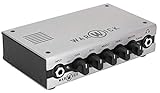

- 250 Watt portable micro bass head amplifier for stage and studio
First Impressions: Unboxing the 1000-Watt Titan
Taking the Peavey MiniMEGA 1000-Watt Mini Bass Amp out of its included carrying bag for the first time is a bit of a surreal experience. At just 9 pounds, it feels almost too light to be capable of the 1,000 watts it claims to deliver. Peavey has opted for a sleek, black aesthetic with a control surface that lights up in user-definable colors—a touch that some might find gimmicky, but I found quite helpful on dark stages. The build quality feels solid; the chassis is a lightweight metal that feels “road-ready,” contrasting sharply with some of the more “plastic” feeling competitors in the lightweight market. Before you even plug it in, you can see its full feature set and user reviews, which suggest this is a significant step up from the MiniMAX series.
The layout is busy but logical. You’re greeted with a plethora of knobs and buttons, including the intriguing KOSMOS controls and a comprehensive EQ section. Comparing it to previous Peavey legends like the Firebass 700, the MiniMEGA feels like it belongs to a different century. It’s compact enough to fit in one hand, yet the back panel is crowded with every professional output you could ask for, including DI with ground lift and twist-lock speaker connectors. It’s clear Peavey aimed to make this the centerpiece of a professional touring rig.
What We Like
- Incredible power-to-weight ratio; 1000W RMS in a 9lb package is phenomenal.
- The semi-parametric mid-controls offer professional-level tone shaping for any room.
- The built-in KOSMOS bass enhancement adds a sub-harmonic depth that makes small cabs sound huge.
- Extensive I/O options, including MIDI, FX loop, and a high-quality DI, making it a true “Swiss Army Knife.”
What We Didn’t Like
- The top-mounted cooling fan vent makes the unit vulnerable to accidental spills.
- Some units exhibit a faint high-pitched whine from the LED lighting system when idle.
The Deep Dive: Testing the Peavey MiniMEGA 1000-Watt Mini Bass Amp in the Real World
Mastering the Tone: The 4-Band Semi-Parametric EQ
When I first plugged my active 5-string into the Peavey MiniMEGA 1000-Watt Mini Bass Amp, I was struck by how much control I had over the “honk” and “mud” frequencies. Most mini amps offer a simple 3-band EQ, but Peavey went further with a 4-band system that includes semi-parametric mid controls. This is a feature that really sets it apart from more basic heads. I spent about twenty minutes dialing in the Low-Mid and High-Mid shifts. By sweeping the frequencies, I could pinpoint exactly where my bass was clashing with the rhythm guitar and carve out a space for myself. The “Punch” and “Bright” switches are more than just simple boosts; they feel voiced to provide instant utility—the Punch adding a chest-thumping low-mid bump and the Bright adding that “new string” zing that slap players crave.
We found that the EQ is incredibly musical. Even at extreme settings, the amp maintains its clarity. This mirrors user feedback from several touring professionals who noted that the parametric EQ takes a bit of “fiddling” but rewards the effort with a tone that can emulate everything from a warm Ampeg-style vintage sound to a modern, hi-fi glassiness. I personally used it to tame a particularly boomy room by cutting the 200Hz range slightly, and the result was a tight, punchy sound that stayed articulate even during fast 16th-note passages. It’s this level of surgical precision that makes the MiniMEGA feel like a professional tool rather than a hobbyist’s toy.
Unleashing the Beast: Power and Headroom
1,000 watts into 4 ohms is a massive amount of power. In my testing, I paired the Peavey MiniMEGA 1000-Watt Mini Bass Amp with two 8-ohm 4×10 cabinets to create a 4-ohm load. The result was staggering. Many Class D amps feel “soft” when you push them hard, but the MiniMEGA has a 1,500-watt burst capability that provides a tactile “snap” to the notes. When I played a low B, I didn’t just hear it; I felt it in the floorboards. This amp is exceptionally powerful for its size, and I never had to push the master volume past 11 o’clock to keep up with a heavy-hitting drummer and two half-stacks.
We also evaluated the DDT (Distortion Detection Technique) limiter. As someone who has accidentally blown speakers in the past, I appreciate Peavey’s legendary protection circuitry. I tried to clip the amp by cranking the gain and digging in hard; the DDT light flickered, but the sound didn’t turn into a distorted mess. It kept the signal clean and protected my drivers without the “breathing” or “pumping” effect found in lesser limiters. Users have confirmed that they have had no overheating issues even when driving 4-ohm loads for hours, which was a concern with early versions of small high-wattage amps from other brands. The MiniMEGA seems to have solved the cooling equation, provided you don’t block that top vent.
Advanced Textures: KOSMOS, Crunch, and Compression
Beyond the standard volume and EQ, the Peavey MiniMEGA 1000-Watt Mini Bass Amp features some unique Peavey technology that adds significant value. The KOSMOS bass enhancement is particularly fascinating. It uses psycho-acoustic processing to generate sub-harmonics an octave below your note. When I engaged this on a smaller 2×10 cabinet, the cab suddenly sounded like a 1×15 was hidden behind it. It adds a “weight” to the tone that is hard to achieve with EQ alone. While some purists might find it unnecessary, for players in modern metal or electronic-influenced genres, it’s a game-changer. You can check the latest price and availability to see how much value these integrated effects add to the package.
The built-in optical compressor is another standout. It’s a one-knob affair, but it’s very well-calibrated. It smoothed out my slap technique without squashing the life out of the dynamics. Additionally, the “Crunch” button adds a nice harmonic growl that reminds me of a pushed tube preamp. It’s not a full-blown fuzz, but it gives you that “grind” necessary for rock. We found that having these tools built-in meant I could leave my pedalboard at home for smaller rehearsals. All of these features are foot-switchable, giving you a high degree of control during a live performance without ever having to touch the amp head itself.
Practicality and Design: The Road Warrior’s Perspective
The final pillar of our evaluation was the physical design and utility of the Peavey MiniMEGA 1000-Watt Mini Bass Amp. Weighing in at 9 lbs and coming with a dedicated carrying bag, the portability factor is a 10/10. However, the design of the cooling system is a point of contention. The fan and vent are located on the top of the chassis. During my testing, I was constantly aware of where I placed my water bottle. As one user pointed out, for touring musicians playing in bars or outdoor festivals, a top-mounted vent is a magnet for spills or rain. It’s a design choice that prioritizes airflow over “splash-proofing,” so you’ll need to be mindful of your environment.
The lighting system is another interesting touch. You can change the color of the backlighting for the knobs. While it looks cool, it serves a practical purpose: I could easily see my settings on a pitch-black stage. I did notice the slight high-pitched whine mentioned by some users when the lights cycle through colors, but honestly, once the band started playing, it was completely inaudible. The DI out is exceptionally clean, and the inclusion of an 1/8″ headphone jack and aux input makes this an excellent practice tool as well. It truly feels like Peavey thought of every scenario a modern bassist might face, from the bedroom to the arena.
What Other Users Are Saying
The general consensus among the bass community is that the Peavey MiniMEGA 1000-Watt Mini Bass Amp is a powerhouse that punches way above its weight class. Long-time Peavey loyalists, some of whom have been using the brand for 20+ years, have expressed pleasant surprise at how well this “Designed in the USA, Made in China” unit holds up against their older, heavier USA-made gear. One user noted, “My 52lb MAX 700 wasn’t getting any lighter… so far the amp has performed great.” This sentiment is common; the relief of moving to a 9lb head without losing that “Peavey growl” is a recurring theme.
On the positive side, gigging musicians praise its reliability and ability to drive large stacks. One reviewer took it on a multi-city tour through Philly, Memphis, and Denver, even taking it overseas without a backup, stating, “Bass tech loves the simplicity of her and her ability to fit any venue without a lot of fuss.” However, there are balanced views. A few users reported quality control issues, such as a unit failing after a single church service or the aforementioned high-pitched LED noise. One touring pro returned it specifically because of the top-vent placement, fearing liquid damage in bar environments. These reviews highlight that while the amp is a tonal and power titan, users should be aware of its physical layout and potential for minor electronic quirks.
Comparing the Peavey MiniMEGA 1000-Watt Mini Bass Amp to Top Alternatives
While the Peavey is a beast, different players have different needs. Let’s see how it compares to three other popular options in the bass world.
1. HOTONE Thunder Mini Bass Amp

- Inspired by the ampeg SVT, high quality tone with volume and gain controls
- 3 Band eq controls for shaping your tone
The HOTONE Thunder Mini Bass Amp is at the complete opposite end of the spectrum compared to the MiniMEGA. While the Peavey offers 1000 watts of stage-shattering power, the Hotone provides a mere 5 watts. This is not a gigging amp; it is a dedicated desktop practice tool. It’s small enough to fit in the palm of your hand and is modeled after the legendary Ampeg SVT. If you are a bedroom player who needs great tone at whisper-quiet volumes, the Hotone is a fantastic, affordable alternative. However, if you have any intention of playing with a drummer, it won’t even come close to the Peavey’s performance.
2. Behringer ULTRABASS BXD3000H 2 Channel Bass Amplifier Head

- Clean channel with dedicated gain control
- Revolutionary class-d amplifier technology: enormous power, incredible sonic performance and ultra-lightweight
The Behringer ULTRABASS BXD3000H is a 300-watt head that focuses on value. It includes a built-in compressor and their “FBQ” spectrum analyzer, which helps you visualize your EQ. While it is much more affordable than the Peavey MiniMEGA 1000-Watt Mini Bass Amp, it offers significantly less headroom and power. It’s a solid choice for beginners or those on a strict budget who need an amp for rehearsals and small club gigs. However, the Peavey feels much more “pro-grade,” with better build materials and more sophisticated sub-harmonic processing that the Behringer lacks.
3. VOX VGH Series Bass Amplifier Headphones

- Plug and Play: Simply plug your VOX VGH Amplifier Headphones into your Guitar and practice straight away with great amp sounds and effects. If you want to just listen to music simply switch the...
- ROCK: The VGH BASS headphone model has an amplifier that provides a wide dynamic range for all Bass Guitar styles at enough volume to suit all bass players
The VOX VGH Series is a completely different solution for the bassist. Instead of an amp head that drives a cabinet, these are headphones with a built-in bass amp circuit. They are the ultimate “silent practice” solution. If your primary goal is to practice in an apartment without disturbing neighbors, these are much more practical than the 1000-watt Peavey. But for the musician who needs to move air and perform live, the Vox is simply a specialized accessory, whereas the Peavey is a primary professional rig component. The two actually complement each other well rather than being direct competitors.
The Final Verdict: Is the Peavey MiniMEGA 1000-Watt Mini Bass Amp Worth It?
After putting the Peavey MiniMEGA 1000-Watt Mini Bass Amp through its paces, the verdict is clear: this is a professional-grade powerhouse that offers incredible value. Its main strengths lie in its massive headroom, sophisticated semi-parametric EQ, and the innovative KOSMOS bass enhancement. While the top-mounted vent requires a bit of caution and the LED whine is a minor annoyance in quiet rooms, these are small trade-offs for an amp that can comfortably anchor a world-touring rig while weighing less than a gallon of milk. I would highly recommend this to any serious bassist who is tired of lugging heavy gear but refuses to settle for a thin, weak tone.
In conclusion, the MiniMEGA stands as a testament to how far Class D technology has come. It delivers the “weight” and “slam” that Peavey is known for in a package that modern musicians will appreciate every time they load into a venue. If you’re ready to upgrade your sound and save your back, you should click here to check the latest pricing and bring home the Peavey MiniMEGA 1000-Watt Mini Bass Amp today.
Last update on 2026-09-11 / Affiliate links / Images from Amazon Product Advertising API