
Ampeg Venture V12 Bass Guitar Head Review: The High-Power Modern Classic Your Back Will Thank You For
For decades, the “Ampeg sound” was synonymous with a 300-pound stack consisting of an SVT Classic head and an 810 “fridge” cabinet. As a gigging bassist who has spent far too many nights lugging heavy gear up narrow venue stairs, I know the physical toll that legendary tone can take. We all want that punch, that grit, and that undeniable presence, but in today’s world of compact cars and aging backs, the era of the “back-breaker” is slowly fading. The struggle for many of us has been finding a Class D amplifier that doesn’t just provide volume, but provides soul. We search for a head that feels responsive, has enough headroom to handle a low B-string on a five-string bass without clipping, and offers the versatility to go from a vintage Motown thump to a modern metallic grind. This is where the Ampeg Venture V12 Bass Guitar Head enters the conversation, promising to bridge the gap between vintage heritage and modern portability.

- Legacy Preamp with 3-band EQ
- Sweepable Mids and Ultra Hi/3-way Ultra Lo switches
What to Consider Before Buying a High-End Bass Guitar Amplifier Head
A Bass Guitar Amplifier Head is more than just an item; it’s a key solution for any serious musician looking to define their sonic footprint. It serves as the brain of your rig, translating the vibrations of your strings into the thunderous roar that fills a room. When you are looking at a professional-grade head like the Ampeg Venture V12 Bass Guitar Head, you are investing in your performance reliability and your creative expression. A high-quality head ensures that your nuances are heard, whether you’re playing a delicate jazz line or a percussive slap solo. Without a capable amplifier, even the most expensive bass guitar will sound thin, lifeless, and lost in the mix of a loud drummer and distorted guitars.
The ideal customer for this type of product is someone facing regular gigging schedules, studio sessions, or touring environments where weight and space are at a premium but tonal quality cannot be compromised. It is perfect for the professional who needs 1200 watts of headroom to drive multiple cabinets at outdoor festivals. However, it might not be suitable for those who strictly play at home or in very small coffee-shop settings where a 50-watt combo would suffice. If you aren’t prepared to handle the learning curve of a sophisticated preamp or don’t need the massive wattage, you might consider smaller, more entry-level alternatives.
Before investing, consider these crucial points in detail:
- Dimensions & Space: In the world of modern bass gear, footprint is everything. You want a head that fits into a standard backpack or a small gig bag. The Ampeg Venture V12 Bass Guitar Head measures 14″D x 21\”W x 5\”H, making it incredibly compact for the power it delivers. Before you buy, ensure your current rack or carrying case can accommodate these dimensions, though its small size usually makes it a “fit-anywhere” solution.
- Capacity/Performance: Power isn’t just about volume; it’s about headroom. A 1200-watt amp like this one allows you to play at high volumes without the power section distorting or “sagging.” This is vital for maintaining a clean, punchy low end. We found that having this much power on tap ensures that your peaks are never compressed unless you want them to be.
- Materials & Durability: Since this is a piece of gear that will likely be moved often, the build quality is paramount. Look for solid-state reliability and a chassis that can withstand the rigors of the road. While lightweight materials are used to keep the weight down to 8.4 pounds, the internal components and external switches should feel robust and professional, not “plasticky” or fragile.
- Ease of Use & Maintenance: A great bass head should be intuitive. While the Ampeg Venture V12 Bass Guitar Head offers deep tone-shaping tools like sweepable mids and SGT overdrive, the layout should make sense in a dark club environment. Maintenance on modern solid-state Class D amps is generally minimal compared to tube amps, which is a huge plus for the busy musician who doesn’t want to worry about biasing tubes or fragile glass components.
While the Ampeg Venture V12 Bass Guitar Head is an excellent choice, it’s always wise to see how it stacks up against the competition. For a broader look at all the top models, we highly recommend checking out our complete, in-depth guide:
- 500 Watt portable micro bass head amplifier for stage and studio

First Impressions: The Lightweight Titan Arrives
When we first pulled the Ampeg Venture V12 Bass Guitar Head out of its packaging, the first thing that struck us was the weight—or rather, the lack of it. At just 8.4 pounds, it feels almost impossible that this unit can pump out 1200 watts of power. The aesthetic is classic Ampeg: a sleek black finish, rugged knobs that feel substantial to the touch, and a layout that immediately feels familiar to anyone who has used a Portaflex or SVT series amp. It’s a handsome piece of gear that manages to look modern while nodding respectfully to the brand’s legendary history. You can see its full feature set and user reviews to understand why this specific design is garnering so much attention.
The assembly—if you can even call it that—is as simple as plugging in the power cord and a speaker cable. However, our initial setup did hit a slight snag that we noticed other users have mentioned as well. The SpeakON outputs on the back require a specific connection type (NL2), which might catch you off guard if you are used to universal cables. Once we sorted our cabling, the initial power-on was silent and efficient. There’s no massive “thump” when you flip the switch, just a ready-to-go indicator that whispers of the power waiting under the hood. It definitely feels like a premium product from the moment you touch the front panel.
Key Benefits
- Massive 1200-watt power section provides incredible clean headroom for any gig size.
- The SGT Overdrive circuit accurately mimics both SVT and B15 voicings for vintage grit.
- Incredibly lightweight at 8.4 lbs, making it the ultimate portable powerhouse.
- Comprehensive I/O including a high-quality XLR DI, effects loop, and aux in.
Limitations
- Requires specific SpeakON NL2 connectors, which may require new cables for some users.
- The price point reflects its professional status and might be steep for hobbyists.
Deep Dive: Performance and Tonal Versatility
The Soul of the Sound: Legacy Preamp and SGT Circuit
The heart of the Ampeg Venture V12 Bass Guitar Head is its preamp, and this is where Ampeg has really outdone themselves. We spent hours dialing in different tones, and the range is staggering. The 3-band EQ is musical and responsive, but the real magic lies in the sweepable mid-frequency control. This allows you to find that specific “honk” or “scoop” that fits your bass perfectly into the band’s mix. When we engaged the SGT (Super Grit Technology) circuit, the amp transformed. By toggling between the SVT and B15 voicings, we were able to go from the aggressive, mid-forward growl of a 70s rock stage to the round, pillowy thump of a 60s studio session. It’s a feature that really sets it apart from other Class D heads that often sound sterile or “flat.”
We found that the SGT circuit isn’t just a simple distortion foot-switch; it’s a tonal reconstruction. The way it interacts with the gain staging feels very “tube-like.” In our testing, even when we pushed the overdrive hard, the low-end remained tight and didn’t fall apart. This confirms what many users have said about the amp having the “punch and tone” they were looking for after years of playing older, heavier Ampeg models like the B4R. To get a better sense of how this circuit sounds in different environments, you should check the latest price and availability and see how other professionals are utilizing the SGT voicings in their rigs.
Unrivaled Headroom: 1200 Watts of Raw Power
In the bass world, wattage is often misunderstood. It’s not just about being “loud”; it’s about the speed and clarity of the transients. When you slap a low E string or dig into a low B on a 5-string, the amplifier needs a massive burst of energy to move the speaker cone without clipping. The 1200-watt power section of the Ampeg Venture V12 Bass Guitar Head handles these demands with ease. During our high-volume tests through a 4×10 cabinet, the amp never felt like it was struggling. There was a sense of “unlimited” power that made our playing feel more dynamic. We didn’t have to fight the amp to be heard; it simply delivered exactly what we put into it.
This level of performance is crucial for players who perform on large stages or outdoors where there are no walls to reflect sound. Often, 500-watt amps can start to feel “squashed” when pushed to these limits. The V12 stays open and airy. We also appreciated the variable compressor. Unlike some “one-knob” compressors that can feel pumping or intrusive, this one is subtle and effective at leveling out a performance without killing the life of the tone. It’s a sophisticated tool that confirms why Ampeg is still a leader in the industry. For those curious about the technical specs of the power section, you can see its full feature set and user reviews to see how it performs under various loads.
Connectivity and Professional Utility
A professional bass head is often judged by its back panel as much as its front. The Ampeg Venture V12 Bass Guitar Head is a Swiss Army knife of connectivity. The XLR DI output is remarkably quiet, which is a godsend for front-of-house engineers. We tested the DI in a studio setting and found it to be clean enough for professional tracking, with the option to send the signal pre or post-EQ. The inclusion of an effects loop, aux input, and a dedicated headphone output means this amp is just as useful for silent practice in an apartment as it is for a world tour. It truly is a versatile tool for the modern bassist.
However, we have to address the elephant in the room: the SpeakON connector. As we noted in our “Cons” section, and as some users have passionately pointed out, Ampeg chose to use a specific physical connection shape (NL2). While this is technically efficient from an electrical standpoint, it means that standard “universal” SpeakON cables may not fit. We found this to be a bit of a head-scratcher. It’s not a deal-breaker, but it is a “musician reality” that you’ll need to ensure your cable crate is stocked with the right leads before heading to a gig. Aside from this minor hurdle, the build quality and the thoughtfulness of the I/O are top-notch. You can view more details and pricing to see if this fits into your current gear ecosystem.
Precision Tone Shaping: Ultra Hi and Ultra Lo Switches
One of the hallmarks of the Ampeg sound is the “Ultra” switches, and they are present and accounted for on the Ampeg Venture V12 Bass Guitar Head. The Ultra Hi switch adds a crispness to the top end that is perfect for fingerstyle funk or pulling out the “click” in a metal mix. The 3-way Ultra Lo switch is even more impressive. It doesn’t just “boost bass”; it changes the character of the low-end frequencies. In the “down” position, it provides a massive sub-bass boost that can make a small cabinet sound like a giant stack. In the “up” position, it acts as a subtle cut, which is incredibly useful for cleaning up a boomy stage or a room with difficult acoustics.
We found these switches to be essential for quick on-the-fly adjustments. If you switch from a P-bass to a Jazz bass mid-set, these toggles allow you to compensate for the different pickup voicings instantly. Combined with the sweepable mids, we were able to replicate almost any classic bass tone we could think of. The sheer amount of control offered by the V12 is impressive, making it one of the most flexible heads we have ever evaluated. It’s a feature-rich environment that invites exploration and rewards the player with professional-grade results every time.
What Other Users Are Saying
The general sentiment surrounding the Ampeg Venture V12 Bass Guitar Head is overwhelmingly positive, especially among long-time Ampeg aficionados. One user who played the older B4R model for over 20 years noted that this head finally provided the “punch and tone” they had been missing in other modern Class D amplifiers. This confirms our finding that Ampeg has successfully translated their “legacy” sound into a much smaller, more efficient package. Users are consistently impressed by the sheer volume and clarity, with many noting that it “cuts through the mix” like a much heavier tube amp would.
On the flip side, the negative feedback is almost exclusively focused on the SpeakON connector choice. One user expressed frustration, stating that “Ampeg broke one of the biggest no-brainers of gear design” by using a restricted physical connection shape. They argued that a musician shouldn’t have to think about their cables when grabbing a standard off-the-shelf part. While this is a valid critique for those who already own a massive collection of NL4 cables, most users find that once they have the correct cable, the amp performs flawlessly. It’s a polarizing design choice, but one that doesn’t detract from the actual sound quality of the unit.
Comparing the Ampeg Venture V12 Bass Guitar Head to Top Alternatives
1. HOTONE Thunder Mini Bass Amp

- Inspired by the ampeg SVT, high quality tone with volume and gain controls
- 3 Band eq controls for shaping your tone
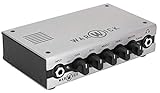
The HOTONE Thunder Mini Bass Amp is at the complete opposite end of the spectrum compared to the Ampeg Venture V12 Bass Guitar Head. While the Ampeg is a 1200-watt professional powerhouse, the Hotone is a 5-watt mini head designed for practice and desktop use. It’s incredibly charming and surprisingly loud for its size, offering a “thunderous” tone inspired by the SVT sound. However, it lacks the headroom, EQ complexity, and professional features required for gigging. We recommend this for students or pros who want a fun “toy” for the coffee table, but it is not a replacement for a main stage rig.
2. Behringer ULTRABASS BXD3000H 2 Channel Bass Amplifier Head

- Clean channel with dedicated gain control
- Revolutionary class-d amplifier technology: enormous power, incredible sonic performance and ultra-lightweight
The Behringer ULTRABASS BXD3000H offers a budget-friendly alternative for those who need a giggable head without the Ampeg price tag. It provides 300 watts of power and includes a 7-band EQ and a built-in compressor. While it is feature-rich and incredibly lightweight, it lacks the refined tone and massive 1200-watt headroom of the Ampeg Venture V12 Bass Guitar Head. The Behringer is an excellent choice for weekend warriors or those just starting to gig, but the tonal depth of the Ampeg’s SGT circuit is in a different league entirely. If you want professional heritage, the V12 is the way to go.
3. VOX VGH Series Bass Amplifier Headphones

- Plug and Play: Simply plug your VOX VGH Amplifier Headphones into your Guitar and practice straight away with great amp sounds and effects. If you want to just listen to music simply switch the...
- ROCK: The VGH BASS headphone model has an amplifier that provides a wide dynamic range for all Bass Guitar styles at enough volume to suit all bass players
The VOX VGH Series Bass Amplifier Headphones are not a head at all, but rather a set of headphones with a built-in bass amp. They are the ultimate solution for “bedroom” practice where you need to be completely silent. Comparing them to the Ampeg Venture V12 Bass Guitar Head is like comparing a bicycle to a freight train; they serve completely different purposes. While the Vox provides a great tone for personal practice, it obviously cannot drive a speaker cabinet. We recommend these as a companion to the V12 for those times when you can’t turn up your 1200-watt beast at 2:00 AM.
Final Verdict: The New Standard for Portable Power?
After putting the Ampeg Venture V12 Bass Guitar Head through its paces, we are confident in saying that this is one of the most impressive bass amplifiers on the market today. It successfully marries the legendary Ampeg “growl” with the modern requirements of portability and efficiency. The 1200 watts of headroom provide a level of confidence that is hard to find in other Class D heads, and the SGT circuit is a legitimate triumph in tonal modeling. While the SpeakON connector issue is a minor annoyance that requires some foresight with cabling, it is a small price to pay for the performance this head delivers.
If you are a professional bassist looking for a “forever” amp that can handle everything from a small club to a stadium stage without breaking your back, the V12 is a premier choice. It offers the versatility, power, and heritage that few other brands can match. Stop struggling with heavy gear and anemic tones. We highly recommend that you check out the Ampeg Venture V12 today and experience the future of the Ampeg legacy for yourself.
Last update on 2026-10-25 / Affiliate links / Images from Amazon Product Advertising API