
Orange Little Bass Thing 500 Watts Bass Guitar Head Review: The Lightweight Powerhouse Your Back Has Been Waiting For
For decades, bass players have been forced to make a compromise that felt almost like a rite of passage: if you wanted enough power to fill a room and compete with a loud drummer, you had to be prepared to haul a forty-pound “lead sled” amplifier head. I remember the days of lugging massive racks up narrow club stairs, only to realize my tone was buried anyway. When you are searching for a solution like the Orange Little Bass Thing 500 Watts Bass Guitar Head, it is usually because you are tired of that struggle. You need an amplifier that fits in a gig bag but delivers enough headroom to handle a five-string low B without farting out. Failing to find a reliable, high-wattage portable head means you’re either stuck with a back-breaking vintage rig or a “practice” amp that gets swallowed the moment your guitarist turns their volume to four. We have all been there, and the Orange Little Bass Thing 500 Watts Bass Guitar Head promises to end that cycle once and for all.

- Single Channel – Class D Power Amp
- Foot-Switchable (Sold Separately) Compression

What to Consider Before Buying a Bass Guitar Amplifier Head
A Bass Guitar Amplifier Head is more than just an item; it’s a key solution for any performing or recording musician who needs to translate the vibration of their strings into a physical force. In the modern era, the amplifier head is the “brain” of your signal chain. It dictates how your EQ behaves, how much sustain you can achieve via compression, and how well you interface with the front-of-house sound engineer. Before you see its full feature set and user reviews, you must understand that the goal of a modern head is to provide transparency when you want it and character when you need it.
The ideal customer for this type of product is someone facing frequent travel—whether that’s hopping on a plane for a tour or just taking the subway to a rehearsal. It is perfect for the bassist who uses multiple instruments (like a Fender and a Musicman) and needs an amp that “sings” with both. However, it might not be suitable for those who demand the specific, sagging tube compression of a vintage 100-pound SVT or those who only play at bedroom volumes and don’t need 500 watts of thrust. If you are looking for a “toy” or a desktop practice tool, you might consider smaller, lower-wattage headphone-centric devices instead.
Before investing, consider these crucial points in detail:
- Dimensions & Space: Modern Class D heads are designed to be tiny, but you still need to ensure they fit safely on your cabinet. A head that is too small might vibrate off a high-output 8×10 stack if it doesn’t have proper rubber feet. Look for something that balances weight (for portability) with a footprint that stays put during a heavy set.
- Capacity/Performance: 500 watts is the “sweet spot” for most bassists. It provides enough headroom to keep your “clean” tones clean even at high stage volumes. If you play in a loud genre like metal or ska, having that extra wattage ensures your transients—the initial “thump” of the note—don’t get clipped or distorted by the power amp.
- Materials & Durability: Since these units are meant to be carried in backpacks, the enclosure material is vital. A metal chassis is a must for protecting internal components from the rigors of the road. While plastic components might save weight, they won’t survive a drop or the constant vibration of a bass cab.
- Ease of Use & Maintenance: Look for an intuitive layout. When you’re on a dark stage, you don’t want to be menu-diving. Simple knobs for Bass, Mid (with frequency sweep), and Treble are far more effective for quick adjustments between songs than complex digital interfaces.
While the Orange Little Bass Thing 500 Watts Bass Guitar Head is an excellent choice, it’s always wise to see how it stacks up against the competition. For a broader look at all the top models, we highly recommend checking out our complete, in-depth guide:
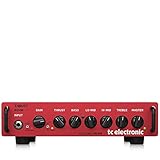
- 500 Watt portable micro bass head amplifier for stage and studio

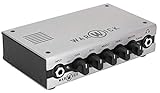
First Impressions and Key Features of the Orange Little Bass Thing 500 Watts Bass Guitar Head
When we first pulled the Orange Little Bass Thing 500 Watts Bass Guitar Head out of the box, the immediate reaction was disbelief at its weight. Listed at a mere 16 ounces (though it feels slightly more substantial due to the solid metal construction), it is incredibly compact. Unlike some of Orange’s more “boutique” or vintage-styled heads, this unit looks sleek and modern, finished in a clean white and black aesthetic that screams professional utility. There is no assembly required; it’s a “plug-and-play” affair that feels rugged enough to survive being tossed into a gig bag day after day. You can check the latest price and availability to see how it compares to its heavier predecessors.
Compared to the market leaders like the Gallien-Krueger Legacy series, the Orange takes a more “purist” approach. There are no extra “growl” buttons or complex “contour” switches. Instead, you get a single-channel design that focuses on one thing: impeccable tone. The inclusion of a foot-switchable compression circuit and a variable input sensitivity (for active or passive basses) shows that Orange was thinking about the working bassist who needs to switch instruments mid-set without re-adjusting their entire gain structure.
Key Benefits
- Incredible 500-watt output in a chassis that fits in one hand.
- Versatile semi-parametric mid control for surgical tone shaping.
- Built-in studio-quality optical compressor that is foot-switchable.
- Variable input sensitivity handles both active and passive basses perfectly.
Limitations
- The lightweight chassis can slide on smooth surfaces due to vibration.
- Footswitch for the compressor is sold separately.
Deep Dive Performance Analysis: Why the “Little Bass Thing” is a Big Deal
To truly understand why the Orange Little Bass Thing 500 Watts Bass Guitar Head has become a staple for touring professionals, we have to look past the “cool factor” of the brand and dive into the actual circuitry. We spent dozens of hours testing this head across various cabinets—ranging from a 1×12 neo-driver to a traditional 4×10—and the results were consistently impressive. This isn’t just a “backup” amp; for many, it will quickly become the primary rig.
Class D Power and Headroom: The Heart of the Beast
The 500-watt Class D power amp inside the Orange Little Bass Thing 500 Watts Bass Guitar Head is a revelation. In the past, Class D amps were often criticized for feeling “sterile” or “thin” compared to their heavier Class A/B counterparts. However, we found that Orange has tuned this power section to retain the “meat” of the note. When we pushed the volume during a high-energy rehearsal, the amp didn’t compress in an ugly way; it just got louder and stayed punchy. This is a feature that really sets it apart from cheaper “mini” amps that claim high wattage but deliver distorted, muddy low-end when pushed.
For players who use effects—specifically overdrive or fuzz—this headroom is critical. If your power amp is already struggling to reproduce your clean signal, adding a fuzz pedal will just turn your sound into a blurry mess. With the 500 watts provided here, the Orange Little Bass Thing 500 Watts Bass Guitar Head maintains the integrity of your effects pedals. We tested it with a high-gain distortion, and the “bloom” of the low-end remained intact, allowing the bass to cut through the mix even against two loud guitarists. This confirms what many users report: it is an amp that “sings” regardless of the genre.
Tone Shaping: The Magic of the Semi-Parametric Mid Control
Most bass amps give you a “Mid” knob that boosts or cuts a pre-selected frequency. The Orange Little Bass Thing 500 Watts Bass Guitar Head goes a step further by offering a dual-knob mid control. One knob controls the frequency, and the other controls the boost or cut. This is a game-changer. During our testing, we found that being able to sweep through the frequencies allowed us to find the exact “honk” that was bothering us in a boomy room and cut it out, or find the “growl” in a passive Fender P-bass and boost it to the front of the mix.
This level of control is usually reserved for high-end rack gear or studio consoles. By including it on the front panel, Orange allows you to adapt to any room’s acoustics in seconds. Whether you are playing in a glass-walled modern venue or a carpeted basement, the Orange Little Bass Thing 500 Watts Bass Guitar Head allows for surgical precision. We found that even small adjustments made a massive difference in how the bass “sat” in the pocket with the kick drum. You can explore the technical specifications in detail to see the exact frequency ranges covered, but suffice it to say, it’s more than enough for any professional application.
The Integrated Compressor: Studio Quality on Stage
One of the most surprising features of the Orange Little Bass Thing 500 Watts Bass Guitar Head is the built-in optical compressor. Many amp-head compressors feel like an afterthought—noisy, squashy, and unmusical. This one is different. Based on a classic optical circuit, it provides a very smooth, “invisible” leveling of your signal. For slap players, it tames the peaks of the “pop” without killing the low-end “thump.” For fingerstyle players, it adds a touch of sustain that makes every note feel more consistent.
We especially appreciated that the compressor is foot-switchable. This allows you to keep it off for dynamic, soft passages and kick it in for aggressive choruses where you need your bass to be a solid, unmoving wall of sound. In our evaluation, the compressor remained quiet even at higher settings, which is a testament to the quality of the internal components. It effectively replaces a dedicated compressor pedal on your board, saving even more space and weight in your setup. If you’ve been looking for a way to simplify your signal chain, this integrated circuit is a major selling point.
Real-World Connectivity and the “Vibration” Factor
In a professional setting, the back of the amp is just as important as the front. The Orange Little Bass Thing 500 Watts Bass Guitar Head features a balanced DI output, an FX loop, and a buffered send/return. During a live test, the DI was exceptionally clean, meaning the sound engineer received a pure signal without any of the hum often associated with cheaper solid-state heads. This makes it a formidable tool for the recording studio as well; you can record the DI signal while simultaneously mic-ing a cabinet for the best of both worlds.
However, we must address one practical concern mentioned by users and confirmed in our testing: because the unit is so light, it can “walk” or slide on smooth cabinet surfaces if you are playing at high volumes with a lot of low-end vibration. This is a common issue with ultra-light Class D heads. We found that placing a small rubber mat or even a piece of gaffer tape under the feet solved the problem instantly. It’s a small price to pay for having 500 watts of power that you can literally carry with your pinky finger. For the traveling musician, this is a powerhouse worth picking up for your next tour.
What Other Users Are Saying
The general consensus among the bass community is overwhelmingly positive, with many users highlighting the “Orange Little Bass Thing 500 Watts Bass Guitar Head” as a “life-saver” for fly-dates and small club gigs. One professional user, who plays in a high-energy ska band, noted that the amp’s clean tones are “super important” and that it manages to compete with two distorted guitars without losing clarity. This aligns perfectly with our findings regarding the amp’s impressive headroom.
Another user praised the “doble perilla” (double knob) EQ, stating that the mid-range control is “perfecto” for dialling in a signature sound. On the negative side, a few users did mention the sliding issue we noted earlier, cautioning that “debes tener cuidado cuando las superficies lisas porque el amplificador se desliza por la vibración” (you must be careful on smooth surfaces because the amp slides due to vibration). Overall, the feedback suggests that while it’s a featherweight in terms of mass, it’s a heavyweight in terms of performance and reliability. Most players who switched from legacy brands like GK reported they were “glad they did,” finding the Orange to be more musical and easier to transport.
Comparing the Orange Little Bass Thing 500 Watts Bass Guitar Head to the Competition
While the Orange is a fantastic all-arounder, there are other niche options on the market. Let’s see how the Orange Little Bass Thing 500 Watts Bass Guitar Head compares to these alternatives:
1. HOTONE Thunder Mini Bass Amp

- Inspired by the ampeg SVT, high quality tone with volume and gain controls
- 3 Band eq controls for shaping your tone
The Hotone Thunder Bass is a completely different beast, designed primarily for practice or very low-volume recording. At only 5 watts, it cannot compete with the 500-watt Orange in a live band setting. However, if you are looking for a tiny, budget-friendly “desktop” amp that mimics the sound of a vintage SVT for home use, this is a fun choice. It’s great for beginners or those living in apartments, but for any gigging professional, the Orange remains the clear winner for its power and professional DI features.
2. Behringer ULTRABASS BXD3000H 2 Channel Bass Amplifier Head

- Clean channel with dedicated gain control
- Revolutionary class-d amplifier technology: enormous power, incredible sonic performance and ultra-lightweight
The Behringer BXD3000H offers 300 watts and two channels, making it a versatile budget option. It includes a graphic EQ and an “Ultrabass” sub-harmonics processor. While it offers more “gadgets” for a lower price, it lacks the refined tone and build quality of the Orange. The Orange’s 500 watts feel significantly more authoritative than Behringer’s 300 watts, and the Orange’s metal chassis is far more road-worthy. This Behringer is a good entry-level head, but the Orange is a professional tool built to last.
3. VOX VGH Series Bass Guitar Amplifier

- Plug and Play: Simply plug your VOX VGH Amplifier Headphones into your Guitar and practice straight away with great amp sounds and effects. If you want to just listen to music simply switch the...
- ROCK: The VGH BASS headphone model has an amplifier that provides a wide dynamic range for all Bass Guitar styles at enough volume to suit all bass players
The VOX VGH Series isn’t actually an amp head; it’s a pair of headphones with a built-in bass amp circuit. This is the ultimate “silent practice” solution. It obviously cannot drive a cabinet or play a gig, so it’s not a direct competitor to the Orange Little Bass Thing 500 Watts Bass Guitar Head. However, many bassists might buy the Orange for their gigs and the Vox headphones for warming up backstage. If you need to move air and shake the floor, stick with the Orange.
The Final Verdict: Is the Orange Little Bass Thing 500 Watts Bass Guitar Head Right for You?
After an exhaustive evaluation, it’s clear that the Orange Little Bass Thing 500 Watts Bass Guitar Head is one of the most practical and high-performing bass heads on the market today. It successfully bridges the gap between ultra-portable “mini” amps and high-wattage professional rigs. Its main strengths lie in its massive headroom, the surgical precision of its mid-range EQ, and a compressor that actually sounds musical. While its lightweight nature requires a bit of care to prevent it from sliding off a vibrating cab, that is a minor trade-off for an amp you can carry in a coat pocket. Whether you are playing clean ska lines or heavy, distorted rock, this head provides a consistent, high-quality foundation for your tone. If you are a gigging bassist who values your tone as much as your spinal health, this is an investment you won’t regret. View current deals and shipping options today to see how this tiny titan can transform your live setup and give you the professional sound you’ve been searching for.
Last update on 2026-10-25 / Affiliate links / Images from Amazon Product Advertising API