
Ampeg Venture V7 700W Bass Amp Head Review: The Ultimate Blend of Portability and Iconic Grit
For years, we as bass players have lived a double life. On one hand, we crave that legendary, soul-shaking “Ampeg growl” that only a massive tube head and an 8×10 cabinet can truly deliver. On the other hand, our lower backs are pleading for mercy every time we load into a club with three flights of stairs. I remember the days of lugging a 90-pound SVT head through narrow corridors, wondering if the tone was worth the physical toll. Many modern “lightweight” amps have tried to solve this, but often at the cost of character—delivering a “sterile” sound that lacks the organic warmth we need.
The Ampeg Venture V7 700W Bass Amp Head aims to end this compromise. It promises to pack the heritage of the B-15 and SVT into a chassis that weighs less than a gallon of milk. When we first got our hands on this unit, we were skeptical. Could something so small truly replace the wall of sound we’ve grown accustomed to? Solving this portability-versus-tone crisis is the holy grail of bass amplification, and failing to do so often leaves players with gear that is either too heavy to use or too thin to be heard.

- Legacy Preamp with 3-band EQ
- Sweepable Mids and Ultra Hi/3-way Ultra Lo switches

What to Consider Before Buying a High-Power Bass Amp Head
A Bass Guitar Amplifier Head is more than just an item; it’s a key solution for any performing musician who needs consistent tone across various venues without being tied to a specific speaker cabinet. Choosing a head like the Ampeg Venture V7 700W Bass Amp Head allows you to bring your “brain” to the gig and plug into whatever backline is provided, or to pair it with your own custom-selected cabinets. The main benefit here is the 700-watt power section, which provides the headroom necessary to keep your low-end clean and punchy even at high stage volumes.
The ideal customer for this type of product is a gigging professional or a dedicated enthusiast who plays everything from jazz clubs to outdoor festivals. If you need a versatile tool that can handle a five-string’s low B-string without clipping, you should definitely see its full feature set and user reviews. However, it might not be suitable for bedroom players who only practice at low volumes and never plan to leave the house—in that case, a small combo amp or even a headphone amp might suffice.
Before investing, consider these crucial points in detail:
- Power Output & Headroom: At 700 watts into 4 ohms, this head is designed for serious volume. You need to ensure your speaker cabinets can handle this power. High headroom is essential for maintaining clarity in your low frequencies; without it, your sound will “fart out” or compress unpleasantly when you dig in.
- Tone Shaping Capabilities: Look for an amp that offers more than just basic Bass and Treble knobs. Sweepable mid-frequencies are vital for bassists because the “character” of the bass lives in the mids. Being able to find the exact frequency to cut through a dense mix of guitars and drums is a make-or-break feature.
- Connectivity & Routing: A professional amp head should serve as the hub of your rig. This means having a high-quality XLR DI output for the soundboard, an effects loop for your pedals, and auxiliary inputs for silent practice. The Ampeg Venture V7 700W Bass Amp Head excels here, but pay close attention to the specific connector types used.
- Weight vs. Durability: While lightweight is the goal, the unit must still be “road-ready.” A metal enclosure is non-negotiable for an amp that will be tossed into gig bags and van trailers. Check the build quality of the knobs and switches to ensure they won’t snap off after a year of heavy use.
While the Ampeg Venture V7 700W Bass Amp Head is an excellent choice, it’s always wise to see how it stacks up against the competition. For a broader look at all the top models, we highly recommend checking out our complete, in-depth guide:
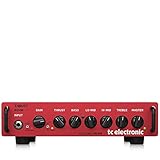
- 500 Watt portable micro bass head amplifier for stage and studio

First Impressions: Lightweight Power in a Professional Package
Unboxing the Ampeg Venture V7 700W Bass Amp Head was a bit of a shock. Weighing in at only 7 pounds, it feels almost impossible that there is a 700-watt power plant inside this sleek, black metal chassis. The aesthetics are classic Ampeg—utilitarian, bold, and professional. It doesn’t look like a toy; it looks like a piece of high-end studio gear that happened to shrink in the wash. The layout is intuitive, and anyone who has used an Ampeg “Rocket” or “SVT” series amp will feel immediately at home with the Ultra Hi and Ultra Lo switches.
Compared to previous Class D offerings from other brands, the Venture V7 feels more robust. The knobs have a satisfying resistance, and the toggle switches click with authority. We found that the inclusion of the SGT (Super Grit Technology) circuit right on the front panel immediately signals that this isn’t just a “clean” amp—it’s designed to have some dirt under its fingernails. For those looking to upgrade their current rig, you can check the latest price and availability here to see if it fits your budget.
What We Like
- Massive 700-watt output provides incredible headroom and punch.
- SGT Overdrive circuit offers authentic SVT and B-15 tube-like voicings.
- Incredibly lightweight (7 lbs) and compact for easy transport.
- Comprehensive I/O including a professional-grade XLR DI and effects loop.
What We Didn’t Like
- Requires specific Neutrik SpeakON NL2 cables, which may require an adapter for standard cables.
- Volume taper is heavily weighted toward the end of the dial (5:00 PM area).
A Deep Dive into the Performance of the Ampeg Venture V7 700W Bass Amp Head
Sculpting the Perfect Tone: The Legacy Preamp and Sweepable Mids
The heart of the Ampeg Venture V7 700W Bass Amp Head is its legacy preamp. During our testing, we found the 3-band EQ to be incredibly musical. Unlike some digital amps that feel like they are just cutting or boosting frequencies in a vacuum, the Venture V7’s EQ feels organic. The “secret sauce” here is the sweepable mid-frequency control. By selecting the exact frequency band you want to emphasize, you can move from a “scooped” slap tone to a “burpy” fingerstyle tone that cuts right through the middle of a heavy rock mix.
We spent significant time toggling the Ultra Hi and 3-way Ultra Lo switches. The Ultra Hi adds a beautiful “clack” and shimmer to the top end, perfect for modern gospel or metal styles. The Ultra Lo switch is even more impressive; in its most extreme setting, it provides a massive sub-bass boost that we found to be incredibly stable. Even with a 700-watt output, the low end remained tight and controlled, a testament to the engineering behind this Class D power section. This is a feature that really sets it apart from cheaper alternatives that tend to get “mushy” when the bass is boosted.
Super Grit Technology: From Motown Thump to Stadium Growl
One of the most exciting aspects of our evaluation was the SGT (Super Grit Technology) circuit. Most modern bassists use a dedicated pedal to get their overdrive, but Ampeg has built two of the most iconic sounds in history directly into this head. The voicing switch allows you to choose between the SVT (the legendary stadium rock sound) and the B-15 (the warm, thumping Motown sound). We found the B-15 setting to be particularly inspiring for vintage soul and blues; it adds a harmonic richness that makes the solid-state amp feel like it has glowing glass tubes inside.
The Grit and Level controls for the SGT circuit allow you to dial in everything from a subtle “hair” on the notes to a full-on grinding distortion. Because it is footswitchable, you can use it as a “second channel” during a live performance. In our sessions, the SVT mode delivered that classic mid-forward growl that has defined rock bass for decades. It’s not just a digital emulation; it responds to your playing dynamics. If you play softly, it stays clean; if you dig in with a pick, it barks back at you. This level of responsiveness is rare in a 7-pound amp.
Pro-Level Features and Practical Gigging Utility
Beyond the tone, the Ampeg Venture V7 700W Bass Amp Head is packed with features that make a touring bassist’s life easier. The variable compressor is a standout. Often, on-board compressors are an afterthought, but this one is remarkably transparent. It helps level out the peaks of your playing without squashing the life out of your tone. We found it especially useful when switching between fingerstyle and slapping mid-set. It keeps the volume consistent, which your sound engineer will definitely appreciate.
The connectivity on the back panel is equally impressive. You have a balanced XLR DI with a ground lift, which sounded pristine through our studio monitors. There’s also an effects loop for your time-based pedals and a 3.5mm Aux input for practicing along to tracks. We also loved the “Phones” output for silent practice; it sounds remarkably close to the actual speaker output. This versatility makes the Venture V7 a “do-it-all” solution. For those looking for a reliable rig that works in the bedroom and the stadium, you can find more details on the connectivity options here.
The Connectivity Hurdle: Addressing the SpeakON NL2 Controversy
We would be remiss if we didn’t discuss the speaker output hardware. As some users have noted, the Ampeg Venture V7 700W Bass Amp Head uses Neutrik SpeakON connectors that are specifically designed for NL2 cables. While SpeakON is the industry standard, most “generic” SpeakON cables in a musician’s gig bag are NL4 (four-pole). During our testing, we confirmed that some standard NL4 cables may not fit snugly or lock correctly without a specific NL2-compatible end.
This is a design choice that has sparked some debate. On one hand, NL2 is a technically “correct” choice for a two-conductor bass amp output. On the other hand, it forces the musician to be very specific about their cabling. Our advice? If you purchase this head, buy a dedicated high-quality NL2 cable (or an adapter) to keep in the gig bag. It’s a minor inconvenience for an otherwise stellar amp, but it’s something you don’t want to discover five minutes before a soundcheck. Despite this, the dual outputs are polarized and provide a very secure, low-resistance connection that ensures all 700 watts reach your speakers efficiently.
What Other Users Are Saying
The general sentiment surrounding the Ampeg Venture V7 700W Bass Amp Head is overwhelmingly positive, with a few technical caveats. We’ve synthesized the feedback from several professional players to give you a balanced view. Most users are absolutely floored by the weight-to-power ratio. One user noted that the “bass guitar sounds wonderful now,” reflecting the plug-and-play nature of the legacy preamp. Another professional mentioned that it is “light, powerful, clean, and quiet,” which are the four hallmarks of a great Class D head.
However, it’s not all sunshine and rainbows. A common observation is the volume taper. As one user pointed out, the “peak power on the volume control really does not kick in until after the 2pm area.” In our testing, we found this to be true; it’s a logarithmic taper that gives you fine-tuned control over lower volumes but requires you to crank it to 75% or more to get that “chest-thumping” 700-watt experience.
The most vocal criticism comes from the SpeakON connector issue. One reviewer mentioned that this hardware “treats the speaker output as a purely electrical math problem instead of an established player reality,” warning others that standard cables might not work. We agree that this is a polarizing design choice, but most users feel the sound quality and portability far outweigh the need to buy a specific $30 cable. Overall, the consensus is that it’s a “super ampli de base” (a great basic amp) that offers a “son parfait” (perfect sound).
Comparing the Ampeg Venture V7 700W Bass Amp Head to Top Alternatives
While the Venture V7 is a powerhouse, it might be more than some players need, or perhaps you’re looking for something even more specialized. Here is how it compares to three other popular options.
1. HOTONE Thunder Bass Mini Amp Head

- Inspired by the ampeg SVT, high quality tone with volume and gain controls
- 3 Band eq controls for shaping your tone
The Hotone Thunder Bass is a completely different animal. While the Venture V7 is a 700-watt monster ready for world tours, the Hotone is a 5-watt mini head designed for practice and desktop use. It’s modeled after the SVT sound, much like the SGT circuit in the Ampeg, but it lacks the headroom to ever be used with a live drummer. If you are a bedroom player who just wants a “flavor” of the Ampeg sound at a fraction of the price and size, this is a fun alternative. However, for any real gigging work, the Venture V7 is the clear winner.
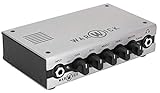
2. Behringer ULTRABASS BXD3000H 2 Channel Bass Amplifier Head

- Clean channel with dedicated gain control
- Revolutionary class-d amplifier technology: enormous power, incredible sonic performance and ultra-lightweight
The Behringer BXD3000H offers 300 watts and a 2-channel design for a significantly lower price point. It includes a 7-band graphic EQ and a built-in compressor. While it is feature-rich, it lacks the iconic “Ampeg” tone and the build quality of the Venture V7. The Behringer is much larger and heavier, despite having less than half the wattage of the Ampeg. It’s a solid “budget” choice for a beginner’s first head-and-cab rig, but professional players will likely find the tone of the Venture V7 to be much more refined and “expensive” sounding.
3. VOX VGH Series Bass Amplifier Headphones

- Plug and Play: Simply plug your VOX VGH Amplifier Headphones into your Guitar and practice straight away with great amp sounds and effects. If you want to just listen to music simply switch the...
- ROCK: The VGH BASS headphone model has an amplifier that provides a wide dynamic range for all Bass Guitar styles at enough volume to suit all bass players
For those who realized they don’t actually need an amp head at all, the VOX VGH Series offers an all-in-one headphone solution. This is not an amp head that you plug into a cabinet; it’s a pair of headphones with a bass amp built inside. It’s the ultimate in portability for silent practice. If your goal is to practice in an apartment without waking the neighbors, these are fantastic. But if you have any intention of playing with other people or hearing your bass “in the room,” you’ll need to stick with a traditional head like the Ampeg Venture V7 700W Bass Amp Head.
The Final Verdict: Is the Ampeg Venture V7 the New Standard?
After putting the Ampeg Venture V7 700W Bass Amp Head through its paces, we can confidently say it is one of the most versatile and impressive bass heads currently on the market. It successfully bridges the gap between the “heavy iron” of the past and the “lightweight convenience” of the future. The SGT circuit alone makes it worth the investment, providing access to two of the most recorded bass tones in history without the maintenance or weight of a tube amp.
While the volume taper and the specific SpeakON cable requirement are small hurdles, they are easily managed once you understand them. This amp is a dream for the gigging bassist who needs to carry their entire rig in a backpack but still wants to sound like they’re playing through a massive stack. Whether you are playing jazz, funk, or heavy rock, this head has the headroom and the grit to handle it all. If you’re ready to stop breaking your back and start perfecting your tone, we highly recommend that you grab the Ampeg Venture V7 700W Bass Amp Head today and experience the next generation of Ampeg power.
Last update on 2026-10-25 / Affiliate links / Images from Amazon Product Advertising API