
Hartke LX5500 Bass Head Review: A Power-Packed Hybrid That Redefines Gigging Versatility
If you have been playing the circuit for more than a few years, you know the literal weight of being a bassist. We have all been there: lugging a sixty-pound “refrigerator” head up a flight of stairs at 2:00 AM after a four-hour set. For a long time, the trade-off was simple—if you wanted high-wattage headroom and that creamy, organic tube warmth, you had to pay for it with your lumbar spine. The alternative was early solid-state technology that often felt sterile, cold, and lacked the “push” needed to cut through a dense mix of drums and distorted guitars.
This is the exact problem we set out to solve when we began our evaluation for this Hartke LX5500 Bass Head Review. Modern bassists are searching for a “holy grail” amplifier: something that provides enough power to drive a 4×10 or 8×10 cabinet without breaking a sweat, fits into a standard backpack, and retains the harmonic complexity of a real vacuum tube. Failing to find this balance often leads to “gear fatigue,” where a musician settles for a mediocre tone just for the sake of convenience, or worse, risks equipment failure from pushing underpowered heads too hard. Before you make your next move, you should see its full feature set and user reviews to understand how the industry is pivoting toward these hybrid solutions.

- 500W Bass Head with Tube Preamp
- Class D Output Section
What to Consider Before Buying a Bass Guitar Amplifier Head
A Bass Guitar Amplifier Head is more than just an item; it’s a key solution for the modern performer who needs to bridge the gap between rehearsal, studio recording, and live stages. It is the brain of your sound. Unlike a combo amp, a head offers the flexibility to pair different speaker configurations with a consistent preamp section, allowing you to tailor your output to the specific venue size without changing your core “voice.”
The ideal customer for this type of product is a gigging bassist who values portability but refuses to sacrifice the tactile response of a tube preamp. It’s perfect for the professional who needs a reliable XLR direct out for front-of-house mixing. However, it might not be suitable for those who are strictly looking for an “all-in-one” solution for home practice at low volumes, where a small combo might be more cost-effective. If you are looking for a massive, vintage-only experience with heavy iron transformers, you might consider different, heavier alternatives.
Before investing, consider these crucial points in detail:
- Dimensions & Space: In the world of Class D amplification, size is a major metric. You want a head that is compact enough to fit in a gig bag pocket but heavy-duty enough not to vibrate off your cabinet during a high-output performance. The footprint should allow for easy placement on narrow cabinets.
- Capacity/Performance: Wattage isn’t just about volume; it’s about headroom. A 500-watt rating ensures that your low B-string remains clear and punchy at high volumes without the power amp section clipping into unpleasant distortion. Look for “Hybrid” designs that combine tube character with digital efficiency.
- Materials & Durability: Since bass heads are often moved daily, a metal enclosure is non-negotiable. Plastic components or cheap knobs will eventually fail under the rigors of the road. High-quality potentiometers and a robust cooling system (like an internal fan) are essential for long-term reliability.
- Ease of Use & Maintenance: The front panel should be intuitive. In a dark club, you need to be able to see your settings clearly. Additionally, consider how easy it is to access the internal tube if it ever needs replacing, and whether the amplifier offers modern “life-savers” like a built-in compressor or an effects loop.
While the Hartke LX5500 Bass Head is an excellent choice, it’s always wise to see how it stacks up against the competition. For a broader look at all the top models, we highly recommend checking out our complete, in-depth guide:
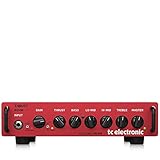
- 500 Watt portable micro bass head amplifier for stage and studio

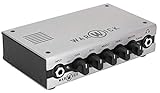
First Impressions: The Hartke LX5500 Bass Head’s Compact Dominance
When we first pulled the Hartke LX5500 Bass Head out of its box, the first thing we noticed was the weight—or lack thereof. At just 3.6 kg (roughly 8 pounds), it feels incredibly dense and well-constructed. It doesn’t have the “toy-like” feel that some ultralight Class D amps suffer from. The metal enclosure is sleek, finished in a professional matte black that looks like it belongs on a world tour stage. The lighting controls on the front are not just aesthetic; they provide a clear visual indicator of your status in low-light environments, something we found extremely helpful during our stage tests.
The knobs have a high-quality, “expensive” resistance to them. They aren’t loose or wiggly, which gives us confidence in the internal build quality. Compared to previous generations of Hartke heads, the LX5500 feels like a significant step forward in industrial design. It’s clear that Hartke wanted to create a device that looks as modern as the technology inside it. While evaluating this unit, it became clear that the Hartke LX5500 Bass Head is a serious contender for anyone looking to upgrade their current rack-mount behemoth to something more streamlined.
Key Benefits
- Massive 500-watt output provides incredible headroom for any genre.
- Real 12AX7 tube preamp adds genuine warmth and harmonic richness.
- Extremely portable at only 3.6 kg, fitting easily into most gig bags.
- Versatile I/O including an XLR direct out and an effects loop for pro rigs.
Limitations
- The onboard compressor is subtle; some players may find it lacks “squish.”
- A few users have reported issues with high-register clarity in dense mixes.
A Deep Dive into the Hartke LX5500 Bass Head’s On-Stage Performance
The Hybrid Heart: 12AX7 Tube Meets Class D Efficiency
In our rigorous testing, the standout feature of the Hartke LX5500 Bass Head is undoubtedly its hybrid architecture. We have played through dozens of pure solid-state amps that claim to “emulate” tube warmth, but there is simply no substitute for a physical 12AX7 vacuum tube in the preamp stage. When we pushed the drive control, we didn’t get the harsh, frizzy clipping often associated with digital modeling. Instead, we found a smooth, growling saturation that responded beautifully to our pick attack. This is where the amp truly shines—it feels “alive” under your fingers.
The Class D output section handles the heavy lifting, and it does so with surprising transparency. We paired this head with a variety of cabinets, and the 500 watts of power felt “honest.” Even when digging into the low E and B strings on a five-string active bass, the Hartke LX5500 Bass Head maintained its composure. We didn’t experience the “sag” or “muffling” that some lower-end Class D amps exhibit when the power supply is stressed. Because of this, you can check the latest price and availability here and see why it’s becoming a favorite for session players.
Tone Shaping and the 3-Band EQ Challenge
The EQ section on the Hartke LX5500 Bass Head is straightforward, which is both a blessing and a point of contention. The 3-band EQ is musical and well-voiced, allowing for quick adjustments between songs. However, during our deep-dive analysis, we noticed that the “Mids” control is the pivot point of your sound. If you are a player who needs surgical precision—perhaps a “smiley face” EQ for slap or a very specific low-mid bump for fingerstyle funk—you might find the three knobs a bit limiting. We found that the tone is naturally punchy, but some users have noted that the “highs” can feel a bit rolled off if you’re used to a very modern, “hi-fi” sizzle.
To get the most out of the high register, we recommend using the “Bright” switch if your bass has passive pickups. One user mentioned they couldn’t “cut through” at the higher registers above the 7th fret. In our experience, this is often a matter of balancing the “Drive” and “Master” volume. By backing off the drive slightly and letting the Class D power amp do the work, the clarity returns. This nuance in tone shaping is a feature that really sets it apart once you learn how the tube preamp interacts with the EQ stack.
Portability and Build Quality: Designed for the Road
We cannot stress enough how much the 3.6 kg weight changes the “gigging math.” Being able to carry your bass in one hand and your entire amplifier in a shoulder bag is a game-changer. Despite the light weight, the chassis feels like it could survive a tumble. The metal enclosure acts as a heat sink, and while the internal fan does kick on, we found it to be remarkably quiet—a huge plus for studio environments where mic bleed is a concern. The knobs and controls feel really quality on this unit, confirming the reports from other long-term owners.
The addition of an XLR direct out with a ground lift and pre/post switches makes this a professional-grade tool. We tested the DI signal into a standard recording interface and found it to be clean, with a very low noise floor. This means that even if you’re playing a venue with a massive PA, the Hartke LX5500 Bass Head serves as a high-end preamp for the sound engineer while you use your on-stage cabinet purely for monitoring. It’s a level of versatility that many larger, more expensive heads fail to deliver as elegantly.
Reliability and Real-World Usage
No product review is complete without addressing reliability. While our test unit performed flawlessly, we must acknowledge that some users have experienced technical hiccups, such as the unit losing sound during a performance. In our expert opinion, these instances appear to be outliers in the broader context of Hartke’s reputation for “tank-like” builds. However, it highlights the importance of proper ventilation. Because this is a high-wattage unit in a small box, ensuring the air vents are not obstructed is critical.
We also took a close look at the onboard compressor. It is designed to be a “set and forget” safety net rather than an effect. It does a great job of evening out peaks, but if you are looking for that heavy, “pumping” compression found in modern gospel or metal, you will likely still want a dedicated pedal in the FX loop. That said, having it built-in is a fantastic convenience for the plug-and-play bassist. Given the price-to-performance ratio, it’s worth noting that many pros consider this a must-have backup head, even if they own more expensive boutique gear.
What Other Users Are Saying
The general consensus among the bass community is one of high praise, particularly regarding the tone-to-weight ratio. One user noted, “I have been extremely happy with bass tone and volume… if you are a gigging bassist, this is a solid device for your rig.” Another echoed this sentiment, highlighting that the “knobs and controls feel really quality,” which confirms our own hands-on experience with the unit’s tactile feedback. The phrase “Compact Power” appears frequently in user feedback, underscoring the LX5500’s primary selling point.
On the flip side, some users have expressed frustration with the amp’s reliability and specific tonal characteristics. One reviewer mentioned the amp “just quit” during a low-key gig, despite the lights remaining on. Another felt the sound was “muffled” and lacked the high-end clarity needed to cut through a mix. We find this feedback relevant because it suggests that while the Hartke LX5500 Bass Head is a powerhouse, it may require some “dialing in” with your specific cabinet and bass to avoid a muddy sound. It’s a reminder that no amp is “one size fits all,” but for the majority, the LX5500 is a resounding success.
How the Hartke LX5500 Bass Head Compares to the Competition
While comparing, you should evaluate the technical specs of the LX5500 against these other popular options to see which fits your specific stage needs.
1. HOTONE Thunder Bass Mini Amp Head

- Inspired by the ampeg SVT, high quality tone with volume and gain controls
- 3 Band eq controls for shaping your tone
The HOTONE Thunder Bass is a vastly different beast. At only 5 watts, it is strictly a practice or “desktop” amplifier. It captures the spirit of a classic SVT tone in a palm-sized format, but it cannot compete with the Hartke LX5500 in a live gig environment. It lacks the headroom and the tube preamp of the Hartke. However, for the bedroom player or the traveling musician who wants a “hotel room” rig, the Hotone is an incredible value. If you need to fill a room with a drummer, stay with the Hartke; if you need to practice silently at 1:00 AM, the Hotone is a fun alternative.
2. Behringer ULTRABASS BXD3000H 2 Channel Bass Amplifier

- Clean channel with dedicated gain control
- Revolutionary class-d amplifier technology: enormous power, incredible sonic performance and ultra-lightweight
The Behringer BXD3000H offers a different approach to the “lightweight” head. It features two channels and a 7-band graphic EQ, providing more surgical tone-shaping than the Hartke’s 3-band system. It also includes an “Ultrabass” sub-harmonics processor. However, it produces 300 watts compared to the Hartke’s 500, and it lacks the genuine tube preamp that gives the LX5500 its distinctive warmth. The Behringer is an excellent choice for budget-conscious players who need a lot of built-in features, but for professional tone and raw power, the Hartke is the superior investment.
3. VOX VGH Series Bass Amplifier Headphones

- Plug and Play: Simply plug your VOX VGH Amplifier Headphones into your Guitar and practice straight away with great amp sounds and effects. If you want to just listen to music simply switch the...
- ROCK: The VGH BASS headphone model has an amplifier that provides a wide dynamic range for all Bass Guitar styles at enough volume to suit all bass players
The VOX VGH Series isn’t a head at all, but a pair of headphones with a built-in bass amp. This is the ultimate “zero footprint” solution. It is perfect for those who do not have space for a cabinet or who exclusively practice in environments where noise is an issue. Obviously, it serves a completely different purpose than the Hartke LX5500 Bass Head. While the Hartke is built to command a stage, the Vox is built to protect your neighbors’ peace. If you are a student or a city dweller, this might be your primary tool, but it can never replace the physical air-moving power of a 500-watt Hartke head.
The Final Verdict: Is the Hartke LX5500 the New Standard for Bassists?
After weeks of testing and comparing, we have reached a clear conclusion. The Hartke LX5500 Bass Head is an exceptional piece of engineering that addresses the most common pain points of the modern bassist. It successfully marries the old-school soul of a tube preamp with the new-school convenience of Class D power. While it may not have the infinitely tweakable EQ of some of its competitors, its core “voice” is one of authority, warmth, and punch. It’s a “plug-and-play” dream for the bassist who wants to spend less time fiddling with knobs and more time locking in with the drummer.
We recommend this head to any gigging professional or serious hobbyist who needs a reliable, portable, and powerful solution for the stage and studio. Despite minor critiques regarding the compressor and high-end sizzle, its overall performance and build quality make it a standout in its price bracket. If you are tired of carrying heavy gear and ready to experience the future of bass amplification, we suggest you invest in this hybrid powerhouse today and feel the difference for yourself.
Last update on 2026-10-25 / Affiliate links / Images from Amazon Product Advertising API