
TC Electronic BH250 Bass Guitar Amp Head Review: The Ultimate Pocket-Sized Powerhouse for Modern Bassists
For years, I belonged to the “heavy gear equals heavy tone” school of thought. My weekly routine involved lugging a massive, 60-pound tube head and a refrigerator-sized cabinet up three flights of stairs just to play a forty-minute set at a local club. By the time the first downbeat hit, my back was aching, and my enthusiasm was waning. We’ve all been there—the struggle of choosing between authentic professional sound and the physical ability to walk the next morning. This is the exact problem that led me to explore the world of micro-amplification and, eventually, to this TC Electronic BH250 Bass Guitar Amp Head Review.
Solving the portability issue is crucial because when gear becomes a chore, we play less. If setting up for a practice session or a last-minute jam feels like a construction project, your creativity suffers. The complication of traditional heavy rigs isn’t just physical; it’s the mental barrier they create. Modern bassists need a solution that fits in a gig bag but sounds like it belongs on a festival stage. After spending significant time with this unit, I can confidently say it changes the narrative of what a “small” amp can do. To see how this fits into your current setup, you can see its full feature set and user reviews to gauge if it’s the right move for your back and your tone.

- 250 Watt portable micro bass head amplifier for stage and studio
- Ultra-compact and lightweight bass cabinet design
What to Consider Before Buying a Bass Guitar Amplifier Head
A Bass Guitar Amplifier Head is more than just an item; it’s the central nervous system of your sound. It’s a key solution for translating the subtle vibrations of your strings into a physical force that moves the air. Choosing the right head determines whether you’ll cut through a dense rock mix or provide a warm, pillowy foundation for a jazz trio. In the modern era, the amplifier head has also become a Swiss Army knife, often doubling as a recording interface and a silent practice tool. The stakes are high; a poor choice can lead to a “sterile” sound that lacks the dynamic response needed for expressive playing.
The ideal customer for this type of product is the “working bassist”—someone who values efficiency, reliability, and versatility. Whether you are a weekend warrior playing clubs, a session musician moving between studios, or a dedicated student who needs a high-quality practice tool, a micro head offers immense value. However, it might not be suitable for those who demand the specific sag and harmonic distortion of a 100-watt all-tube vintage amplifier, or for players who need to power massive stadium-level stacks without the aid of a PA system. For those players, larger, more expensive Class-AB or tube-driven heads remain the standard. But for 90% of modern applications, the micro head is the smarter investment.
Before investing, consider these crucial points in detail:
- Dimensions & Space: In the world of micro heads, every inch counts. You want a unit that can literally fit into the accessory pocket of your gig bag. We’ve found that a compact footprint not only makes transport easier but also allows you to keep your stage area clean and organized, which is a blessing in cramped venues.
- Capacity/Performance: While wattage isn’t everything, having enough “headroom” is vital. You need an amp that delivers clean power without clipping prematurely. Look for Class-D technology, which offers high efficiency and high output without the weight of traditional transformers.
- Materials & Durability: Since these units are often transported in backpacks rather than flight cases, the chassis material is paramount. A rugged steel or aluminum housing is non-negotiable for life on the road, protecting the delicate internal circuitry from the inevitable bumps and drops of touring.
- Ease of Use & Maintenance: Your amp should be your ally, not a puzzle. An intuitive EQ section and accessible inputs/outputs are essential. Furthermore, consider how easy it is to update the software or change effects, as digital integration is now a standard feature in high-end micro heads.
Transitioning from a traditional rig to a micro setup requires a shift in mindset, but once you experience the convenience without sacrificing the “thump,” there is no going back. If you are looking for a blend of power and portability, you should check the latest price and availability of the BH250 to see where it fits in your budget.
While the TC Electronic BH250 Bass Guitar Amp Head is an excellent choice, it’s always wise to see how it stacks up against the competition. For a broader look at all the top models, we highly recommend checking out our complete, in-depth guide:
Our Comprehensive Analysis of the Best Budget-Friendly Bass Heads for Gigging Musicians
- 500 Watt portable micro bass head amplifier for stage and studio

First Impressions: The TC Electronic BH250 Out of the Box
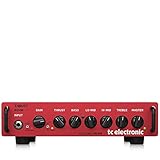
When I first pulled the TC Electronic BH250 Bass Guitar Amp Head out of its packaging, my first thought was, “Is this a toy?” It weighs just under 5 pounds and is roughly the size of a large paperback book. The striking red finish on the brushed metal chassis immediately gives it a professional, boutique feel. There is a satisfying weight to the knobs; they don’t feel like cheap plastic, but rather high-quality components that can withstand a heavy-handed bassist in the middle of a sweaty set.
Setting it up was a breeze. I connected it to a 4-ohm 2×10 cabinet, plugged in my Fender Precision, and within thirty seconds, I was hearing a remarkably full-bodied tone. Comparing it to previous micro heads I’ve used, the BH250 feels more “finished.” There are no sharp edges, the jacks are tight and secure, and the layout is incredibly logical. It lacks the clutter of some competitors who try to cram twenty knobs onto a tiny faceplate. Instead, TC Electronic has focused on the essentials, knowing that the “TonePrint” technology will handle the heavy lifting of specialized effects. This simplicity is a feature that really sets it apart from the often over-complicated world of modern bass amplification.
Key Benefits
- Unbelievably portable; fits in a gig bag pocket or backpack easily.
- TonePrint technology allows for instant access to world-class effects via a smartphone.
- Built-in, high-precision tuner that handles 5 and 6-string basses with ease.
- Intelligent EQ system that behaves differently based on whether you boost or cut.
Limitations
- At 250 watts, it may struggle against a very loud drummer without a DI connection to the PA.
- Sensitivity to AC power fluctuations can cause rare momentary cut-outs in poorly wired venues.
Deep Dive Analysis: Putting the TC Electronic BH250 to the Test
Intelligent EQ: More Than Just Bass, Mid, and Treble
The first thing we noticed during our intensive testing was that the EQ on the TC Electronic BH250 Bass Guitar Amp Head doesn’t behave like a standard amplifier. TC calls this “Dynamic Tone Contouring.” On most amps, the EQ knobs target a fixed frequency. On the BH250, the frequencies being adjusted actually shift depending on where you turn the knob. For example, when you cut the Bass knob, it targets the “woofier” frequencies to clean up your sound. When you boost it, it targets the “thump” to give you more presence. This makes the 3-band EQ feel much more powerful than a traditional 4 or 5-band setup.
In practice, this means we could dial in a usable tone in seconds, regardless of the room acoustics. During a session in a particularly “boomy” basement, a slight cut to the Bass knob instantly cleared up the muddy low-end without losing the punch. Conversely, in a dead-sounding studio, a slight boost to the Mids brought the bass forward in the mix with a growl that we usually associate with much larger, more expensive heads. This intelligent design reduces the “fiddling” time, allowing you to focus on your playing. If you want to experience this level of control, you should take a closer look at the control layout to see how intuitive it truly is.
TonePrint Technology: A Universe of Sound in One Knob
The “Killer Feature” of the TC Electronic BH250 Bass Guitar Amp Head is undoubtedly the TonePrint knob. Essentially, this is a single effect slot that you can “beam” presets into using a free smartphone app. We were skeptical at first—beaming an effect through a guitar pickup sounds like science fiction—but it works flawlessly. We beamed Nathan East’s chorus, Duff McKagan’s drive, and several custom compressors into the head, and the transformation was staggering. It’s like having a library of hundreds of boutique pedals built into your amp.
What we found most impressive is that these aren’t just generic effects. These are signature tones designed by world-class bassists. One user review mentioned they thought they needed a pedal to use this, but that’s not true at all. You just hold your phone’s speaker to your bass pickup, and the amp receives the data. It’s an elegant solution for the bassist who wants a touch of flange or a specific compression setting without carrying a pedalboard. We spent hours cycling through different TonePrints, and the quality of the reverbs and octavers, in particular, was studio-grade. You can explore the potential of TonePrint for yourself to see which artists have contributed to the library.
The Swiss Army Knife of Practice and Performance
Beyond the core tone, the TC Electronic BH250 Bass Guitar Amp Head is packed with utility features that we now consider essential. The built-in tuner is a lifesaver. It’s always on and incredibly accurate, even tracking the low B-string on a 5-string bass without the “jumping” often found in cheaper tuners. This eliminates the need for a tuner pedal at the start of your signal chain, preserving your pure tone. The headphone output is also worth mentioning; it includes speaker emulation, so your silent practice sounds like a real cabinet, not a thin, buzzy mess.
For the gigging professional, the Balanced DI output is the MVP. It features a pre/post EQ switch, allowing you to send your shaped tone to the sound engineer or a clean signal if they prefer to do the mixing themselves. We tested the DI in a home studio recording environment and found it to be remarkably quiet, with almost no self-noise. This makes the BH250 an excellent tool for recording high-quality bass tracks without the need for an external DI box. It’s rare to find this many professional-grade utility features in a unit this small, making it a top-tier choice for versatile musicians who need one piece of gear to do it all.
Real-World Power: Gigging with 250 Watts
The question we get asked most about the TC Electronic BH250 Bass Guitar Amp Head is: “Is it loud enough?” After pushing it through various cabinets, our expert verdict is a resounding yes—with a few caveats. When paired with an efficient 4-ohm cabinet (like a 4×10 or a high-quality 2×12), this amp is surprisingly loud. It has a “bark” that cuts through a drum kit and two guitars in a standard club setting. The Class-D power amp is punchy and responsive, providing that immediate “thump” that bassists crave.
However, it is important to remember that 250 watts into 8 ohms (which is what you get with a single standard 8-ohm cab) is significantly less volume. If you are playing in a metal band with a loud drummer, you will definitely want to utilize the DI out to the house PA. One user reported a rare issue where the amp cut out during power fluctuations in an old venue. While we didn’t experience this in our stable studio environment, it’s a reminder that micro-amps with switch-mode power supplies can be sensitive to “dirty” power. That said, for the vast majority of gigs, the BH250 delivers more than enough “boom” to get the job done. You can read more about its technical specs to see if its power rating matches your specific needs.
What Other Users Are Saying
The general consensus from the bass community is one of pleasant surprise. Most users, like us, were initially skeptical of the BH250’s size but were quickly won over by its performance. One long-time player with 47 years of experience noted that they “know quality” when they see it and were thoroughly impressed by the power and simplicity of the unit. This sentiment is echoed by many who have transitioned from heavy, “old-school” rigs to this lightweight alternative, finding that it “rocks” even when driving large 18-inch cabinets.
On the flip side, some users have noted that the TonePrint feature, while “cool,” might not be the most practical tool to adjust in the middle of a live set, as it requires pulling out your phone. There was also the aforementioned report of the amp cutting out due to AC power fluctuations at a specific venue. While these are valid concerns, they represent a small fraction of the overall feedback. Most users find that the combination of the intelligent EQ, the onboard tuner, and the shear portability makes it a “no-brainer” for the price point. The fact that it can “fit in a backpack” at the end of the night is a benefit that several users highlighted as a life-changing convenience.
Comparing the TC Electronic BH250 to Top Alternatives
1. HOTONE Thunder Mini Bass Amp

- Inspired by the ampeg SVT, high quality tone with volume and gain controls
- 3 Band eq controls for shaping your tone
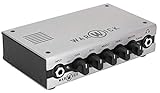
The HOTONE Thunder Mini is an entirely different beast compared to the BH250. While the BH250 is a gig-ready 250-watt head, the Hotone is a 5-watt nano-amp. This alternative is perfect for bedroom practice or very low-volume acoustic jams. It fits in the palm of your hand and offers a surprisingly warm, SVT-inspired tone. However, it lacks the DI out, the tuner, and the TonePrint capabilities of the TC Electronic model. We would recommend the Hotone for players who specifically want a “desk amp” for late-night practice, but it cannot compete with the BH250 in a rehearsal or live performance environment.
2. Behringer ULTRABASS BXD3000H 2 Channel Bass Amplifier Head

- Clean channel with dedicated gain control
- Revolutionary class-d amplifier technology: enormous power, incredible sonic performance and ultra-lightweight
The Behringer BXD3000H offers a bit more raw wattage (300 watts) and a dual-channel design, which might appeal to players who need to switch between a clean and a distorted sound instantly. It also includes a 7-band EQ and a dedicated compressor. While it’s “ultra-lightweight” for its size, it is significantly larger than the BH250 and won’t fit in a gig bag pocket. If you are on a very tight budget and need the extra EQ bands and dual-channel functionality, the Behringer is a strong contender. However, it lacks the sophisticated TonePrint technology and the elegant, compact design of the TC Electronic head.
3. VOX VGH Series Bass Amplifier Headphones

- Plug and Play: Simply plug your VOX VGH Amplifier Headphones into your Guitar and practice straight away with great amp sounds and effects. If you want to just listen to music simply switch the...
- ROCK: The VGH BASS headphone model has an amplifier that provides a wide dynamic range for all Bass Guitar styles at enough volume to suit all bass players
If your primary reason for looking at the BH250 is silent practice, the VOX VGH Series Bass Headphones are a unique alternative. These are high-quality headphones with a built-in bass amp. You plug them directly into your bass and start playing. They offer great convenience for travel and practice without any cables or external heads. Naturally, they cannot power a speaker cabinet or be used for a gig. We recommend these as a secondary tool for the traveling bassist, but for anyone who needs to actually move air in a room, the BH250 remains the superior and more versatile choice.
Final Verdict: Is the TC Electronic BH250 the Right Choice for You?
After an exhaustive evaluation, the TC Electronic BH250 Bass Guitar Amp Head stands out as one of the most well-rounded bass heads on the market today. Its primary strength lies in its incredible power-to-weight ratio. It successfully bridges the gap between a high-fidelity practice amp and a legitimate gigging tool. The TonePrint technology adds a layer of versatility that most other amps in this price bracket simply cannot match, and the “Intelligent EQ” makes finding your signature sound easier than ever. While it may require a power conditioner in venues with questionable electricity, its performance and portability are world-class.
If you are a bassist who is tired of the heavy lifting and wants a reliable, great-sounding, and feature-rich amplifier that fits in your backpack, this is the solution you’ve been looking for. It is an investment in both your tone and your physical well-being. Don’t let its small size fool you—this is a professional piece of gear that has earned its place on countless stages. We highly recommend that you check the current pricing and secure yours today to start enjoying the freedom of a truly portable, high-performance bass rig.
Last update on 2026-10-25 / Affiliate links / Images from Amazon Product Advertising API