
Yamaha JR1 FG Junior Acoustic Guitar Review: The Ultimate Compact Companion for New Players and Travel Enthusiasts
There is a specific kind of frustration that comes when a passion for music hits a physical wall. I remember clearly when I first tried to teach my younger nephew how to play. We had a standard, full-sized dreadnought sitting in the corner, but every time he tried to wrap his arm around that massive lower bout, his shoulder would hunch up to his ear. His small fingers couldn’t quite reach the low E string without muting everything else. It wasn’t a lack of talent; it was a mismatch of equipment. This is the primary reason why many aspiring musicians give up before they’ve even mastered their first G-chord. Finding an instrument that fits your body is just as important as finding one that fits your budget.
When you are looking for a solution to this physical mismatch, the Yamaha JR1 FG Junior Acoustic Guitar often surfaces as the top recommendation. It’s designed specifically to bridge the gap for children, petite adults, or seasoned travelers who need something that doesn’t require a suitcase of its own. Without the right-sized instrument, the learning process becomes a chore of physical endurance rather than a joy of discovery. Solving this “size gap” is crucial because it allows the player to focus on technique and muscle memory rather than just trying to hold the thing up. In this review, we’ll dive deep into whether this 3/4-sized wonder is a legitimate musical instrument or just a glorified toy.

- The FG Junior is a 3/4 sized guitar modeled after the acclaimed Yamaha FG Series
- The JR1 has a smaller body and shorter neck, perfect for young players or those with smaller hands
Choosing the Perfect Acoustic Guitar: A Guide for Small Hands and Aspiring Players
An acoustic guitar is more than just an item; it’s a key solution for creative expression and a lifelong skill. When you are browsing through the vast world of Acoustic Guitars, you aren’t just buying wood and strings; you are buying the ease of playability and the inspiration to pick the instrument up every single day. The right guitar should feel like an extension of your body. If the neck is too thick or the body is too deep, you’ll find yourself fighting the instrument instead of flowing with the music. A well-designed small-body guitar provides the same tactile feedback as its larger counterparts but in a package that is manageable and ergonomic.
The ideal customer for this type of product is someone facing the physical limitations of a standard guitar—specifically children aged 5 to 11, or smaller-framed adults who find full-sized guitars cumbersome. It’s also an incredible choice for the nomadic musician who wants a “couch guitar” or a reliable travel companion for camping trips and flights. However, it might not be suitable for those who are looking for deep, booming bass response or professional-level concert projection. If you are a tall adult with large hands, you might find the 21.25″ scale length a bit cramped for complex fingerstyle work, and you might consider a parlor or 000-sized guitar instead.
Before investing, consider these crucial points in detail:
- Dimensions & Space: A true 3/4 guitar should have a significantly shorter scale length (the distance from the nut to the bridge). Look for something around 21 to 23 inches. This reduces string tension, making it much easier for beginners to press down the strings without developing immediate blisters. Also, consider the depth of the body; a shallower body is easier for children to reach over.
- Capacity/Performance: While you expect a smaller sound from a smaller box, the quality of the wood still matters. A spruce top is the industry standard for a reason—it provides a bright, punchy sound that helps the notes ring out clearly. Check if the guitar can hold its tune, as cheaper “toy” versions often slip out of tune within minutes of play.
- Materials & Durability: Travel and beginner guitars take a lot of abuse. Look for sturdy tonewoods like Meranti or Nato. These are durable and less sensitive to humidity changes than expensive solid woods, which is a major plus if you plan on taking the guitar from a dry bedroom to a humid campfire setting.
- Ease of Use & Maintenance: Consider what comes in the box. A guitar that includes a gig bag is a significant value add, especially for students taking lessons. Also, look at the bridge system; a fixed bridge is much easier for a beginner to maintain and restring compared to more complex setups.
Transitioning from a “any guitar will do” mindset to a “the right fit matters” mindset is the first step in a successful musical journey. While the Yamaha JR1 FG Junior Acoustic Guitar is an excellent choice, it’s always wise to see how it stacks up against the competition. For a broader look at all the top models, we highly recommend checking out our complete, in-depth guide:

- One right-handed Fender Alternative Series Dreadnought Acoustic Guitar – a perfect beginner guitar for all ages


- Perfect beginner guitar: Designed for students and teens who are just getting started. This 38-inch, right-handed, acoustic guitar features all the bells and whistles. Designed with 18 smooth frets...

- One right-handed Fender Alternative Series Dreadnought Acoustic Guitar – a perfect beginner guitar for all ages
First Impressions: Unboxing the Yamaha JR1 FG Junior Acoustic Guitar
When we first pulled the Yamaha JR1 FG Junior Acoustic Guitar out of its included gig bag, the first thing that struck us was the finish. Despite its entry-level price point, the Natural finish and the spruce top give it an air of “real instrument” rather than “gift shop souvenir.” It feels solid in the hands—weighing in at just under 5 pounds, it has enough heft to feel durable but is light enough for a 7-year-old to carry comfortably. You can check the current pricing on this 3/4 size model to see how it fits into your budget.
The assembly is non-existent; it arrives fully strung, though as with any guitar shipped across various climates, it required a quick tuning. The chrome hardware felt smoother than we expected, and the rosewood fretboard was clean with no sharp fret ends—a common issue on budget guitars that Yamaha seems to have avoided here. Compared to market leaders like the Baby Taylor or Little Martin, the JR1 is significantly more affordable, and while those higher-end models offer solid wood tops, the JR1’s laminate construction offers a level of ruggedness that we actually prefer for a child’s first instrument.
Key Benefits We Discovered
- Perfectly scaled 21.25″ length for smaller hands and easy fretting.
- Authentic spruce top provides a bright, clear acoustic tone.
- Incredibly durable laminate Meranti construction, ideal for travel.
- Includes a functional, well-fitted gig bag for immediate portability.
Considerations & Limitations
- The 3/4 size naturally lacks the deep bass of a full-sized guitar.
- Requires frequent tuning during the initial “break-in” period of the strings.
A Deep Dive into the Performance of the Yamaha JR1 FG Junior Acoustic Guitar
Build Quality and Material Integrity
When we evaluate a guitar in this price bracket, our biggest concern is usually the “corner-cutting” that happens in the factory. However, our time with the Yamaha JR1 FG Junior Acoustic Guitar revealed a surprisingly high standard of craftsmanship. The body is constructed from Meranti, a wood often compared to Mahogany for its durability and warm tonal qualities. The top is Spruce, which is the gold standard for acoustic resonance. While these are laminates, Yamaha’s lamination process is legendary in the industry for creating instruments that can survive “real life”—meaning they handle temperature swings and the occasional bump against a chair leg much better than solid wood guitars.
We examined the internal bracing and the neck joint, finding them to be clean and secure. The Nato neck is sturdy and has a comfortable “C” shape that doesn’t feel like a baseball bat in a child’s hand. One user feedback point we confirmed was that the finishes are consistent; there were no “bubbles” or rough spots in the gloss on our test unit. This level of quality control is why we often suggest beginners explore the full specifications of the Yamaha JR1 when they are tired of looking at “no-name” brands that fall apart within a month. It feels like a genuine Yamaha, just shrunk down in a shrink-ray.
Playability and Ergonomics for Small Hands
This is where the Yamaha JR1 FG Junior Acoustic Guitar truly shines. The 21.25-inch scale length is the “secret sauce.” Because the distance between the frets is shorter, the string tension is lower. During our testing, we found that even beginners who hadn’t developed calluses yet could hold down a barre chord with significantly less pain than on a full-sized instrument. The nut width is also slightly narrower, which helps smaller fingers reach the lower strings without accidentally muting the higher ones. It’s an ergonomic win that directly translates to more time spent practicing.
We also noticed that the action (the height of the strings above the fretboard) was set at a very reasonable level straight out of the box. While some “pro” reviewers might want to shave down the urea saddle for a “shredder” feel, for 99% of users, it’s ready to play. We found that this guitar encouraged us to play more because it was simply so easy to pick up and fiddle with while sitting on the couch. You can see why this is a top-rated starter instrument by looking at how many parents report their children actually sticking with lessons because the physical barrier has been removed.
Tonal Characteristics and Sound Projection
Let’s be honest: a 3/4 size guitar is never going to rattle the windows with its bass response. However, we were pleasantly surprised by the “voice” of the Yamaha JR1 FG Junior Acoustic Guitar. It has a very bright, “zingy” character that cuts through the air. The Spruce top does its job well, providing a crisp high-end that makes chords sound articulate. When we played folk-style fingerpicking, the individual notes were clear and didn’t get muddy, which is a common flaw in small, cheap guitars. It has a punchy mid-range that makes it great for strumming along to pop songs.
Some users have noted that the sound can be “thin,” and we would agree that it lacks the “thump” of a dreadnought. But in a practice environment or a quiet campfire setting, this is actually a benefit. It’s loud enough to be heard clearly but not so loud that it will annoy the neighbors in the next apartment. The projection is focused and directional. If you are looking for a more “mature” tone, we found that swapping the factory strings for a set of high-quality phosphor bronze strings significantly deepened the resonance. To see how it sounds in various environments, you might want to view the detailed craftsmanship and finish options online to get a better sense of its construction.
Portability and the Travel Experience
As much as this is a “Junior” guitar, it is also a fantastic travel tool. We took it on a weekend road trip and found that it tucked into the trunk of a packed car with ease. The included gig bag is more than just a dust cover; it has decent padding and backpack straps that make it a breeze to carry through an airport or on a hike. Because of its 33-inch total length, it often qualifies as a carry-on item for many airlines (though always check your specific carrier). It’s the kind of guitar you don’t have to think twice about bringing along.
We found that the Yamaha JR1 FG Junior Acoustic Guitar holds its tune surprisingly well once the strings have stretched. This is vital for a travel guitar that might be subjected to different temperatures. The chrome tuners are stable and don’t feel “jumpy” when you’re trying to dial in that last bit of pitch. For anyone looking to invest in this portable acoustic solution, the peace of mind knowing you have a durable, playable instrument in the back of the car is worth the entry price alone. It turns “dead time” in a hotel or a park into a practice session.
What Other Users Are Saying
The general sentiment surrounding the Yamaha JR1 FG Junior Acoustic Guitar is overwhelmingly positive, especially from parents and guitar teachers. Many users highlight that this was the specific model recommended by their music instructors. One parent shared that their 7-year-old was finally “happy to learn” because the size was just right, while another noted that even as a professional musician, they were “impressed by the build quality and finish” for such a low price point. It’s clear that the “Yamaha” name carries weight here; people trust that they aren’t getting a toy.
However, no product is without its critics. We found a few reports of quality control issues, such as one user who received a guitar with a small dent at the bottom or another who noticed rough areas on the binding. There was also a notable review from a small-framed adult who felt the guitar was actually *too* small for them, suggesting that for adults, this is strictly a “travel” or “parlor” experience rather than a primary instrument. Additionally, a few users mentioned that the shipping boxes sometimes arrive in rough shape, though the guitar inside is usually protected. Overall, the consensus is that for the money, you are getting a high-value tool that serves its purpose excellently.
Comparing the Yamaha JR1 FG Junior Acoustic Guitar to the Competition
While the JR1 is a powerhouse in the 3/4 market, it’s helpful to see how it compares to full-sized beginner options. This helps you decide if you really need the “Junior” size or if you should go for a standard model.
1. Fender CD-60S Dreadnought Acoustic Guitar

- One right-handed Fender CD-60S Dreadnought Acoustic Guitar
- Dreadnought Body: This guitar's dreadnought body shape resonates with a bold and rich bass tone, great for playing country, folk or bluegrass
The Fender CD-60S is a full-sized dreadnought, making it a completely different beast than the JR1. While the JR1 focuses on portability and small hands, the CD-60S focuses on “big” sound with its solid mahogany construction and solid spruce top. If you are an adult beginner with standard-sized hands, the CD-60S will provide a much richer, fuller sound that will grow with you for years. However, for a child under 10, the CD-60S will likely feel like trying to play a cello. Choose this if you want a “real” dreadnought sound and have the physical reach to handle it.
2. Fender FA-25 Dreadnought Acoustic Guitar
- One right-handed Fender Alternative Series Dreadnought Acoustic Guitar – a perfect beginner guitar for all ages
- Backed by a 75 year legacy of quality and craftsmanship -- the FA Series has all the sound and style of Fender's iconic acoustic guitars with specially designed features for beginners.
The Fender FA-25 is another full-sized entry that often appeals to those who want a classic look, especially in its Sunburst finish. It is priced similarly to the Yamaha but lacks the portability of the JR1. The FA-25 is a great “bedroom” guitar for a teenager who wants to look like a rockstar. Compared to the JR1, the FA-25 has much higher string tension and a wider fretboard. If you are buying for a 7-year-old, the Yamaha JR1 is the clear winner for ergonomics, but for a 14-year-old, the FA-25 might be the more “cool” and sonically capable choice.
3. Fender Dreadnought Acoustic Guitar Bundle
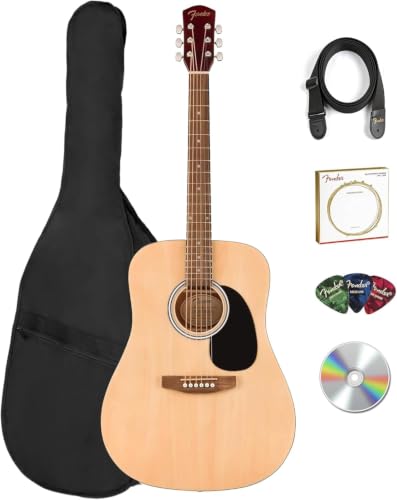
- DREADNOUGHT BODY: Full-bodied dreadnought design delivers rich, resonant acoustic sound with strong projection for strumming and everyday playing
- DURABLE CONSTRUCTION: All-laminate body with a basswood top, sapele body material, and satin finish offers lasting durability and classic acoustic styling
This bundle is the “all-in-one” solution for people who don’t want to buy accessories separately. It includes a strap, picks, and extra strings. While the guitar itself is a standard dreadnought (and thus much larger than the JR1), the value is in the package. If you are a traveler, the Yamaha JR1’s smaller footprint is still superior, but if you are setting up a home practice space for a beginner who isn’t intimidated by a large guitar, this bundle offers a lot of “bang for your buck.” Again, the JR1 wins on playability for small hands, while this bundle wins on sheer volume of gear included.
Final Verdict: Is the Yamaha JR1 FG Junior Acoustic Guitar Right for You?
After our extensive time evaluating the Yamaha JR1 FG Junior Acoustic Guitar, our conclusion is that it remains one of the most practical and reliable choices on the market for its specific niche. Its strengths lie in its impeccable scaling—Yamaha didn’t just shorten the neck; they balanced the entire instrument to feel “right” for a smaller player. The durability of the laminate woods and the inclusion of a quality gig bag make it a worry-free purchase for parents and travelers alike. While the sound is naturally brighter and thinner than a full-sized guitar, it is musically accurate and pleasing to the ear.
We recommend this guitar wholeheartedly to any parent whose child is starting lessons, and to any traveler who needs a “no-excuses” guitar to take on the road. It solves the problem of physical accessibility without breaking the bank. If you want a guitar that is easy to play, easy to carry, and built to last, this is it. Don’t let a poorly-sized instrument stand in the way of musical progress. You can get your hands on this beginner-friendly guitar today and start a musical journey on the right foot—and with the right fit.
Last update on 2026-10-16 / Affiliate links / Images from Amazon Product Advertising API