
Samson MDA1 Mono Active Direct Box Review: The High-Performance Workhorse for Studio and Stage
I remember the first time I realized my signal was “dying” before it even reached the mixer. I was recording a classic P-Bass through a cheap passive DI box, and the sound coming out of the monitors was muddy, lifeless, and frankly, disappointing. This is a common heartbreak for musicians and engineers alike. Whether you are in a quiet bedroom studio or on a loud church stage, the transition from your instrument to the recording interface or PA system is where the magic—or the disaster—happens. Without a high-quality bridge, your passive pickups lose their sparkle, and your signal becomes a magnet for hum and interference.
This is exactly why searching for a reliable direct box is a rite of passage for any serious audio enthusiast. The problem isn’t just about getting a signal from point A to point B; it’s about preserving the integrity of that signal. When you’re dealing with long cable runs or instruments with low output, a standard passive box often just doesn’t cut it. You need something that provides enough headroom and impedance matching to let your instrument breathe. That’s where the Samson MDA1 Mono Active Direct Box enters the conversation. It promises to solve the “dull tone” dilemma without breaking the bank, acting as a robust, transparent intermediary for your precious audio.
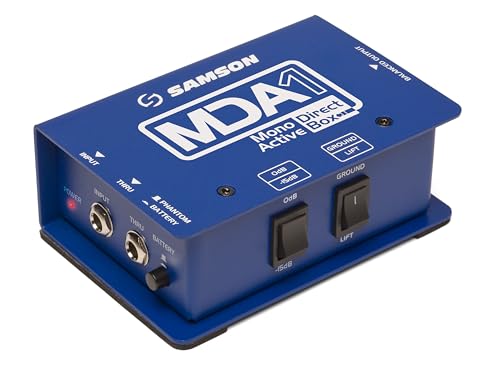
- All-metal, impact resistant design
- 2-position 0dB/-15dB attenuation switch
What to Consider Before Buying a Recording Signal Direct Box
A Recording Signal Direct Box is more than just an item; it’s a key solution for signal integrity, noise rejection, and professional-grade connectivity. At its core, a DI (Direct Injection) box converts a high-impedance, unbalanced signal (like what comes out of your guitar) into a low-impedance, balanced signal (what a mixer or interface expects). This conversion allows you to run long cables without losing high frequencies or picking up radio interference. For anyone serious about clean audio, investing in a dedicated active DI box is often the single most effective way to upgrade a home recording chain.
The ideal customer for this type of product is someone facing signal degradation issues, specifically those using instruments with passive pickups like classic electric guitars, basses, or even some vintage keyboards. It’s also a godsend for gigging musicians who deal with unpredictable “buzz” in various venues. While it is a powerhouse for passive gear, it might not be suitable for those who strictly use active electronics (which already have a low-impedance output) or those who need a DI for piezo-equipped acoustic guitars, as some active DIs have specific impedance curves that might not pair perfectly with every piezo preamp. In those cases, a high-end passive box with a premium transformer might be an alternative worth considering.
Before investing, consider these crucial points in detail:
- Dimensions & Space: In a crowded studio or on a pedalboard, real estate is precious. You want a unit that is small enough to tuck away but heavy enough that it won’t slide around when a cable gets tugged. Look for a compact “brick” design that can handle the weight of heavy XLR cables without flipping over.
- Capacity & Performance: The heart of an active DI is its circuitry. You need to look for a unit that offers a flat frequency response—meaning it doesn’t “color” the sound—and ultra-low distortion. High headroom is also vital so that your loudest playing doesn’t result in ugly digital-sounding clipping.
- Materials & Durability: Direct boxes are often stepped on, dropped, or tossed into gear bags. A steel or thick aluminum enclosure is non-negotiable for professional use. Impact-resistant designs ensure that the internal components and solder joints remain intact after years of road abuse.
- Ease of Use & Maintenance: Consider the power source. An active DI requires power, so look for a unit that offers the flexibility of both 48V phantom power (from your mixer) and a 9V battery. This ensures you are never stranded if your interface doesn’t provide phantom power or your battery dies mid-set.
Choosing the right DI can feel like a technical chore, but it is the foundation of a professional sound. While the Samson MDA1 Mono Active Direct Box is an excellent choice, it’s always wise to see how it stacks up against the competition. For a broader look at all the top models, we highly recommend checking out our complete, in-depth guide:
Finding the Best Budget Direct Boxes: Our Top Picks for Home Recording and Live Performance

- Passive Stereo DI with Isolation Transformer

- DEVICE CONNECTOR: Provides a variety of DI solutions with its inch device connector live sound recording applications. It allows you to easily connect keyboards, guitars & outboard signal processors


- Passive Mono Direct Box with Custom Transfmer Rugged I-beam Construction
First Impressions: The Blue Tank in the Studio
When the Samson MDA1 Mono Active Direct Box first arrived at our studio, the first thing I noticed was its weight. At 1.3 pounds, it feels significantly more substantial than the plastic-housed alternatives that often flood the budget market. It looks and feels like a piece of industrial equipment. The all-steel, impact-resistant enclosure is finished in a professional matte blue that looks great on a stage floor or a desk. To get a better sense of its build quality, you really have to hold it; there is zero flex in the metal, and the switches have a satisfying, firm “click.”
Unboxing is straightforward—no unnecessary frills here. Inside, you find the unit itself and a basic manual. Comparing it to industry standards like the Radial J48 (which costs significantly more), the MDA1 holds its own in terms of physical presence. While it may lack some of the advanced boutique features of high-end boxes, its simplicity is its strength. It provides exactly what you need: a 1/4″ input, a 1/4″ “Thru” for your amp, and a balanced XLR output. The addition of the 0dB/-15dB attenuation switch and the ground lift on the side are perfectly placed for quick adjustments mid-session.
Key Benefits
- Incredibly robust, all-metal construction that feels “built like a tank.”
- Transparent sound quality that significantly improves the clarity of passive pickups.
- Flexible power options with both 48V phantom power and a 9V battery compartment.
- Exceptional value for money, rivaling performance of much more expensive boutique DI boxes.
Drawbacks
- No external DC power input (battery or phantom power only).
- Does not pass signal through the XLR output if the power is off (even if using the “Thru” jack for an amp).
Performance Deep Dive: Testing the Samson MDA1
We spent several weeks putting the Samson MDA1 Mono Active Direct Box through its paces in various environments, from a high-gain home recording setup to a live church environment. Our goal was to see if this affordable unit could truly maintain signal integrity where others failed.
The Active Circuit Advantage: Clarity and Headroom
The standout feature of the Samson MDA1 Mono Active Direct Box is its internal active circuitry. Unlike passive boxes that rely on transformers—which can sometimes “color” the sound or lose high frequencies due to impedance mismatch—the MDA1 uses an active preamp to buffer the signal. In our testing with a passive P-Bass, the difference was immediately audible. The high-end “snap” that usually gets lost in long cable runs was preserved beautifully. We found that the 1-Megaohm input impedance is the “sweet spot” for electric guitars; it prevents the pickups from being loaded down, which results in a much more open and detailed sound.
During our recording sessions, the transparency of the MDA1 was impressive. We compared it to direct inputs on budget interfaces, and the Samson MDA1 Mono Active Direct Box consistently provided a cleaner, more robust signal with significantly less floor noise. As one user noted, the signal feels “cleaner and less distorted” compared to cheap passive alternatives. This makes it an essential tool for “re-amping” or for anyone using software guitar modelers who wants the purest possible DI track to work with. You can see its full technical specs here to understand how it handles high-gain inputs without clipping.
Road-Ready Resilience and Practical Features
In a live setting, the “tank-like” build of the Samson MDA1 Mono Active Direct Box isn’t just marketing—it’s a necessity. We purposely placed it in high-traffic areas on stage, and it shrugged off accidental kicks and stepped-on cables. The steel enclosure provides excellent shielding against RF interference and hum, which is a major problem in venues with old wiring or complex lighting rigs. We encountered a nasty ground loop hum in one of our test venues, and engaging the “Ground Lift” switch on the MDA1 instantly silenced the buzz. It’s one of those “set it and forget it” features that saves a gig.
The inclusion of a 2-position attenuation switch (0dB and -15dB) is another professional touch. We tested it with a high-output active keyboard and found that the -15dB pad allowed us to keep the signal from hitting the mixer too hot, preventing digital clipping at the source. This versatility ensures that the Samson MDA1 Mono Active Direct Box can handle everything from a delicate single-coil guitar to a roaring synthesizer. To find out more about how it handles different signal levels, check the latest price and availability for this essential stage tool.
The Flexibility of Dual Powering
One of the most practical aspects we evaluated was the dual-powering system. In the modern studio, 48V phantom power is the standard, and the Samson MDA1 Mono Active Direct Box handles this seamlessly. It draws power directly from the XLR cable, meaning you never have to worry about a battery dying during a long session. However, we found the 9V battery option to be a lifesaver when using older mixers or portable PA systems that lack phantom power. The battery compartment is easy to access, though as some users mentioned, it’s a tight fit that ensures the battery won’t rattle around during transport.
One quirk we noticed—and this is common among active DIs—is that the unit must be powered on to pass signal to the XLR output. This might seem obvious, but if you’re in a hurry and forget to engage phantom power or check your battery, you’ll be met with silence. Fortunately, the “Thru” jack continues to work, allowing you to hear your amp even if the DI circuit is inactive. This “Thru” feature is perfect for double-tracking in the studio: you can send a clean DI signal to your interface while simultaneously hearing your actual guitar amp in the room. This lack of lag is a feature that really sets it apart from using software-only monitoring.
What Other Users Are Saying
The general consensus among the audio community is that the Samson MDA1 Mono Active Direct Box is one of the best-kept secrets in the industry. Many users compare it directly to the Radial J48, a industry standard that costs nearly four times as much. One user mentioned, “I’ve been wanting a J48 for a long time… but at this price, the MDA1 is a steal. It’s a road-worthy beast and just as heavy-duty.” This sentiment is echoed by many who find the build quality to be far superior to anything else in this price bracket.
On the positive side, many users highlight the sound quality for bass. One bassist with over 30 years of experience noted that switching to this DI made their sound “definitely cleaner” compared to using the balanced out on their combo amp. However, there are a few minor gripes. A recurring “con” is the lack of an external DC power jack. As one user noted, if you aren’t using phantom power, you are “forced” to use a 9V battery, which can be a nuisance for permanent pedalboard setups. Despite this, the overwhelming majority of feedback suggests that the Samson MDA1 Mono Active Direct Box is a “keeper” that delivers professional results on a budget.
Comparing the Samson MDA1 to the Competition
While the MDA1 is an incredible value, it’s important to see how it compares to other popular options on the market. Here are three alternatives we’ve also spent time with.
1. Radial Pro DI Passive Direct Box
- Passive Mono Direct Box with Custom Transfmer Rugged I-beam Construction
The Radial Pro DI is a legendary passive box. Unlike the active Samson MDA1 Mono Active Direct Box, the Radial uses a high-quality custom transformer. It doesn’t require any power (no batteries or phantom power needed), which makes it incredibly reliable. However, because it is passive, it may not provide the same level of high-end clarity for passive pickups over very long cable runs as the MDA1 does. If you want the most bulletproof, “no-power-needed” DI for high-output instruments like active basses or keyboards, the Radial is a fantastic, albeit more expensive, choice.
2. Pyle Premium Passive DI Box

- ¼ “ DEVICE CONNECTOR: Provides a variety of DI solutions with its ¼ inch device connector and detachable AC power cord for live sound recording applications. It allows you to easily connect...
- PROVIDES CLEAN AUDIO: Useful for connecting unbalanced signals from sources submixers, effects processors & keyboards to a main PA or recording mixer. This impedance transformer also has buzz & hum...
The Pyle Premium is the ultimate budget contender. It is a passive unit and significantly cheaper than the Samson. In our experience, while the Pyle is functional, it lacks the shielding and high-fidelity components of the Samson MDA1 Mono Active Direct Box. You may notice more noise and a slightly muffled high-end. This is a good “emergency” DI to keep in your gig bag, but for critical recording or professional stage use, the Samson’s active circuitry and superior build are worth the extra investment.
3. Pyle 2-Channel Ground Loop Isolator

- REMOVES AC NOISE: The Pyle Hum Eliminator removes 60Hz AC hum caused by ground loops that act like radio antennae (loop antenna). It breaks the ground loop safely making it impossible for the signal...
- PASSIVE DEVICE: The noise isolator is a passive device that does not require power to operate. Equipped w/ ¼” TRS phone and XLR inputs and outputs on 2 channels. Automatically converts...
This Pyle unit is specifically designed to kill hum and buzz in a 2-channel setup. It is not a traditional instrument DI like the Samson MDA1 Mono Active Direct Box, but rather a problem-solver for line-level signals. It’s great for connecting a laptop or a consumer audio device to a pro mixer. However, it lacks the 1/4″ instrument input and the active buffering that makes the Samson so good for guitars and basses. If your problem is strictly hum between two pieces of pro gear, this is the tool; if you want to record a guitar, stick with the Samson.
The Final Verdict: Is the Samson MDA1 Right for You?
After weeks of testing, the conclusion is clear: the Samson MDA1 Mono Active Direct Box is a phenomenal piece of gear that punches way above its weight class. It successfully bridges the gap between flimsy budget boxes and overpriced boutique units. Its greatest strengths lie in its transparent sound, its indestructible steel chassis, and its ability to breathe new life into passive instruments by preserving those delicate high frequencies. While the lack of a DC power input and the requirement for power to pass signal are minor inconveniences, they are easily overshadowed by the sheer value and performance on offer.
If you are a home studio owner looking to upgrade your DI tracks, or a gigging musician tired of losing your tone to long stage snakes, this is a no-brainer. It provides the professional features—like the -15dB pad and ground lift—that you would expect from a box triple its price. Don’t let your tone suffer from a weak link in the chain. I highly recommend that you pick up the Samson MDA1 Mono Active Direct Box today and experience the difference that a high-quality active circuit can make for your music.
Last update on 2026-10-16 / Affiliate links / Images from Amazon Product Advertising API