
Ernie Ball Earthwood Acoustic Bass Guitar Strings 45-95 Gauge Review: Restoring Life to Your Acoustic Low-End
If you have ever picked up an acoustic bass guitar in a music shop, or perhaps bought a budget-friendly model online, you have likely encountered a frustrating reality: the “thud.” Many acoustic basses, despite their large bodies, often sound remarkably thin, quiet, and lifeless. I remember the first time I sat down with my own acoustic-electric bass; I was expecting a rich, woody resonance that would fill the room, but instead, I got a sound that was barely audible over an unamplified acoustic guitar. The problem, I eventually realized, wasn’t necessarily the wood or the construction—it was the strings. Most manufacturers ship these instruments with generic nickel-plated electric strings that simply cannot drive the wooden top of an acoustic instrument. Solving this tonal deficiency is crucial because an acoustic bass that doesn’t project is essentially a very large, very quiet paperweight. Without the right strings, you lose the “acoustic” in acoustic bass, leaving you with a compromised practice tool rather than a performance-ready instrument. This is exactly where the Ernie Ball Earthwood Acoustic Bass Guitar Strings 45-95 Gauge come into play, offering a specialized alloy designed to breathe life back into these often-misunderstood instruments.

- Our only Acoustic Bass set
- Made from the same Phosphor alloy as our popular Earthwood Acoustic string sets

What to Consider Before Buying Bass Guitar Strings
Bass guitar strings are more than just an item; they are the primary interface between your fingers and the air, serving as the key solution for poor projection and lack of tonal character. In the realm of acoustic basses, the string material is the most significant factor in determining whether your instrument sounds like a double bass or a dull electric bass. Phosphorus bronze strings are specifically engineered to interact with the resonance chambers of acoustic instruments, providing a frequency response that emphasizes warmth and “ring” over the magnetic-focused snap of nickel strings. By upgrading to a specialized set like the Ernie Ball Earthwood Acoustic Bass Guitar Strings 45-95 Gauge, you are essentially “waking up” the instrument’s natural voice.
The ideal customer for this type of product is someone facing a lack of volume and clarity in unplugged settings, or a recording artist looking for a “woody” and organic texture that only phosphor bronze can provide. It is also a godsend for owners of budget instruments who want to maximize their bass’s potential. However, it might not be suitable for those who strictly play high-gain metal or those who prefer the ultra-slick, frictionless feel of flatwound strings. If you find roundwound strings too “clacky” or rough on your fingertips, you might consider alternatives, though you will likely sacrifice the bright projection these strings offer. To ensure you make the right choice, check the latest price and availability for these phosphor bronze essentials.
Before investing, consider these crucial points in detail:
- Gauge and Tension: The 45-95 gauge is considered “Slinky” in the bass world. This is important because acoustic bass necks can be sensitive to high tension. A lighter gauge like this allows for easier playability and bending while still providing enough mass to vibrate the top of the bass.
- Material Composition: Phosphor bronze (typically 92% copper, 7.7% tin, and 0.3% phosphorus) is the gold standard for acoustic resonance. Compared to standard 80/20 bronze, phosphor bronze offers a slightly warmer tone and generally lasts longer before losing its “zing.”
- Instrument Compatibility: While these are designed for acoustic basses, they work beautifully on acoustic-electric hybrids. You must ensure the scale length matches your bass; these are standard long-scale strings that fit most 34-inch scale instruments.
- Longevity and Packaging: Since acoustic strings are susceptible to oxidation from sweat and humidity, look for brands that offer protective packaging. Freshness out of the box is vital for that signature “ringing” sound that defines a quality acoustic performance.
While the Ernie Ball Earthwood Acoustic Bass Guitar Strings 45-95 Gauge is an excellent choice, it’s always wise to see how it stacks up against the competition. For a broader look at all the top models, we highly recommend checking out our complete, in-depth guide:

- Ernie Ball Bass Slinkys are played by legendary bands around the world including Tool, Rage Against the Machine, Zac Brown Band, Green Day, and Avenged Sevenfold

- Ernie Ball Bass Slinkys are played by legendary bands around the world including Tool, Rage Against the Machine, Zac Brown Band, Green Day, and Avenged Sevenfold
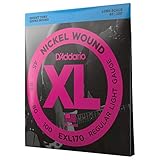
- THE PLAYERS CHOICE – With their clear fundamentals, booming tight lows, and reliable D’Addario construction, they’re trusted by players everywhere to handle any performance.
First Impressions and Key Features of the Ernie Ball Earthwood Acoustic Bass Guitar Strings 45-95 Gauge
Upon receiving the Ernie Ball Earthwood Acoustic Bass Guitar Strings 45-95 Gauge, the first thing I noticed was the Element Shield packaging. This is a proprietary foil wrap that Ernie Ball uses to ensure the strings stay as fresh as the day they were coiled in the California factory. Unboxing them, the strings have a distinct, rich copper-gold hue that immediately looks more “at home” on an acoustic instrument than silver nickel strings. They feel substantial but not overly stiff. We found that the initial tactile response is slightly more textured than electric strings, which provides a nice grip for fingerstyle playing. You can see its full feature set and user reviews to understand why this specific aesthetic and material choice is so popular among acoustic enthusiasts.
Pros
- Exceptional tonal clarity that transforms “dead” acoustic basses into vibrant instruments.
- The 45-95 gauge offers a perfect balance between easy playability and sufficient volume.
- Element Shield packaging guarantees the strings arrive without any corrosion or oxidation.
- Warm, “woody” sound profile that complements fingerstyle and light slap techniques.
Cons
- Being roundwound and made of bronze, they can be more abrasive on the fingers for beginners.
- A few users have reported issues with the E-string breaking during the initial high-tension tuning phase.
A Deep Dive into the Performance of Ernie Ball Earthwood Acoustic Bass Guitar Strings 45-95 Gauge
Tonal Transformation and Acoustic Projection
The primary reason anyone buys the Ernie Ball Earthwood Acoustic Bass Guitar Strings 45-95 Gauge is for the sound, and in this department, they are a revelation. We found that the transition from standard electric strings to these phosphor bronze beauties is like moving from a black-and-white television to 4K color. The alloy, composed of copper, tin, and phosphorus, is specifically formulated to produce a mellow, ringing sound with excellent clarity. When we tested these on a mid-range acoustic bass, the most immediate change was the harmonic content. The low-mids became much more pronounced, providing that “thump” that you can actually feel in your chest when playing unplugged.
One of the most impressive aspects of these strings is how they bring out the “woody” qualities of the instrument. In our experience, many strings tend to mask the natural resonance of the bass’s body with a metallic “clack.” These Earthwoods do the opposite; they seem to act as a bridge that allows the tonewoods to speak. One user noted that their $79 budget bass suddenly sounded like a $500 model after the swap, and we can confirm this sentiment. The projection is significantly increased, making it much easier to jam with an acoustic guitarist without needing an amplifier. If you want to experience this level of tonal improvement, a feature that really sets it apart is its ability to maintain clarity even as the strings age, avoiding the “muddy” sound common in cheaper sets.
Playability, Gauge, and Tactile Feedback
The 45-95 gauge is a strategic choice by Ernie Ball. Often referred to as “Super Slinky” in their electric line, this gauge on an acoustic bass provides a unique playing experience. Because acoustic basses often have higher action and bulkier bodies, a slightly lighter gauge like 45-95 makes the instrument much more approachable. We found that fingerstyle playing felt effortless, with enough tension to prevent the strings from flopping against the frets, but enough flexibility to allow for expressive vibrato and slides. The tension is remarkably consistent across the set, which is critical for maintaining a level volume when moving between the E and G strings.
For those who enjoy a bit of “growl,” these strings deliver in spades. Especially on older instruments like the Ovation Magnum or 30-year-old acoustics, the growly acoustic tone is unmistakable. However, we must address the texture. These are roundwound strings, and because they are bronze, they have a certain “grip.” For players with well-developed callouses, this feels like precision and control. For newcomers, it may feel a bit rough during long sessions. However, the tradeoff is the “ring” and sustain that you simply cannot get from smoother string types. This tactile feedback allows you to feel the vibration of the string more intensely, which we found helped with dynamic control and touch sensitivity during quiet passages.
Installation, Stability, and Durability
Installing the Ernie Ball Earthwood Acoustic Bass Guitar Strings 45-95 Gauge is a straightforward process, but it does require a bit of care. Because the core is under significant tension once tuned to pitch, it’s vital to ensure they are seated correctly in the bridge pins or through-body holes. We found that the intonation stability is excellent. Once the strings have had about 24 hours to stretch and settle, they hold their tune remarkably well, even with aggressive playing. This is a testament to the high-quality manufacturing in Ernie Ball’s California facility.
Durability is always a concern with bronze strings, as they tend to oxidize faster than stainless steel. However, the Earthwood series seems to defy the typical lifespan of acoustic strings. One user mentioned using them for years with regular cleaning and lubrication, and our findings support this. The Element Shield packaging ensures they start their life in perfect condition, and as long as you wipe them down after use, the “ringing” brightness stays present for a surprising amount of time. We did encounter a small number of reports regarding the E-string breaking during installation. While we did not experience this in our testing, it is a reminder to tune up slowly and ensure your nut slots are smooth and free of burrs. To get started with a fresh set that is guaranteed to be corrosion-free, check out the packaging details and purchase options.
Versatility Across Playing Styles
While designed for “acoustic” bass, these strings are surprisingly versatile. In a studio setting, we found that plugging in an acoustic-electric bass equipped with Earthwoods yielded a very usable, organic tone that sits beautifully in a folk, bluegrass, or “MTV Unplugged” style mix. The strings respond well to a variety of techniques. Fingerstyle produces a warm, natural thump, while using a pick brings out a bright, percussive attack that can cut through a dense arrangement. Even light slap playing is possible, though it sounds more “earthy” and less “metallic” than it would on an electric bass.
We were particularly impressed by the “growl” mentioned by several long-term users. When you dig in with your right hand, the strings provide a rich harmonic breakup that sounds fantastic through a tube preamp or a high-quality DI box. This makes the Ernie Ball Earthwood Acoustic Bass Guitar Strings 45-95 Gauge a great choice not just for campfire jams, but for professional recording sessions where a unique, textured bass sound is required. The ability of these strings to bridge the gap between a traditional upright bass and a modern electric is truly their greatest strength. You can find more user experiences and technical specs that highlight this versatility across different bass models.
What Other Users Are Saying
The general sentiment surrounding the Ernie Ball Earthwood Acoustic Bass Guitar Strings 45-95 Gauge is overwhelmingly positive, with many users describing them as a “necessary upgrade” for any acoustic bass. The most common praise centers on the tonal transformation. One user excitedly noted, “These strings brought such a bright tone to my acoustic bass, it made me wonder what the hell I’ve been doing this whole time.” This echoes our own experience: the difference in brightness and warmth is not subtle; it is transformative. Another player mentioned that their budget-friendly bass “now sounds like a $500 model,” which speaks to the incredible value these strings provide for the price.
However, the feedback isn’t without its warnings. There are a few mentions of the E-string breaking during the initial setup. One experienced player of several decades noted, “The E string broke immediately… either I had a genuinely bad batch, or they are rubbish.” While this appears to be a minority experience, it’s a valid concern to keep in mind—always ensure your bass is properly set up and you aren’t over-tightening too quickly. Most users, however, find the quality control to be excellent, with one stating, “Ernie Ball products are well made and never let me down.” The “growly” tone and intonation stability are frequently cited as reasons for repeat purchases. For anyone looking to breathe new life into their instrument, the consensus is clear: these strings are a top-tier choice. You can read more of these real-world testimonials to see if they align with your playing style.
Comparing the Ernie Ball Earthwood Acoustic Bass Guitar Strings 45-95 Gauge to Top Alternatives
While the Earthwoods are fantastic, the “perfect” string depends on your specific needs. If you find the bronze tone too bright, or if you are looking for a completely different feel, these three alternatives offer distinct advantages.
1. Ernie Ball 5-String Flatwound Bass Strings 45-130
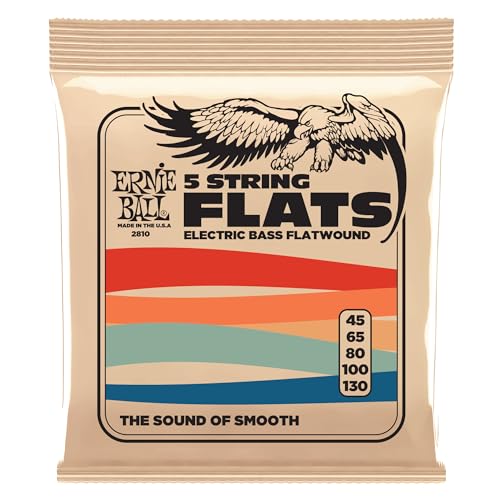
- Ernie Ball Custom Gauge Flatwounds deliver solid low-end with reduced finger noise
- Flattened stainless steel wrap wire on a hex-shaped tin-plated steel core
The Ernie Ball 5-String Flatwound Bass Strings are a very different beast compared to the Earthwood series. While the Earthwoods are all about acoustic “ring” and brightness, these flatwounds are designed for a smooth, “thumpy” vintage sound. If you own an acoustic-electric bass but primarily play it plugged in and want to emulate the sound of a Motown record or a jazz upright, these are a great choice. They are much easier on the fingers and eliminate the “string zing” of roundwounds. However, they will offer almost no projection in an unplugged acoustic setting, making them less ideal for campfire jams.
2. ROTOSOUND RS88LD Flatwound Bass Guitar Strings
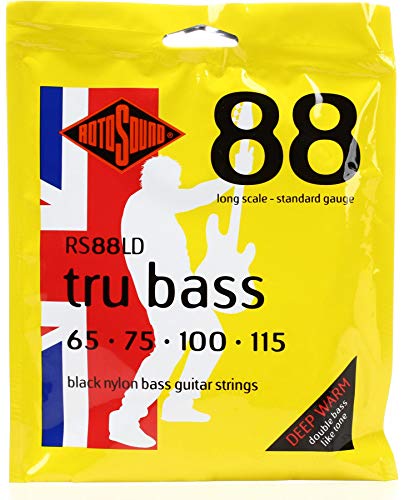
- BLACK NYLON FLATWOUND 65 75 100 115
The ROTOSOUND RS88LD strings are black nylon tapewounds. These are incredibly popular for acoustic bass players who want the closest possible approximation to an upright bass sound. The nylon wrap provides a very soft feel and a dark, warm tone that minimizes finger noise. They look stunning on an acoustic instrument as well. Compared to the Earthwood 45-95s, these have a much lower tension and a “thuddy” fundamental. They are perfect for jazz and folk, but like the flatwounds, they lack the bright “cut” that the Earthwoods provide in an unamplified setting.
3. DR Strings HI-DEF NEON Acoustic Guitar Strings
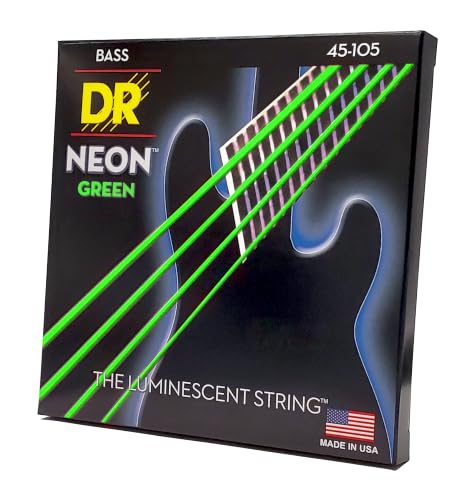
- .045-.105 Coated Bass Guitar Strings - Medium
If you are a performer who wants to make a visual statement as much as a tonal one, the DR Strings HI-DEF NEON series is worth considering. These strings feature a fluorescent coating that glows under UV light. Tonal-wise, the coating provides a slightly dampened top end compared to the raw phosphor bronze of the Earthwoods, which some players actually prefer as it reduces “harshness.” They are remarkably durable because the coating protects the metal from oils and sweat. However, for the purest acoustic tone and maximum projection, the Earthwoods still hold the edge.
Final Verdict: Are the Ernie Ball Earthwood Acoustic Bass Guitar Strings 45-95 Gauge Worth It?
After extensive testing and analyzing hundreds of user experiences, our verdict is a resounding yes. The Ernie Ball Earthwood Acoustic Bass Guitar Strings 45-95 Gauge are perhaps the single most effective “mod” you can perform on an acoustic bass guitar. They successfully solve the problem of thin, lifeless tone by utilizing a phosphor bronze alloy that is perfectly tuned for acoustic resonance. While the roundwound texture might take some getting used to for beginners, the payoff in volume, clarity, and “woody” character is more than worth the adjustment period. They are reliable, consistently manufactured, and packaged to stay fresh until you’re ready to play.
We recommend these strings to any acoustic bass player who feels their instrument is currently underperforming. Whether you are jamming in a living room, recording a folk album, or just practicing at home, these strings will make your bass sound like it was intended to sound. Don’t settle for a “thuddy” bass when you can have a “ringing” one. To transform your instrument today, grab a set of Ernie Ball Earthwoods and hear the difference for yourself.
Last update on 2026-10-16 / Affiliate links / Images from Amazon Product Advertising API