
Behringer STUDIO L Review: The Professional Command Center Your Home Studio Has Been Missing
If you have ever been in the middle of a heated mixing session, only to realize you need to reach behind your desk to toggle a speaker switch or fiddle with a tiny volume knob on your audio interface, you know the frustration of a disjointed workflow. In our years of testing gear, we have found that the biggest hurdle for home producers isn’t usually the quality of their plugins, but the physical ergonomics of their setup. Without a central hub, communicating with a vocalist in another room requires shouting, and comparing mixes between two sets of monitors becomes a chore that kills your creative momentum. We recently integrated the Behringer STUDIO L into our daily routine to see if it could truly solve these common studio headaches without breaking the bank.
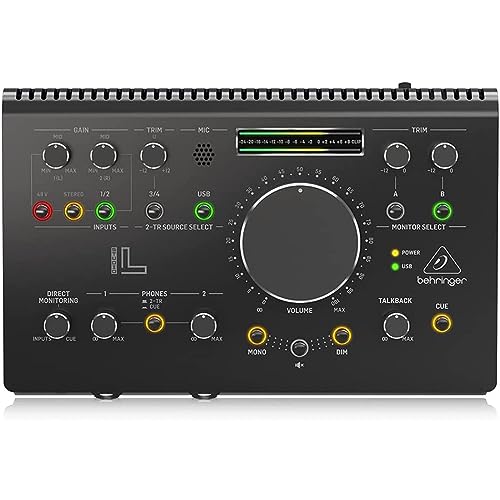
- Premium, ultra-low noise and high headroom studio control and communication center
- All-in-one master volume controller, source selector, monitor switcher and talkback box
What to Consider Before Buying a Digital Audio Workstation Controller
A Digital Audio Workstation controller or monitor station is more than just an item; it’s a key solution for streamlining your creative process and ensuring your ears aren’t being fooled by poor signal routing. When you move beyond a simple “plug-and-play” interface, you are looking for a device that acts as the brain of your operation. It bridges the gap between your computer’s digital world and the physical reality of your speakers, headphones, and microphones. Choosing the right one can mean the difference between a session that flows effortlessly and one that feels like a constant battle with your hardware.
The ideal customer for this type of product is someone facing a growing gear list—perhaps someone who has just added a second pair of monitors or needs a dedicated talkback system for recording others—while it might not be suitable for those who strictly work “in the box” with a single pair of headphones and no external hardware. If you are just starting out with a laptop and a pair of earbuds, you might find this level of control overkill, and you would be better served by a simple mobile interface.
Before investing, consider these crucial points in detail:
- Dimensions & Space: Studio real estate is often limited. You need to ensure the controller fits comfortably within arm’s reach without cluttering your desk. We found the Behringer STUDIO L to have a substantial footprint that feels professional, but you should measure your desk space to ensure it doesn’t crowd your keyboard and mouse.
- Capacity/Performance: Look for high-resolution audio support. In the modern era, 192 kHz capability is the gold standard for capturing every nuance of a performance. You also want to ensure the unit has enough inputs and outputs to grow with your studio, rather than needing an upgrade in six months.
- Materials & Durability: Since this is a device you will touch hundreds of times a day, the build quality is paramount. Metal chassis are preferred over plastic, and the “feel” of the main volume knob—often referred to as the “Big Knob”—should be smooth and weighted to allow for micro-adjustments during critical listening.
- Ease of Use & Maintenance: The layout should be intuitive. You shouldn’t have to look at the manual to figure out how to dim the speakers or talk to a performer. Maintenance is generally low for these units, but having high-quality potentiometers (the internal parts of the knobs) ensures you won’t hear “crackling” sounds when adjusting volume years down the road.
While the Behringer STUDIO L is an excellent choice for those seeking a balance between price and professional features, it’s always wise to see how it stacks up against the competition. For a broader look at all the top models, we highly recommend checking out our complete, in-depth guide:

- Tactile Control, Visual Feedback: LCD keys, touch strip, and dials for audio, video, lighting, and more. Know that your command has been executed.


- Complete Command of Ableton Live - Seamlessly integrates with Ableton Live (V9.1.3+), providing hands-on control of Ableton's clip matrix, mixer parameters, virtual instruments, effects, and more

- 8 touch-sensitive, 100 mm long-throw, motorized faders
First Impressions: Unboxing the Behringer STUDIO L
When we first pulled the Behringer STUDIO L out of the box, the weight was the first thing that struck us. At over three pounds, it doesn’t feel like a toy. The black finish is sleek, and the buttons have a satisfying tactile “click” that feels far more expensive than its price tag suggests. If you’ve looked at other market leaders in this space, you might notice a striking resemblance to some of the industry’s most famous monitor controllers. However, Behringer has added its own flair, particularly with the inclusion of the Midas-designed preamps, which are legendary in the live sound world for their transparency and headroom.
Setting it up was a breeze. As a dedicated audio interface for Windows systems, it integrates seamlessly once the drivers are installed. We were immediately impressed by the layout; everything is where a professional engineer would expect it to be. If you want to see its full feature set and user reviews, you will notice that many users share our sentiment: it brings a “large console” feel to a compact home studio environment. The large VCA volume knob sits right in the center, inviting you to take control of your monitoring environment with precision.
Key Benefits
- True VCA control for incredibly precise stereo tracking and level management.
- Dual Midas preamps provide professional-grade vocal and instrument recording.
- Built-in Talkback microphone makes communication with talent effortless.
- High-resolution 192 kHz audio interface ensures audiophile-grade playback.
Limitations
- Large physical footprint may be too bulky for very small “bedroom” desks.
- Some users have noted a “gain jump” at the very lowest end of the headphone volume pot.
Deep Dive: Putting the Behringer STUDIO L to the Test
Precision Monitoring with True VCA Control
One of the most significant technical advantages we discovered while using the Behringer STUDIO L is the use of VCA (Voltage Controlled Amplifier) technology for the main volume control. In traditional, cheaper monitor controllers, the volume knob is a simple potentiometer that the audio signal passes through directly. This often leads to “stereo drift,” where one speaker becomes slightly louder than the other at low volumes. Because the Behringer STUDIO L uses a VCA, the knob actually controls a DC voltage that tells the amplifier how loud to be. This keeps the stereo image perfectly centered, regardless of how low you turn it down.
During our testing, we constantly toggled between our main studio monitors and a smaller set of “real-world” speakers. The ability to trim the levels of the B-speakers so they match the A-speakers exactly is a godsend. It allows for honest A/B comparisons without your brain being tricked by one set of speakers simply being louder. This level of precision is something we usually only find in controllers costing twice as much. For anyone serious about mixing, this feature alone makes it worth looking into to check the latest price and availability.
Midas Preamps: The Secret Weapon for Recording
While many people will buy the Behringer STUDIO L strictly for its monitor control capabilities, we shouldn’t overlook the fact that it is a high-end 2×2 USB audio interface. We put the Midas preamps through their paces with both sensitive condenser microphones and gain-hungry dynamic mics. The result? Pure, clean headroom. The preamps are exceptionally quiet, which is vital when you are recording delicate acoustic guitars or intimate vocal takes where background hiss can ruin a track.
We found that having the preamps built directly into the controller simplifies the signal chain significantly. Instead of having an interface over here and a controller over there, everything is unified. The +48V phantom power is easily accessible, and the 192 kHz sample rate ensures that you are capturing the full frequency spectrum of your source. As we analyzed the recordings, the clarity in the high frequencies was particularly notable—a hallmark of the Midas design. If you are building a studio from scratch, having this level of input quality inside your monitor controller is a massive value proposition.
Workflow and Communication: The Talkback and Routing
Communication is the lifeblood of a productive recording session. There is nothing worse than a singer feeling isolated in a booth or another room because they can’t hear the engineer’s feedback. The integrated talkback system in the Behringer STUDIO L is a game-changer for home setups. With a dedicated “Talk” button and a built-in microphone, we were able to give direction to the “talent” without having to set up an extra mic and channel in our DAW. It’s a feature that really sets it apart from more basic interfaces.
Furthermore, the headphone section is robust. It features two independent headphone outputs with their own level controls. In our experience, many interfaces skimp on the headphone amp power, leading to weak sound when using high-impedance studio headphones. The Behringer STUDIO L had no trouble driving our 250-ohm reference cans to loud, clear levels. The inclusion of Mono, Mute, and Dim buttons right at your fingertips allows for the kind of rapid-fire checking that is essential during the mastering phase. You can quickly check if your mix has phase issues in mono or dim the volume to see if the vocals still sit correctly in the mix at low levels.
Build Quality and Ergonomic Design
Let’s talk about the physical experience of using this unit. In a studio environment, you want gear that stays put. The Behringer STUDIO L has a solid, rubberized base that prevents it from sliding around when you hit the buttons. The “Big Knob” is the center of the experience, and it feels smooth and consistent throughout its rotation. While one user mentioned a slight gain jump at the very lowest setting of the headphone pots, we found that in practical use—where you are rarely listening at “whisper” levels—it didn’t impact our workflow significantly. However, it is a nuance that an expert ear will want to be aware of.
The layout is logical and spacious. Even with larger hands, we never felt like we were accidentally hitting the wrong button. The LED metering is bright and responsive, providing a clear visual cue of your input and output levels. This helps prevent clipping before it even happens. When you see its full feature set and user reviews, you will find that many professionals are replacing their older, bulkier gear with this unit because it condenses so much functionality into a single, well-built chassis. It feels like a piece of equipment designed by people who actually spend their days in a studio.
What Other Users Are Saying
The general consensus among the community is that the Behringer STUDIO L offers an incredible feature-to-price ratio. One user noted that they use it strictly as a monitor controller and found it “impressive” for the price point, highlighting the A/B monitor trim and the modern design as major wins. Another user praised the “quality materials and good sound,” stating that for the cost, you stay “completely satisfied.” This aligns with our experience; the value here is undeniable.
However, it wouldn’t be an honest review without addressing the criticisms. Some users have compared it heavily to the Mackie Big Knob Studio, with one individual questioning if Behringer can match that level of long-term quality. Additionally, as we mentioned earlier, a few users have reported a “step of gain jump” on the headphone potentiometers at very low volumes. While this hasn’t been a dealbreaker for most, it is something to consider if you frequently listen at the absolute minimum volume level. Overall, the feedback is overwhelmingly positive, with most users finding it a significant upgrade to their studio workflow.
Comparing the Behringer STUDIO L to Top Alternatives
1. Elgato Stream Deck + Studio Controller
- Tactile Control, Visual Feedback: LCD keys, touch strip, and dials for audio, video, lighting, and more. Know that your command has been executed.
- Fully Customizable: Use as an audio mixer, studio controller, production console, etc.
The Elgato Stream Deck + is a very different beast compared to the Behringer STUDIO L. While the Behringer focuses on analog-style signal routing, preamps, and physical VCA control, the Elgato is a digital powerhouse designed for content creators and streamers. It features customizable LCD keys and touch strips that can be programmed to control almost any software parameter. If your “studio” work is 90% streaming or video editing and you don’t need to plug in professional XLR microphones or switch between multiple sets of studio monitors, the Elgato is a fantastic, highly customizable alternative. However, for pure audio engineering and mixing, it lacks the tactile analog feel and the dedicated audio interface capabilities of the Behringer.
2. Akai Professional APC40 MKII MIDI Controller
- Complete Command of Ableton Live - Seamlessly integrates with Ableton Live (V9.1.3+), providing hands-on control of Ableton's clip matrix, mixer parameters, virtual instruments, effects, and more
- Create, Jam, Produce - Trigger clips, loops and samples using a 5X8 clip-launch matrix with RGB feedback for clip status and color coding
If your primary goal is to “perform” your mix or produce electronic music in Ableton Live, the Akai Professional APC40 MKII is the industry standard. Unlike the Behringer STUDIO L, which is a monitor controller and audio interface, the Akai is a MIDI controller. It doesn’t process audio; it sends data to your computer to move faders and launch clips. We recommend the Akai for producers who need a 5×8 clip launch matrix and physical faders for mixing “in the box.” But remember, you will still need a separate audio interface and monitor controller if you want the features the Behringer provides. They are actually great companions rather than direct competitors.
3. Novation Launchkey 61 MK4 MIDI Keyboard Controller

- The Creative Controller: Launchkey is an all-in-one DAW controller with premium hardware, 16 velocity-sensitive pads, and more
- Seamless DAW integration: Work intuitively in Ableton Live, Logic, Cubase, Reason, FL Studio, and Ardour
The Novation Launchkey 61 MK4 is a keyboard-centric controller designed for composers and players. It offers deep DAW integration, semi-weighted keys, and drum pads. If you are a songwriter who needs to play in melodies and chords, this is an essential tool. However, it serves a completely different purpose than the Behringer STUDIO L. While the Launchkey helps you create the music, the Behringer helps you hear and record it with professional accuracy. For a complete studio, you might actually find yourself wanting both: the Novation for inputting notes and the Behringer STUDIO L for managing your speakers and recording vocals.
Final Verdict: Is the Behringer STUDIO L Right for You?
After weeks of testing, we can confidently say that the Behringer STUDIO L is one of the most versatile pieces of gear we’ve added to our setup in a long time. It successfully bridges the gap between a high-quality audio interface and a professional monitor station. Its strengths lie in the crystal-clear Midas preamps, the rock-solid VCA volume control, and a talkback system that makes you feel like you’re working in a million-dollar facility. While the size and the minor quirk with the headphone pot at low volumes are worth noting, they are small concessions for the sheer amount of utility provided.
We recommend the Behringer STUDIO L for home studio owners who are tired of messy cabling and want a centralized, professional command center. It will simplify your workflow, improve your mixing accuracy, and make your recording sessions much more professional. If you are ready to take your studio ergonomics and audio quality to the next level, we highly suggest you check the latest price and bring this powerhouse into your setup today.
Last update on 2026-10-16 / Affiliate links / Images from Amazon Product Advertising API