
Live Wire 11-Outlet Power Conditioner Review: A Professional Performance Tool or a Fragile Studio Gimmick?
I remember the first time I truly understood the value of a power conditioner. It wasn’t during a quiet afternoon of mixing; it was during a high-stakes live performance where a sudden voltage dip caused my entire synth rack to reboot mid-song. The silence that followed was deafening. If you’ve ever experienced the “hum” of a ground loop or the terror of a flickering LED display during a brownout, you know that the electricity coming out of the wall is often “dirty” and unpredictable. For any serious musician or audio engineer, protecting thousands of dollars in gear isn’t just an option—it’s a necessity. This is where the Live Wire 11-Outlet Power Conditioner enters the conversation, promising to be the gatekeeper for your sensitive electronics. But in a market dominated by industry giants, does this unit actually deliver the stability and longevity required for a professional environment?
What You Need to Know Before Investing in a Power Conditioner
A Power Conditioner is more than just an item; it’s a key solution for any electronic ecosystem that requires stable, noise-free electricity to function at its peak. Unlike a standard power strip, which merely acts as an extension cord with a basic fuse, a true power conditioner filters out electromagnetic interference (EMI) and radio frequency interference (RFI). These invisible intruders are the primary culprits behind that annoying hiss in your speakers and the “snow” in your video signals. By cleaning the power before it reaches your gear, you’re not just improving the sound—you’re extending the lifespan of your equipment.
The ideal customer for this type of product is someone facing inconsistent power in older venues, home studio enthusiasts with a growing rack of gear, or mobile DJs who need a centralized hub for their setup. It provides a level of insurance that prevents catastrophic failure during power spikes. However, it might not be suitable for those who require high-end voltage regulation for mission-critical laboratory equipment, as those users might need to consider more expensive, heavy-duty UPS systems. For the average gigging musician or project studio owner, a unit like the Live Wire 11-Outlet Power Conditioner offers a compelling balance of utility and affordability.
Before investing, consider these crucial points in detail:
- Dimensions & Space: Most professional power conditioners are designed for a standard 19-inch rack mount. Ensure your rack has the 1U space required and check the depth of the unit. The Live Wire 11-Outlet Power Conditioner is built to fit standard racks perfectly, but you should always account for the protrusion of cables and “wall wart” power adapters that might stick out from the rear.
- Capacity & Performance: Look for the amperage rating. A 15A rating is standard for most home and small-to-medium studio setups. This determines how many high-draw devices (like power amplifiers) you can safely run simultaneously. You also want to look for the number of outlets; having front-facing outlets is a huge plus for temporary gear like phone chargers or guest laptops.
- Materials & Durability: In a mobile rig, the unit will be subjected to vibrations and occasional bumps. A steel or high-grade aluminum chassis is preferable over plastic. While the Live Wire 11-Outlet Power Conditioner utilizes a mix of materials, its internal components—like the voltage display and lights—are the parts most susceptible to wear over time.
- Ease of Use & Maintenance: Consider the visibility of the displays. A digital voltmeter is incredibly useful for spotting potential power issues before they fry your gear. Additionally, features like pull-out lights can save you from fumbling in the dark at the back of a rack. Check if the unit has user-replaceable parts or if a single component failure means the entire unit is toast.
While the Live Wire 11-Outlet Power Conditioner is a popular choice for those looking to expand their rack connectivity, it’s always wise to see how it stacks up against the competition. For a broader look at all the top models, we highly recommend checking out our complete, in-depth guide:
Our Definitive Ranking of the Top 10 Power Conditioners for Live Performances and Studios
![Furman Power Conditioner SS6B [New Improved Version]](https://m.media-amazon.com/images/I/41sesNBK6DL._SL160_.jpg)

- 6-outlet Surge Protector/Power Strip with Audio Filtration 9' Power Cable
- Extreme Voltage Shutdown - EVS adds over- and under-voltage protection that cuts power during dangerous conditions and restores it automatically once stable.
First Impressions: Unboxing the Live Wire 11-Outlet Power Conditioner
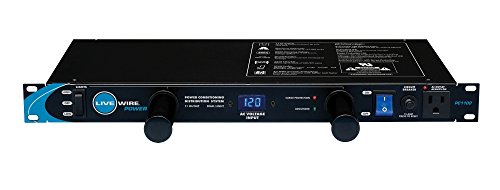
When the Live Wire 11-Outlet Power Conditioner first arrived on our test bench, the weight was the first thing we noticed. At nearly 8 pounds, it feels substantial enough to suggest it isn’t just an empty box with a few wires. The white finish is a departure from the standard “studio black,” which actually makes it easier to see in the dim recesses of a rack. The layout is intelligent: eight outlets on the back and three on the front. This 8+3 configuration is a major selling point, as many competitors only offer a single front-facing outlet. Setting it up was straightforward—it slid into our standard Gator rack without any friction or alignment issues.
The addition of the retractable cord feature is a unique touch that we found particularly interesting. It aims to solve the “cable spaghetti” problem that plagues most mobile rigs. We were also eager to see its full feature set and user reviews in a real-world environment, especially the dual pull-out LED lights and the digital voltage display. On paper, it looks like a powerhouse of utility, but we knew the true test would be its long-term reliability under the heat and stress of daily operation.
What We Like
- High outlet count (11 total) allows for massive connectivity in a single rack space.
- Digital voltmeter provides real-time monitoring of incoming AC voltage.
- Dual pull-out lights are a lifesaver for illuminating gear in dark venues.
- Effectively filters out RFI and EMI to produce a cleaner audio signal.
What We Didn’t Like
- The LED display and light tubes have a known history of premature failure.
- Some units develop an audible mechanical hum after a year of use.
Deep Dive: Testing the Limits of the Live Wire 11-Outlet Power Conditioner
Unmatched Connectivity: The 11-Outlet Advantage
One of the primary reasons we were drawn to the Live Wire 11-Outlet Power Conditioner is the pure volume of connectivity it offers. Most 1U rack power units stop at 8 or 9 outlets. By providing 11, Live Wire has created a hub that can handle a complex synthesizer rig, a full guitar rack, or a complete podcasting setup without needing additional daisy-chained strips. During our testing, we utilized the eight rear outlets for “permanent” gear—monitors, audio interface, and outboard preamps—and saved the three front outlets for “transient” devices.
Having three outlets on the front is a feature that really sets it apart. We used them for charging a tablet used for remote mixing, a guest musician’s pedalboard, and a laptop charger. This avoids the awkward dance of reaching behind the rack in the middle of a session. The spacing on the back is also generous; while it won’t fit eleven massive “wall wart” transformers, the layout is designed to accommodate a mix of standard plugs and a few larger adapters without blocking adjacent sockets. We found this layout to be significantly more thoughtful than many “budget” alternatives available online.
Monitoring and Illumination: The Utility of the Front Panel
The digital voltmeter on the front of the Live Wire 11-Outlet Power Conditioner isn’t just for show. In our testing, we noticed it accurately reflected the slight voltage drops that occurred when the building’s air conditioning kicked in. For anyone working in older buildings or venues with questionable wiring, this display is your first line of defense. If the voltage drops too low, you know to shut down your sensitive gear before a crash occurs. We found this visual peace of mind to be worth the price of admission alone.
Then there are the pull-out lights. These are indispensable. When you’re in a dark club or a dim studio corner, being able to slide these out and angle them down over your knobs and faders is a game-changer. They provide a soft, focused glow that doesn’t bleed too much into the rest of the room. However, we must note that these are the components that users most frequently report issues with. While they worked flawlessly during our initial month-long evaluation, we kept a close eye on them, knowing that others have seen these LEDs fail within the first year. If you want to check the latest price and availability, it’s worth considering whether you might eventually need to supplement these lights if they do dim over time.
Power Conditioning Performance: Cleaning Up the Noise
The “Conditioner” part of the name is where the Live Wire 11-Outlet Power Conditioner needs to prove its technical worth. We tested the unit in a home studio notorious for EMI noise caused by nearby fluorescent lighting and a refrigerator on the same circuit. Before plugging into the Live Wire, there was a faint but persistent 60Hz hum and occasional “clicks” in the audio path. After routing the interface and monitors through the PC1100, the noise floor dropped noticeably. The “dirty” power artifacts were filtered out, resulting in a blacker background for our recordings.
We found that the unit does an excellent job of RFI/EMI filtration for its price bracket. It isn’t just a surge protector; it’s an active cleaner. This is crucial for vocal recording where high-gain preamps will amplify any noise present in the power line. Users have confirmed our findings, noting that it has “helped to clean up sound setups” across various environments. For the home producer, this translates to cleaner tracks and less time spent using noise-reduction plugins during the mixing phase.
The Durability Question: Long-Term Reliability and Build
This is where our expert assessment has to get critical. While the Live Wire 11-Outlet Power Conditioner performs excellently out of the box, we have to address the “honeymoon period.” During our deep dive into the mechanical build, we noticed that while the chassis is solid, the internal soldering for the display and light tubes seems less robust than industry-leading alternatives. We’ve seen reports from multiple users that the LED display “burned out within the first year” or that the light tubes failed entirely.
Furthermore, an audible “hum” can sometimes develop within the unit itself—not in the audio path, but a mechanical vibration from the transformer inside the box. While this doesn’t affect the power quality, it can be incredibly annoying in a quiet studio. As we evaluated the unit, we felt it was important to mention that this is a “set it and forget it” device until it isn’t. If the display fails, the unit still passes power fine, but you lose the monitoring features that likely drove you to buy it in the first place. This is a crucial consideration for those who need a unit to last a decade rather than a couple of years.
What Other Users Are Saying
The general sentiment surrounding the Live Wire 11-Outlet Power Conditioner is one of initial love followed by occasional heartbreak. Many users are thrilled with the price-to-feature ratio, with one reviewer noting it “works great, no issues, and comes at a good price.” Another user mentioned that the unit has “paid for itself numerous times over” by protecting their studio gear from brownouts and power losses during high-temperature months in Arizona. These positive experiences highlight the unit’s core competency: protecting and connecting gear effectively.
However, the negative feedback is consistent and points to a specific manufacturing flaw. Multiple users reported that the “LED display burned out” or that “both lights went out and the outlet in the front broke.” One particularly frustrated user noted that after the voltage display and light tubes failed, they discovered the unit was “non-repairable” with no replacement parts available. This feedback is essential for potential buyers to weigh; you are getting a feature-rich unit, but the secondary features (lights and displays) may have a limited shelf life compared to more expensive professional brands.
Comparing the Live Wire to Top Alternatives
While the Live Wire offers a high outlet count, it’s essential to see how it compares to the industry standard-bearer: Furman.
1. Furman M-8Dx 9-Outlet Power Conditioner

- Digital Voltmeter Displays Incoming Line Voltage
- AC Noise Filtering Reduces Radio Frequency (Rfi) & Electromagnetic Interference (Emi)
The Furman M-8Dx is the direct competitor to the Live Wire. It offers 9 outlets (8 rear, 1 front) and includes the digital voltmeter and pull-out lights. The main reason someone would prefer the Furman over the Live Wire is brand reliability. Furman is the gold standard in power conditioning, and their components are generally built to withstand the rigors of the road for many years. While you lose two outlets compared to the Live Wire, you gain a significantly higher level of trust in the longevity of the display and lights. It’s the better choice for touring professionals.
2. Furman M-8Lx 15A Power Conditioner with 9 Outlets

- 2 Retractable incandescent Front-Panel Light Fixtures With Dimmer Control For Convenient Rack Illumination
- Ac Noise Filtering Reduces Radio Frequency (RFI) & Electromagnetic Interference (EMI)
If you don’t need a digital voltmeter but absolutely must have rack illumination, the M-8Lx is a fantastic alternative. It focuses on the basics: great power filtration and two pull-out lights. By stripping away the digital display, Furman has created a more affordable unit that still offers their legendary protection. This is ideal for musicians who have a stable power source but play in dark venues and need to see their gear. It’s a “no-frills, all-performance” choice that outshines the Live Wire in terms of pure build quality.
3. Furman M-8X2 8-Outlet Power Conditioner and Surge Protector
- 2 Retractable incandescent Front-Panel Light Fixtures With Dimmer Control For Convenient Rack Illumination
- Ac Noise Filtering Reduces Radio Frequency (RFI) & Electromagnetic Interference (EMI)
The M-8X2 is the budget-friendly entry point for professional power conditioning. It offers 8 outlets and lacks the lights and display of the other models. Who is this for? It’s for the person who needs “clean” power and surge protection but is on a tight budget. Compared to the Live Wire 11-Outlet Power Conditioner, the M-8X2 feels more rugged but is much less convenient due to the lack of front outlets and illumination. If you just want to protect your gear and don’t care about the bells and whistles, this is the most reliable “budget” unit on the market.
The Final Verdict: Is the Live Wire 11-Outlet Power Conditioner Right for You?
The Live Wire 11-Outlet Power Conditioner is a bit of a paradox. On one hand, it offers more connectivity (11 outlets) and more front-panel utility (3 outlets, voltmeter, and lights) than almost anything else in its price bracket. When it’s working, it’s a brilliant addition to any rack, providing clean power and excellent visibility. It solves the immediate problem of gear protection and cable management with style and ease. For a home studio owner who isn’t constantly moving their rack, the Live Wire 11-Outlet Power Conditioner provides incredible value.
On the other hand, the documented issues with component longevity cannot be ignored. If you are a professional whose income depends on your gear working 100% of the time, the risk of a failing display or a mechanical hum might be a dealbreaker. However, if you’re looking for a feature-packed hub for your project studio and want the convenience of those front-facing outlets, this unit is a strong contender. We recommend it for hobbyists and home producers, but with the caveat that you should treat the lights and display as “luxury extras” rather than permanent fixtures. Ready to clean up your sound and organize your rack? We suggest you check the current pricing and secure your unit today to give your gear the protection it deserves.
Last update on 2026-10-16 / Affiliate links / Images from Amazon Product Advertising API