
Sound Town 10-Outlet Rack-Mountable Power Conditioner Review: A Professional Sequencer with a Contentious Twist
We have all been there—that heart-stopping moment when you power up your studio or live rig and hear a massive “thump” or “pop” resonate through your expensive monitors. It is a sound that sends a shiver down the spine of any audio engineer or home theater enthusiast. For years, I struggled with the chaotic nature of power management in my rack setups. Without a dedicated system, I was manually flipping switches on a dozen different pieces of gear, hoping I remembered the correct order to avoid damaging my speakers. Worse yet, living in an area with an aging power grid meant that every lightning storm or brownout felt like a game of Russian Roulette with my equipment.
When you invest thousands of dollars into preamps, interfaces, and amplifiers, a simple power strip from a hardware store just doesn’t cut it. You need something that manages the “turn-on” sequence and provides a clean, stable source of electricity. This is where the Sound Town 10-Outlet Rack-Mountable Power Conditioner enters the conversation. It promises to be the guardian of your gear, offering sequenced power-up and protection in a professional 1U package. But does it truly deliver on all its promises, or is it just a fancy-looking power strip? We took it into the lab to find out.

- Eight sequenced outlets protect your speakers and other valuable equipment. Each outlet comes with individual switch and indicator on the front panel
- Two additional always-on outlets, one USB charging port. Built-in spike protector protects guards against voltage fluctuations and electrical surges
What to Consider Before Investing in a Professional Power Conditioner
A Power Conditioner is more than just an item; it’s a key solution for any professional or enthusiast who values the longevity and performance of their electronic investments. In the world of high-fidelity audio and sensitive digital electronics, the “purity” of the electricity coming out of your wall is often much lower than you’d expect. Interference from appliances, fluctuations in voltage, and the physical stress of sudden power surges can degrade your audio signal and, over time, destroy the delicate capacitors and circuits inside your gear. A dedicated conditioner acts as a gatekeeper, filtering out noise and providing a structured environment for your equipment to live in.
The ideal customer for this type of product is someone facing the complexities of a multi-device setup, such as a touring musician with a rack of wireless receivers, a studio owner with a desk full of outboard gear, or a home theater buff with a high-draw power amp. It is a necessity for those who need to ensure their equipment turns on in a specific order (sequencing) to prevent “speaker pop.” However, it might not be suitable for those who only have one or two devices or those who require laboratory-grade voltage regulation, which usually costs four to five times as much. If you are in a high-voltage industrial environment, you might consider a dedicated voltage regulator alongside a conditioner.
Before investing, consider these crucial points in detail:
- Dimensions & Space: Most professional power conditioners are designed for 19-inch racks. You need to ensure you have 1U of vertical space available and sufficient depth for cable management. The Sound Town 10-Outlet Rack-Mountable Power Conditioner fits the standard 1U profile, making it easy to integrate into existing rigs without taking up too much real estate.
- Capacity/Performance: Look for the amperage rating. A 15-amp unit is standard for most home and small studio setups, allowing you to run multiple high-draw devices simultaneously. Ensure the unit can handle the total wattage of your connected gear without tripping the internal circuit breaker, especially during the initial power-on surge.
- Materials & Durability: Since these units are often the “foundation” of a rack, a steel chassis is preferred over plastic. Metal housing provides better shielding against electromagnetic interference (EMI) and can withstand the rigors of being moved from gig to gig. The weight and build quality often reflect the internal shielding and component quality.
- Ease of Use & Maintenance: Features like a front-panel display for voltage and current are invaluable for monitoring the health of your power source in real-time. Additionally, having a few “always-on” outlets on the front or back is crucial for charging phones or powering devices that shouldn’t be part of the power-up sequence, like a clock or a Wi-Fi router.
While the Sound Town 10-Outlet Rack-Mountable Power Conditioner is an excellent choice for many, it’s always wise to see how it stacks up against the competition. For a broader look at all the top models, we highly recommend checking out our complete, in-depth guide:
![Furman Power Conditioner SS6B [New Improved Version]](https://m.media-amazon.com/images/I/41sesNBK6DL._SL160_.jpg)

- 6-outlet Surge Protector/Power Strip with Audio Filtration 9' Power Cable
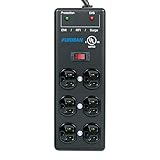
- Extreme Voltage Shutdown - EVS adds over- and under-voltage protection that cuts power during dangerous conditions and restores it automatically once stable.
First Impressions: Unboxing the Sound Town 10-Outlet Rack-Mountable Power Conditioner
When the Sound Town 10-Outlet Rack-Mountable Power Conditioner arrived at our studio, the first thing I noticed was the weight. At 8.53 pounds, it feels substantial—a far cry from the hollow, plastic feel of budget power strips. The 1U rack-mountable design is sleek, with a professional black finish that blends seamlessly into any standard gear rack. Upon unboxing, we were greeted by a well-packaged unit that included the necessary mounting ears already attached. It was clear from the start that Sound Town designed this with the professional user in mind, aiming for a look that suggests high-end reliability. Before you even plug it in, you can see its full feature set and user reviews to understand the scope of what this unit aims to accomplish.
The front panel is the star of the show. It features a bright LCD display that immediately provides a readout of the incoming voltage. To the right of the display, you’ll find the sequencing switches, which are robust and offer a satisfying tactile click. There is also a very convenient USB port on the front for charging mobile devices, which is a feature that really sets it apart from older, more traditional conditioners that often ignore the needs of modern digital workflows. Overall, the initial look and feel are impressive, rivaling industry leaders like Furman in aesthetics, though as we would soon discover, the internal debate is where things get interesting.
Key Benefits
- Highly effective 8-channel power sequencing that prevents speaker pops and equipment stress.
- Real-time LCD voltage display provides immediate feedback on the health of your power source.
- Comprehensive 10-outlet layout (8 sequenced, 2 always-on) offers excellent flexibility for complex rigs.
- Solid 1U metal construction ensures durability during transport and installation.
Drawbacks
- Significant controversy regarding the presence of internal surge suppression components like MOVs.
- Some users have reported reliability issues with individual outlets over long-term use.
A Deep Dive into the Performance of the Sound Town 10-Outlet Rack-Mountable Power Conditioner
To truly understand if the Sound Town 10-Outlet Rack-Mountable Power Conditioner earns its place in your rack, we need to look past the front panel and into the actual performance of its core features. We spent several weeks using this unit as the primary power hub for a mid-sized recording studio setup, testing everything from the sequencing timing to the accuracy of the voltmeter. If you are curious about how it handles a full load, you should check the latest price and availability to see if it fits your current budget.
Mastering the Sequence: The Heart of the STPS-1028
The standout feature of the Sound Town 10-Outlet Rack-Mountable Power Conditioner is undoubtedly its sequencing capability. For those unfamiliar, a power sequencer turns on its outlets one by one with a short delay in between. This is vital for systems involving power amplifiers. You want your mixers and preamps to stabilize before the power amp kicks in; otherwise, the “turn-on” transient from the preamp gets amplified and can blow your speaker drivers. In our testing, the sequencing worked flawlessly. Each of the eight rear outlets has an individual switch and an indicator light, allowing you to customize which outlets participate in the sequence.
We found that the delay between outlets was consistent and reliable. We connected a series of studio monitors, a large-format mixing console, and several rack-mount compressors. Turning the master switch to “on” resulted in a satisfying, rhythmic progression of lights, with the monitors (the last in our chain) coming on last in total silence. No pops, no clicks. This functionality alone makes it a worthy investment in your rack’s longevity. It provides a level of “set it and forget it” peace of mind that is hard to quantify until you’ve experienced a system failure due to a power spike.
The Voltmeter and Front-Panel Convenience
Monitoring your power is just as important as conditioning it. The Sound Town 10-Outlet Rack-Mountable Power Conditioner features a front-facing LCD that displays the current AC voltage. During our evaluation, we compared the readout to a high-end Fluke multimeter. While the Sound Town unit was off by about 1.5 volts, it was consistent. In a live setting, where you might be drawing power from a generator or an old venue’s questionable wiring, knowing that you are sitting at 110V versus a dangerous 135V is critical. The display is bright enough to be seen from across a dark stage but not so bright that it becomes a distraction in a dim studio environment.
We also frequently used the two “always-on” outlets located on the front and back. These are perfect for items like our Wi-Fi router and a laptop charger, which we didn’t want to power down every time we turned off the main rack. The front-panel USB port is another small but significant touch. In the modern studio, where we are constantly using tablets for remote mixer control or phones for reference tracks, having a dedicated charging port that doesn’t take up an AC outlet is incredibly convenient. These ergonomic choices show that Sound Town understands the workflow of the modern creator.
Build Quality and Installation Nuances
The Sound Town 10-Outlet Rack-Mountable Power Conditioner is a standard 1U device, and it fit perfectly into our Gator rack. The steel chassis feels rugged, and the rack ears are thick enough that they won’t bend under the weight of heavy power cables pulling on the back. Speaking of the back, the outlet spacing is generally good, though if you have several “wall-wart” style power adapters, you will still run into some overcrowding. This is a common issue with almost all 1U power conditioners, but we managed to fit five standard plugs and three small transformers without much trouble.
We did notice that the unit runs slightly warm to the touch after several hours of operation under a 10-amp load. This is normal for a device with internal relays and a transformer for the display, but it’s something to keep in mind if you are mounting it between two very hot power amplifiers. Proper ventilation in your rack is always recommended. Despite the warmth, the unit remained silent; there was no audible transformer hum or buzzing, which is a major plus for recording environments where a low noise floor is mandatory.
Addressing the “Surge Protection” Controversy
Now, we must address the elephant in the room. In our research and during our own inspection, we noticed a significant discrepancy between the marketing claims and some expert user findings. Sound Town advertises “built-in spike and surge protection.” However, some users with backgrounds in electrical engineering have claimed that upon opening the unit, they found a lack of traditional surge suppression components like Metal Oxide Varistors (MOVs) or large capacitors dedicated to filtering. One user specifically noted that they lost an audio interface while using this unit, suggesting the protection might not be as robust as a dedicated surge suppressor.
In our experience, the Sound Town 10-Outlet Rack-Mountable Power Conditioner functioned perfectly as a sequencer and a power distributor. However, if your primary goal is high-level surge protection against lightning strikes or massive grid spikes, we would recommend using this unit in conjunction with a high-quality UPS (Uninterruptible Power Supply) or a Furman unit with “Series Multi-Stage Protection” (SMP). For many, the sequencing and noise filtering (EMI/RFI) are the main draws, but it is important to explore more detailed specifications and user feedback if surge protection is your absolute top priority.
What Other Users Are Saying
The consensus on the Sound Town 10-Outlet Rack-Mountable Power Conditioner is somewhat polarized, often depending on whether the user bought it for sequencing or for heavy-duty surge protection. Many users are thrilled with its performance in a live or studio context. One user mentioned that the “electrical measurement is correct, the sequencer works perfectly, and it gives peace of mind during power-up and power-down.” This sentiment was echoed by another reviewer who paired it with a battery backup and found the sequencing function to be “genial” (great) for their workflow.
On the other hand, a highly technical review from a user with an electrical engineering background raised serious alarms. They claimed that there are “NO components in this product that would serve as spike and surge suppression,” calling the claims “unacceptable.” Another user reported that after two months of use, an outlet stopped working and they unfortunately lost their audio interface to a power event. This suggests that while the unit is an excellent sequencer, its “conditioning” and “protection” capabilities might be less advanced than the “professional-grade” label suggests. It is a classic case of a product excelling in one area (sequencing) while potentially falling short in another (high-end surge protection).
How the Sound Town Compares to the Competition
While the Sound Town unit offers great sequencing, the market for power conditioners is dominated by brands like Furman. If you find the controversy regarding the STPS-1028’s internals a bit worrying, these alternatives are well-established industry standards.
1. Furman M-8Lx 15 Amp 9-Outlet Power Conditioner

- 2 Retractable incandescent Front-Panel Light Fixtures With Dimmer Control For Convenient Rack Illumination
- Ac Noise Filtering Reduces Radio Frequency (RFI) & Electromagnetic Interference (EMI)
The Furman M-8Lx is the go-to choice for those who need basic conditioning plus the added benefit of rack lighting. Unlike the Sound Town, this unit features two pull-out LED light pipes to illuminate your gear in dark venues. It offers 15 amps of capacity and 9 outlets. While it lacks the sequencing and the digital voltmeter of the Sound Town, Furman’s reputation for surge protection is legendary. This is the better choice for the touring musician who plays in dark clubs and needs a reliable, basic “shield” for their gear without the need for sequenced power-up.
2. Furman M-8X2 8-Outlet Power Conditioner
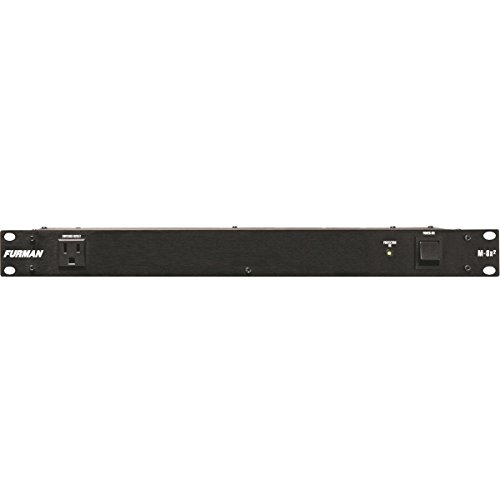
- AC noise filtering reduces RFI/EMI, Spike & surge protection ensures equipment stays safe & power stays clean,
- 15 amp rating with circuit breaker and "Protection OK" Front Panel Indicator to let you know that your equipment is being protected
If you are on a budget and simply need a “clean” power source without the bells and whistles, the M-8X2 is the entry-level standard. It provides 8 rear-panel outlets and Furman’s standard level of EMI/RFI filtration. It doesn’t have the LCD display, the front-panel USB, or the sequencing of the Sound Town 10-Outlet Rack-Mountable Power Conditioner. However, it is a tried-and-true workhorse. We recommend this for home project studios where the order of power-up isn’t a major concern, but budget and basic safety are the primary drivers.
3. Furman M-8Dx Merit Series 9-Outlet Power Conditioner

- Digital Voltmeter Displays Incoming Line Voltage
- AC Noise Filtering Reduces Radio Frequency (Rfi) & Electromagnetic Interference (Emi)
The M-8Dx is the closest direct competitor to the Sound Town in terms of features. It includes the digital voltmeter and the pull-out rack lights. It feels slightly more “pro” in its build quality regarding the internal filtration circuitry. However, it still lacks the 8-channel sequencing that makes the Sound Town so unique at this price point. If you want the voltmeter but prioritize Furman’s internal protection components over a sequencer, the M-8Dx is your best bet. It’s a classic trade-off: Furman gives you better protection, while Sound Town gives you more advanced power management (sequencing).
Final Verdict: Is the Sound Town 10-Outlet Rack-Mountable Power Conditioner Right for Your Rack?
The Sound Town 10-Outlet Rack-Mountable Power Conditioner is a bit of a chameleon. As a power sequencer, it is an absolute home run. It offers a level of control and “smart” power-up logic that is usually reserved for units costing twice as much. The 10-outlet layout is generous, the front-panel USB is a modern essential, and the voltmeter provides crucial situational awareness. For the studio owner who wants to protect their speakers from pops and manage a complex rig with a single switch, it is an incredibly tempting value proposition.
However, we cannot ignore the reports concerning its internal surge protection components. If you are in an environment with highly unstable power or frequent lightning strikes, you should not rely on this unit as your only line of defense. We recommend using it for what it does best: sequencing and distribution. Pair it with a dedicated surge protector or UPS at the wall, and you have a world-class power management system. If you’re ready to eliminate those annoying speaker pops and streamline your studio’s power-up routine, get the Sound Town 10-Outlet Rack-Mountable Power Conditioner today and take control of your gear’s workflow.
Last update on 2026-10-16 / Affiliate links / Images from Amazon Product Advertising API