
Klowra Polyphonic Octave Pedal for Guitar & Bass Review: A Sound Designer’s Dream or Just Another Gimmick?
Every guitarist and bassist eventually hits a wall where their dry tone, no matter how “pure,” feels restrictive. We’ve all been there: you’re trying to fill space in a power trio, or perhaps you’re layering tracks in a home studio, and you realize your instrument lacks the harmonic girth to carry the melody. The problem is simple—a standard guitar signal is mono-dimensional. Without the ability to shift pitches or add octaves, you’re stuck in a single frequency range. This limitation can stifle creativity, especially for those of us exploring ambient, cinematic, or experimental genres.
Choosing a subpar pitch shifter only complicates things. Many budget options suffer from “latency lag” or “digital burble,” where the pedal can’t track your playing speed, resulting in a glitchy, unmusical mess. When we set out to test the Klowra Polyphonic Octave Pedal for Guitar & Bass, we wanted to see if it could bridge the gap between traditional octave effects and high-end synth-like soundscapes without the high-end price tag.
- After receiving your pedal, please update it to the latest firmware before use for optimal performance.*
- [One-Man Band Organ & Bass Tones] Instantly transform your solo performance into a full ensemble. With 4-Voice Polyphonic tracking (+1, +2, -1, -2 octaves), easily emulate rich organ chords or deep...
What to Consider Before Investing in Electric Guitar Pitch & Octave Effects
An Electric Guitar Pitch & Octave Effects pedal is more than just an item; it’s a key solution for musicians who need to expand their sonic footprint without switching instruments. These pedals allow a single guitarist to sound like a 12-string orchestra, a deep-seated bass, or even a cathedral organ. By digitally manipulating the frequency of your input signal, these devices open up “impossible” registers, providing a layer of harmonic complexity that standard overdrive or modulation pedals simply cannot achieve.
The ideal customer for this type of product is someone facing the limitations of a small band setup or a studio artist looking for unique “ear candy” textures. It is perfect for those who want to experiment with synth-like filters and ambient swells. However, it might not be suitable for those who demand absolute 100% analog purity or those who only need a simple “drop tune” for heavy metal, as some pedals in this category—including this one—focus more on shifting pitch “up” rather than “down.”
Before investing, consider these crucial points in detail:
- Tracking Accuracy & Polyphony: This is the most critical metric. Tracking refers to how quickly the pedal “hears” your note and outputs the shifted pitch. Cheap pedals struggle with chords (polyphony), creating a warbling sound. You want a pedal that handles full chords as cleanly as single notes.
- I/O and Signal Chain Integration: Look for pedals with features like Analog Dry-Through. This ensures your original guitar tone remains untouched and passes through the circuitry without being converted to digital and back, preserving your core “feel.”
- Build Quality and Componentry: Since these pedals are often stomped on in dark, sweaty venues, an aluminum alloy chassis is non-negotiable. Plastic housings are a recipe for disaster on the road. Also, check for “True Bypass” or “Buffered Bypass” options to suit your specific cable run.
- Ease of Use & Maintenance: High-functionality pedals often have “hidden” menus. You should consider how much time you’re willing to spend reading manuals versus playing. Maintenance is usually low, but physical aspects like screw accessibility and power requirements (9V DC) are vital for long-term integration into your board.
While the Klowra Polyphonic Octave Pedal for Guitar & Bass is an excellent choice, it’s always wise to see how it stacks up against the competition. For a broader look at all the top models, we highly recommend checking out our complete, in-depth guide:

- [Octave/Pitch shifter Pedal] With 7 shift types and 3 tone mode toggles, Harmonic Square guitar pedal gives you 21 options of semitonal, octave and detune sounds

- Industry-Standard Octave Pedal: The updated version features enhanced capabilities for modern guitarists


- Three shift modes: up, down or dual
Unboxing the Klowra Verdict: First Impressions and Aesthetic Mastery
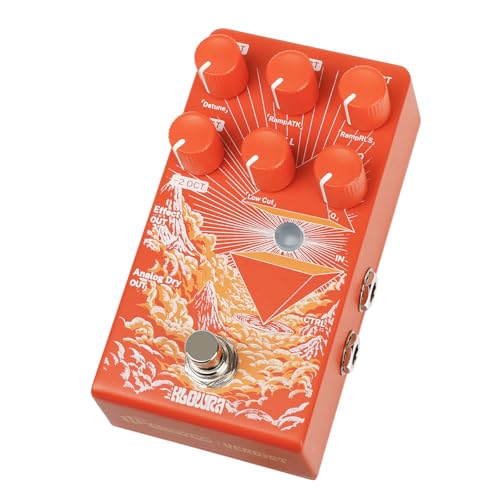
When we first pulled the Klowra Polyphonic Octave Pedal for Guitar & Bass out of its packaging, the first thing that struck us was the artwork. As part of the “Bloom Infinity Series,” the hand-painted silkscreen design is genuinely stunning. It doesn’t look like a mass-produced tool; it looks like a piece of boutique gear. The aluminum alloy chassis feels incredibly sturdy, and the knobs have a satisfying resistance that suggests they won’t shift if you accidentally graze them with your foot during a solo.
Inside the box, we found the pedal itself and some unique plastic cards (which some users have noted are a nice collectible touch). One immediate observation was the 32-bit WildSeed Engine under the hood. In the world of digital signal processing, 32-bit is the “sweet spot” for high-fidelity audio without the latency issues that plagued 16-bit units of the past. Before you even plug it in, you can see its full feature set and user reviews to understand the level of detail Klowra has put into this “Verdict” model.
Advantages of the Verdict
- Exceptional 4-voice polyphonic tracking that handles complex chords with ease.
- Zero tone loss thanks to the switchable Analog Dry-Through circuitry.
- Creative ambient features like Infinite Freeze and Adjustable Swell.
- Premium aesthetic with hand-painted silkscreen artwork.
Potential Drawbacks
- User interface has a learning curve due to “hidden” secondary settings.
- Does not offer “Drop Tuning” (shifts pitch UP only).
Deep Dive: Putting the Klowra Polyphonic Octave Pedal for Guitar & Bass to the Test
The Tracking Engine: 32-Bit WildSeed Performance
We spent several hours testing the tracking capabilities of the Klowra Polyphonic Octave Pedal for Guitar & Bass using both a Fender Telecaster and a five-string active bass. The most impressive aspect of the WildSeed Engine is how it handles the “attack” of the note. In many pitch shifters, there is a micro-delay—a “latency”—that makes the player feel disconnected from their instrument. We found that the Klowra tracks as “good as it gets,” with almost no perceived lag, even during fast alternate picking.
Polyphony is where this pedal really shines. We threw complex jazz chords (Major 7ths and 13ths) at it, and instead of the usual digital glitching or “burble,” we heard a clean, articulated shift. This is crucial if you plan to use the pedal to simulate a 12-string guitar. However, we must confirm a point raised by some users: this pedal is specifically designed to shift pitch *up*. If you are looking for a tool to drop your E-standard guitar down to Drop C, this isn’t the right tool. But for creating shimmering highs and harmonic layers, it is top-tier. To truly appreciate the clarity, you should check the latest price and availability for this professional-grade engine.
Ambient Textures: Freeze, Swell, and the Ramp Function
The Klowra Polyphonic Octave Pedal for Guitar & Bass is far more than just a pitch shifter; it’s an ambient workstation. We were particularly enamored with the “Infinite Freeze” function. By holding down the footswitch, you can lock a chord in place, creating a lush, synth-like pad that you can then play over. When paired with a high-quality reverb, like the Walrus Ambient Reverb, the results are cinematic.
The “Swell” feature is equally impressive. It allows you to dial back the initial attack of your note, creating a “violin” or “cello” effect. When we combined the swell with the polyphonic octave, our Telecaster genuinely sounded like a pipe organ in a vast cathedral. We also experimented with the “Ramp” function, which allows for smooth, linear parameter variations. While some might see this as a bit of a gimmick, we found it incredibly useful for transitions between song sections, allowing for a “glide” effect that feels more organic than a sudden tonal jump.
Interface and Control: The “Hidden” Logic
If there is one area where we had to spend some extra time, it was the control layout. The Klowra Polyphonic Octave Pedal for Guitar & Bass packs a lot of features into a standard-sized chassis. To achieve this, Klowra utilized a “hidden” settings system. We found that you need to be intentional about learning the secondary functions of the knobs. We highly recommend watching a few video tutorials to understand the “press and hold” logic.
As one user noted, the instructions can be a bit vague, but once you master the interface, the degree of control is staggering. You have independent tone and modulation controls for the shifted note, allowing you to “darken” the octave or add a bit of “shimmer” to the synth filter. The inclusion of an external control port for a TS/TRS footswitch or expression pedal is a feature that really sets it apart in this price bracket, allowing for real-time manipulation of the pitch or filter sweeps.
Build Quality and Road Readiness
From a physical standpoint, the Klowra Polyphonic Octave Pedal for Guitar & Bass is built like a tank. The aluminum alloy chassis is rigid, and the internal components seem well-shielded. During our testing, we didn’t experience any significant interference, though one user mentioned a slight “whine” without a noise suppressor. In our studio environment, with a high-quality isolated power supply, the pedal was remarkably quiet.
However, we did encounter a slight frustration that echoed some user feedback: the battery compartment. The screws on our unit were quite tight, and since the rubber gripper pads are glued over the screw holes, getting inside the pedal is a chore. This shouldn’t be a dealbreaker, as most professional guitarists use a dedicated power supply anyway, but it is something to keep in mind. Despite this minor annoyance, the overall “hand-painted” aesthetic and the pure analog dry-through path make this a premium addition to any board. You can view the high-resolution artwork and chassis details here to see the craftsmanship for yourself.
What Other Users Are Saying
The general consensus among musicians who have integrated the Klowra Polyphonic Octave Pedal for Guitar & Bass into their rigs is one of pleasant surprise, particularly regarding its versatility. Many users have praised the “organ” and “synth” emulations, with one user specifically mentioning how much they enjoyed making their Telecaster sound like a church organ when paired with a delay pedal.
On the positive side, one reviewer noted: “The options on this pedal extend its musical use beyond a usual octave pedal. Tracking is as good as it gets… for the price, it is a very good clean octave pedal.” Another player mentioned that while the manual’s fake “Walt Whitman” quote was a bit strange, the actual performance of the “glide/ramp” effect was a unique creative tool they hadn’t found elsewhere.
However, there are a few cautionary tales. A recurring theme in negative feedback involves the “up-only” pitch shifting. One frustrated user stated, “This DOES NOT DROP TUNE! It only shifts pitch UP.” This highlights the importance of reading the specs carefully before purchase. Additionally, the tight screws and glued rubber pads have been a point of contention for those who prefer to use 9V batteries. Nevertheless, for the majority of users who use power bricks and are looking for “shimmer” and “octave-up” textures, the feedback is overwhelmingly positive. You can read more verified user experiences to see how it fits different playing styles.
Comparing the Klowra Polyphonic Octave Pedal for Guitar & Bass to Its Top Alternatives
1. DigiTech Whammy 2-Mode Pitch Shift Effect

- Classic Whammy Sound
- Chordal Whammyv-01 Pitch Shifting
The DigiTech Whammy is the undisputed king of pitch-shifting pedals, famous for its massive treadle that allows for foot-controlled “dive bombs” and multi-octave bends. While the Klowra offers more “ambient” features like Freeze and Swell in a compact format, the Whammy is the better choice for those who want that classic Tom Morello or Jack White “screaming” pitch effect. However, the Whammy takes up significantly more space on a pedalboard and lacks the specific “synth-filter” textures found on the Klowra. If you need a treadle for expressive bends, go with the DigiTech; if you need ambient pads and compact polyphony, the Klowra is the winner.
2. DigiTech DROP Compact Polyphonic Pitch-Shifter

- Polyphonic drop tune allows you to drop tune from 1 semi-tone to a full octave
- Momentary or latching mode footswitch
This is the perfect alternative for the one thing the Klowra doesn’t do: drop tuning. The DigiTech DROP is a specialized tool designed specifically to lower your guitar’s pitch in half-step increments all the way down to a full octave. It is incredibly simple—one knob, one switch. However, it lacks the “octave up,” “swell,” “freeze,” and “ramp” functions that make the Klowra a creative workstation. If you just want to play heavy riffs in Eb without changing guitars, the DROP is your best bet. If you want to create beautiful, shimmering soundscapes, the Klowra is far more versatile.
3. Donner Octave Guitar Pedal Digital Pitch Shifter
- [Octave/Pitch shifter Pedal] With 7 shift types and 3 tone mode toggles, Harmonic Square guitar pedal gives you 21 options of semitonal, octave and detune sounds
- [3 Tone Modes]: 3 tone modes including Sharp, Flat, and Detune; Sharp: Pitch up; Detune: Adjustable pitch signal shifted by 10 cents; Flat: Pitch down
The Donner Harmonic Square is a budget-friendly “mini” pedal that offers basic pitch shifting in a tiny footprint. While it is excellent for those on a strict budget or with a very crowded pedalboard, it doesn’t hold a candle to the Klowra in terms of tracking accuracy or feature depth. The Donner can sound a bit “processed” or “metallic” compared to the Klowra’s 32-bit WildSeed engine. Furthermore, you won’t find the Freeze or Swell functions here. The Donner is a “utilitarian” tool, whereas the Klowra is a professional “instrument” in its own right. For a few extra dollars, the Klowra offers a significant leap in audio quality and creative potential.
The Final Verdict: Is the Klowra Verdict Worth It?
After putting the Klowra Polyphonic Octave Pedal for Guitar & Bass through its paces in both live and studio scenarios, our verdict is clear: this is an exceptional value for sound designers and ambient guitarists. Its ability to track complex chords with zero latency, combined with its unique “Freeze” and “Swell” functions, makes it a powerful creative ally. While the lack of drop-tuning and the slightly complex “hidden” menu system might deter those looking for a simple utility pedal, the “Bloom Infinity” aesthetics and professional 32-bit engine more than make up for it.
We recommend this pedal to any guitarist or bassist who wants to explore the “infinite vastness” of their instrument’s harmonic potential. It’s a road-ready, beautifully designed piece of kit that punches well above its weight class. If you’re ready to transform your dry signal into a lush, polyphonic masterpiece, we suggest you grab the Klowra Polyphonic Octave Pedal for Guitar & Bass today and start experimenting.
Last update on 2026-09-26 / Affiliate links / Images from Amazon Product Advertising API