
Keeley Mini Compressor Pedal Review: Is It the Ultimate Secret Weapon for Your Pedalboard?
We have all been there. You are midway through a gig, switching between a high-output humbucker-equipped guitar and a delicate single-coil Strat, and suddenly your signal chain feels completely unbalanced. One guitar is punchy and loud, while the other feels thin and unresponsive. Finding a compressor that can handle these drastic shifts in output without requiring you to dive into a sea of knobs mid-set is the holy grail for many guitarists. We have spent years chasing that perfect, “always-on” studio-quality polish, only to end up with pedals that either color the tone too aggressively or crush the life out of our playing dynamics. If you struggle with maintaining consistent volume and sustain across different instruments, you are likely missing that essential “glue” in your signal chain. This is exactly where the Keeley Mini Compressor Pedal enters the conversation, promising to streamline your sound without the complexity of a boutique studio rack.
What to Consider Before Buying an Electric Guitar Compression Effect
An electric guitar compression effect is more than just a volume limiter; it is a critical tool for managing your signal’s dynamic range. By narrowing the gap between your quietest and loudest notes, a high-quality compressor provides that professional, polished sheen that makes every note pop. It is the secret to those long, singing sustain notes in solos and the crisp, punchy attack in funk and country rhythms. Without a compressor, your playing can sound inconsistent in a mix, leading to “lost” notes during complex passages.
The ideal customer for this type of product is a gigging musician or a studio enthusiast who values a consistent output and improved note definition. If you are the type of player who relies on touch-sensitivity, you might have previously avoided compression for fear of “squashing” your tone. Conversely, those who play predominantly clean or heavily processed leads will find a compressor indispensable. If you are a “knob-twiddler” who loves deep control over attack, release, and blend ratios, a mini pedal might feel too restrictive, and you may prefer a larger, more feature-heavy unit.
Before investing, consider these crucial points in detail:
- Dimensions & Space: In the modern pedalboard era, real estate is premium. A mini-pedal format ensures you can tuck your compression into the tightest corners of your board, leaving more room for your essential drives and modulations. Always check your power supply capability to ensure your board can handle the extra unit without introducing ground loops.
- Capacity & Performance: Look for transparency. You want a pedal that enhances your signal without adding unnecessary hiss or altering your natural frequency response. The ability to automatically adjust for different pickup outputs, as seen in the Keeley Mini Compressor Pedal, is a massive performance advantage.
- Materials & Durability: Since this pedal will likely stay on for your entire set, build quality is paramount. Seek out rugged, metal-encased units that can withstand the rigors of travel and constant stomping. The internal circuit design is just as important as the shell—look for high-fidelity components that reduce signal degradation.
- Ease of Use & Maintenance: Simplicity is often the key to consistency. A pedal with fewer controls often means less time spent tweaking during soundcheck and more time performing. Ensure the power requirements match your existing power supply system to maintain long-term reliability.
As you evaluate your compression needs, keep in mind that the right pedal acts as an extension of your playing style rather than an obstacle. While the Keeley Mini Compressor Pedal is an excellent choice for those who value efficiency, it is always wise to see how it stacks up against the competition. For a broader look at all the top models, we highly recommend checking out our complete, in-depth guide:

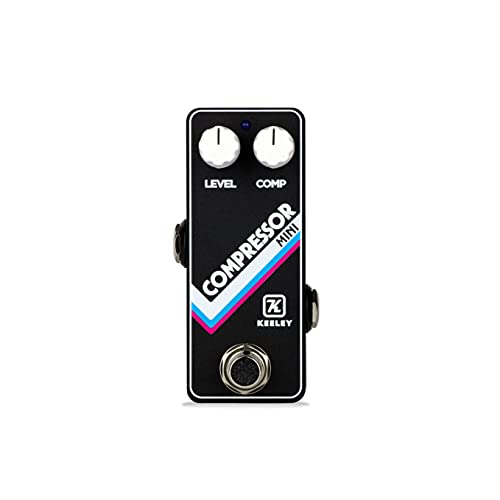
- Compact Design: Compression/Sustainer pedal with high-quality circuitry in a compact form factor
- 【Advanced Compressor Pedal】Donner’s comprehensive pedal can smoothen out dynamics between the high and low frequencies without degrading the original sound, offering you a more even and robust...

- 【Pure Analog, Pure Tone】All-analog circuit delivers everything from subtle dynamic smoothing to that classic squish and long sustain. Whatever clean country picking and thick blues leads, this...

First Impressions: Tiny Footprint, Massive Tone
When I first pulled the Keeley Mini Compressor Pedal out of its box, I was struck by how incredibly small it is. It occupies so little space that it almost feels like a utility piece rather than an effect, yet the moment I plugged it into my board, the quality was immediately apparent. Keeley has long been considered a standard-bearer for compression, and this iteration feels like a distilled version of their legendary circuits. The finish is professional, the switch is sturdy, and it feels built to handle years of abuse. It doesn’t scream for attention on your board; instead, it promises to do its job quietly and effectively. If you are looking to check the latest price and availability, you will find that the value proposition of this pedal lies in its ability to offer high-end studio performance in an ultra-portable package.
Key Benefits
- Automatic Manhattan-style compression that preserves your playing dynamics.
- Incredible small “mini” footprint that saves essential pedalboard space.
- Automatic tone recovery circuit that keeps your high frequencies crystal clear.
- Plug-and-play simplicity that handles both single coils and humbuckers perfectly.
Drawbacks
- Lacks a dedicated tone knob, which may limit surgical frequency adjustment.
- Can introduce slight noise if the compression is pushed to extreme, full-on settings.
Performance Deep-Dive: Why This Pedal Changes the Game
The Magic of Automatic Dynamics
The standout feature of the Keeley Mini Compressor Pedal is its “Manhattan-style” compression. For the uninitiated, this means it blends your dry signal with the compressed one automatically. This is a game-changer because it prevents that “choked” feeling that traditional, heavy-handed compressors often introduce. In my testing, I found that I could dig in hard on my low strings for that percussive “cluck” without losing the nuance of my lighter, softer picking. It feels natural, which is a rare feat for a compressor at this price point. Users often note that switching between guitars is no longer a headache; the internal circuitry effectively normalizes the input, ensuring you don’t have to scramble to adjust your master volume or amplifier settings every time you swap your instrument. It is this set-it-and-forget-it nature that makes it a favorite for touring musicians who want a consistent, studio-grade sound regardless of the gear they are using. If you are curious about the technical specs, you can see its full feature set and user reviews to understand how it maintains such transparency.
Transient Response and Tone Clarity
Many guitarists avoid compression because they fear it will “dull” their top end. The Keeley Mini Compressor Pedal addresses this with an ingenious automatic tone recovery circuit. Usually, when you squeeze a signal hard, the treble is the first thing to suffer, leading to a muffled, “blanket-over-the-amp” sound. This pedal avoids that trap entirely. During my session, I put it through both a clean tube amp and a drive-heavy signal chain. In both scenarios, my harmonics remained sharp, and the “chime” of my bridge pickup was fully preserved. The transient release time is perfectly dialed in, meaning that the snap of the pick against the string is not lost in the compression cycle. It sounds lively and expressive, reacting to your pick attack rather than just squashing it. This level of clarity is often reserved for rack-mounted studio units, making its inclusion here a true testament to Keeley’s engineering.
The Pre-Amp Power and Sustaining Capability
Beyond simple compression, this unit acts as a fantastic pre-amp booster. By pushing the level knob, you can effectively drive your amplifier’s input stage, which adds a beautiful, harmonic richness to your tone. I found that I could set the compression at a moderate level and use the output as a way to “thicken” the sound of thin single-coil pickups. It adds that extra bit of “sustain range” that makes lead lines sing without needing a dedicated boost pedal further down the line. It is not designed to replace an extreme effects processor, but rather to perform a vital role in cleaning up and fattening your core guitar tone. As one user noted, this pedal really hits the mark for those who want a “decent job of basic compression and gain adjustment” without the complexity of a larger, more daunting unit. You can check out how it can transform your signal chain here.
What Other Users Are Saying
The consensus across the user community is largely positive, especially regarding the pedal’s ease of use and its ability to handle different pickup types. One user specifically highlighted that the pedal’s ability to automatically compensate for changing between single coils and humbuckers was a primary selling point, noting that the “simplicity” was exactly what they were looking for. However, some users do point out that it is not a “do-it-all” studio processor. For instance, a few players mentioned that they missed having a dedicated tone knob for surgical adjustments. There is also a minor acknowledgement that at extreme settings, there can be a bit of noise, which is common for analog compression circuits. Overall, most musicians seem to agree that it offers exactly what is advertised: a transparent, high-quality, and incredibly space-efficient compression tool that fits on even the most crowded pedalboards.
Comparing the Keeley Mini Compressor Pedal to its Top Alternatives
Keeley Compressor Plus Pedal
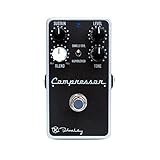 Keeley Compressor Plus Pedal, Black (KCompPlus)
- The first true advancement in our 2 and 4 knob compressor line. The new features are simple and straight forward
- There is a simple Release Switch that is tuned for single coils or humbuckers. No more wondering if you have the attack or release set right
The Keeley Compressor Plus is the “big brother” to the mini version. If you are someone who craves granular control, this is the superior choice. It includes a dedicated sustain knob, a blend control, and a switch specifically for switching between single-coil and humbucker settings. While the Mini is designed for simplicity and space-saving, the Plus is built for the player who wants to fine-tune their signal to a microscopic degree. You might prefer the Plus if you have the physical space on your board and want that extra level of versatility for studio recording, but for the average gigging guitarist, the Mini often does the job with far less hassle. Check it out if you need that additional control that sets it apart.
JOYO JF-10 Dyna Compressor Pedal
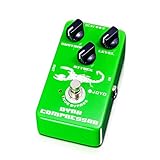 JOYO Dynamic Compressor Guitar Pedal, Transparent Tone with Low Noise, Sustain & Attack Control for...
- TRANSPARENT, STUDIO-STYLE ANALOG COMPRESSION: The JF-10 delivers smooth, natural compression that subtly polishes your sound without squashing your tone. Players describe it as "very transparent" and...
- 3-KNOB CONTROL – SUSTAIN, ATTACK & LEVEL: Sustain adjusts compression amount, Attack controls how quickly it engages, and Level compensates output volume. The Attack knob is especially useful for...
The JOYO JF-10 is a classic “Ross-style” recreation that focuses on affordability and that iconic, squishy compression sound associated with 70s rock and country. It is much larger than the Keeley Mini and uses a different circuit architecture, which imparts more “color” to your tone. If you are on a strict budget and you like that vintage, noticeable compression effect rather than the transparent, modern feel of the Keeley, the JOYO is a great value. However, it lacks the sophisticated, automatic tone recovery and the refined, studio-grade transient response of the Keeley unit. It is a fantastic entry point for those learning to use compression for the first time.
Behringer CS400 Ultimate Compressor
 Behringer CS400 Compressor Sustainer Ultimate Dynamics Effects Pedal
- Get super-smooth compression and endless sustain
- This BEHRINGER product has been designed to compete head to head with leading products on the market
The Behringer CS400 is an incredibly budget-friendly option that mimics the classic “sustainer” circuit. It is a great choice for beginners who want to experiment with what a compressor can do to their sound without making a significant financial commitment. It provides decent sustain and basic level control; however, it is housed in a plastic chassis and does not offer the same level of audio transparency or build durability as the Keeley. If you are looking for a reliable, “workhorse” pedal that will live on your board for years, the Keeley is a clear step up. Use this as a temporary solution if you are just starting your pedalboard journey.
The Final Verdict: Is It For You?
The Keeley Mini Compressor Pedal is a masterclass in balance. It manages to provide professional-grade, transparent compression that serves as the backbone of a great signal chain, all while remaining small enough to disappear into the smallest corner of your pedalboard. While it may not satisfy the player who needs five different knobs to feel like they have total control, it is an absolute dream for the musician who values clarity, consistency, and ease of use. It effectively bridges the gap between single-coil and humbucker instruments, saving you time and frustration during live performances. If you are ready to elevate your sound with one of the most reliable and transparent compressors on the market, click here to grab your Keeley Mini Compressor Pedal and experience the difference for yourself.
Last update on 2026-09-26 / Affiliate links / Images from Amazon Product Advertising API