
MXR Super Comp Compressor Review: The Secret Weapon for Professional Sustain and Snappy Tones
We’ve all been there: you’re mid-solo, pouring your heart into a melodic line, and suddenly your notes seem to disappear into the ether. Or perhaps you’re trying to nail those iconic, percussive “Nashville” clean licks, but your pick attack sounds uneven and jarring. The struggle to maintain a consistent, professional-sounding signal is one of the most common frustrations for guitarists of all skill levels. Without proper dynamic control, your quietest notes get lost in the mix, while your loudest strums can spike unpleasably, causing digital clipping or ear fatigue for your audience. This is exactly where a high-quality compression pedal comes into play. If you’ve felt that your sound is “thin” or lacks that elusive “studio-polished” feel, you’re likely searching for something like the MXR Super Comp Compressor to bridge the gap between a raw signal and a professional performance.

- An update of the legendary Dyna Comp
- Attack level control preserves initial volume without sacrificing sustain

What to Consider Before Buying Electric Guitar Compression Effects
An electric guitar compression effects pedal is more than just an item; it’s a key solution for any player looking to tame their dynamics and add a layer of sophisticated “glue” to their overall sound. In the simplest terms, a compressor narrows the dynamic range of your signal—it brings down the peaks and boosts the quieter parts. This results in a more even output that sits perfectly in a live or studio mix. Beyond just leveling volume, a great compressor adds sustain, allowing your notes to ring out for much longer without needing excessive gain or distortion. It’s the difference between a guitar that sounds “small” and one that feels “huge” and authoritative.
The ideal customer for this type of product is someone facing issues with inconsistent volume levels, such as funk players who need snappy rhythms or lead players who want soaring, singing sustain. It is also a staple for country players who require that “squashed” percussive attack. However, it might not be suitable for those who prefer an extremely raw, high-dynamic response where every slight nuance of touch must be translated directly to the amp without any smoothing. If you are a purist who plays mostly low-gain blues where you want total control over “loud vs. soft” purely via your fingers, you might find compression a bit restrictive unless used very subtly.
Before investing, consider these crucial points in detail:
- Dimensions & Space: When building a pedalboard, every square inch matters. You want a pedal that offers professional circuitry without hogging the space of three other units. The MXR Super Comp Compressor is housed in the classic, compact MXR chassis, making it a “pedalboard-friendly” choice that fits into tight setups while offering a robust, heavy-duty build.
- Capacity & Performance: Look for a pedal that offers more than just a “more” knob. The ability to control the “Attack” is paramount. This determines how quickly the compressor kicks in. Too fast, and you lose your pick definition; too slow, and you don’t catch the peaks. A pedal that balances sensitivity with output volume is essential for maintaining your signal’s integrity.
- Materials & Durability: Since this is a device you’ll be literally stepping on, metal construction is non-negotiable. Plastic pedals might save you money upfront, but they often fail under the rigors of gigging. MXR is legendary for their “built-like-a-tank” philosophy, ensuring your investment survives years of stage use.
- Ease of Use & Maintenance: While some studio-grade compressors have six or seven knobs, a guitar pedal should be intuitive. You want the ability to dial in a great sound in seconds during a soundcheck. Look for clear labeling and high-quality potentiometers that don’t crackle over time. Before you buy, check the latest price and availability to ensure you’re getting the best value for this essential tool.
Understanding these factors will help you decide if the MXR Super Comp Compressor is the right fit for your rig. While it is an excellent choice, it’s always wise to see how it stacks up against the competition. For a broader look at all the top models, we highly recommend checking out our complete, in-depth guide:

- Compact Design: Compression/Sustainer pedal with high-quality circuitry in a compact form factor
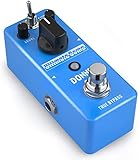
- 【Advanced Compressor Pedal】Donner’s comprehensive pedal can smoothen out dynamics between the high and low frequencies without degrading the original sound, offering you a more even and robust...

- 【Pure Analog, Pure Tone】All-analog circuit delivers everything from subtle dynamic smoothing to that classic squish and long sustain. Whatever clean country picking and thick blues leads, this...
First Impressions and Key Features of the MXR Super Comp Compressor
When we first unboxed the MXR Super Comp Compressor, the immediate impression was one of rugged reliability. It carries that classic MXR weight—16 ounces of solid metal that feels substantial in the hand. The matte black finish is sleek and professional, a departure from the traditional red of the standard Dyna Comp. This pedal is essentially an evolved version of that legendary circuit, designed for the modern player who needs a bit more control. While the Dyna Comp is famous for its “squish,” the MXR Super Comp Compressor introduces an “Attack” level control, which is the absolute game-changer here.
Out of the box, the setup is straightforward. It includes a 9V battery, but we highly recommend using a dedicated power supply for consistent performance. We found that the knobs have a satisfying resistance—they won’t move if you accidentally brush them with your foot. Comparing it to previous “script” versions of MXR compressors, this unit feels much more versatile. It’s not just a “one-trick pony” for squashed country tones; it’s a sophisticated dynamic processor. To get a better sense of how it looks in a real setup, you can see its full feature set and user reviews to see why it remains a staple on so many professional boards.
Key Benefits
- The dedicated Attack control allows you to keep your initial pick “bite” while still getting massive sustain.
- Incredibly durable metal housing that can withstand years of heavy touring.
- Offers a significant “invisible boost” that helps lead lines cut through a dense band mix.
- Much quieter operation than older, vintage compressor circuits.
Drawbacks
- Can introduce some hiss if the Sensitivity is cranked past 3 o’clock.
- The compression can feel “too aggressive” if you don’t spend time balancing the Attack knob.
A Deep Dive into the MXR Super Comp Compressor’s Performance
Mastering Dynamics: The Power of the Attack Level Control
In our extensive testing, the standout feature of the MXR Super Comp Compressor is undeniably the Attack knob. For those familiar with the standard Dyna Comp, you know that it can sometimes “gulp” the beginning of your note, smoothing it out so much that you lose the percussive character of your playing. With the Super Comp, we were able to dial the Attack back to let the initial “cluck” of the guitar strings pass through before the compression clamped down. This is crucial for genres like funk or blues-rock where the “chunk” of the rhythm is just as important as the sustain.
We found that by setting the Attack around 10 o’clock, we could maintain a natural feel that didn’t feel like the pedal was fighting our fingers. As one user noted in their feedback, this extra knob makes the pedal worth the slightly higher price point compared to the base model. It adds a level of versatility that allows the pedal to transition from a subtle “always-on” tone sweetener to a heavy, squashed sustainer for soaring Gilmour-esque leads. During our sessions, this control allowed us to switch between a Telecaster and a Les Paul without the compression feeling too muddy on the humbuckers—a common issue with lesser pedals.
Sustain for Days: The Sensitivity and Output Balance
The “Sensitivity” knob on the MXR Super Comp Compressor is essentially your sustain engine. We pushed this knob to various extremes to see where the “sweet spot” lies. At lower settings (9 to 11 o’clock), it acts as a subtle leveler, making your clean chords sound more professional and “recorded.” However, when you push it past 12 o’clock, the sustain becomes legendary. We held notes that seemed to ring out indefinitely, making it a perfect companion for slow, emotive soloing. For the best experience, you should explore the detailed technical specs to understand how the internal circuitry handles these high-gain sustain levels.
Crucially, the “Output” knob provides plenty of makeup gain. We often used the MXR Super Comp Compressor as a clean boost by keeping the Sensitivity low and cranking the Output. This drove our tube amp into a natural, creamy saturation that felt incredibly responsive. We did notice, as some other users have pointed out, that if you max out the Sensitivity, a bit of floor noise (hiss) is inevitable—this is simply the nature of high-ratio compression. However, compared to vintage units we’ve tested, this model is significantly quieter and more manageable in a live environment.
Tone Shaping and Signal Chain Integration
One of the most impressive aspects of the MXR Super Comp Compressor is how it focuses the frequency spectrum. It has a slight brightening effect that we found particularly useful for humbucker-equipped guitars that can sometimes sound “dark” or “woolly.” It pushes the signal toward the middle and upper-middle of the spectrum, which is exactly where the guitar needs to live to be heard clearly over a drummer and bassist. This “focusing” effect is why many pros consider this an “always-on” pedal.
During our signal chain tests, we followed the classic advice of placing the MXR Super Comp Compressor first in the chain. The difference was night and day. When placed before overdrive pedals, it provided a consistent signal that made our dirt pedals sound smoother and more harmonically rich. It smoothed out the “spikes” from our wah-wah pedal and ensured that fret-tapping passages were just as loud and clear as heavy power chords. If you’re looking to upgrade your board’s core tone, you can a feature that really sets it apart is how well it plays with other effects.
Build Quality: The MXR “Tank” Heritage
We cannot overstate the durability of the MXR Super Comp Compressor. In our hands, it feels like a piece of industrial equipment rather than a delicate electronic toy. The 1/4-inch jacks are tight and secure, and the footswitch has a positive, “clicky” engagement that lets you know it’s active even on a dark, loud stage. The internal wiring is clean, and the use of high-quality components is evident in the weight and the clarity of the audio path.
Whether you’re throwing it into a gig bag or mounting it permanently to a tour-grade board, this pedal is designed to take a beating. We evaluated it against several boutique compressors, and while some of those offered more “flavor,” none felt as physically indestructible as the MXR. For many working musicians, this reliability is the most important feature. Knowing your pedal won’t fail during the first song of a set is worth every penny. You can check the current price to see how this durability stacks up against the more “delicate” alternatives on the market.
What Other Users Are Saying
The general consensus among the guitar community is that the MXR Super Comp Compressor is a “workhorse” pedal. Many users who have transitioned from the standard Dyna Comp praise the added versatility of the Attack knob, with one reviewer noting that it “adds some much-needed versatility” and is “less noisy” than their older units. It is frequently described as an “always-on” pedal, especially for those playing Strats or Teles who want to add some “girth” to their single-coil sound.
However, the feedback isn’t without its critiques. A few users mentioned that the pedal can become “too distorted” if not dialed in correctly with high-output pickups, and some noted the noise floor increase when the Sensitivity is pushed to the limit. We found these comments relevant because they highlight the importance of understanding how compression works—it’s a powerful tool that requires a bit of finesse. Overall, the sentiment is overwhelmingly positive, with users calling it “great compression for the money” and “built like a tank.” For more perspectives, we recommend you read more user testimonials and experiences to see how it performs across different genres.
Comparing the MXR Super Comp Compressor to the Competition
1. Keeley Compressor Plus Pedal
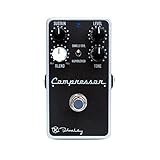
- The first true advancement in our 2 and 4 knob compressor line. The new features are simple and straight forward
- There is a simple Release Switch that is tuned for single coils or humbuckers. No more wondering if you have the attack or release set right
The Keeley Compressor Plus is often considered the gold standard of modern pedalboard compressors. While the MXR Super Comp Compressor focuses on a classic, punchy OTA circuit, the Keeley offers a bit more “studio” transparency. It features a “Blend” knob, which allows you to mix your dry signal back in—a feature the MXR lacks. If you are looking for ultra-transparent compression that sounds like a high-end rack unit, the Keeley is a fantastic (though often more expensive) alternative. However, for those who want that classic, percussive “pedal” compression sound, the MXR still holds its own.
2. JOYO JF-10 Dyna Compressor Pedal for Electric Guitar & Bass
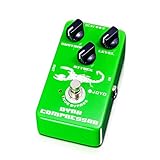
- TRANSPARENT, STUDIO-STYLE ANALOG COMPRESSION: The JF-10 delivers smooth, natural compression that subtly polishes your sound without squashing your tone. Players describe it as "very transparent" and...
- 3-KNOB CONTROL – SUSTAIN, ATTACK & LEVEL: Sustain adjusts compression amount, Attack controls how quickly it engages, and Level compensates output volume. The Attack knob is especially useful for...
The JOYO JF-10 is an incredible budget-friendly alternative that aims to recreate the classic Ross Compressor circuit (the same ancestor as the MXR). While it performs remarkably well for its price point, it lacks the rugged, tour-ready build quality of the MXR Super Comp Compressor. We found the JOYO to be a great “entry-level” pedal for those experimenting with compression for the first time, but for the serious gigging musician, the MXR’s superior components and lower noise floor make it a more reliable long-term investment.
3. Behringer CS400 Ultimate Compressor Sustainer Pedal

- Get super-smooth compression and endless sustain
- This BEHRINGER product has been designed to compete head to head with leading products on the market
The Behringer CS400 is the ultimate “value” choice. It’s significantly cheaper than the MXR and provides a surprising amount of sustain and leveling. However, the housing is made of plastic, which is a major concern for long-term durability. In our comparison, the MXR Super Comp Compressor is far superior in terms of tone clarity and physical resilience. The Behringer is perfect for a bedroom player or someone on a very tight budget, but it cannot compete with the professional-grade performance and road-worthiness of the MXR unit.
The Final Verdict: Is the MXR Super Comp Compressor Right for You?
After weeks of testing and comparing, we can confidently say that the MXR Super Comp Compressor remains one of the best values in the world of guitar effects. It takes a legendary formula and adds the one thing it was missing: control over the attack. This simple addition transforms a classic “squash box” into a versatile dynamic processor that can handle everything from subtle tone-shaping to aggressive, singing sustain. While it might introduce a bit of noise at extreme settings, its ability to focus your tone and help you cut through the mix is unparalleled in this price range. It is rugged, intuitive, and, most importantly, it sounds professional.
Whether you’re a country picker looking for that Nashville cluck, a funk player in need of snappy rhythms, or a rock guitarist seeking endless sustain, this pedal is a top-tier choice. If you’re ready to take your tone to the next level and stop getting lost in the mix, we highly recommend you add the MXR Super Comp Compressor to your rig today and experience the difference that professional dynamic control can make.
Last update on 2026-09-26 / Affiliate links / Images from Amazon Product Advertising API