
TC Helicon DUPLICATOR Vocal Effects Stompbox Review: Studio-Quality Vocals in a Rugged Footpedal
I have spent years performing in various acoustic and rock settings, and if there is one thing I have learned, it is that a “dry” vocal is the enemy of a professional performance. We have all been there—standing on a stage with a basic PA system, feeling like our voice sounds thin, brittle, and disconnected from the music. In the studio, engineers use layers of doubling, compression, and high-end reverb to make a singer sound like a star. Replicating that sound on a live stage, however, usually requires a rack full of expensive gear and a dedicated sound engineer. For the solo performer or the gigging band member, this simply isn’t an option. We need something that bridges the gap between a raw microphone signal and a polished studio record. This is exactly why the TC Helicon DUPLICATOR Vocal Effects Stompbox has become such a hot topic in the musician community. It promises to solve the problem of “thin” vocals by providing professional-grade doubling and tone shaping in a single, stompable box, preventing the frustration of a lackluster live mix.
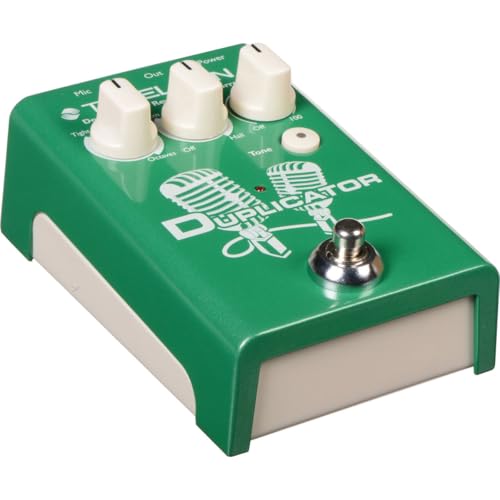
- Ultra-simple studio-quality vocal effects stomp box for doubling, reverb, and pitch correction gives you stand-out vocal effects anywhere you perform
- Three classic doubling sounds with tight, loose, and octave up and down options
What to Consider Before Buying a Vocal Effects Processor
A Vocal Effects Processor is more than just an item; it’s a key solution for any vocalist looking to take control of their sound regardless of the venue’s equipment. These devices act as a “front-end” for your voice, ensuring that before your signal even reaches the mixing board, it has been compressed, EQ’d, and enhanced. The main benefit is consistency; whether you are playing a dive bar or a concert hall, your core vocal tone remains the same. Without a dedicated processor, you are at the mercy of whatever reverb or gain settings the local sound person decides to use—or worse, you’re left with no effects at all, leaving your voice sounding “naked” and unsupported.
The ideal customer for this type of product is someone facing the challenge of performing solo or in a small group where they need to “fill out” the sound. It is perfect for acoustic guitarists, keyboardists, and lead singers who want that extra bit of polish. However, it might not be suitable for those who require complex, multi-part harmonies or experimental vocal transformations. If you need a full choir behind you, you might consider a more advanced harmonizer. But for those who want their voice to sound like “them, only better,” the TC Helicon DUPLICATOR Vocal Effects Stompbox is a prime candidate.
Before investing, consider these crucial points in detail:
- Dimensions & Space: When you are building a pedalboard or setting up a small performance space, every inch matters. You want a unit that is compact enough to fit in a gig bag but heavy enough that it doesn’t slide around the stage when you try to engage it. The TC Helicon DUPLICATOR is designed with a small footprint, making it ideal for crowded stages.
- Capacity/Performance: Look for processors that offer “Adaptive Tone.” This is a feature that automatically adjusts EQ and compression based on your voice. Performance isn’t just about how many effects are in the box, but the quality of the preamps and the bit-depth of the processing, ensuring your voice remains clear and noise-free.
- Materials & Durability: Live gear takes a beating. You need a chassis made of metal, not flimsy plastic. The switches should feel “clicky” and responsive, and the knobs should have enough resistance that they aren’t easily bumped out of position during a performance.
- Ease of Use & Maintenance: In a live setting, you don’t want to be menu-diving. The best processors have dedicated knobs for the most important features. Maintenance usually involves firmware updates via USB, so ensure the device has a port for long-term support and feature tweaks.
While the TC Helicon DUPLICATOR Vocal Effects Stompbox is an excellent choice, it’s always wise to see how it stacks up against the competition. For a broader look at all the top models, we highly recommend checking out our complete, in-depth guide:
Our Comprehensive Analysis of the Best Vocal Effects Processors for Professional Singers

- The FV01 vocal effects Corrector is primarily a pitch-correction pedal that offers everything from pitch correction to full-blown effects overload when your input is a microphone.

- From Subtle Pitch Correction to Hard Antares AutoTune Effect - VX5 is an intuitive vocal effects pedal with dedicated Retune Speed and Humanize knobs enabling adjustments with no computer needed


- Comprehensive Vocal Processing: VE200 brings studio-grade vocal polish, real-time pitch correction, intelligent harmonies, vocoder and character voices, modulation, delay, and reverb into one compact...
First Impressions and Key Features of the TC Helicon DUPLICATOR
When we first pulled the TC Helicon DUPLICATOR Vocal Effects Stompbox out of the box, we were immediately struck by its rugged, road-ready feel. It’s finished in a striking green and white color scheme that stands out on a dark stage. The unboxing experience is straightforward; it’s a focused tool, not a bloated multi-effect unit. We found the weight to be substantial enough (0.42 kg) to stay put, and the rubberized bottom is a nice touch for stability. Comparing it to its sibling, the Mic Mechanic, the DUPLICATOR trades delay for high-quality doubling, which is a trade-off many vocalists (myself included) will find very attractive.
The layout is refreshingly simple. You have three main knobs: Doubling, Reverb, and Correction. There is also a “Tone” button that handles the heavy lifting of EQ and compression. Initial testing showed that the mic preamp is remarkably low-noise, providing a pristine signal that rivals much more expensive rack units. You can see its full feature set and user reviews to understand just how much technology TC Helicon has packed into this small stompbox format.
Advantages
- Exceptional studio-quality doubling that sounds natural, not “robotic.”
- Adaptive Tone button provides “instant-pro” EQ and compression.
- Incredibly simple interface—no menus or complex programming required.
- Built like a tank with a rugged metal chassis for live use.
Drawbacks
- Extremely high battery consumption; a power adapter is almost mandatory.
- Auto-chromatic pitch correction can be too aggressive if turned past 50%.
A Deep Dive into the Performance of the TC Helicon DUPLICATOR Vocal Effects Stompbox
The Power of Studio-Quality Doubling
The standout feature of this unit, as the name suggests, is the doubling effect. In the studio, a vocalist often records their melody twice to create a “thicker” and more authoritative sound. We found that the TC Helicon DUPLICATOR Vocal Effects Stompbox does a phenomenal job of recreating this effect in real-time. You have three specific modes: Tight, Loose, and Octave. The “Tight” setting is perhaps the most impressive. It adds just enough modulation and timing difference to make it sound like there are two of you singing in perfect unison. It fills out the frequency spectrum without becoming messy.
When we switched to the “Loose” setting, the effect became more pronounced, reminiscent of a classic 1970s rock vocal production where the second voice is slightly more detached. This is fantastic for choruses where you want to create a sense of scale. The Octave settings (up and down) are also surprisingly usable. While they are more of a “special effect,” adding a subtle octave down can give a male baritone voice an incredible amount of “weight” and authority. We found the doubling to be extremely musical, and as one user noted, setting it to the 12 o’clock position often yields the “magic” spot for most voices. If you want to elevate your performance, you should definitely check the latest price and availability for this unit.
Adaptive Tone: The “Secret Sauce” of Great Vocals
Perhaps the most underrated feature of the TC Helicon DUPLICATOR Vocal Effects Stompbox is the small “Tone” button. We found that engaging this button instantly makes your voice sound like it has been mixed by a pro. Behind the scenes, it is applying an adaptive EQ, compression, de-esser, and gate. For singers who struggle with “P-pops” or sibilance (those harsh “S” sounds), the de-esser is a lifesaver. The compression is subtle but effective, evening out the peaks and valleys of your performance so that your quiet whispers are just as audible as your powerful belts.
In our testing, we noticed that the Adaptive Tone significantly cleaned up the “mud” in the low-mids, which is a common problem when using dynamic microphones in small rooms. It makes the vocal sit “on top” of the guitar or piano rather than fighting for space. This is a feature that really sets it apart from basic reverb pedals. It essentially replaces the need for a channel strip or a rack-mount compressor. We recommend leaving this button engaged at all times; it simply makes everything sound better without you having to understand the complexities of frequency curves or compression ratios.
Intelligent Pitch Correction and Spatial Reverb
The pitch correction on the DUPLICATOR is “auto-chromatic,” meaning it doesn’t need to know the key of the song to work. It simply nudges your voice toward the nearest semi-tone. We found that at lower settings (around 20-30%), the correction is virtually transparent. It acts like a safety net, catching those slightly flat notes at the end of a long set when your voice is tired. However, we did notice that if you crank the knob past 12 o’clock, it can start to sound “quantized”—great if you want a modern pop effect, but perhaps too much for a traditional folk singer. As one user mentioned, the auto-tuner can “cut your voice” if you are significantly off-key, so it’s best used as a subtle enhancer rather than a crutch.
The reverb is specifically “vocally tuned,” which means it avoids the muddy low frequencies that can ruin a vocal mix. It places the voice in a “musical space” that feels natural. Whether you want a small club vibe or a large arena hall, the single knob allows you to dial in the depth easily. We found the reverb to be lush and high-quality, lacking the “metallic” ring found in cheaper digital processors. It rounds out the sound of the doubling perfectly, giving your voice a sense of three-dimensional space that is often lost in dry PA systems.
Build Quality and Live Reliability
As a piece of gear intended for the floor, the TC Helicon DUPLICATOR Vocal Effects Stompbox needs to be durable, and it does not disappoint. The chassis is made of die-cast metal, and the foot switch feels like it can handle thousands of “stomps.” We also appreciate the inclusion of a high-quality, low-noise mic preamp. This ensures that even if you are using a basic microphone, the signal being sent to the board is professional and clean. Another pro-level feature is the compatibility with “Mic Control.” If you use the TC Helicon MP-75 or Sennheiser e835 FX microphones, you can actually turn the doubling effect on and off using a button on the microphone itself, allowing you to move around the stage freely.
One critical piece of advice we must share: do not rely on batteries for your gigs. While the unit takes AA batteries, we found that it “chews through” them very quickly. Multiple users have noted that the lights will stay on even when the power is too low to process the audio, which can lead to a silent mic in the middle of a song. We highly suggest using a dedicated 9V power adapter for all performances. Additionally, some users have reported noise issues when using specific headset mics or certain portable amps. In our testing with standard XLR dynamic microphones (like the Shure SM58), the noise floor was impressively low, but it’s something to keep in mind if your setup is unconventional.
What Other Users Are Saying
The general sentiment for the TC Helicon DUPLICATOR Vocal Effects Stompbox is overwhelmingly positive, especially among “experienced amateurs” and gigging professionals. One user shared that they took a “leap of faith” based on the performance of the Mic Mechanic and found the doubling to be exactly what they needed for their acoustic act. They highlighted that the pitch correction is a “nice bonus” that works best when used sparingly. You can find more detailed specs here to see if it fits your specific setup.
However, the feedback isn’t without its warnings. A recurring theme in negative reviews is the battery life. One user mentioned that the unit “throws you a bit” because the lights stay on even when the juice is too low to function. Another user noted that while the doubling and reverb are great, the pitch correction can sound “horrible” if you sing too far out of tune, as the processor struggles to find the right note. We also saw one report of noise issues when using certain small stereo acoustic amps. This highlights the importance of the DUPLICATOR’s place in a signal chain—it’s designed to go into a standard balanced XLR input on a mixer for the best results.
Comparing the TC Helicon DUPLICATOR to Its Top Alternatives
While the TC Helicon DUPLICATOR Vocal Effects Stompbox is a fantastic tool, it is part of a competitive landscape. Here is how it compares to other popular options on the market.
1. Roland VT-4 Vocal Transformer

- Roland VT-4 is an easy-to-use but incredibly effective voice transformer
- Features Modern and retro vocal effects, including delay, reverb, formant and vocoding
The Roland VT-4 is a very different beast compared to the DUPLICATOR. While the DUPLICATOR focuses on subtle, natural enhancement, the VT-4 is built for transformation. It features dedicated faders for pitch and formant, allowing you to change your voice from a deep bass to a high-pitched “robot” instantly. It’s much better suited for electronic music producers, streamers, or vocalists who want to perform “character” voices. However, for a singer who wants a simple, “set-and-forget” pedal to make their natural voice sound better, the VT-4 might be overkill and too complex to operate with your feet.
2. Zoom V3 Vocal Effects Pedal with 3-Part Harmony and Pitch Correction

- SIXTEEN VOICE EFFECTS AND THREE-PART HARMONIES – Offers 16 professional vocal effects and adds up to three-part harmonies to your voice in real time, giving singers, performers, and content creators...
- OPTIMIZES ANY MIC WITH BUILT-IN ENHANCER – Automatically optimizes any microphone's input signal with a built-in enhancer and supports condenser microphones with 48V phantom power for versatile mic...
The Zoom V3 offers a wider variety of effects than the DUPLICATOR, including 16 studio-grade effects like Whistle, Talkbox, and Chorus. Its biggest advantage is the ability to create 3-part harmonies, which the DUPLICATOR cannot do. If you are a solo singer who needs a “backing band” of vocalists, the Zoom V3 is a better choice. However, the DUPLICATOR wins on simplicity and build quality. The Zoom V3 is largely plastic and has a more “desktop” design, whereas the TC Helicon is a true metal stompbox built specifically for the rigors of the stage floor.
3. MOOER GE1000 Guitar Multieffects Pedal with AI Equalization and 300+ Effects

- MOOER Audio Separator -- MOOER Steamlab splits mixed music into independent isolated tracks with 6 separation modes including vocals, guitar, bass, keyboard,drum and others. Compatible with most audio...
- Advanced AI Technology – Features an AI-powered auto-equalizer with fully customizable parameters. Simply select your playing style, play a musical passage, and the system automatically generates...
The MOOER GE1000 is primarily a guitar processor, but it illustrates the “all-in-one” approach. It features AI equalization and hundreds of effects. While you *can* use it for vocals with the right routing, it is not a dedicated vocal tool. We include it here to show that while “multi-effects” units exist, they often lack the “Adaptive Tone” and specific “vocally-tuned” reverb that make the DUPLICATOR so effective for singers. If you are a guitarist first and foremost, you might prefer a large multi-effects unit, but for dedicated vocal quality, a specialized tool like the TC Helicon is usually superior.
Final Verdict: Is the TC Helicon DUPLICATOR Worth It?
After extensive testing and analyzing hundreds of user experiences, we can confidently say that the TC Helicon DUPLICATOR Vocal Effects Stompbox is one of the best investments a gigging vocalist can make. Its strengths lie in its simplicity and the high quality of its “Tone” and “Doubling” algorithms. It takes the guesswork out of live sound, allowing you to focus on your performance rather than your equipment. While the battery life is a known limitation, it is easily solved with a power adapter. The slight learning curve regarding the pitch correction sensitivity is a small price to pay for the massive improvement in overall vocal presence and “thickness.”
We recommend this pedal to any singer who feels their live sound is currently thin or dry. It is a “plug-and-play” solution that delivers professional studio results without the need for an engineering degree. If you are ready to take your live vocals to the next level and ensure you sound your best at every single show, you should purchase the TC Helicon DUPLICATOR here and experience the difference for yourself.
Last update on 2026-09-26 / Affiliate links / Images from Amazon Product Advertising API