
TC Helicon MIC MECHANIC 2 Vocal Effects Stompbox Review: Professional Studio Vocals for the Every-Day Performer
Imagine walking onto a stage, the lights are dim, the crowd is expectant, and you lean into the microphone to deliver your first line. You’ve practiced for weeks, but the moment the sound hits the speakers, it feels flat, dry, and uninspiring. As vocalists, we are often at the mercy of the venue’s sound system or a sound engineer who might not understand the nuances of our voice. This lack of consistency is a common nightmare for gigging musicians. Without the right compression, EQ, or a touch of reverb, even the best voices can sound “naked” in a bad way. This is exactly the frustration that led me to explore the world of vocal processors, eventually landing on the TC Helicon MIC MECHANIC 2 Vocal Effects Stompbox. The struggle to find a portable, “set-it-and-forget-it” solution that makes you sound like you’ve brought your own studio engineer to the pub or the street corner is what makes this device so intriguing.
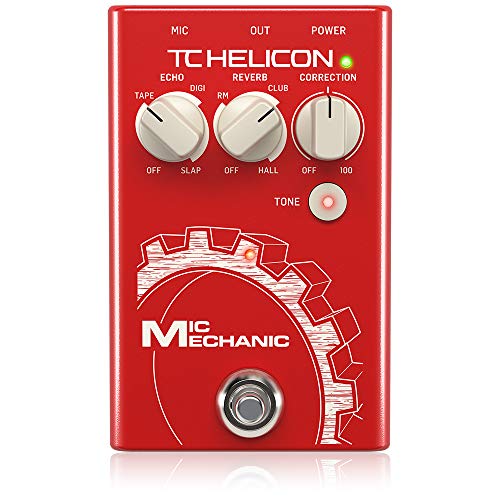
- Optional battery power operation lets you reduce cord clutter onstage and be extra mobile Adaptive Tone for perfect EQ compression de-essing and gating Intelligent mic input gain for quick and...
- Tap tempo control to keep your echoes right on the beat Dedicated reverb echo and correction controls to fine-tune your sound

What to Consider Before Buying a Vocal Effects Processor
A Vocal Effects Processor is more than just an item; it’s a key solution for singers who want to take control of their live sound. In the past, achieving studio-quality vocals required racks of expensive gear—compressors, de-essers, and high-end reverb units. Today, these processors condense that technology into a foot-pedal format. The primary benefit is consistency. Whether you are playing a cavernous hall or a tiny basement, your vocal chain remains the same. It solves the problem of “muddy” vocals by providing clear EQ and compression, and it helps fix minor pitch issues in real-time, allowing you to focus on the emotion of your performance rather than technical perfection.
The ideal customer for this type of product is a solo performer, an acoustic duo, or a lead singer in a band who wants a reliable, high-quality sound without a steep learning curve. It is perfect for those who prioritize simplicity and portability. However, it might not be suitable for experimental vocalists who need deep sound design, looping, or complex multi-part harmonies. If you are looking for a device to transform your voice into a synthesizer or a choir, you might consider more advanced processors with larger footprints and more buttons. But for the singer who just wants to sound like “them, but better,” this is the sweet spot. We recommend looking at the TC Helicon MIC MECHANIC 2 Vocal Effects Stompbox if your goal is professional polish with minimal fuss.
Before investing, consider these crucial points in detail:
- Dimensions & Space: Consider where the pedal will live. If you have a crowded pedalboard, a compact “stompbox” size is essential. You want something that fits into a gig bag pocket but is sturdy enough to be stepped on repeatedly during a high-energy set.
- Power Versatility: Check if the unit requires a specific power brick or if it can run on batteries. For buskers or performers in venues with limited outlets, battery power is a massive advantage that reduces “cable clutter” and setup time.
- Input/Output Logic: Look for standard XLR connections. The processor should act as a bridge between your mic and the mixer. High-quality preamps and “intelligent” gain settings are vital to ensure you don’t introduce unwanted noise or distortion into the signal chain.
- Ease of Use & Maintenance: In a live setting, you don’t want to be menu-diving. Physical knobs for Reverb, Echo, and Correction are much better for quick, on-the-fly adjustments. Maintenance usually involves keeping the XLR ports clean and updating firmware via USB.
In summary, a good vocal processor should empower the singer, not distract them. It should be a tool that builds confidence. While the TC Helicon MIC MECHANIC 2 Vocal Effects Stompbox is an excellent choice, it’s always wise to see how it stacks up against the competition. For a broader look at all the top models, we highly recommend checking out our complete, in-depth guide:
Discover the Best Vocal Pedals with Harmony and Correction Features for Live Performance

- The FV01 vocal effects Corrector is primarily a pitch-correction pedal that offers everything from pitch correction to full-blown effects overload when your input is a microphone.

- From Subtle Pitch Correction to Hard Antares AutoTune Effect - VX5 is an intuitive vocal effects pedal with dedicated Retune Speed and Humanize knobs enabling adjustments with no computer needed

- Comprehensive Vocal Processing: VE200 brings studio-grade vocal polish, real-time pitch correction, intelligent harmonies, vocoder and character voices, modulation, delay, and reverb into one compact...
First Impressions and the “Box-to-Stage” Experience
When we first got our hands on the TC Helicon MIC MECHANIC 2 Vocal Effects Stompbox, the first thing that struck us was the build quality. It feels like a tank—a solid, die-cast metal chassis in a vibrant red finish that’s easy to spot on a dark stage. Unboxing is a straightforward affair. Since this is the “Version 2” of the popular Mic Mechanic, TC Helicon has streamlined the power requirements, now allowing for a standard 9V power supply or four AA batteries. This is a huge upgrade from the original version, which required a specific 12V adapter.
The layout is refreshingly simple: three main knobs, a “Tone” button, and a rugged footswitch. There’s no power switch (unless you count the one on the side for battery mode), and no gain knob. At first, we were skeptical about the lack of a gain control, but we found that the “intelligent” mic input gain actually works quite well, automatically adjusting to your mic’s level. For anyone who has struggled with clipping or weak signals in the past, this “auto-gain” approach is a breath of fresh air. You can see its full feature set and user reviews here to understand why this simplicity is such a selling point.
What We Like: The Advantages
- Adaptive Tone button provides instant EQ, compression, and de-essing for a studio-quality sound.
- Battery power option (4x AA) makes it incredibly portable for busking or mobile rigs.
- High-quality Reverb and Echo algorithms derived from TC Helicon’s flagship products.
- Extremely simple interface—no menus or complex programming required.
What We Didn’t Like: The Limitations
- Lack of a manual gain knob might frustrate users who want total control over their input levels.
- Some users have reported reliability issues or “noise” when using certain power supplies.
A Deep Dive into the Performance of the TC Helicon MIC MECHANIC 2 Vocal Effects Stompbox
The Magic of “Adaptive Tone”: Your Personal Sound Engineer
The standout feature of the TC Helicon MIC MECHANIC 2 Vocal Effects Stompbox is undoubtedly the “Tone” button. In our testing, we found this to be the “make me sound better” button. When engaged, it activates an automated chain of studio-grade processing: EQ, Compression, De-Essing, and Gating. For many singers, the technical side of live sound is a mystery. You might know your voice sounds “boomy” or “harsh,” but you don’t know which frequency to cut. The MIC MECHANIC 2 handles this dynamically. It cleans up the low-end mud, tames the harsh “s” sounds with the de-esser, and uses compression to bring your quiet whispers and loud belts into a consistent volume range.
We found that even with the reverb and echo turned all the way down, just having the Tone button on made a world of difference. It gives the voice a “finished” quality that is usually only found on professional recordings. One user noted that they had to re-EQ their entire PA system because the pedal provided such clarity that their previous settings were no longer needed. It acts as a gate as well, which is crucial for acoustic guitarists who sing; it helps prevent the guitar sound from bleeding into the vocal mic too much when you aren’t singing. This level of processing in such a small box is a feature that really sets it apart from basic reverb pedals.
Reverb and Echo: Creating Space and Time
The TC Helicon MIC MECHANIC 2 Vocal Effects Stompbox offers three primary reverb styles: Room, Club, and Hall. These aren’t just generic echoes; they are high-quality algorithms that feel “lush” and “expensive.” The Room setting provides a subtle thickening that works great for intimate acoustic sets, while the Hall setting can make you sound like you’re singing in a cathedral. What we particularly appreciated was the Echo/Delay section. It includes a “Tap Tempo” feature—by tapping the footswitch in time with the song, you can sync the echoes to the beat. This is essential for modern pop or rock where a stray delay can ruin the rhythm.
There is also a “Timed” echo and a “Slap” echo. The Slap echo is perfect for that vintage rockabilly or 50s pop sound. During our evaluation, we noticed that the “Dry/Wet” mix on the knob is very well-calibrated. You can go from a completely dry signal to a drenched, ethereal sound without losing the core clarity of your voice. One thing to note, which we confirmed with user feedback, is that if you find yourself only using the Hall setting and feeling “meh” about it, you might be missing the nuance of the Club and Room settings, which often provide a more natural lift for live performances. If you want to dive deeper into how these effects sound, you should check the latest price and availability to see if this fits your current rig.
Auto-Chromatic Pitch Correction: A Subtle Safety Net
Let’s talk about the elephant in the room: Pitch Correction. Many singers are wary of “auto-tune,” fearing it will make them sound like a robot. The TC Helicon MIC MECHANIC 2 Vocal Effects Stompbox utilizes “Auto-Chromatic” pitch correction, which is designed to be transparent. It doesn’t force you into a specific key; instead, it gently nudges your voice to the nearest semitone. In our experience, when set to about 50%, the correction is almost invisible to the listener, but it provides a “safety net” that helps you stay on track when you’re tired or can’t hear yourself well in the monitors.
However, we discovered (and user reviews support this) that if you are “hunting” for a note or if your technique is significantly off, the pedal can create a slight “doubling” or “chorusing” effect as it tries to pull your voice to two different notes. It’s not magic; you still need to be able to sing. But as one decent singer noted, “it adds a bit of reinforcement and polish” for those wobbly moments. It’s a tool for enhancement, not a replacement for talent. For those who want that extra bit of confidence on stage, the pitch correction feature is a massive bonus. You can read more about how it handles different voice types in the user feedback section of the product page.
Portability, Power, and the “Hidden” Features
The “2” in MIC MECHANIC 2 signifies the move toward battery power. This makes the TC Helicon MIC MECHANIC 2 Vocal Effects Stompbox a dream for buskers. Being able to run on 4 AA batteries means one less cable to trip over and one less search for a power outlet in a crowded venue. We also tested the “Mic Control” feature. If you use a TC Helicon MP-75 or Sennheiser e835 FX microphone, you can actually turn the effects on and off directly from a button on the mic. This allows you to walk around the stage and talk to the audience without having to run back to your pedalboard.
There is also a “Talk Mode.” By holding down the footswitch, you can bypass the effects (reverb/echo/pitch) while keeping the Tone processing active. This is perfect for when you want to speak to the crowd between songs; your speaking voice will sound clear and “pro” without being washed out in reverb. While the pedal is “ultra-simple,” these thoughtful additions make it a professional tool. We did encounter some reports of units arriving dead or failing after a few uses, which suggests that while the build is solid, you should always test your gear thoroughly upon arrival and check the warranty details and return policies.
What Other Users Are Saying
The general sentiment surrounding the TC Helicon MIC MECHANIC 2 Vocal Effects Stompbox is overwhelmingly positive, especially regarding its value and ease of use. Many users describe it as an “extreme value” for the price, noting that the “vocal clarity and sustain” it provides is transformative for their live sound. One musician noted, “other musicians are amazed at the quality,” specifically highlighting how the gate and compression helped their acoustic duo sound more professional. Another user pointed out that it “cut out a whole lot of post-editing on recordings,” showing its versatility beyond just live performance.
On the flip side, there are some valid criticisms. A recurring theme in negative reviews involves reliability issues. One user reported the unit “completely died” after two practices, while another mentioned receiving a unit that wouldn’t power up at all. There are also mentions of “ground loop” noise, which can usually be fixed with a better power supply or a DI box, but it’s something to be aware of. One reviewer suggested that the “Duplicator” (another TC Helicon pedal) might be a better value because it often comes bundled with a power supply, whereas the Mic Mechanic 2 usually doesn’t. Despite these few concerns, for the vast majority of singers, the TC Helicon MIC MECHANIC 2 Vocal Effects Stompbox remains a top-tier choice for enhancing their vocal presence.
Comparing the TC Helicon MIC MECHANIC 2 Vocal Effects Stompbox to Top Alternatives
When choosing a vocal processor, it’s essential to look at the landscape. While we love the Mic Mechanic 2 for its simplicity, other singers might need different features like harmonies, vocoding, or more robust looping. Before you pull the trigger, check the latest price and availability and compare it against these three strong contenders:
1. Roland VT-4 Vocal Transformer

- Roland VT-4 is an easy-to-use but incredibly effective voice transformer
- Features Modern and retro vocal effects, including delay, reverb, formant and vocoding
The Roland VT-4 is a very different beast compared to the MIC MECHANIC 2. While the TC Helicon focuses on “polishing” your natural voice, the Roland VT-4 is all about transformation. It features dedicated sliders for Pitch and Formant, allowing you to instantly change your gender, sound like a robot, or create heavy Auto-Tune effects. It is a favorite among electronic music producers and streamers. If you need deep sound manipulation and creative “toy-like” features, the VT-4 is the winner. However, for a traditional singer-songwriter looking for a natural, transparent sound, the Mic Mechanic 2 is much more intuitive and effective.
2. Zoom V3 Vocal Effects Pedal with 3-Part Harmony and Pitch Correction

- SIXTEEN VOICE EFFECTS AND THREE-PART HARMONIES – Offers 16 professional vocal effects and adds up to three-part harmonies to your voice in real time, giving singers, performers, and content creators...
- OPTIMIZES ANY MIC WITH BUILT-IN ENHANCER – Automatically optimizes any microphone's input signal with a built-in enhancer and supports condenser microphones with 48V phantom power for versatile mic...
The Zoom V3 sits somewhere in the middle. It offers a much wider range of 16 effects, including Whistle, Talkbox, and Chorus, which the Mic Mechanic 2 lacks. Most importantly, it includes a dedicated Harmony section. If you are a solo artist who wants to add backing vocals to your choruses at the press of a button, the Zoom V3 is a better choice. It is also battery-powered and has a built-in USB audio interface. The trade-off is a slightly more “plastic” feel and a bulkier footprint. If harmonies are a “must-have,” go with the Zoom; if you just want the best possible “Basic” vocal tone, the TC Helicon’s Adaptive Tone is superior.
3. BOSS VE-20 Vocal Effects Processor
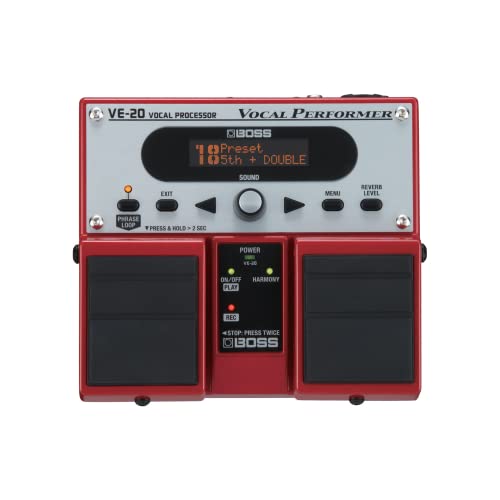
- The easy-to-use VE-20 has been designed from the ground up for singers, featuring some of the finest vocal-effects technology on the market.
- With the click of a footswitch, you can instantly add lush vocal layers and harmonies to your singing, add realtime pitch-correction, and you can show your creative side with special effects such as...
The BOSS VE-20 is a classic in the industry. It is a double-pedal unit that includes a built-in phrase looper and a massive array of multi-part harmonies. It feels incredibly rugged and offers deep menu-diving for those who want to customize every aspect of their delay times and reverb tails. It is significantly more expensive and complex than the Mic Mechanic 2. We recommend the VE-20 for “power users” who want to build complex vocal landscapes live. For the average performer who doesn’t want to spend hours reading a manual, the TC Helicon MIC MECHANIC 2 Vocal Effects Stompbox provides 90% of the usable sound quality with 10% of the setup effort.
Final Verdict: Is the TC Helicon MIC MECHANIC 2 Vocal Effects Stompbox Worth It?
After putting the TC Helicon MIC MECHANIC 2 Vocal Effects Stompbox through its paces, our verdict is a resounding “yes” for the vast majority of singers. Its greatest strength lies in its simplicity. The “Adaptive Tone” feature alone is worth the price of admission, providing a level of vocal polish that usually requires years of sound engineering experience to achieve. While the pitch correction is subtle and the reverb/echo effects are top-notch, it’s the fact that you can get this sound while running on batteries in the middle of a park that truly impresses us. We did note the lack of manual gain control and the occasional report of hardware failure, so we recommend purchasing from a reputable source with a good return policy.
In conclusion, if you are a vocalist who wants to sound like a professional without hauling a rack of gear, this is the pedal for you. It empowers you to take control of your sound, giving you the confidence to perform at your best every single night. Whether you are a weekend warrior or a touring pro, this little red box belongs in your gig bag. Don’t let a bad room sound hold your performance back—click here to grab the TC Helicon MIC MECHANIC 2 Vocal Effects Stompbox and start sounding like the best version of yourself today.
Last update on 2026-09-29 / Affiliate links / Images from Amazon Product Advertising API