
Roland VT-4 Vocal Transformer Review: Professional Vocal Transformation in the Palm of Your Hand
In the modern era of content creation and live performance, the human voice is more than just a means of communication; it is an instrument that demands precision, texture, and character. Whether you are a bedroom producer trying to nail that elusive Daft Punk vocoder sound, a streamer looking to add a professional sheen to your broadcast, or a live performer needing instant harmonies, the struggle is real. Most software solutions introduce debilitating latency, while bulky rack units are a nightmare for portability. We’ve all been there: staring at a flat, dry vocal track that lacks “vibe,” or worse, struggling with a complex interface in the middle of a gig. This is exactly where the Roland VT-4 Vocal Transformer enters the fray, promising a tactile, immediate, and high-quality solution to vocal manipulation. If you’ve been searching for a way to break free from the “standard” vocal sound without getting lost in menu-diving, you may want to see its full feature set and user reviews to understand how it bridges that gap.

- Roland VT-4 is an easy-to-use but incredibly effective voice transformer
- Features Modern and retro vocal effects, including delay, reverb, formant and vocoding
What to Consider Before Investing in a Vocal Effects Processor
A Vocal Effects Processor is more than just an item; it’s a key solution for bridging the gap between a raw, unpolished voice and a studio-grade production. For many of us, the vocal is the most vulnerable part of a performance. Adding processing isn’t about “cheating”; it’s about enhancement, character, and sometimes, total transformation. Whether you are correcting pitch, adding lush reverbs, or layering harmonies, these devices provide the confidence needed to deliver a stellar performance. Without one, you are often at the mercy of a sound engineer who may not understand your aesthetic, or you are stuck with a “naked” vocal that doesn’t fit the genre you are exploring.
The ideal customer for this type of product is someone facing the challenges of live performance or real-time streaming—think DJs, solo electronic artists, and podcasters who need instant results. It is also a godsend for authors who, like some users we’ve encountered, need to create distinct character voices for audiobooks without hiring a full cast. However, it might not be suitable for those who require deep, surgical-grade VST-style editing or those who need 500+ presets for complex theatrical productions. If you are a “set it and forget it” person, some of the simpler pedals might suffice, but if you want to perform with your effects, the Roland VT-4 Vocal Transformer is designed for you.
Before investing, consider these crucial points in detail:
- Dimensions & Space: In a crowded studio or on a cramped DJ booth, every inch matters. You want a device that is compact enough to fit in a gig bag but large enough that the sliders aren’t fiddly. The Roland VT-4 Vocal Transformer strikes a great balance here, measuring roughly 7 by 5 inches, making it a “take-anywhere” powerhouse.
- Capacity/Performance: Look for processors that offer low-latency processing. Nothing ruins a vocal performance faster than hearing your own voice delayed in your monitors. High-quality A/D conversion and the ability to handle phantom power for condenser mics are non-negotiable features for professional results.
- Materials & Durability: While many modern processors use hardened plastic to save on weight, you must consider the “road-worthiness” of the device. If you are a traveling musician, check if the knobs and sliders feel reinforced. Lightweight gear is great for portability but often requires a dedicated carrying case for protection.
- Ease of Use & Maintenance: The best vocal processor is the one you actually use. Look for “one-knob-per-function” designs. If you have to scroll through three menus just to add a bit of reverb, you’ll likely stop using that feature mid-performance. Battery power options are also a huge plus for mobile setups.
While the Roland VT-4 Vocal Transformer is an excellent choice, it’s always wise to see how it stacks up against the competition. For a broader look at all the top models, we highly recommend checking out our complete, in-depth guide:

- The FV01 vocal effects Corrector is primarily a pitch-correction pedal that offers everything from pitch correction to full-blown effects overload when your input is a microphone.

- From Subtle Pitch Correction to Hard Antares AutoTune Effect - VX5 is an intuitive vocal effects pedal with dedicated Retune Speed and Humanize knobs enabling adjustments with no computer needed


- Comprehensive Vocal Processing: VE200 brings studio-grade vocal polish, real-time pitch correction, intelligent harmonies, vocoder and character voices, modulation, delay, and reverb into one compact...
First Impressions: Unboxing the Roland VT-4 Vocal Transformer
Taking the Roland VT-4 Vocal Transformer out of the box, the first thing we noticed was its weight—at just 16 ounces, it is incredibly light. It has a sleek, black finish with backlit green buttons that scream “modern Roland.” The layout is incredibly intuitive; there are no screens, just sliders, knobs, and buttons. This design philosophy is clearly aimed at live performers who don’t have time to squint at a tiny LCD. We found that the tactile nature of the pitch and formant sliders encourages experimentation. Unlike its predecessor, the VT-3, this version feels more refined, with better-calibrated controls. You should check the latest price and availability to see how it fits into your current budget, as it offers a lot of “pro” feel for a mid-range price point.
Pros
- Incredible real-time control with dedicated pitch and formant sliders.
- Supports phantom power for high-quality condenser microphones.
- Highly portable with battery power (4x AA) or USB bus power options.
- Low-latency performance makes it ideal for live singing and gaming.
Drawbacks
- Plastic chassis feels a bit lightweight; a protective case is recommended for travel.
- USB power can occasionally introduce ground loop noise in some computer setups.
Deep Dive: Real-Time Performance and Sonic Versatility
Tactile Manipulation: The Power of the Sliders
The standout feature of the Roland VT-4 Vocal Transformer is undoubtedly its hands-on interface. In our testing, the pitch and formant sliders were the stars of the show. Many processors hide these settings in menus, but having them as dedicated faders allows you to perform “vocal surgery” on the fly. We were able to smoothly transition from a deep, masculine growl to a high-pitched, feminine lead without any digital stepping or artifacts. This is a feature that really sets it apart from software plugins. When you combine the pitch shift with the formant control—which changes the “size” of the vocal tract—you can create entirely new characters. Based on user feedback, this is a favorite for audiobook narrators and streamers who need to switch personas instantly. The sliders have just enough resistance to feel “pro,” and the backlit indicators make it easy to see your settings on a dark stage.
The Effects Engine: From Auto-Tune to Robot Vibes
Roland has packed a surprising amount of variety into this compact unit. The Roland VT-4 Vocal Transformer features several effect blocks: Robot, Megaphone, Vocoder, Harmony, and Reverb. The “Auto-Pitch” knob is particularly impressive. It’s not just a binary “on or off” effect; you can dial in the amount of correction you want. At lower settings, it subtly nudges your notes into place, while at max, it gives you that hard-tuned “trap” vocal sound that is so popular today. We also loved the Vocoder section. By plugging in a MIDI keyboard, you can control the pitch of the vocoder with your playing, allowing for complex polyphonic vocal textures. It’s an incredibly fun experience that we feel many electronic musicians will gravitate toward. To see exactly what this engine can do, you can view the hardware details and full effects list.
Connectivity and Professional Integration
For a device this small, the Roland VT-4 Vocal Transformer offers serious connectivity. The front-panel combo jack accepts XLR or 1/4-inch inputs, and the built-in phantom power means you aren’t restricted to dynamic mics. We tested it with a high-end condenser, and the preamp was surprisingly clean for a device at this price point. One of the most useful hidden features is the USB audio interface capability. You can plug it directly into your PC or Mac, and it acts as your primary audio input. However, we did notice what some users mentioned regarding ground loop noise when powered solely via USB in certain environments. To fix this, we found that using the battery power option or a dedicated USB power isolator completely cleared up the signal. This flexibility makes it a “Swiss Army knife” for creators who move between a home studio and a live stage.
The Harmony Engine: Adding Instant Backing Vocals
The harmony feature on the Roland VT-4 Vocal Transformer is remarkably effective for solo performers. By selecting a key via the dedicated knob, you can add up to two additional voices to your lead vocal. We found the “Auto” mode to be quite intelligent, following the input pitch accurately. While it may not replace a four-piece choir, it adds a much-needed “thickness” to choruses during a live set. The ability to mix the level of the harmony independently of the lead vocal via a dedicated slider is a huge win for live dynamics. We found that adding a touch of the built-in reverb to the harmony voices helped them sit better in the mix, creating a lush, professional soundscape. If you’re a singer-songwriter looking to fill out your sound, this unit is a feature-rich tool that really sets itself apart.
What Other Users Are Saying
The general sentiment among users is overwhelmingly positive, with many praising the Roland VT-4 Vocal Transformer for its “fun factor” and ease of use. One user, a published author, noted that they used the device to create distinct character voices for an audiobook, finding the dials and knobs perfect for searching for the right “tone.” Another professional vocalist mentioned that it’s the perfect tool for real-time control, highlighting the “subtle and versatile” sounds that are easy to manage mid-performance. We found that many users appreciate the portability, often taking it to rehearsals or small gigs without needing a bulky power brick.
However, the feedback isn’t without its critiques. A few users mentioned that the device feels “flimsy” or “lightweight,” warning that it might not survive a significant drop. One user reported issues with the headphone jack after a year of heavy use, suggesting that the internal components might be a bit delicate. Additionally, the ground loop noise issue when using USB power was a recurring theme in several “pro” reviews. Despite these concerns, the consensus is that for the price, the Roland VT-4 Vocal Transformer outperforms many of its competitors in sound quality and layout. You might want to read more verified feedback to see how others have mitigated these minor hardware quirks.
Comparing the Roland VT-4 Vocal Transformer to the Competition
1. Zoom V3 Vocal Processor Pedal with 3-Part Harmony & Pitch Correction

- SIXTEEN VOICE EFFECTS AND THREE-PART HARMONIES – Offers 16 professional vocal effects and adds up to three-part harmonies to your voice in real time, giving singers, performers, and content creators...
- OPTIMIZES ANY MIC WITH BUILT-IN ENHANCER – Automatically optimizes any microphone's input signal with a built-in enhancer and supports condenser microphones with 48V phantom power for versatile mic...
The Zoom V3 is perhaps the closest competitor to the Roland VT-4. It offers a similar compact footprint and battery power. However, the Zoom V3 focuses more on “presets” and buttons rather than the VT-4’s sliders. While the Zoom V3 has an excellent harmony engine and an optional expression pedal input, it lacks the deep, real-time formant manipulation that the VT-4 excels at. We recommend the Zoom V3 for singers who want a set-and-forget pedal for classic harmonies, whereas the Roland is better for those who want to “play” the effects like an instrument.
2. BOSS VE-20 Vocal Effects Processor
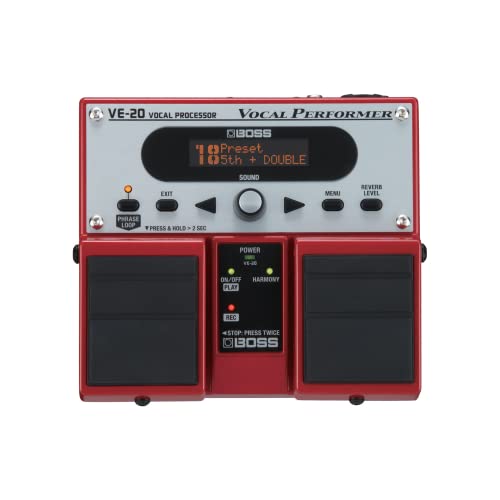
- The easy-to-use VE-20 has been designed from the ground up for singers, featuring some of the finest vocal-effects technology on the market.
- With the click of a footswitch, you can instantly add lush vocal layers and harmonies to your singing, add realtime pitch-correction, and you can show your creative side with special effects such as...
The BOSS VE-20 is a legend in the vocal processing world. Built like a tank with a heavy-duty metal chassis, it is far more durable than the Roland VT-4. It features a built-in looper, which is a major advantage for solo performers. However, the VE-20’s interface is quite dated; it requires menu-diving on a small screen to change parameters, making it less intuitive for real-time tweaking. If you need a floor-based unit that can take a beating and offers looping, the VE-20 is the choice. If you want desktop-friendly, instant-access controls, the VT-4 wins hands down.
3. MOOER GE1000 Guitar Multieffects Pedal

- MOOER Audio Separator -- MOOER Steamlab splits mixed music into independent isolated tracks with 6 separation modes including vocals, guitar, bass, keyboard,drum and others. Compatible with most audio...
- Advanced AI Technology – Features an AI-powered auto-equalizer with fully customizable parameters. Simply select your playing style, play a musical passage, and the system automatically generates...
The MOOER GE1000 is primarily a guitar processor, but it features dual effects chains and a sophisticated AI EQ system. It is a much more complex (and expensive) device than the VT-4. For musicians who play both guitar and sing, the MOOER offers a “one-stop-shop” solution. However, for pure vocal transformation, it is overkill and lacks the specific, tactile vocal-centric controls of the VT-4. We suggest the MOOER for the tech-heavy multi-instrumentalist, but for dedicated vocal manipulation, the Roland remains the superior, more focused tool.
Final Verdict: Is the Roland VT-4 Vocal Transformer the Right Choice for You?
After putting the Roland VT-4 Vocal Transformer through its paces, our verdict is clear: it is one of the most intuitive and creative vocal processors currently on the market. Its strengths lie in its immediacy—you don’t need a manual to start making incredible sounds. The pitch and formant sliders are addictive, and the sound quality is high enough for both professional streaming and live performances. While the plastic construction and potential USB noise are points to be aware of, they are easily managed with a little care and the right power setup. We highly recommend this to electronic artists, streamers, and anyone looking to add a unique “voice” to their creative output.
In summary, if you want a portable, powerful, and tactile way to transform your vocals without the headache of complex software, this is your best bet. It empowers you to be more than just a singer; it lets you be a vocal architect. Ready to take your vocal production to the next level? Check the current price and pick up your Roland VT-4 today to start exploring new sonic territories.
Last update on 2026-09-26 / Affiliate links / Images from Amazon Product Advertising API