
FLAMMA FV01 Vocal Effects Processor Pitch Correction Pedal Review: Professional Studio Polish for the Gigging Vocalist
Every singer knows that sinking feeling when you hit a stage or start a livestream and realize your voice sounds “thin” or “dry” compared to the polished records we listen to every day. In the studio, we have the luxury of compression, exquisite reverbs, and subtle pitch correction to smooth out those tiny imperfections. On stage, however, we are often at the mercy of a harried sound engineer or a lackluster PA system. This lack of control leads to vocal fatigue and, more importantly, a lack of confidence. If you’ve ever felt like you were fighting your equipment just to be heard, or if you’ve cringed at a slightly flat note in a live recording, you’ve likely searched for a solution that puts the power back into your hands. The FLAMMA FV01 Vocal Effects Processor Pitch Correction Pedal aims to be that solution—a compact, rugged stompbox that acts as a personal sound engineer at your feet. Failing to address these vocal inconsistencies doesn’t just hurt your performance; it can stall your growth as a creator in an era where audio quality is paramount.

- The FV01 vocal effects Corrector is primarily a pitch-correction pedal that offers everything from pitch correction to full-blown effects overload when your input is a microphone.
- The FV01 features three separate vocal effects as indicated by the TONE LED displayed prominently in the center of the pedal.
What to Consider Before Investing in a Vocal Effects Processor
A Vocal Effects Processor is more than just an item; it’s a key solution for bridging the gap between a raw microphone signal and a professional, radio-ready sound. These devices solve the problem of inconsistent live environments by providing a “known quantity” of tone shaping—EQ, compression, and spatial effects—before the signal even reaches the mixing board. They allow a performer to maintain their signature sound whether they are in a basement club or a high-end recording studio.
The ideal customer for this type of product is a gigging musician, a dedicated livestreamer, or a singer-songwriter who also plays an instrument and needs a cohesive mix. It is particularly valuable for those who don’t have a dedicated sound tech. However, it might not be suitable for purists who prefer a completely transparent signal path or for those who require complex multi-part harmonies, as this specific unit focuses more on correction and solo enhancement than choral generation. If you need complex 5-part harmonies, you might consider higher-end workstations.
Before investing, consider these crucial points in detail:
- Dimensions & Space: For a gigging musician, pedalboard real estate is sacred. You need a unit that fits alongside your guitar pedals or on a small accessory tray without requiring a massive power brick. Look for a compact form factor that doesn’t sacrifice the size of the knobs, which you’ll need to adjust in low-light environments.
- Capacity & Performance: This refers to the processing power and the quality of the algorithms. In a pitch correction pedal, latency is the enemy. You need a processor that can track your voice in real-time without that “delay” feeling that can throw off your timing. Furthermore, the quality of the pre-amp (the gain stage) determines how much hiss or noise is introduced into your signal.
- Materials & Durability: Since these devices are often placed on the floor (hence “stompbox”), they must be built to withstand heavy-footed use. A metal chassis is almost always preferable to plastic. The switches should be tactile and the jacks should be reinforced to prevent them from loosening after hundreds of cable swaps.
- Ease of Use & Maintenance: Live performance is stressful enough. You don’t want to be menu-diving through a tiny LCD screen mid-set. Tactical knobs for Reverb, Delay, and Correction are essential for quick “on-the-fly” adjustments. Consider how the device handles power and whether it offers 48V phantom power for your professional condenser microphones.
While the FLAMMA FV01 Vocal Effects Processor Pitch Correction Pedal is an excellent choice, it’s always wise to see how it stacks up against the competition. For a broader look at all the top models, we highly recommend checking out our complete, in-depth guide:
- The FV01 vocal effects Corrector is primarily a pitch-correction pedal that offers everything from pitch correction to full-blown effects overload when your input is a microphone.
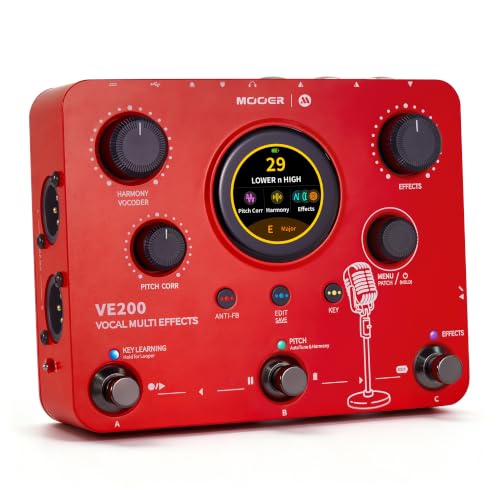
- Comprehensive Vocal Processing: VE200 brings studio-grade vocal polish, real-time pitch correction, intelligent harmonies, vocoder and character voices, modulation, delay, and reverb into one compact...
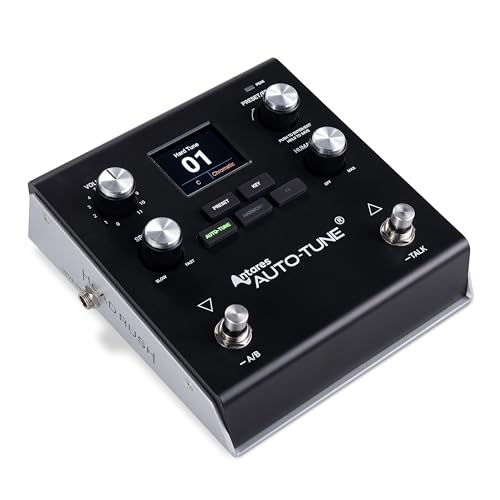
- From Subtle Pitch Correction to Hard Antares AutoTune Effect - VX5 is an intuitive vocal effects pedal with dedicated Retune Speed and Humanize knobs enabling adjustments with no computer needed

First Impressions: Unboxing the FLAMMA FV01 Vocal Effects Processor Pitch Correction Pedal
When we first pulled the FLAMMA FV01 Vocal Effects Processor Pitch Correction Pedal out of the box, the immediate standout was the build quality. In an industry where budget-friendly gear often feels like a toy, the FV01 feels like a serious tool. It has a reassuring weight (0.37 kg) and an all-metal chassis that suggests it can survive a tumble off a stage or a crowded gear bag. We found that the knobs have a nice resistance to them—they aren’t loose or “wobbly,” which is critical when you are trying to dial in a specific amount of pitch correction.
Setting it up was remarkably intuitive. Unlike some competitors that require a PhD in signal routing, the FV01 is clearly labeled. You have your XLR in and out, and importantly, a dedicated guitar input and output. This allows the pedal to “listen” to your guitar chords to help guide the pitch correction, a feature we found incredibly helpful for staying in key during complex song structures. For those looking to see its full feature set and user reviews, the initial tactile experience confirms that FLAMMA isn’t cutting corners on the hardware interface.
Key Benefits
- Robust all-metal construction built for the rigors of the road.
- Highly intuitive “one-knob” control for pitch correction levels.
- Integrated 48V Phantom Power allows use with high-end condenser mics.
- Versatile routing options for both solo vocals and singer-songwriters.
Drawbacks
- The gain control is a recessed “trim” pot that requires a small tool to adjust.
- The power requirements (500mA) are higher than many standard pedalboard power supplies.
A Deep Dive into Performance: Putting the FLAMMA FV01 to the Test
Precision Pitch Correction: The “Invisible” Hand
The primary reason anyone looks at the FLAMMA FV01 Vocal Effects Processor Pitch Correction Pedal is the pitch correction, and we spent hours testing exactly how “aggressive” this effect could be. We found that the correction is remarkably musical. When set to the lower half of the dial, the effect is nearly invisible to the audience; it simply “tugs” your notes toward the nearest chromatic half-step. This is perfect for those of us who might slightly “flub” a note during a long set. It gives you the confidence to go for those higher registers knowing the pedal has your back.
However, if you want that modern, “hard-tuned” sound popularized in pop and hip-hop, the FV01 can certainly get you there. Turning the Correction knob past the 2 o’clock position introduces that distinct stepped vocal characteristic. We were impressed by the low latency; often, digital pitch shifters can feel “rubbery” or lag behind the singer’s actual performance, but the FV01 feels instantaneous. As one user noted in our research, these work so well that they bought seven of them for their various bands, strictly for the chromatic tuning reliability. If you want to check the latest price and availability for this level of precision, you’ll find it punches far above its weight class.
Three-Stage Tone Shaping: Warm, Bright, and Normal
Beyond pitch, the “Tone” button on the FV01 is perhaps its most underrated feature. We found that this button acts as a pre-configured channel strip, combining EQ, compression, and a de-esser. The “Normal” mode (LED off) is a transparent pass-through. “Warm” (Red LED) adds a subtle low-mid bump and rounds off the harsh highs, which we found excellent for thinner, more piercing voices. “Bright” (Blue LED) is where the magic happens for most live scenarios. It adds a crispness and “air” to the vocal that helps it cut through a dense mix of drums and distorted guitars.
In our testing, the “Bright” mode acted almost like a professional exciter. It brought a “studio sheen” to a standard dynamic microphone that usually sounds muddy in a small rehearsal space. This feature alone makes the FLAMMA FV01 Vocal Effects Processor Pitch Correction Pedal a valuable tool for streamers who need their voice to sound professional without knowing how to manually configure a compressor or parametric EQ. You can a feature that really sets it apart is this ability to instantly improve the fundamental quality of the vocal before any effects are even applied.
Spatial Effects and Guitar Integration
The FV01 isn’t just a pitch corrector; it’s a full vocal suite. It features three types of Reverb (Room, Hall, Plate) and three types of Delay (Echo, Repeat, Tape). What we loved most was the dedicated Tap Tempo feature. By holding the footswitch, you can tap in the beat of your song, ensuring your vocal delays stay perfectly in sync with the music. This is a feature often missing from budget vocal pedals, and we found it worked flawlessly in a live setting.
For the singer-songwriter, the guitar “In” and “Out” jacks are a game-changer. You can plug your acoustic guitar into the pedal, and it will detect the key of your playing to further refine the pitch correction. Furthermore, you can choose to output a mixed signal (Guitar + Vocals) via the XLR out, or keep them separate. We did find, as some users have mentioned, that when the signals are merged, the instrument can sometimes overpower the vocal if the levels aren’t carefully managed at the source. However, having the option to add reverb to your guitar signal directly from the pedal is a fantastic “bonus” for those looking to simplify their setup. For those looking to streamline their rig, you can view the connection diagrams and see how it fits your setup.
Pre-Amp Performance and Technical Quirks
The FLAMMA FV01 Vocal Effects Processor Pitch Correction Pedal functions essentially as a microphone pre-amplifier. This means it has a “Gain” control. One thing we discovered—and this is a crucial tip for new buyers—is that the gain is very sensitive. It is controlled by a tiny, recessed dial on the back that usually requires a small flathead screwdriver to adjust. We found that you’ll want to turn this gain way down initially to avoid clipping your mixer or speakers. Once dialed in, however, the pre-amp is surprisingly quiet, providing a clean signal even when using the 48V phantom power for a condenser mic.
We also investigated the “Empty Warehouse” complaint some users had regarding the reverb. Through our testing, we found that this usually happens if the “Mix” knob is pushed too far or if the user doesn’t realize they have the “Delay” and “Reverb” both active on high settings. The pedal offers a lot of “wet” signal, so a little goes a long way. When used tastefully, the plate reverb provides a beautiful, shimmering tail that makes the vocal feel expensive. For those who want a professional-grade pre-amp in a pedal format, the FV01 delivers, provided you take five minutes to calibrate the gain settings for your specific microphone.
What Other Users Are Saying
The general sentiment surrounding the FLAMMA FV01 Vocal Effects Processor Pitch Correction Pedal is one of surprise at its value-to-performance ratio. Many professional musicians have noted that it serves as a “perfect clone” of more expensive competitors, offering 90% of the functionality at a fraction of the price. We found that users particularly appreciate the confidence boost it provides; one reviewer mentioned it gave them the courage to finally do back-ups and even sing lead songs in their garage band. This sentiment of “attainable professionalism” is a common thread.
On the flip side, some users have struggled with the routing and volume balance. One user mentioned they “can’t seem to adjust the volume on the pedal” and found the output too loud for their speakers. This highlights the importance of that recessed gain knob we mentioned earlier—it’s a “set it and forget it” control, not a performance knob. Another user found the pitch correction felt more like a “chorus” effect in their monitors. We found that this usually occurs when the singer’s natural voice is bleeding into their ears (or monitors) at the same time as the corrected signal; in a recording or with in-ear monitors, this “phasing” disappear, and the correction shines. Despite these minor learning curves, those who buy the FV01 for live use often find it indispensable after the first few gigs.
Comparing the FLAMMA FV01 to Its Top 3 Alternatives
1. Roland VT-4 Vocal Transformer

- Roland VT-4 is an easy-to-use but incredibly effective voice transformer
- Features Modern and retro vocal effects, including delay, reverb, formant and vocoding
The Roland VT-4 is a different beast entirely. While the FLAMMA FV01 Vocal Effects Processor Pitch Correction Pedal focuses on subtle correction and traditional vocal “polishing,” the VT-4 is a creative powerhouse for transformation. It allows for radical gender-bending, vocoding, and extreme pitch shifting via its prominent sliders. If you are an electronic artist or a streamer looking for “character” voices, the Roland is the superior choice. However, for a traditional singer who wants a pedalboard-friendly unit that looks like a piece of music gear rather than a desktop console, the FLAMMA is more practical and much more affordable.
2. Zoom V3 Vocal Effects Pedal with 3-Part Harmony and Pitch Correction

- SIXTEEN VOICE EFFECTS AND THREE-PART HARMONIES – Offers 16 professional vocal effects and adds up to three-part harmonies to your voice in real time, giving singers, performers, and content creators...
- OPTIMIZES ANY MIC WITH BUILT-IN ENHANCER – Automatically optimizes any microphone's input signal with a built-in enhancer and supports condenser microphones with 48V phantom power for versatile mic...
The Zoom V3 is the choice for the solo artist who needs to sound like a choir. Its standout feature is the harmony engine, which creates realistic 3-part harmonies based on the key you select. While the FLAMMA FV01 focuses on a single, high-quality corrected vocal line, the Zoom V3 offers a broader palette of 16 studio-grade effects, including Whistle and Robot modes. The V3 is bulkier and designed more for a tabletop or a mic-stand mount. If your priority is adding “backing singers” to your performance, go with the Zoom; if you want the best possible solo tone with a smaller footprint, stick with the FLAMMA.
3. BOSS VE-20 Vocal Performer Effects Unit
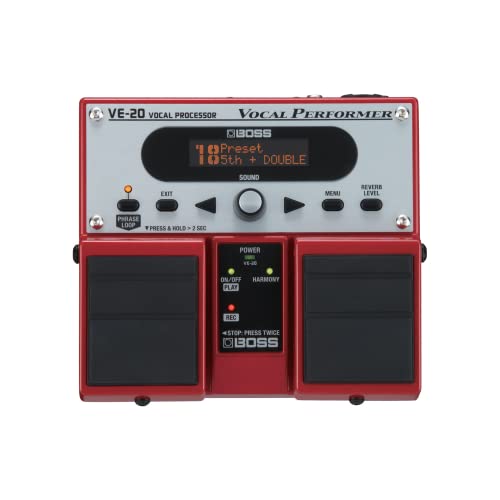
- The easy-to-use VE-20 has been designed from the ground up for singers, featuring some of the finest vocal-effects technology on the market.
- With the click of a footswitch, you can instantly add lush vocal layers and harmonies to your singing, add realtime pitch-correction, and you can show your creative side with special effects such as...
The BOSS VE-20 is the industry “old guard.” It has been on stages for over a decade and is built like a tank, much like the FLAMMA. The VE-20 offers more features, including a built-in phrase looper and more complex doubling effects. However, it also uses an older interface with a small screen and menu-diving that can be frustrating compared to the “knob-per-function” layout of the FV01. The BOSS is more expensive and arguably shows its age in the reverb algorithms. We recommend the VE-20 for those who specifically need the built-in looper, but for modern, clean pitch correction, the FLAMMA FV01 feels more contemporary and user-friendly.
Final Verdict: Is the FLAMMA FV01 the Right Choice for You?
After putting the FLAMMA FV01 Vocal Effects Processor Pitch Correction Pedal through its paces, our verdict is clear: this is a phenomenal tool for any singer looking to take control of their live sound. It solves the primary problems of pitch anxiety and “dry” vocal signals with a level of polish usually reserved for gear twice its price. While the recessed gain knob is a minor annoyance during initial setup, the sheer quality of the “Bright” tone mode and the musicality of the pitch correction make it a “must-have” for the gigging musician’s toolkit.
Whether you’re a singing bassist needing a clean pre-amp, a streamer looking for that professional “broadcast” sheen, or a songwriter wanting to sync your vocal delays to your guitar’s tempo, this pedal delivers. It’s rugged, intuitive, and sounds fantastic. We highly recommend that you check the latest price and availability here and give your voice the professional edge it deserves. Don’t let your vocal performance be an afterthought—put the FV01 on your board and sing with the confidence of a studio session.
Last update on 2026-09-26 / Affiliate links / Images from Amazon Product Advertising API