
Behringer ABACUS Analog Music Computer for Eurorack Review: Is This the Most Essential Utility for Your Modular Rig?
If you have ever dipped your toes into the world of Eurorack, you know the feeling of “patcher’s block.” You have a beautiful oscillator and a creamy filter, but your sequences feel static, your modulations feel predictable, and your rack lacks that “living, breathing” quality that defines the best modular performances. For years, the solution to this problem was often a single, expensive, and frequently out-of-stock module from boutique manufacturers. We found ourselves constantly weighing the cost of a “Swiss Army Knife” utility against the cost of an entire second voice. This is the exact hurdle that leads many to look for a Behringer ABACUS Analog Music Computer for Eurorack. Solving the problem of complex modulation isn’t just about adding more LFOs; it’s about finding a way to make your existing signals talk to each other in musical ways. Without a central “computer” to process these voltages, your rack remains a collection of parts rather than a cohesive instrument.

- Envelope LFO Functionality
- LED Activity Indicats
What to Consider Before Diving Into Tabletop and Modular Synthesizers
A Tabletop Synthesizer or a modular utility is more than just an item; it’s a key solution for breaking out of the “fixed-architecture” mindset. In a standard synthesizer, the signal flow is pre-determined. In the world of modular and advanced tabletop gear, you are the architect. This product category allows you to define how a sound evolves over time, how a filter responds to a sequence, and even how a single trigger can blossom into a complex rhythmic event. By investing in a dedicated function generator and CV processor, you are essentially unlocking the hidden potential of every other module you own.
The ideal customer for this type of product is someone facing the limitations of basic LFOs and envelopes, looking to add “West Coast” synthesis techniques to their setup, or someone building a rig on a budget who needs maximum functionality per square inch. It is perfect for the experimenter who wants to explore self-generating patches. However, it might not be suitable for those who prefer a “one knob per function” simplicity or musicians who find the “algebraic” nature of voltage processing more frustrating than creative. For those individuals, a pre-patched semi-modular system or a dedicated groovebox might be a better entry point.
Before investing, consider these crucial points in detail:
- Dimensions & Space: In the Eurorack world, space is measured in “HP” (Horizontal Pitch). You need to ensure your case has the room and the power overhead to support a module of this size. A 20HP module like this offers a lot of control, but it requires a commitment of real estate that could otherwise hold three smaller modules.
- Capacity & Performance: Look at the range of the function generators. Can they go slow enough for evolving ambient drones (minutes long) and fast enough to reach audio rates (kHz) for FM synthesis? The ability to switch between linear, exponential, and logarithmic curves is also vital for getting the “feel” of a patch right.
- Materials & Durability: Modular gear is meant to be patched and repatched. Check the quality of the jacks and the tension of the potentiometers. Since you will be “playing” these knobs like an instrument, they need to feel sturdy and shouldn’t wobble or feel “gritty” over time.
- Ease of Use & Maintenance: While these units are “computers,” they are analog and require no software updates. However, the learning curve is steep. You should look for a layout that uses visual feedback, like LEDs, to help you understand what the voltages are doing at any given moment, which saves hours of troubleshooting.
Choosing the right utility is the difference between a rack that makes noise and a rack that makes music. Before you commit, it is important to see how this specific unit compares to the broader market of portable synthesis tools.
While the Behringer ABACUS Analog Music Computer for Eurorack is an excellent choice, it’s always wise to see how it stacks up against the competition. For a broader look at all the top models, we highly recommend checking out our complete, in-depth guide:

- 【Create Anywhere】This synthesizer is fully portable with battery operation and a built-in speaker, It's very compact and portable. 27 full-range silicone keys with soft, comfortable touch...
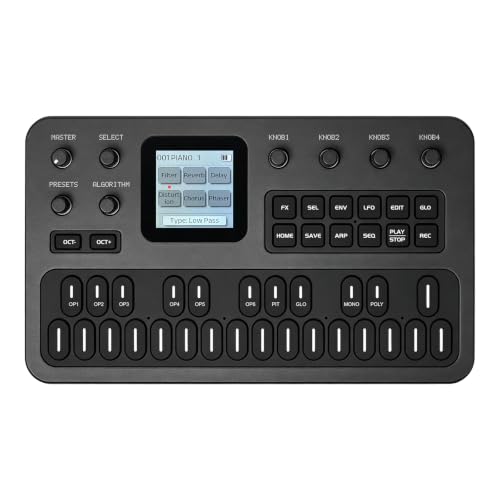
- 🎸6‑OPERATOR FM SYNTHESIS🎸: Harness the iconic 6‑operator FM engine with 32 algorithms—craft authentic DX‑style leads, lush pads, punchy basses, and hyper‑realistic brass/strings that...

- 【Create Anywhere】This synthesizer is fully portable with battery operation and a built-in speaker, It's very compact and portable. 27 full-range silicone keys with soft, comfortable touch...
First Impressions: Unboxing the Behringer ABACUS Analog Music Computer for Eurorack
Upon unboxing the Behringer ABACUS Analog Music Computer for Eurorack, the first thing that struck us was the aesthetic. Unlike some of their previous clones, this one sports a sleek, professional black faceplate with a matte finish that looks fantastic alongside both modern and “boutique” modules. It feels substantial in the hand, weighing about 300g, and the “Modern” style layout is surprisingly clean for a module that packs so much functionality. We found the installation into our test case to be straightforward, using the included Eurorack power cable. You can check the latest price and availability to see just how accessible this entry point into complex synthesis has become.
The initial “feel” of the knobs is generally positive, though there is a noticeable difference in size between the primary Rise/Fall controls and the much smaller attenuverter knobs in the center. We noticed right away that the LEDs are bright and highly responsive, providing instant visual confirmation of the “attack” and “decay” (or rise and fall) of our envelopes. While it is clearly inspired by legendary West Coast designs, the ABACUS feels like it has its own identity in a modern rack, offering a “Swiss Army Knife” utility set that promises to handle everything from simple LFO duties to complex logic operations.
Key Benefits
- Incredible value for a 4-channel function generator and algebraic CV processor.
- Highly versatile range, capable of cycles from 25 minutes down to 1 kHz audio rates.
- Bright, clear LED indicators for every output, making it easy to track complex modulations.
- Sleek black aesthetic that fits perfectly into modern Eurorack builds.
Drawbacks
- Attenuverter knobs (the center four) are quite small and can feel fiddly for precise adjustments.
- Potentiometers are not secured to the faceplate with nuts, which may affect long-term durability under heavy use.
Deep Dive: Putting the Behringer ABACUS Analog Music Computer for Eurorack to the Test
To truly understand what the Behringer ABACUS Analog Music Computer for Eurorack is capable of, we spent several weeks integrated it into a variety of patches, ranging from rhythmic techno to generative ambient soundscapes. It is marketed as an “Analog Music Computer,” and while that might sound like hyperbole, the way it processes voltage really does feel like a form of analog programming.
The Power of the Dual Function Generators
The heart of the Behringer ABACUS Analog Music Computer for Eurorack lies in its two outer channels (1 and 4). These are function generators that can act as envelopes, LFOs, or even oscillators. We found that the “Rise” and “Fall” controls are incredibly musical. By adjusting the curve response, you can move from a snappy, percussive linear envelope to a more “natural” sounding exponential decay. This is where you should see its full feature set and user reviews to understand how people are using it as the rhythmic backbone of their systems.
In our testing, we pushed the “Cycle” mode to its limits. When set to cycle, the module becomes a wide-range LFO. We were able to create ultra-slow, evolving modulations that took nearly 20 minutes to complete a single cycle—perfect for ambient textures. On the other end of the spectrum, cranking the knobs into the audio range (up to 1 kHz) allowed us to use the ABACUS as a crude but effective third and fourth oscillator for FM (Frequency Modulation) or as a sound source for “clanging” metallic percussion. The transition between these states is smooth, and the LED activity indicators make it very clear when the module is reaching its threshold.
Algebraic CV Processing and Mixing
The “Computer” aspect of the Behringer ABACUS Analog Music Computer for Eurorack comes into play with the middle section and the collective outputs. This is where you can combine up to four different control voltages (CVs) to create entirely new shapes. We found the “Sum,” “Or,” and “Difference” outputs to be revolutionary for our patch designs. For example, by sending a slow LFO into channel 2 and a fast sequence into channel 3, the “Sum” output provided a sequence that slowly drifted up and down in pitch, while the “Difference” output gave us a strange, inverted version of the melody.
This type of math-based modulation is what separates a static patch from a dynamic one. We used the attenuverters to precisely dial in how much of each signal was mixed. While we agree with some users that these four knobs are a bit small, their responsiveness is excellent. This ability to amplify, attenuate, or even invert a signal on the fly is a feature that really sets it apart in this price bracket. You are essentially getting a four-channel mixer, a bipolar attenuator, and a logic module all in one 20HP footprint.
Lag, Slew, and Musical Timing
Another profound use case we explored was using the Behringer ABACUS Analog Music Computer for Eurorack as a slew limiter or portamento generator. By sending a stepped pitch CV (like from a sequencer) into the input and turning up the “Rise” and “Fall” times, we were able to “glide” between notes. This “lag” effect is essential for creating acid-style basslines or organic-sounding pitch shifts. We found that the module handles these tasks with a high degree of precision, never feeling “mushy” or unresponsive.
Furthermore, the “End of Rise” and “End of Cycle” gate outputs allowed us to trigger other events in our rack based on the status of the ABACUS. We used this to create “flam” effects (double-triggers) and to divide notes in a sequence. By the time we were done with our evaluation, it was clear that this module is the “connective tissue” of the system. It takes the “dumb” signals from your other gear and gives them intelligence and timing. If you are looking to expand your system’s capabilities, you can check the latest pricing here to see if it fits your current build plan.
What Other Users Are Saying
The general sentiment around the Behringer ABACUS Analog Music Computer for Eurorack is overwhelmingly positive, especially regarding its value proposition. Many users highlight that it performs the exact same functions as the industry-standard “Maths” module but at a significantly lower price point. One user noted, “It’s a perfect clone… I have owned both at the same time and can say they function 100% the same.” This sentiment is common among those who want to “democratize” the modular experience, making advanced synthesis accessible to everyone.
Another reviewer praised its versatility, calling it a “Fantastic Swiss Army knife with endless modulation configurations.” We also saw several comments appreciating the black faceplate, which helps it blend in with diverse rack aesthetics. However, the feedback isn’t without its critiques. A common complaint involves the ergonomics: “The 4 knobs for the attenuverters are very small. I would have preferred bigger knobs there.” Some users also mentioned that the pots aren’t bolted to the panel, which can lead to a slight “fiddly” feeling. Despite these minor build-quality quibbles, the consensus is that for the price, the Behringer ABACUS Analog Music Computer for Eurorack is an unbeatable tool for the modern synthesist. You can read more user experiences and see how they patch it here.
Comparing the Behringer ABACUS to Top Alternatives
While the ABACUS is a dedicated Eurorack module, many users look at it as part of a larger tabletop ecosystem. If you aren’t ready to commit to a full Eurorack case, or if you need a different kind of performance tool, here are three alternatives that solve similar musical problems in different ways.
1. Novation Circuit Tracks Groovebox Sequencer
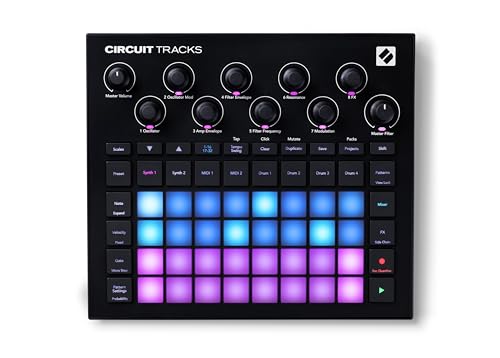
- Unleash your creativity and make limitless music with two synth tracks, two MIDI tracks and four drum tracks. Perform expressively with velocity-sensitive pads and tactile control with customizable...
- Create 32-step patterns, chainable for up to 256 steps sequences per track. Go off-grid with microtiming. Keep your music evolving with probability and pattern mutate

The Novation Circuit Tracks is a very different beast but serves the same ultimate goal: being the “brain” of your setup. While the ABACUS computes analog voltages, the Circuit Tracks computes MIDI and digital signals. It is an all-in-one groovebox that can sequence two internal synth engines and two external MIDI devices. We recommend this for musicians who want a “tabletop” experience without the complexity of patch cables. It’s portable, battery-powered, and much easier for a beginner to wrap their head around than the algebraic logic of the ABACUS. However, it lacks the infinite “warping” capabilities that analog slew and integration provide.
2. KORG Volca Bass Analog Synthesizer

- Powerful analog bass sound creation with three oscillators for a variety of bass sounds
- Electribe-inspired sequencer for generating ultimate bass lines and grooves
If you are drawn to the ABACUS for its analog warmth and rhythmic potential, the KORG Volca Bass is a fantastic entry-level companion. While the ABACUS is a processor, the Volca Bass is a complete voice with three oscillators and a classic filter. It is highly portable and great for those who want that “analog sound” in a small tabletop format. You might prefer the Volca if you want a self-contained instrument rather than a utility module. However, many users eventually find themselves wanting to modulate the Volca in ways its internal LFO can’t handle—which is exactly when they might buy an ABACUS to control it via CV.
3. Otamatone Neo Electronic Musical Instrument
![Otamatone 'Neo 10th Anniversary Special Edition [Japanese Version] White - Japanese Electronic...](https://m.media-amazon.com/images/I/21YTfcxjhuL.jpg)
- : W 2.6 x H 11.2 x D 5.4 inches (6.7 x 28.5 x 13.7 cm)
- : 3 ()
The Otamatone Neo is a bit of a wildcard in this list, but it represents the “experimental” side of the synthesizer world. While the ABACUS is a serious tool for technical sound design, the Otamatone is about fun, gestural control, and quirkiness. It is an electronic musical instrument that relies on physical touch and “sliding” notes—conceptually similar to the “slew” and “portamento” you can create with the ABACUS. We’d recommend this for someone who wants a fun, portable gift or a unique “toy” synthesizer for their studio. It obviously lacks the CV connectivity and professional depth of the ABACUS, but it shares that spirit of “West Coast” experimentalism.
The Final Verdict: Is the Behringer ABACUS Your Next Must-Have Module?
After our deep dive and extensive testing, we can confidently say that the Behringer ABACUS Analog Music Computer for Eurorack is one of the most cost-effective ways to exponentially increase the power of your synthesizer setup. It successfully bridges the gap between legendary 1960s synthesis theory and modern, affordable production. While the ergonomics of the small center knobs might take some getting used to, the sheer breadth of functionality—from envelopes and LFOs to complex mixers and slew limiters—is simply staggering for the price. We found it to be a reliable, musical, and visually helpful addition to our rack.
We recommend this module to anyone building a Eurorack system on a budget, as well as experienced pros who need “just one more” function generator without spending a fortune. It is a “Swiss Army Knife” that will find its way into every single patch you create. If you are ready to stop making static sounds and start creating evolving, “intelligent” music, this is the tool to get you there. Click here to grab your Behringer ABACUS and start transforming your sequences today!
Last update on 2026-09-20 / Affiliate links / Images from Amazon Product Advertising API