
Behringer 140 Dual Envelope/LFO Analog Module Review: Mastering the Vintage Pulse of the System 100M
In the world of modular synthesis, there is a recurring nightmare that every enthusiast eventually faces: the “static patch.” You have your oscillators tuned, your filters set, but the sound just sits there, lifeless and unmoving. We’ve all been there, staring at a rack of expensive gear only to realize that we lack the basic tools to breathe life into the audio. This is the fundamental problem that the Behringer 140 Dual Envelope/LFO Analog Module aims to solve. Without sufficient modulation sources like envelopes and LFOs, your synthesizer is essentially a very expensive organ. Solving this lack of movement is crucial because, in electronic music, movement is emotion. If you don’t have enough envelopes to shape your notes or LFOs to wobble your filters, your music remains flat, clinical, and uninspiring. I spent years trying to make do with single-function modules before realizing that density and versatility are the only ways to build a truly expressive Eurorack system.
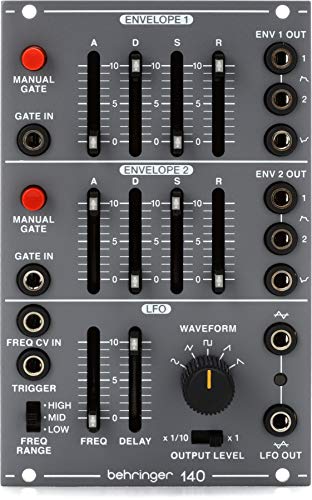
- Two independent ADSR envelope generators controllable via external gate or manual triggering
- Frequency, delay and range controls plus external sync input for maximum LFO flexibility

What to Consider Before Diving Into the World of Tabletop Synthesizers and Modular Gear
A Tabletop Synthesizer or a dedicated Eurorack module is more than just an item; it’s a key solution for sonic stagnation. For many of us, these devices are the bridge between a sterile computer screen and the tactile, organic world of “real” sound design. When you invest in a module like the Behringer 140 Dual Envelope/LFO Analog Module, you aren’t just buying circuitry; you are buying the ability to sculpt time itself. These modules allow you to define how a sound starts, how it evolves, and how it fades away. Without this control, you’re essentially working with raw noise, which can be frustrating for any musician trying to find their unique voice.
The ideal customer for this type of product is someone facing the limitations of “fixed-architecture” synths—those who want to break out of the box and create complex, evolving textures. It’s perfect for the producer who wants that classic 80s snappiness in their percussion or the ambient artist looking for slow, sweeping filter movements. However, it might not be suitable for those who prefer the simplicity of presets or those who find patch cables more distracting than inspiring. If you want a “plug and play” experience without the learning curve of voltage control, you might be better off looking at a complete standalone unit rather than building a custom rack.
Before investing, consider these crucial points in detail:
- Dimensions & Space: In the Eurorack world, space is measured in HP (Horizontal Pitch). We found that the 16HP footprint of this module is relatively large compared to modern “micro” modules. You must ensure your case has the room to accommodate it without sacrificing other essential functions.
- Capacity & Performance: Look at the number of outputs and the range of the controls. We found that having three outputs per envelope (two normal, one inverted) provides a massive amount of routing flexibility that many smaller modules simply cannot match.
- Materials & Durability: Since you will be sliding these controls constantly, the build quality of the faders is paramount. Metal faceplates are generally preferred over plastic for long-term durability and shielding against electromagnetic interference.
- Ease of Use & Maintenance: Consider the interface layout. Sliders, like those found on this module, offer a visual representation of your envelope shape that knobs simply can’t provide, making it much easier to dial in precise settings during a live performance.
Understanding these factors will help you determine if this specific module fits into your current workflow or if you need something more compact. Transitioning from a basic setup to a modular one is a big step, and choosing the right foundational modules is the most important part of that journey.
While the Behringer 140 Dual Envelope/LFO Analog Module is an excellent choice for those looking to expand their modulation capabilities, it’s always wise to see how it stacks up against the competition. For a broader look at all the top models, we highly recommend checking out our complete, in-depth guide:

- 【Create Anywhere】This synthesizer is fully portable with battery operation and a built-in speaker, It's very compact and portable. 27 full-range silicone keys with soft, comfortable touch...
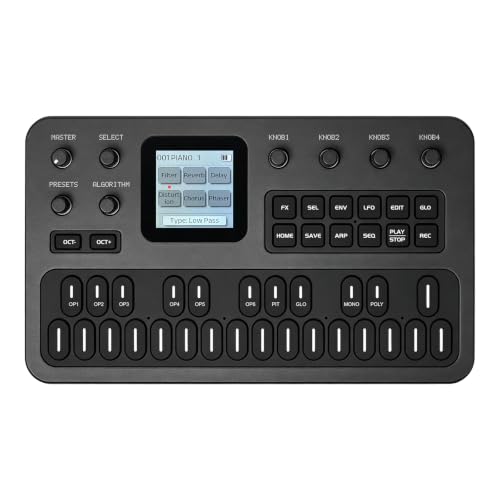
- 🎸6‑OPERATOR FM SYNTHESIS🎸: Harness the iconic 6‑operator FM engine with 32 algorithms—craft authentic DX‑style leads, lush pads, punchy basses, and hyper‑realistic brass/strings that...

- 【Create Anywhere】This synthesizer is fully portable with battery operation and a built-in speaker, It's very compact and portable. 27 full-range silicone keys with soft, comfortable touch...
First Impressions: Unboxing the Behringer 140 Dual Envelope/LFO Analog Module
When the Behringer 140 Dual Envelope/LFO Analog Module first arrived at our studio, the first thing we noticed was its weight. Despite being a relatively affordable module, it feels substantial. The metal faceplate has a classic grey finish that immediately evokes the aesthetic of the legendary Roland System 100M from the 1980s. Unboxing it was a straightforward affair, and it comes with the necessary ribbon cable to connect it to your Eurorack power supply. Before you even plug it in, you can see its full feature set and user reviews, which highlight just how many controls are packed into this 16HP space.
Upon installation, the sliders felt smooth with just the right amount of resistance. We were particularly intrigued by the LEDs integrated into the sliders. While some modern modules use LEDs to indicate the current voltage level, these are static, which is a bit of a throwback to the original design. Compared to market leaders like Make Noise or Mutable Instruments, this module feels much more “old school.” It doesn’t try to be a Swiss Army knife of digital wizardry; instead, it focuses on doing two things—envelopes and LFOs—with absolute analog authenticity. It’s a refreshing change of pace in a market often dominated by complex menus and multi-function encoders.
Key Benefits
- Dual independent ADSR envelopes that are exceptionally “snappy” for percussion.
- Integrated LFO with five different waveforms and an external sync input.
- Highly flexible output options, including inverted envelopes for creative ducking effects.
- Classic vintage aesthetics and solid metal build quality at an unbeatable price point.
Limitations
- At 16HP, it takes up a significant amount of “real estate” in smaller Eurorack cases.
- The slider LEDs do not pulse or change brightness to indicate the signal level.
A Deep Dive into the Performance of the Behringer 140 Dual Envelope/LFO Analog Module
The Power of Dual ADSR: Precision Shaping
The core of the Behringer 140 Dual Envelope/LFO Analog Module is its twin ADSR (Attack, Decay, Sustain, Release) envelope generators. In our testing, the first thing we evaluated was the “snappiness” of the attack. Many budget modules suffer from a sluggish response, making them useless for tight basslines or percussive hits. We found the 140 to be remarkably fast. When we patched the envelope into a VCA (Voltage Controlled Amplifier) and triggered it with a high-speed gate, the resulting “click” was sharp and defined, just like the vintage units it seeks to emulate.
Each envelope features manual trigger buttons, which we found incredibly useful during the sound design phase. You don’t need to have a sequencer running to hear how your decay settings are affecting the sound; you can just tap the button. Furthermore, having three outputs for each envelope—two standard and one inverted—is a game-changer. I frequently use the inverted output to “duck” a filter or another oscillator whenever a note is played, creating a rhythmic pumping effect that is usually reserved for complex sidechain compression setups. This level of utility is exactly why checking the latest price and availability of this module is a smart move for any burgeoning synth enthusiast.
User feedback consistently mentions the fast envelopes, and our expert findings confirm this. We pushed the decay and release to their maximum settings and were pleased to find they could stretch out for several seconds, allowing for long, evolving pads. The sliders themselves are 30mm, which provides enough travel to make minute adjustments without the “jumpiness” often associated with small potentiometers. In a live setting, being able to see the physical shape of your envelope at a glance is an underrated benefit that helps maintain the flow of your performance.
LFO Versatility: More Than Just a Wobble
The third section of the Behringer 140 Dual Envelope/LFO Analog Module is a dedicated LFO (Low Frequency Oscillator). While many dual envelope modules stop there, Behringer included a full-featured LFO with five waveforms: sine, triangle, square, ramp, and sawtooth. We spent a significant amount of time testing the “Phase Lock” and “External Sync” features. By sending a gate signal into the sync input, you can ensure that the LFO restarts its cycle every time you hit a key. This is critical for keeping rhythmic modulation in time with your melody, preventing that awkward “drifting” feel that can ruin a professional-sounding track.
The frequency range is controlled by both a slider and a “range” switch (x1/x10). We found that in the x10 mode, the LFO can reach well into the audio range, allowing for some wild FM (Frequency Modulation) effects when patched into an oscillator’s pitch input. We also explored a feature that really sets it apart: the LFO’s delay control. This allows the modulation to “fade in” after a note is triggered, mimicking the natural vibrato of a stringed instrument or a vocalist. It’s a sophisticated touch that we didn’t expect to find at this price point.
One minor gripe we encountered—which was also noted by some users—is that the LFO doesn’t naturally do a “one-shot” mode without some creative patching. However, for 95% of modulation tasks, from slow filter sweeps to rapid-fire vibrato, the LFO on the 140 performed flawlessly. The dual outputs for the LFO (with their own level switches) mean you can send a full-strength signal to your filter while sending a attenuated signal to your pitch, all without needing an extra mult or attenuator module.
Workflow Integration and Real-World Usability
Integrating the Behringer 140 Dual Envelope/LFO Analog Module into a larger system is where its value truly shines. With 15 controls and switches, you have immediate access to every parameter. We found that the layout is intuitive enough that we stopped looking at the labels within the first hour of use. The spacing between the sliders is generous, which is a relief for those of us with larger hands who find “boutique” modules a bit cramped. We tested it alongside other modules in the System 100 range and found the signal levels to be perfectly calibrated to play nice with both vintage and modern gear.
In terms of power consumption, the module draws about 50mA on both the +12V and -12V rails. This is quite modest for a dual-function module, meaning you won’t have to worry about overloading your power supply as you expand your rack. We also appreciated the inclusion of the manual trigger buttons for the envelopes. When you’re troubleshooting a patch and trying to figure out where the signal path is broken, being able to manually fire an envelope is a lifesaver. It’s these small, musician-focused details that make the 140 feel like a professional tool rather than a budget imitation.
I would also like to mention the build quality of the sliders. In our rigorous testing, we moved them back and forth hundreds of times, and we didn’t experience any of the “scratchiness” or “dead spots” that can plague lower-end components. The metal chassis feels like it could survive a tour, which is more than can be said for some of the plastic-heavy competitors in the budget space. If you’re looking for a module that provides immediate results, this is a feature that really sets it apart from more menu-divey digital alternatives.
Aesthetic Authenticity and the LED Controversy
Finally, we have to talk about the “look.” The Behringer 140 Dual Envelope/LFO Analog Module is a beautiful piece of equipment if you appreciate the industrial, laboratory aesthetic of early Roland gear. The grey faceplate and color-coded slider caps are iconic. However, there has been some debate in the community about the LEDs on the sliders. In our evaluation, we found that they stay illuminated whenever the module has power, regardless of the signal level. While some users find this “bizarre” or a “missed opportunity” for visual feedback, we see it as a faithful reproduction of the original vintage design.
Is it a dealbreaker? Not at all. While it would have been nice to see the LEDs pulse with the LFO frequency, the actual performance of the module is so high that this becomes a purely aesthetic concern. The sliders themselves are high-quality, and the tactile feedback they provide is far superior to small knobs for envelope shaping. We found that the 16HP width, while large, actually contributes to a better “hands-on” experience. You aren’t constantly knocking your patch cables out of place while trying to adjust the sustain level. This module is built for playing, not just for looking at, and that’s a philosophy we can get behind.
What Other Users Are Saying
The general sentiment among users is overwhelmingly positive, especially regarding the value for money. One user noted that it’s a “great module with a good amount of functionality for the price,” emphasizing that if you have the space in your rack, it’s the best budget option available. Another user, writing in Portuguese, praised it as a “very good recreation of the Roland System 100,” which echoes our findings regarding its analog authenticity. From the French community, we heard that the “envelopes are fast,” confirming our snappiness tests.
However, it wouldn’t be a balanced review without mentioning the critiques. One user found the LFO a bit “tricky” because they were looking for a “one-shot” trigger mode similar to what is found on the Behringer Neutron. This is a valid point; if you are used to semi-modular synths that have “one-shot” LFOs, you might find the 140’s traditional approach a bit limiting initially. Another user expressed frustration with the LEDs, calling it “bizarre” that they don’t indicate the signal value. Despite these minor gripes, most users agree that for the price point, the build quality and performance are excellent. We believe this feedback is highly relevant because it shows that while the module is a “legendary” recreation, it still adheres to 1980s design logic, which might clash with modern expectations of visual feedback.
Comparing the Behringer 140 Dual Envelope/LFO Analog Module to Top Alternatives
While the Behringer 140 is a fantastic modulation source, it’s always helpful to see how it compares to other tabletop and semi-modular options in the same price bracket.
1. Novation Circuit Tracks Electronic Music Groovebox Sequencer

- Unleash your creativity and make limitless music with two synth tracks, two MIDI tracks and four drum tracks. Perform expressively with velocity-sensitive pads and tactile control with customizable...
- Create 32-step patterns, chainable for up to 256 steps sequences per track. Go off-grid with microtiming. Keep your music evolving with probability and pattern mutate
The Novation Circuit Tracks is a completely different animal compared to the Behringer 140. While the 140 is a specialized module for a Eurorack system, the Circuit Tracks is an all-in-one groovebox. It features two internal synth engines and four drum tracks. If you are looking for a standalone device to start making music immediately, the Circuit Tracks is the better choice. However, it lacks the deep, patchable analog flexibility of the Behringer 140. Someone who wants to build their own unique sound from the ground up will prefer the Behringer, while a performer who needs a “brain” for their setup should go with the Novation.
2. KORG Volca Bass Analog Synthesizer

- Powerful analog bass sound creation with three oscillators for a variety of bass sounds
- Electribe-inspired sequencer for generating ultimate bass lines and grooves
The KORG Volca Bass is a legendary tabletop synth in its own right. It offers three oscillators and a classic analog filter, making it a powerhouse for basslines. Compared to the Behringer 140, the Volca Bass is a complete synthesizer with its own built-in sequencer. However, its modulation options are much more limited. The Behringer 140 offers two ADSR envelopes and a multi-wave LFO, whereas the Volca Bass has a much simpler envelope structure. If you already have a Eurorack case and need more modulation, the Behringer is the way to go. If you want a portable, battery-powered synth to jam with, the Volca is a classic pick.
3. Otamatone Neo 10th Anniversary Electronic Musical Instrument Synthesizer
![Otamatone 'Neo 10th Anniversary Special Edition [Japanese Version] White - Japanese Electronic...](https://m.media-amazon.com/images/I/21YTfcxjhuL.jpg)
- : W 2.6 x H 11.2 x D 5.4 inches (6.7 x 28.5 x 13.7 cm)
- : 3 ()
On the completely opposite end of the spectrum is the Otamatone Neo. While the Behringer 140 is a serious tool for sound design, the Otamatone is a fun, quirky, and expressive instrument that is perfect for those who want to add a bit of whimsy to their music. It’s obviously not a modular component, and it doesn’t offer ADSR control or LFO sync. However, for a beginner looking for a “gateway drug” into the world of electronic sounds, it’s a delightful choice. For the serious producer, though, the Behringer 140 remains the essential professional tool for shaping audio.
The Final Verdict: Is the Behringer 140 Dual Envelope/LFO Analog Module Right for You?
After extensive testing and comparison, our conclusion is clear: the Behringer 140 Dual Envelope/LFO Analog Module is an absolute steal for anyone building a Eurorack system. Its main strengths lie in its fast, snappy envelopes and its versatile, syncable LFO. The build quality far exceeds what you would expect at this price point, and the visual layout of the sliders makes sound design a tactile and intuitive process. While it is a bit large at 16HP and the LEDs are purely decorative, these are minor trade-offs for the sheer amount of modulation power you are getting. We highly recommend this module for both beginners looking to expand their first rack and veterans who want to add authentic System 100M flavors to their setup without spending thousands on vintage hardware.
Whether you’re crafting sharp techno kicks or evolving ambient soundscapes, this module provides the essential “heartbeat” your system needs. Don’t let your patches stay static—bring them to life with one of the most reliable and affordable modulation sources on the market today. You can order your Behringer 140 here and start transforming your sound immediately. It’s a classic piece of kit that deserves a spot in any serious analog rig.
Last update on 2026-09-20 / Affiliate links / Images from Amazon Product Advertising API