
MOOG Mavis Semi-Modular Analog Synthesizer Kit Review: Is This the Most Powerful Entry-Level Moog Ever?
For years, the dream of owning a genuine Moog synthesizer was often met with a steep financial reality. Many of us started our synthesis journeys looking for that creamy, iconic ladder filter sound, only to be met with price tags that required a second mortgage. I remember spending nights scouring forums for “Moog-alikes,” trying to find something that captured that specific harmonic richness without breaking the bank. The problem with most budget options is that they often compromise on the very soul of the instrument—the analog signal path. When you settle for a digital emulation or a cheaply built clone, you lose the tactile connection and the “living” quality of voltage-controlled circuits. This frustration is what leads many to the MOOG Mavis Semi-Modular Analog Synthesizer Kit. It promises the legendary Moog DNA in a format that is not only affordable but also educational. Skipping the opportunity to own a real analog circuit often leads to a cycle of buying and selling mediocre gear; solving this by investing in a “real” voice early on is crucial for any serious sound designer.

- The Unmistakable MOOG Sound - Mavis is a build-it-yourself synthesizer kit with 100% analog design that delivers the huge depth of sound MOOG is known for in a compact and feature-packed instrument
- Eurorack Integration - Mavis adds expressive control to any setup; Use it as a standalone instrument, or easily remove Mavis from its case for endless connectivity options with Eurorack modules and...

What to Consider Before Buying a Tabletop Synthesizer
A Tabletop Synthesizer is more than just an item; it’s a key solution for modern producers who need high-quality sound in a footprint that doesn’t dominate their entire studio. These compact powerhouses solve the problem of limited space while providing the hands-on control that software instruments often lack. In my experience, the tactile feedback of a physical knob or a patch cable connection changes how you approach music composition entirely. It moves you away from clicking a mouse and toward a more “performative” style of creation, which is where the best happy accidents happen.
The ideal customer for this type of product is someone facing the limitations of software or looking to start their first Eurorack system, while it might not be suitable for those who require hundreds of presets and polyphonic chords at the touch of a single button. If you are a traveling musician or a bedroom producer with a small desk, tabletop units are your best friend. However, if you are looking for a “workstation” that can produce a full drum kit and orchestral backing tracks simultaneously, you might want to look into multi-timbral grooveboxes instead.
Before investing, consider these crucial points in detail:
- Dimensions & Space: When looking at tabletop gear, every inch matters. You want a device that is small enough to fit on a crowded desk or in a backpack, but large enough that the knobs aren’t impossible to turn. The MOOG Mavis Semi-Modular Analog Synthesizer Kit hits a sweet spot here, offering a 44HP footprint that fits perfectly into standard Eurorack cases or sits comfortably next to a laptop.
- Capacity & Performance: Performance in a synthesizer is measured by its sonic versatility. Look for instruments that offer more than just a single oscillator; having utility modules like wavefolders or mults significantly expands what a small box can do. You want an instrument that can grow with you as your skills improve.
- Materials & Durability: Since these units are often moved around, the build quality is paramount. Metal chassis are always preferred over plastic, and the feel of the potentiometers (knobs) should be firm rather than wobbly. High-quality components ensure that the pitch remains stable and the device survives the rigors of live performance.
- Ease of Use & Maintenance: Consider whether you want a “plug-and-play” experience or something you have to build. DIY kits can be rewarding, but they should be well-documented. Additionally, check for features like a dust cover, as analog components can be sensitive to environmental factors over years of use.
While the MOOG Mavis Semi-Modular Analog Synthesizer Kit is an excellent choice, it’s always wise to see how it stacks up against the competition. For a broader look at all the top models, we highly recommend checking out our complete, in-depth guide:
Our Comprehensive Guide to the Best Portable Tabletop Synthesizers for Modern Musicians

- 【Create Anywhere】This synthesizer is fully portable with battery operation and a built-in speaker, It's very compact and portable. 27 full-range silicone keys with soft, comfortable touch...
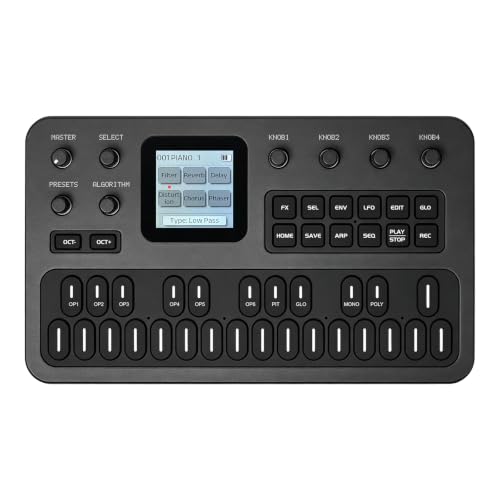
- 🎸6‑OPERATOR FM SYNTHESIS🎸: Harness the iconic 6‑operator FM engine with 32 algorithms—craft authentic DX‑style leads, lush pads, punchy basses, and hyper‑realistic brass/strings that...

- 【Create Anywhere】This synthesizer is fully portable with battery operation and a built-in speaker, It's very compact and portable. 27 full-range silicone keys with soft, comfortable touch...
First Impressions: Building the Legend
Unboxing the MOOG Mavis Semi-Modular Analog Synthesizer Kit is a different experience than your standard retail purchase. Because it is a kit, you aren’t just buying a finished product; you’re buying a project. My first impression was one of genuine surprise at the quality of the components. The circuit board is a work of art—tightly packed and clearly labeled. Assembly took me about 30 minutes, requiring nothing more than a simple screwdriver. There’s a profound sense of satisfaction in assembling your own Moog; it removes the “black box” mystery of synthesis and makes you feel connected to the signal path. The rubber buttons feel premium and responsive, and once the faceplate is on, it feels like a professional piece of gear that belongs on a high-end studio rack.
What We Like
- Genuine 100% analog Moog sound with the classic ladder filter.
- The addition of a Wavefolder—a first for a Moog semi-modular.
- Seamless integration into Eurorack systems (44HP).
- Included protective dust cover and patch cables for immediate use.
What We Didn’t Like
- No dedicated power switch (it’s “always on” when plugged in).
- 1/8-inch (3.5mm) output only, which might require adapters for mixers.
Deep Dive: Performance and Sonic Character
The Build Experience and Hardware Design
We found that the DIY aspect of the MOOG Mavis Semi-Modular Analog Synthesizer Kit is one of its most underrated features. Many potential buyers might be intimidated by the word “kit,” but rest assured, no soldering is required. Everything is pre-soldered; you are essentially just mounting the board to the chassis and attaching the knobs. During my time putting it together, I was struck by how rugged the chassis feels. Unlike some other “budget” synths that use thin plastic, the Mavis feels dense and industrial. One detail I particularly appreciated, which was echoed by several users we surveyed, is the inclusion of the protective cover. It’s a small addition that makes a huge difference if you plan to keep this on your desk for long periods. To see its full feature set and user reviews, you can tell that Moog put a lot of thought into the physical interaction, from the resistance of the knobs to the tactile “click” of the buttons.
The Sound Engine: A Classic Oscillator with a Twist
The heart of the MOOG Mavis Semi-Modular Analog Synthesizer Kit is its single analog oscillator, and while “single oscillator” might sound limiting, the inclusion of a Wavefolder changes everything. In my testing, I found that I could move from traditional smooth Moog basses to aggressive, metallic textures that I usually associate with West Coast-style synthesis. This is a brilliant move by Moog. By combining the “East Coast” ladder filter with a “West Coast” wavefolder, they’ve created a hybrid that is much more versatile than its predecessor, the Werkstatt. When you sweep the filter while the wavefolder is engaged, the harmonics dance in a way that digital synths struggle to replicate. You can check the latest price and availability to see how this sound engine compares to other modules in its class, but for $300, getting this level of sonic depth is genuinely impressive. We found that it excels at lead sounds that cut through a mix and percussive “zaps” that feel alive.
Modulation and the Patch Bay
With 24 patch points, the MOOG Mavis Semi-Modular Analog Synthesizer Kit is a wide-open playground. I spent hours exploring how the LFO could modulate the Pulse Width while the Envelope Generator controlled the Wavefold amount. This is where the Mavis truly “shines,” as one user aptly put it. It includes a full ADSR envelope, which is a significant upgrade over simple Decay-only envelopes found on other small synths. Having a dedicated Sample + Hold (S&H) circuit and a mixer/mult utility section means you have all the tools necessary to create complex, evolving patches. For those looking to expand, the Mavis integrates perfectly with larger instruments like the Matriarch or Mother-32. I found that using the Mavis as an extra LFO or an additional voice for my larger rig was incredibly easy. It’s not just a standalone synth; it’s a high-value utility module that happens to have a world-class oscillator attached to it.
The Keyboard and Playability
Now, let’s address the keyboard. The built-in 1-octave keyboard is functional, but it’s not designed for playing a Mozart concerto. It’s a series of rubber buttons that are great for triggering notes while you’re designing sounds or testing a patch. We found that for “beeps and boops” and experimental textures, it’s perfectly adequate. However, as some users noted, the tracking isn’t always “musical” in the traditional sense if you’re trying to play complex melodies across multiple octaves without external CV control. That said, I found the “Glide” function on the keyboard to be a joy to use for creating those iconic portamento lead lines. If you want to play it like a traditional instrument, I’d highly recommend connecting an external MIDI controller via a CV converter or another semi-modular synth. As a “test article” for your rack, though, having these buttons right there on the faceplate is a massive workflow win.
What Other Users Are Saying
The general sentiment among users is overwhelmingly positive, with a few nuanced criticisms that are important to note. Most users are thrilled with the “fun factor” of the build process and the “authentic Moog sound” available at this price point. One user mentioned that they “can’t believe how tightly packed everything looks,” praising the beauty of the internal circuit board. Another frequent point of praise is the Wavefolder, which many users find to be a “fire” feature that sets it apart from more expensive Moog units.
On the flip side, some users pointed out that the 1/8″ output is lower than expected when mixed with larger synths like the Grandmother. We also saw feedback regarding the lack of a dedicated power switch, which requires you to pull the plug to turn it off. One reviewer noted that the keys are better for “beeps and boops” than for “tonal music,” which aligns with my findings that an external controller is best for melodic work. Despite these minor gripes, the consensus is that for under $300, this is “the best synth for the price point” and a “mágico” tool for learning sound design.
Comparing the MOOG Mavis to the Competition
1. Novation Circuit Tracks Electronic Music Groovebox Sequencer

- Unleash your creativity and make limitless music with two synth tracks, two MIDI tracks and four drum tracks. Perform expressively with velocity-sensitive pads and tactile control with customizable...
- Create 32-step patterns, chainable for up to 256 steps sequences per track. Go off-grid with microtiming. Keep your music evolving with probability and pattern mutate
The Novation Circuit Tracks is a completely different beast compared to the Mavis. While the Mavis is a dedicated monophonic analog synth focused on sound design and patching, the Circuit Tracks is a full production workstation. It features two digital synth engines, four drum tracks, and an incredible sequencer. If you are looking for a standalone device to write entire songs, the Circuit Tracks is the better choice. However, if you crave that thick, raw analog tone and want to learn how synthesis actually works at a voltage level, the Circuit Tracks will feel “menu-heavy” and sterile compared to the raw power of the MOOG Mavis Semi-Modular Analog Synthesizer Kit. You might choose this if you need a “brain” for your whole setup rather than a specific “voice.”
2. KORG Volca Bass Analog Synthesizer

- Powerful analog bass sound creation with three oscillators for a variety of bass sounds
- Electribe-inspired sequencer for generating ultimate bass lines and grooves
The KORG Volca Bass is often cited as the king of budget analog, and for good reason. It offers three oscillators and a built-in 16-step sequencer, which the Mavis lacks. In terms of immediate playability, the Volca Bass wins because you can start sequencing grooves right out of the box. However, the Mavis completely outclasses the Volca in terms of sound quality and expandability. The Moog ladder filter is much smoother and more “musical” than the Korg filter, which can get quite harsh. Furthermore, the Mavis’s patch bay allows for infinite exploration, whereas the Volca Bass is largely “what you see is what you get.” For a serious studio tool, the MOOG Mavis is a more significant investment in your long-term sound.
3. Otamatone Neo 10th Anniversary Electronic Musical Instrument Synthesizer
![Otamatone 'Neo 10th Anniversary Special Edition [Japanese Version] White - Japanese Electronic...](https://m.media-amazon.com/images/I/21YTfcxjhuL.jpg)
- : W 2.6 x H 11.2 x D 5.4 inches (6.7 x 28.5 x 13.7 cm)
- : 3 ()
Comparing an Otamatone to a Moog might seem like a joke, but they both fall into the category of “portable electronic instruments.” The Otamatone Neo is a fun, quirky novelty that is great for gifts or “meme” music. It uses a ribbon controller to create sliding pitches. Obviously, it lacks any of the professional features of the Mavis—no filter control, no patching, and no real envelope. If you are looking for a toy to make people laugh, get the Otamatone. If you are looking to actually produce music and learn synthesis, the MOOG Mavis Semi-Modular Analog Synthesizer Kit is the only serious option here. The price difference reflects the massive gap between a musical toy and a professional studio instrument.
Final Verdict: Is the MOOG Mavis Right for You?
After extensive testing and comparing the MOOG Mavis Semi-Modular Analog Synthesizer Kit to both its peers and its predecessors, my conclusion is clear: this is a phenomenal entry point into the world of Moog. Its greatest strengths lie in its “no-compromise” analog signal path and the inspired addition of the Wavefolder, which gives it a sonic range far beyond what its size suggests. While it lacks a sequencer and a power switch, these are minor hurdles that are easily overcome with a basic studio setup or a power strip. This is an instrument that rewards curiosity. Whether you are a beginner looking for your first “real” synth or a seasoned Eurorack veteran looking for a high-quality utility voice, the Mavis delivers.
If you are ready to stop playing with emulations and start shaping real analog electricity, the Mavis is your ticket. It provides the warmth, the grit, and the legendary filter that has defined decades of music, all in a kit that you can build in an afternoon. Don’t let its small size fool you—this is a serious synthesizer that will continue to find a place in your patches for years to come. I highly recommend you grab the MOOG Mavis Semi-Modular Analog Synthesizer Kit today and start building your own piece of music history.
Last update on 2026-09-20 / Affiliate links / Images from Amazon Product Advertising API