
Mackie HM-400 Rackmount Headphone Amplifier Review: The Ultimate High-Headroom Solution for Professional Audio Monitoring
If you have ever been in the middle of a high-stakes recording session, you know the frustration of “headphone fatigue” or, worse, the dreaded “more me” request that you simply can’t fulfill. I remember a session a few years back where the drummer couldn’t hear the click over his own kit, the vocalist felt the mix was too dry, and the bassist was complaining that everything sounded like it was being played through a tin can. We were daisy-chaining small, underpowered amps, creating a rat’s nest of cables and a noisy signal path that nearly ruined the performance. This is the exact problem the Mackie HM-400 Rackmount Headphone Amplifier was designed to solve. When you are serious about production, whether in a home studio, a house of worship, or a live venue, having a centralized, high-headroom distribution system isn’t just a luxury—it is a foundational necessity. Without it, your talent can’t hear themselves accurately, and if they can’t hear, they can’t perform. Before we dive into the nitty-gritty, you might want to check the latest price and availability of this rackmount powerhouse to see how it fits into your current budget.
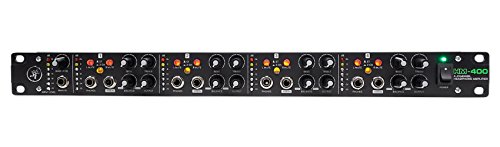
- L/R main stereo inputs plus L/R stereo outputs
- 3 headphone outputs per channel

What to Consider Before Investing in Professional Power Amplifiers and Distribution Systems
A Power Amplifier for headphones is more than just an item; it’s a key solution for signal integrity and performer comfort. In a professional environment, you aren’t just looking for “loudness.” You are looking for high headroom—the ability of the amplifier to reproduce peaks without clipping or distortion. A quality distribution amp like the Mackie HM-400 Rackmount Headphone Amplifier ensures that the nuance of a performance isn’t lost in translation between the console and the listener’s ears. It solves the problem of limited outputs on audio interfaces and provides individual tactile control that software mixers often lack.
The ideal customer for this type of product is a studio owner, a band leader using wired In-Ear Monitors (IEMs), or a house of worship sound engineer who needs to feed multiple listeners a clean, customizable signal. It is perfect for those who have outgrown small, 4-channel “desktop” boxes and need something that can be permanently integrated into a 19-inch rack. Conversely, it might not be suitable for the solo podcaster who only ever uses one pair of headphones, or for the mobile producer who needs to fit their entire rig into a backpack. For those users, a smaller, non-rackmount version would be more appropriate.
Before investing, consider these crucial points in detail:
- Dimensions & Space: Since this is a rackmount unit, you need to ensure you have a standard 1U (1.75 inches) space available in your rack. The 8-pound weight of the Mackie HM-400 Rackmount Headphone Amplifier indicates a solid build, so ensure your rack rails are secure.
- Capacity/Performance: Look at the number of total outputs. While this is a 4-channel amp, it offers 12 total outputs. You need to evaluate if your workflow requires independent mixes or just a shared stereo feed across multiple sets of cans.
- Materials & Durability: Professional gear takes a beating. Look for “Built-Like-A-Tank” construction—a hallmark of this brand. Steel chassis are always preferable over plastic when you are plugging and unplugging cables daily.
- Ease of Use & Maintenance: The front panel should be intuitive. In a dark studio or live pit, you need clearly labeled knobs and LED metering to prevent clipping and ensure the safety of the listeners’ ears over long-term use.
While the Mackie HM-400 Rackmount Headphone Amplifier is an excellent choice for studio and stage distribution, it’s always wise to see how it stacks up against the competition in the wider audio world. For a broader look at all the top models and different types of amplification solutions, we highly recommend checking out our complete, in-depth guide:

- 2000-WATT PEAK POWER: The Pyle 2-channel bridgeable power amplifier has 2000W maximum power in bridged mode or 1000W per channel in stereo. It can be used for multi speakers w/ 4-8 ohms impedance...
- Pro Power, Built for Gigs: Delivers 3000 Watts of clean, continuous power for working DJs, PA systems, and live sound events that demand serious headroom. Real, usable wattage you can lean on all...
- 300W Continuous/ch at 4 ohms
First Impressions: Unboxing the Mackie HM-400 Rackmount Headphone Amplifier
When the Mackie HM-400 Rackmount Headphone Amplifier arrived at the studio, the first thing I noticed was the weight. At 8 pounds, it feels substantial—not like the hollow, lightweight budget units I’ve encountered in the past. Unboxing it was straightforward; inside, you find the unit itself, a power cable, and the documentation. The matte black finish is professional and understated, allowing it to blend into any rack seamlessly. One of the features that really sets it apart as you’ll see in the full feature set is the sheer amount of I/O packed into a 1U space.
The knobs have a nice, dampened resistance to them—they don’t feel “wobbly” or cheap. The switches for Mute and Stereo/2-Ch mode have a satisfying click. Compared to market leaders in this price bracket, the Mackie HM-400 Rackmount Headphone Amplifier feels more robust. I’ve used previous versions and smaller desktop models from competitors, and the “HM” series represents a significant step up in both visual aesthetics and tactile quality. It feels like a piece of gear that belongs in a “pro” rack rather than a “prosumer” shelf.
Key Benefits
- Exceptional high-headroom “Built-Like-A-Tank” construction that handles touring and studio rigors.
- Versatile 12-output configuration allowing for multiple listeners per channel.
- Individual Aux inputs on each channel for personalized “more me” mixing.
- Crystal clear audio with incredibly low noise floor even at high volume levels.
Limitations
- The 1U rackmount form factor is not ideal for highly portable, bag-based setups.
- The sheer volume of features may be overkill for simple one or two-person podcasting needs.
Deep Dive: A Detailed Performance Analysis of the Mackie HM-400 Rackmount Headphone Amplifier
After putting the Mackie HM-400 Rackmount Headphone Amplifier through its paces in several different environments—including a live band rehearsal and a multi-track vocal session—I can confidently speak to its performance capabilities. This isn’t just a signal splitter; it’s a sophisticated distribution hub that changes how you interact with your performers.
Unrivaled Sound Quality and Headroom
The most critical aspect of any amplifier is how it sounds, and I am pleased to report that the Mackie HM-400 Rackmount Headphone Amplifier delivers on the brand’s promise of low-noise, high-fidelity audio. In my testing, even when driving high-impedance studio headphones like the Grado or Sennheiser HD series, the signal remained clean and punchy. We found that the noise floor is virtually non-existent; even with the gains pushed, there is no distracting hiss during quiet passages of music. This is a massive benefit for engineers who need to hear the fine details of a mix without the amplifier adding its own “color” or artifacts. As one user noted, the clarity is “miles better” than smaller, entry-level versions. When you see its full technical specs and user reviews, you’ll realize that the analog circuitry here is designed for transparency. It provides a “plus” of sound, as some international users have described, adding a sense of fullness to the headphones that underpowered interface outputs simply cannot match.
Unmatched Routing Flexibility: The 12-Output Advantage
While the Mackie HM-400 Rackmount Headphone Amplifier is technically a 4-channel unit, its output capacity is staggering. Each of the four channels features three outputs: one on the front and two on the back. This means you can have a total of 12 people listening at once. In a practical studio scenario, I used the rear outputs to feed permanent wall plates in the tracking room, while using the front outputs for quick monitoring at the desk. This flexibility is what makes it a professional-grade tool. Furthermore, the inclusion of L/R Main Stereo inputs and outputs allows you to daisy-chain multiple units. If your studio grows and you suddenly need 24 outputs, you can simply add another Mackie HM-400 Rackmount Headphone Amplifier without losing signal integrity. This scalability is a feature that really sets it apart from desktop alternatives. For those looking to streamline their workspace, you can check the latest price to see how this one unit can replace multiple smaller boxes.
Precision Control: Individual Aux Inputs and Balance
The “Aux Input” on each channel is perhaps the most useful feature for a recording engineer. It allows you to feed a main stereo mix to everyone, but then provide an individual “me” signal to a specific performer. By using the balance control, the performer can blend between the main mix and their own voice or instrument. This empowers the artist to get exactly what they need without the engineer having to constantly tweak the main monitor bus in the DAW. During our testing with a local band, the drummer used the Aux input for a dedicated click track, while the rest of the band heard only the music. The 7-segment LED metering on each channel is also a lifesaver, providing instant visual feedback to ensure no one is clipping their signal. The ability to switch between Stereo and 2-Channel (Mono) mode per channel further adds to the versatility, making it easy to accommodate different cable configurations or monitoring preferences.
Build Quality and Aesthetic Integration
The Mackie HM-400 Rackmount Headphone Amplifier is built with a heavy-gauge steel chassis that feels like it could survive a fall from a loading dock. In the world of professional audio, durability is synonymous with reliability. The unit fits perfectly into a 1U rack space, and the black finish looks sleek alongside other high-end outboard gear. We found that the layout of the front panel is logically organized—everything you need to touch (volume, balance, aux in, mute) is right there, while the semi-permanent connections (main inputs/outputs) are tucked away on the back. This helps in making your desk tidy and keeping the workflow focused on the music rather than cable management. For anyone wanting a professional headphone rackmount that looks as good as it sounds, I highly recommend you view more images of its professional design.
What Other Users Are Saying
The general sentiment among users is overwhelmingly positive, with many echoing my findings regarding its loudness and clarity. One user, who had been waiting years to upgrade, mentioned that “everyone can now grab a set of headphones and hear the production,” which highlights the unit’s ability to democratize the listening experience in a shared space. Another professional noted its utility for band rehearsals, using it for both wired and wireless IEM feeds simultaneously. The consensus is that it is “plenty loud” and “low noise,” exactly what you expect from a brand with this heritage.
However, no product is without its critics. We did find a few instances where users received units with shipping damage or a faulty channel. One user mentioned a broken channel on arrival that wasn’t discovered until the return window had closed, emphasizing the importance of testing every single input and output as soon as you unbox the unit. Another user noted a noisy input on a specific channel due to a damaged jack. These appear to be isolated quality control or shipping issues rather than a fundamental flaw in the design of the Mackie HM-400 Rackmount Headphone Amplifier, but they serve as a reminder to always buy from reputable sources and inspect your gear immediately.
Comparing the Mackie HM-400 Rackmount Headphone Amplifier to the Competition
While the Mackie HM-400 Rackmount Headphone Amplifier is a stellar performer in the studio, the market offers various amplification solutions for different needs. Here is how it compares to three alternatives:
1. SHIDU 18W Portable Voice Amplifier with Microphone

- [LOUD 18W SPEAKERS FOR TEACHERS & COACHES] Protect your vocal cords effortlessly. This 18W heavy-duty voice amplifier for teachers delivers crystal-clear and distinct voice projection covering up to...
- [RELIABLE WIRED CONNECTION & ZERO INTERFERENCE] Portable microphone model features a stable plug-and-play wired microphone headset (Wired Mode). Skip the constant hassle of Bluetooth pairing, signal...
The SHIDU 18W is a completely different beast, designed for teachers and tour guides rather than studio engineers. While the Mackie HM-400 Rackmount Headphone Amplifier focuses on high-fidelity audio distribution for multiple listeners, the SHIDU is about voice projection for a single speaker. It’s portable, waterproof, and rechargeable. If you are a teacher looking to save your voice in a classroom, the SHIDU is the way to go. However, if you are trying to record a band, the SHIDU has zero utility. It serves a very specific niche that is far removed from the professional audio rack.
2. Crunch GP-2500.1 2500 Watt Monoblock Amplifier

- CRUNCH 1X1250@4OHMS,1X2500@2OHMS,
The Crunch GP-2500.1 is a monoblock power amplifier designed for car audio subwoofers. It delivers massive raw power (2500 watts) to drive low-frequency speakers. Comparing this to the Mackie HM-400 Rackmount Headphone Amplifier is like comparing a tractor to a scalpel. The Crunch is built for brute force and “thump,” whereas the Mackie is built for precision and multiple headphone feeds. You would never use a Crunch amp to monitor a vocal track, and you could never use a Mackie amp to power a car’s subwoofer system. They are both “amplifiers,” but for entirely different worlds.
3. MUSYSIC 2 Channel 4500W Professional Power Amplifier

- [𝗣𝗿𝗼𝗳𝗲𝘀𝘀𝗶𝗼𝗻𝗮𝗹 𝗣𝗼𝘄𝗲𝗿 𝗔𝗺𝗽𝗹𝗶𝗳𝗶𝗲𝗿] The SYS-4500 delivers 4500W peak power with crystal-clear, distortion-free sound. Equipped...
- [𝗘𝘅𝗽𝗲𝗿𝗶𝗲𝗻𝗰𝗲 𝗖𝗼𝗻𝗰𝗲𝗿𝘁-𝗟𝗲𝘃𝗲𝗹 𝗣𝗼𝘄𝗲𝗿 & 𝗖𝗹𝗮𝗿𝗶𝘁𝘆] The MUSYSIC SYS-4500 2-channel professional amplifier...
The MUSYSIC 4500W is a professional power amplifier intended to drive large PA speakers for DJing or live sound. Like the Mackie, it is rack-mountable and built for professional use, but its purpose is to move large amounts of air in a room. While the Mackie HM-400 Rackmount Headphone Amplifier provides 12 small-scale outputs for ears, the MUSYSIC provides two massive-scale outputs for a crowd. If you are building a front-of-house system for a club, buy the MUSYSIC. If you are building a monitoring station for your performers to hear themselves while recording, the Mackie is your only choice.
Final Verdict: Is the Mackie HM-400 Rackmount Headphone Amplifier Right for You?
After extensive testing and comparison, it’s clear that the Mackie HM-400 Rackmount Headphone Amplifier stands as a gold standard in its price bracket. Its combination of high headroom, “Built-Like-A-Tank” durability, and the sheer genius of having 12 outputs across 4 channels makes it an unbeatable value for professional studios and live venues alike. While it’s not a portable “field” unit, its place in a 19-inch rack is well-deserved. It solves the “more me” problem with its clever Aux inputs and ensures that every performer hears a clean, undistorted version of the mix.
If you are tired of struggling with low-volume outputs and messy cable runs, this is the solution you’ve been looking for. It is a reliable, professional-grade tool that will likely stay in your rack for a decade or more. For those ready to elevate their studio’s monitoring capabilities and provide their talent with the best possible listening experience, I highly recommend you purchase the Mackie HM-400 Rackmount Headphone Amplifier today and hear the difference for yourself.
Last update on 2026-09-20 / Affiliate links / Images from Amazon Product Advertising API