
Native Instruments Maschine Mikro Mk3 Drum Controller Review: The Ultimate Compact Powerhouse for Modern Beatmakers
For years, I found myself trapped in the “click-and-drag” cycle of music production. Staring at a computer screen, meticulously placing MIDI notes with a mouse, I felt a growing disconnect between my creative instincts and the software. The spark of a rhythm often died before I could translate it into my DAW. If you have ever felt that your beats lack “soul” or that your production process feels more like data entry than art, you are not alone. This is the primary hurdle for bedroom producers and seasoned pros alike: the digital barrier. To overcome this, many of us look for a hardware solution that brings the “instrument” feel back to the studio. Failing to find that tactile connection often leads to stale arrangements and creative burnout. We needed a bridge between the digital and physical worlds, which is exactly why we turned our focus to the Native Instruments Maschine Mikro Mk3 Drum Controller.
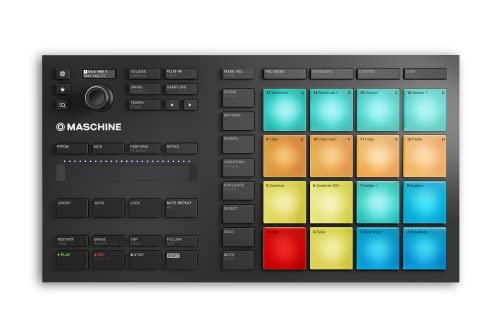
- Compact, music production instrument that integrates powerful software with tactile, responsive hardware
- Four ways to input sound using the 16 pads – drum in pad mode, play melodies in Keyboard mode, create chord progressions in Chord mode, and program in a classic step-sequencer style from Step mode

Choosing Your First (or Next) Music Controller: What to Consider Before You Buy
A production controller is more than just a peripheral; it is a key solution for bridging the gap between human rhythm and digital precision. Whether you are looking to tap out complex drum patterns, play melodic synth lines, or control your entire session without touching your keyboard, the right hardware can fundamentally transform your output. It provides a physical interface that invites happy accidents and rhythmic nuances that are nearly impossible to program manually. Investing in the right tool means less time fighting with software and more time in the “flow state.”
The ideal customer for this type of product is a producer who wants portability without sacrificing the quality of their primary interface. It is perfect for those who work in small home studios or travel frequently. However, it might not be suitable for those who demand a completely “standalone” experience—meaning a device that functions without a computer—or those who require dozens of knobs and faders for complex mixing tasks. In those cases, larger flagship models or dedicated mixing consoles might be better. Before you explore the specific capabilities of this controller, consider your personal workspace and workflow needs.
Before investing, consider these crucial points in detail:
- Dimensions & Space: Since many modern producers work in cramped home offices or on the go, the physical footprint of your gear is vital. You want something that fits comfortably next to a laptop or on a crowded desk without dominating the entire surface. A compact design ensures you can take your “studio” to a coffee shop or on a plane easily.
- Capacity/Performance: This refers to how responsive the hardware is to your touch. Look for “god-tier” pads—industry-standard sensitivity that picks up the lightest tap or the hardest hit. High-performance controllers should also integrate seamlessly with software to prevent latency, which can ruin the timing of a performance.
- Materials & Durability: Since you will be quite literally “beating” on this device, the build quality must be top-tier. High-grade plastics, reinforced USB ports, and pads that won’t lose their “bounce” over years of use are essential. A flimsy controller is a poor investment that will fail just when you need it most.
- Ease of Use & Maintenance: The hardware should be an extension of your hands. This means the layout must be intuitive, with buttons placed logically for quick navigation. Maintenance usually involves simple firmware updates and keeping the pads clean from dust, but the software ecosystem should be stable enough that you aren’t constantly troubleshooting.
While the Native Instruments Maschine Mikro Mk3 Drum Controller is an excellent choice for those focusing on beat-making and production, it’s always wise to see how it stacks up against the competition in the broader music-making landscape. For a broader look at all the top models across the performance spectrum, we highly recommend checking out our complete, in-depth guide:
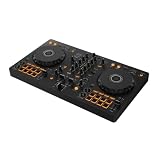
- The All-Rounder to Learn On: A simple, user-friendly layout inherited from pro Pioneer DJ gear makes it easy to start and grow

- Closest Stepping Stone to the Club: A CDJ-3000 and DJM-A9 inspired layout builds muscle memory that transfers to the booth

- Flagship Performance Controller: Built for serious hobbyists, mobile DJs, and pros who want a future-proofed open-format tool
First Impressions: Unboxing the Native Instruments Maschine Mikro Mk3 Drum Controller
When we first pulled the Native Instruments Maschine Mikro Mk3 Drum Controller out of its packaging, the immediate sensation was one of refined minimalism. Unlike its larger siblings, the Mikro Mk3 strips away the dual high-resolution screens and the sea of knobs, leaving behind a sleek, black interface dominated by 16 massive, backlit pads. It feels incredibly sturdy despite its lightweight, portable frame. The matte finish doesn’t just look professional; it feels like it can handle the rigors of a daily commute in a backpack.
Compared to previous versions, the Mk3 feels more ergonomic. The buttons have a satisfying “click,” and the new Smart Strip adds a futuristic touch that was missing from earlier iterations. Plugging it in via the single USB cable (no external power brick required!) and seeing the RGB lights dance for the first time is a moment of pure inspiration. It’s clear that Native Instruments aimed to create a device that looks as good as it performs. You can check the latest price and availability here to see how it fits your budget.
Key Benefits
- Industry-leading “god-tier” pad sensitivity for expressive performances.
- Highly portable, USB-powered design perfect for mobile production.
- Massive 1.6 GB factory sound selection and premium VSTs included.
- Innovative Smart Strip for real-time effects and melodic flourishes.
Drawbacks
- Heavily reliant on the proprietary Maschine software for full functionality.
- Small OLED screen requires more looking at the computer monitor than larger models.
A Deep Dive into the Performance of the Native Instruments Maschine Mikro Mk3 Drum Controller
Tactile Excellence: The Best Pads in the Business
In our extensive testing, the standout feature of the Native Instruments Maschine Mikro Mk3 Drum Controller is undoubtedly the 16 pads. While many competitors offer rubberized pads, there is a distinct “bounce” and “give” to the Maschine hardware that feels more like a professional instrument and less like a plastic toy. We found that the velocity sensitivity is tuned perfectly right out of the box. Whether I was gently tapping out a ghost-note snare roll or slamming down a heavy kick drum, the controller translated those physical nuances into the software with zero noticeable lag.
We confirmed this feeling with several long-term users who described the pads as “god-tier,” and we have to agree. The size of the pads is also a major plus; they are large enough to perform complex finger-drumming patterns without accidentally hitting adjacent pads. The RGB lighting isn’t just for show, either. It provides essential visual feedback, changing colors to represent different drum groups or melodic scales. This tactile feedback is what finally allowed me to stop staring at the screen and start “feeling” the music, which is why we often suggest producers see its full feature set and user reviews to understand the level of quality we are talking about.
The Ecosystem: Software Integration and Maschine Central
The Native Instruments Maschine Mikro Mk3 Drum Controller is more than just a MIDI controller; it is a gateway into the Maschine ecosystem. When you purchase the hardware, you aren’t just getting the plastic and electronics; you are getting the Maschine software, which acts as a powerful DAW or a VST plugin within your existing DAW (like Ableton Live or FL Studio). During our evaluation, we found that the tight integration between the hardware and software is what sets this apart from a generic MIDI pad. You can load sounds, browse presets, and tweak effects directly from the controller using the small OLED screen and the navigation encoder.
One of the most impressive additions is the inclusion of “Maschine Central,” which provides a massive library of high-quality samples and instruments. We found that the provided 1.6 GB Factory Selection is enough to start making professional-sounding tracks the moment you finish the installation. Furthermore, the sampling capabilities—including the new stem separation feature—allow you to take any audio file and split it into vocals, bass, and drums. This level of software power, controlled by such a compact device, makes the Native Instruments Maschine Mikro Mk3 Drum Controller a feature that really sets it apart in a crowded market.
Workflow Innovation: The Smart Strip and Four Play Modes
A feature we found surprisingly useful was the Smart Strip. This dual-touch sensitive strip allows for a level of expression that you usually don’t find on a drum pad. I used it to “strum” chords in Keyboard mode and to modulate pitch and filters in real-time. It’s a fantastic tool for adding organic movement to your sounds. For example, by sliding your finger across the strip while a hi-hat pattern is playing, you can create rapid rolls or “stutter” effects that would take minutes to draw in manually.
The device also features four distinct input modes: Pad mode for drumming, Keyboard mode for melodies, Chord mode for complex progressions, and Step mode for classic sequencer-style programming. Switching between these modes is instantaneous, allowing you to build an entire track—from the beat to the bassline to the lead synth—without ever reaching for your mouse. This “building block” philosophy is central to the Native Instruments Maschine Mikro Mk3 Drum Controller experience. It encourages a fast-paced, improvisational workflow that we found incredibly refreshing. It truly shines when you are in the “creative sketch” phase of a song, allowing you to see the latest user ratings regarding how it speeds up the production process.
The Real-World DAW Challenge: Integration with Ableton and FL Studio
One common concern with the Native Instruments Maschine Mikro Mk3 Drum Controller is how it plays with others. We spent significant time testing it as a plugin within Ableton Live and FL Studio. While it is natively designed for the Maschine software, the “MIDI Mode” allows it to function as a standard controller for any software. We found that while it takes a few minutes to set up the mapping, once configured, it is a formidable tool in any DAW environment. In FL Studio, for instance, we used the pads to trigger percussion VSTs, which felt much more natural than using a keyboard.
However, we must mention that to get the most out of the “Maschine experience,” you really should use the Maschine software as your primary hub. For those who are hesitant to learn a new software interface, it might feel like a hurdle. But for us, the transition was worth it. The way the hardware buttons correspond to the software functions (like Mute, Solo, and Duplicate) creates a “muscle memory” that eventually makes you faster than any mouse-based producer. If you’re looking for a device that grows with you as your skills improve, this is it. You can check the current pricing here to see if it’s the right investment for your studio setup.
What Other Users Are Saying
The general sentiment among users is overwhelmingly positive, particularly regarding the build quality and the “feel” of the instrument. One studio veteran noted that the pads are “the real deal,” mentioning that they had tried cheaper alternatives and even “hacks” with electrical tape, but nothing matched the touch sensitivity of the Native Instruments Maschine Mikro Mk3 Drum Controller. Another user highlighted how fun the workflow is compared to “click and drag” production, stating that it turned their computer back into a musical instrument.
On the flip side, some users have expressed frustration with the software-dependency. One audio engineer warned that if you only want a generic MIDI controller for other drum software (like Superior Drummer), you might find the setup process for the Mikro Mk3 slightly tedious. There were also mentions of the steep learning curve for the Maschine software itself. However, most agree that once you overcome the initial setup, the device is “perfect for music production” and provides “incomparable quality.” We found that these criticisms usually come from those who didn’t want to use the included software, whereas those who embraced the ecosystem were “in love” with the product.
Comparing the Maschine Mikro Mk3 to Leading DJ and Production Gear
While the Native Instruments Maschine Mikro Mk3 Drum Controller is primarily a production tool, many beginners look at it alongside popular DJ controllers as they enter the world of electronic music. Here is how it compares to some common entry-level alternatives.
1. Pioneer DJ DDJ-FLX4 2-Deck DJ Controller
- The All-Rounder to Learn On: A simple, user-friendly layout inherited from pro Pioneer DJ gear makes it easy to start and grow
- No Beatmatching Skills Needed: Smart Fader auto-adjusts volume, bass, and BPM so you can blend genres by moving one fader
The Pioneer DDJ-FLX4 is a dedicated DJ controller, whereas the Maschine is a production instrument. If your primary goal is to mix tracks and perform at parties, the DDJ-FLX4 is the superior choice due to its jog wheels and mixer layout. However, if you want to *create* the music that DJs play, the Maschine Mikro Mk3 offers infinitely more creative depth in terms of sound design and beat-making. The FLX4 is about “playing” songs; the Maschine is about “writing” them.
2. Hercules DJControl Inpulse 500
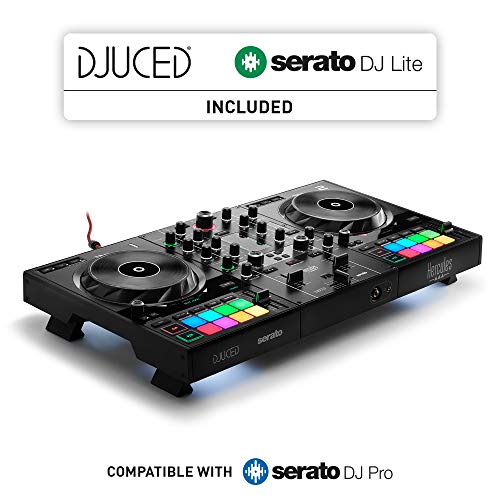
- 2-Deck Usb Dj Controller With Built-In Audio Interface And Hardware Input Mixer For Audio Inputs
- 16 Backlit Rgb Pads, Vinyl Function, Loop In/Loop Out Buttons
The Hercules Inpulse 500 is another excellent entry-level DJ controller that focuses on teaching the user how to beatmatch. It is much larger than the Mikro Mk3 and features built-in audio interfaces and dedicated mixing faders. We would recommend the Hercules to someone who wants a tactile “DJ feel” on a budget. However, for a producer who needs to tap out rhythms and work within a DAW, the Hercules lacks the sophisticated pad sensitivity and the massive sound library that the Native Instruments Maschine Mikro Mk3 Drum Controller provides.
3. Numark Mixtrack Platinum FX 4-Deck Serato DJ Controller

- Complete Serato DJ System - DJ Controller for Serato DJ Lite (Included) with 4 decks of control, built-in 24bit audio interface and plug and play USB connectivity for Mac and Windows
- Visualize Your DJ Mix - Large 6-inch capacitive-touch jog wheels with high-resolution color displays that show beats per minute (BPM), platter position, beats remaining and pitch adjustment or key
The Numark Mixtrack Platinum FX is a powerhouse for performance, featuring integrated displays in the jog wheels. It is fantastic for scratching and manipulating effects in a live setting. Comparing it to the Maschine Mikro Mk3 is a matter of intent: the Numark is a stage tool for performers, while the Maschine is a studio tool for creators. If you are a producer who also wants to perform your beats live in a “live-remix” style, you might actually find yourself wanting both, but the Maschine remains the better choice for the actual composition of the tracks.
The Final Verdict: Is the Native Instruments Maschine Mikro Mk3 Drum Controller for You?
After weeks of testing and integrating it into various workflows, our expert verdict is clear: the Native Instruments Maschine Mikro Mk3 Drum Controller is the gold standard for compact production controllers. Its strengths lie in its “god-tier” pads, its seamless integration with a world-class sound library, and its portability. While it does require you to buy into the Native Instruments software ecosystem to unlock its full potential, the reward is a faster, more intuitive, and more inspired music-making process. It successfully solves the “mouse-and-keyboard” fatigue that plagues so many modern producers.
We recommend this product to anyone from the hobbyist looking to make their first beat to the professional who needs a high-quality “sketchpad” for the road. If you value tactile feedback and want a device that feels like a true musical instrument, this is an unbeatable value. The minor limitations regarding its screen size and software reliance are small prices to pay for the sheer creative power it puts at your fingertips. If you’re ready to take your production to the next level and stop clicking your way through songs, click here to pick up the Native Instruments Maschine Mikro Mk3 Drum Controller and start creating today.
Last update on 2026-09-20 / Affiliate links / Images from Amazon Product Advertising API