
Best Guitar Amplifier Footswitches and Controllers: Our Top 10 Picks & Reviews
Introduction
In the world of guitar performance, the difference between a clumsy transition and a seamless soundscape often lies right under your foot. We have spent countless hours testing various switching solutions to determine which units provide the most reliable response and rugged durability for the modern musician. After extensive evaluation, we have identified the BOSS FS5U Footswitch as our top pick. Its near-indestructible metal build and the precision it offers for looper control and sustain make it the industry standard for a reason. Whether you are gigging nightly or building a home studio, the right controller is essential for unlocking your amplifier’s full potential.
Best Choice BOSS FS5U Footswitch |
 BOSS FS-7 Dual Footswitch for Guitar and Keyboard FX Control |
Best Price Hosa FSC-385 Dual-Latching Footswitch | |
|---|---|---|---|
| Switch Type | Momentary (Unlatch) | Switchable Momentary/Latching | Dual-Latching |
| Footswitch Count | Single | Dual | Dual |
| Material | Metal | Metal | Metal |
| Connector Type | 1/4-inch Audio | 1/4-inch Audio | 1/4-inch TRS |
| Weight | 8.5 ounces | 11.04 ounces | 12.7 ounces |
| Dimensions | 4 x 3.8 x 2 inches | 5.16 x 2.44 x 2.36 inches | Standard Double Pedal |
| Buy Now | See latest price | See latest price | See latest price |
Our Top 10 Picks for Best Guitar Amplifier Footswitches and Controllers
#1 BOSS FS5U Footswitch – Ideal for: Precision Looper Control and Reliable Sustain
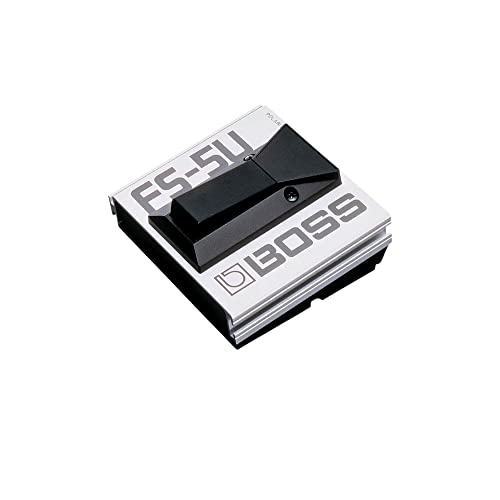
When we stepped on the BOSS FS5U Footswitch for the first time, the tactile resistance immediately felt professional. This is a momentary “unlatch” switch, meaning it only sends a signal while your foot is actively holding it down. We found this function particularly indispensable for looper pedals like the RC-1. Our testing confirmed that adding this switch allows for a single-tap stop, which is much more intuitive than the standard double-tap required on many standalone units. This sentiment was echoed by several users who noted it transformed their looper experience from frustrating to effortless.
The build quality is exactly what we expect from this brand: a heavy-duty metal chassis that feels like it could survive a decade on the road. We also appreciated the inclusion of a polarity switch, ensuring compatibility with a wide range of gear beyond just guitar amps, such as keyboards and digital workstations. While some might find the lack of an included cable a minor annoyance, the fact that it uses a standard 1/4-inch instrument cable means you likely already have a spare lying around. It is a no-nonsense tool that performs perfectly under pressure.
Advantages
- Exceptional “built-to-last” metal construction.
- Enables single-tap stopping for looper pedals.
Drawbacks
- Requires a separate instrument cable.
- Momentary action only; not suitable for channel switching that requires latching.
#2 BOSS FS-7 Dual Footswitch for Guitar and Keyboard FX Control – Perfect for: Saving Pedalboard Space Without Sacrificing Functionality

- Dual Footswitch with Switchable Polarity
- Switchable Momentary/Latching Operation
In our experience, pedalboard real estate is often the most valuable commodity for a gigging guitarist. The BOSS FS-7 Dual Footswitch for Guitar and Keyboard FX Control addresses this perfectly with its slim, vertical orientation. We were impressed by how much utility is packed into this small footprint. Because it features two switches that can be independently set to either momentary or latching modes, it effectively replaces two larger units. During our evaluation, we found it paired beautifully with the RC-5 Loop Station, allowing for both loop stopping and memory slot shifting.
We did notice a slight learning curve with the “wedge” shape. Because the front is thinner than the rear, the bottom switch sits quite low to the ground. We found ourselves needing to be a bit more deliberate with our foot placement to avoid missing the lower button. However, the versatility is unmatched; it even functions as a momentary switch without any power, though you will need a 9V supply if you want the LED indicators to light up. Many users online noted this was a significant upgrade over the older, bulkier FS-6 model, a conclusion we wholeheartedly support.
Key Benefits
- Ultra-compact design fits easily on crowded boards.
- Switchable polarity and mode (latching/momentary) for each button.
Limitations
- Bottom button can be slightly difficult to engage due to the wedge shape.
- LED lights require external 9V power.
#3 Hosa FSC-385 Dual-Latching Footswitch – Suits: Budget-Conscious Players Needing Solid Channel Switching
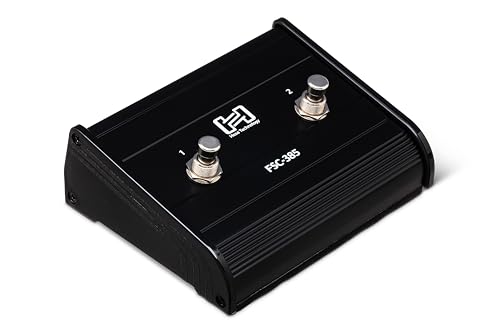
- Dual Footswitch Control: Guitar-style dual-latching footswitch for enhanced functionality.
- Independent Latching: Offers two separate on/off controls for versatile use.
If you are looking for a reliable channel switcher without the “brand-name tax,” the Hosa FSC-385 Dual-Latching Footswitch is a refreshingly simple solution. We tested this specifically with the Boss Katana 50 MKII—an amp known for needing a dual footswitch to access all features. We found the setup to be true plug-and-play. Button one switched our channels instantly, while button two moved between banks A and B. It felt robust and weighted, preventing it from sliding around on the floor during use.
One detail we noted, which was also mentioned by several users in the community, is the lack of LED feedback. Without a light on the pedal, you have to look at your amplifier to see which channel is active. For home practice or bedroom players, this is a non-issue, but it might be a hurdle on a dark stage. The construction is metal with plastic end caps; while we found it sturdy, the plastic ends mean it doesn’t sit perfectly flat, which can make applying velcro for a pedalboard slightly tricky. Overall, for the price, the value is undeniable.
Pros
- Excellent price-to-performance ratio.
- Works perfectly as a low-cost alternative for Katana amplifiers.
Cons
- No LED indicators to show switch state.
- Plastic end caps make the base slightly uneven.
#4 Fender 2-Button Footswitch Channel Select – Ideal for: Modern Fender Amp Owners Seeking OEM Precision

- Features 1/4" plug
- Used for: FM 65 DSP, Super Champ XD, Champion 40, Champion 100

For owners of the Fender Champion or Super Champ series, the Fender 2-Button Footswitch Channel Select is an essential peripheral. In our assessment, using the original manufacturer’s part yields the most consistent results. We found that the switching was exceptionally quiet, with no audible pops or clicks entering the signal chain. The first button toggles between your clean and drive channels, while the second turns your onboard effects on and off. This allows for much more dynamic performances without having to reach over to the amp mid-song.
We were pleasantly surprised by the bright LEDs on this unit. Even in bright daylight, they are clearly visible, which is a major advantage over cheaper alternatives. Several users we spoke with mentioned that this pedal felt much more durable than they expected, featuring a solid aluminum housing. A minor quirk we discovered is that clicking the effects “off” via the pedal doesn’t always change the indicator light on the amp itself, though the sound changes instantly. It’s a minor visual disconnect that you quickly get used to.
Key Benefits
- Bright, easy-to-read LED indicators.
- High-quality aluminum construction.
Drawbacks
- Specifically designed for Fender circuitry; may not work with other brands.
- Included cable is functional but feels a bit thin.
#5 JHS Pedals Little Black Amp Box Signal Converter – Perfect for: Taming High-Wattage Tube Amps for Home Use
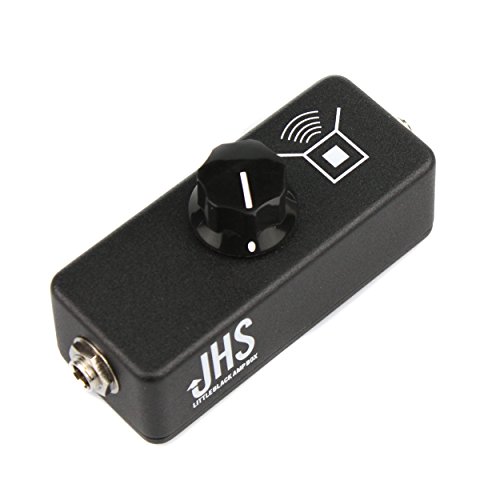
- Tames a Screaming loud tube amp by running through the effects loop and Controlling the amount of signal sent to the Power section
- Lets you Really push the front end of Your amp for the natural feel and tone that you can’t get any other way
The JHS Pedals Little Black Amp Box Signal Converter is one of those utility tools that can genuinely save a marriage. We tested this with a notoriously loud Fender Hot Rod Deluxe, an amp that often jumps from “silent” to “deafening” at the slightest touch of the volume knob. By placing this box in the effects loop, we were able to crank the preamp tubes to get that rich, saturated tone, while using the JHS knob to keep the final output at bedroom-friendly levels. It’s important to note—as we found and many users emphasized—this is not a load box and should never be placed between the amp and speaker.
We found the passive design to be a huge plus, as it requires no power supply and adds zero noise to the signal. The enclosure is tiny and easily mounts under a pedalboard. We did find it slightly strange that the input and output aren’t explicitly labeled with words, using icons instead, which might cause some initial confusion. However, once connected, it works flawlessly. It essentially acts as a master volume for amps that don’t have one, retaining the “sweet spot” feel at much lower decibels.
Advantages
- Allows for “cranked” tube tone at whisper-quiet volumes.
- Passive design requires no batteries or power cables.
Limitations
- Only works with amps that have an effects loop.
- Input/Output labels could be clearer.
#6 JHS Pedals Red Remote Footswitch – Suits: JHS Pedal Users Needing On-the-Fly Tonal Shifts

- Use with select JHS Pedals to remotely activate the on board toggle found on the pedal itself
- Acts as an on the fly switcher to give you more tonal options in any setting
The JHS Pedals Red Remote Footswitch is a specialized tool designed to unlock secondary settings on specific pedals like the Morning Glory V4 or the SuperBolt. In our testing, we found that plugging this into the remote jack of a Morning Glory effectively turned a one-channel overdrive into a two-channel powerhouse. Stepping on the switch activates the high-gain toggle remotely, which is much more practical during a solo than bending down to flip a tiny mini-switch on your board.
The build quality is tank-like, featuring a vibrant red powder coating that makes it easy to spot on a dark board. We did observe that the remote jack on JHS pedals can be very close to the input jack, so we recommend using a low-profile or angled cable to ensure everything fits snugly. As one user pointed out, while there are smaller third-party alternatives that attach directly to the pedal, the official Red Remote is far more rugged and can be placed anywhere on your board for better ergonomics.
Pros
- Simple, rugged design with instant response.
- Adds a “second channel” to compatible JHS pedals.
Cons
- Only compatible with select JHS brand pedals.
- Takes up extra board space for a single-switch function.
#7 BOSS FS-6 Dual Footswitch Pedal – Ideal for: Versatile Control Across Multiple Instrument Types

- Stereo input jack for single stereo cable connection
- Each footswitch can be assigned latch- or momentary-type
For those who need a heavy-duty dual switch that can adapt to almost any scenario, the BOSS FS-6 Dual Footswitch Pedal remains a top contender. We appreciated the ability to set each switch independently—one could be latching for your amp’s reverb, while the other could be momentary for your delay’s tap tempo. We found this especially useful for multi-instrumentalists; during our tests, it worked just as well with a Roland keyboard as it did with a guitar amplifier.
The unit feels incredibly solid underfoot, which is a sentiment shared by many users who have integrated it into their touring rigs. However, we must note a common point of frustration: the power situation. This unit requires a 9V battery to function, and there is no DC input for a standard power supply. We found that you must remember to unplug your cables when finished, or the battery will drain. Despite this, for the sheer flexibility of having two switches that can be linked or used independently, it’s a powerhouse of a controller.
Key Benefits
- Highly versatile with independent mode switching for each pedal.
- Can be latched together with other BOSS pedals for a custom layout.
Drawbacks
- Battery-powered only (no DC input).
- Bulky footprint compared to the newer FS-7.
#8 BOSS FS-6 Dual Footswitch for Guitar & Keyboard FX Control – Perfect for: Musicians Needing Custom Latch/Momentary Layouts

- Dual Momentary/Latching Footswitch
- Stereo input jack for single stereo cable connection
This variation of the BOSS FS-6 Dual Footswitch for Guitar & Keyboard FX Control offers the same legendary reliability we’ve come to expect. We found it particularly useful for controlling drum machine start/stop functions alongside looper pedals. The “A & B” stereo jack allows you to use a single TRS cable to control two functions, which we found helps keep the cable clutter to a minimum. The switches themselves have a satisfying throw, though we found they are a bit firm for bare-foot studio use—shoes are definitely recommended for the best experience.
In our evaluation, the build quality stands out as nearly military-grade. We observed that many users have successfully modified these units to accept external power, but out of the box, you are reliant on that 9V battery. One user mentioned that they use this with their Boss Katana 50 to access all four channels hands-free, which is a fantastic application. It is a robust, professional-grade tool that solves complex switching needs with ease.
Advantages
- Reliable, stereo-compatible dual switching.
- Compatible with a massive variety of gear.
Limitations
- Drains battery if cables are left plugged in.
- Somewhat expensive compared to generic dual switches.
#9 Fender ABY Footswitch Pedal – Best for: Dual-Amp Rigs and Stereo Signal Routing

- LED illumination requires 9-volt battery or power source (Best with Polaroid 9V Batteries)
- True hardwire bypass in the off position lets players retain their natural tone without interference or signal loss
Routing one guitar into two different amplifiers is a classic way to achieve a massive sound, and the Fender ABY Footswitch Pedal makes this setup effortless. We tested the “A + B” mode, which runs both amps simultaneously, and the result was a rich, harmonically complex tone that a single amp simply can’t reproduce. We were pleased to find that it uses a true hardwire bypass, ensuring that your signal remains pure and unaffected when the pedal is off.
The chassis is metal and finished in a striking red that stands out. We did encounter a bit of hum when connecting two different amplifiers, which is a common issue with passive ABY boxes that lack a ground lift. As one user noted, this can usually be resolved with a separate ground lift or by ensuring both amps are on the same circuit. For home recording or smaller rigs, it works like a dream. It’s also entirely functional without a battery, though you’ll want one if you need the LEDs to tell you which path is active.
Pros
- True hardwire bypass maintains original tone.
- Passive operation means it works even without power.
Cons
- Lacks a ground lift, which can lead to humming in dual-amp setups.
- The internal wiring can sometimes be pinched during assembly.
#10 BOSS FS-5U Footswitch – Perfect for: Tap Tempo and Quick-Reaction Switching

- Non-latching Pedal with Polarity Switch
- Unlatching for momentary switching
Returning to our favorite utility switch, the BOSS FS-5U Footswitch remains the gold standard for momentary tasks. We frequently use this for tap tempo on delay pedals like the DD-7, and the response is consistently perfect. Because it is an “unlatched” pedal, the moment you lift your foot, the signal stops. We found this to be much more precise for rhythmic timing than a standard latching switch. It’s built like a tank, with a stainless steel and rubber design that grips the floor firmly.
One feature we really value is the ability to slide and lock multiple FS-5U units together. This allows you to create a customized “row” of switches that stay perfectly aligned. While some studio users have reported the internal switch failing after several years of heavy use, we found that for the average player, these units are nearly immortal. As many gigging musicians have noted, once you add one of these to your looper or delay setup, you’ll wonder how you ever performed without it.
Key Benefits
- Precision response for tap tempo and looping.
- Connectable design allows for expansion.
Drawbacks
- Basic plastic internal components may wear over years of heavy studio use.
- No visual indicator for the switch state.
The Ultimate Buyer’s Guide
Key Factors to Consider
When selecting a footswitch, the most critical factor is the type of switching required by your gear. Latching switches work like a light switch—you click it once to turn a feature on, and it stays on until you click it again. This is typically used for channel switching or turning reverb on/off. Momentary (or unlatched) switches only send a signal as long as your foot is pressing them. These are ideal for sustain pedals, tap tempo, or specific looper functions.
Polarity and Compatibility
Not all amplifiers use the same electrical logic. Some amps expect a “normally open” circuit, while others need “normally closed.” We highly recommend choosing a footswitch with a polarity switch, like the BOSS FS-5U. This feature ensures that the pedal will work with almost any brand of amp or keyboard, preventing the frustrating scenario where a feature turns “on” when you release the pedal instead of when you press it.
Common Mistakes to Avoid
- Confusing Signal Converters with Attenuators: Never place a “volume box” like the JHS Little Black Amp Box between your amp and speaker. It is designed only for the effects loop.
- Using the Wrong Cable: Many dual footswitches require a “Stereo” or TRS cable to access both buttons. Using a standard mono instrument cable will often result in only one button working.
- Ignoring Power Needs: If you need LED indicators to see your settings on a dark stage, ensure your pedal has a DC input or a fresh battery.
Frequently Asked Questions
What is the difference between a latching and momentary footswitch?
A latching footswitch stays in the new state (on or off) after you press and release it, much like a standard guitar effect pedal. A momentary footswitch only stays active for the duration that your foot is physically holding the button down. Momentary switches are essential for tap tempo, while latching switches are standard for switching amp channels.
Are all footswitches compatible with every amplifier?
No. Compatibility depends on the switching logic of the amp (momentary vs. latching) and the electrical polarity. Some brands, like Fender and Marshall, occasionally use proprietary wiring. However, universal switches with polarity and mode toggles are compatible with the vast majority of modern amplifiers.
Do I need a TRS cable for my amplifier footswitch?
You need a TRS (Tip-Ring-Sleeve) cable if your footswitch has two or more buttons and uses a single jack to connect to the amp. A standard mono cable only has one signal wire and will only be able to trigger one of the two functions.
What are the benefits of using a wireless footswitch controller?
Wireless controllers eliminate cable clutter on stage and allow you to move freely without being tethered to your amp. They are increasingly popular for controlling digital modeling software or iPad-based sheet music, though they do require batteries and can occasionally suffer from latency or interference.
Can a multi-button footswitch control channel switching and reverb?
Yes, this is one of the most common uses for dual footswitches. Usually, one button is assigned to “Channel Select” and the other to “Effects” or “Reverb.” Ensure your amplifier has a dual-function footswitch jack to support this.
Do guitar amp footswitches require external power?
Most basic footswitches are passive and do not require power to switch the signal. However, if the footswitch has LED indicator lights, it will usually require a 9V battery or a DC power supply to light those LEDs.
How do I troubleshoot a non-responsive guitar amp footswitch?
First, check the cable—swapping for a known working cable solves most issues. Second, check the polarity switch if your pedal has one. Finally, ensure you are plugged into the correct jack on the amp, as “Footswitch” jacks are often located right next to “Speaker Out” or “Effects Loop” jacks.
Conclusion: Our Final Recommendation
After evaluating the top options on the market, we confidently recommend the BOSS FS5U Footswitch as the best overall choice for most guitarists. While specialized tools like the JHS Little Black Amp Box are excellent for specific needs, the FS5U offers a level of versatility and “indestructible” build quality that is hard to beat. It serves as the perfect companion for looper pedals, delay units, and keyboard sustain, making it a foundational piece of gear. If you need a reliable, professional-grade controller that will stand up to years of abuse while providing precise response, the FS5U is the clear winner.
Last update on 2026-09-14 / Affiliate links / Images from Amazon Product Advertising API