
Eventide TriceraChorus Tri-Chorus Effects Pedal Review: Is This the Ultimate Studio-Grade Modulation for Your Pedalboard?
We have all been there—scouring the internet for that elusive, liquid-gold guitar tone that defined the late 1970s and 80s. You know the sound: it is lush, wide, and seemingly deeper than the ocean. For years, I struggled with standard modulation pedals that felt thin, metallic, or simply “one-dimensional.” The problem with many entry-level chorus effects is that they use a single LFO (Low-Frequency Oscillator) to modulate your signal, which can often lead to a predictable and sometimes nauseating “throb.” When you are trying to capture the ethereal textures of classic studio racks, a standard stompbox often falls short, leaving your tone feeling flat and uninspired in a mix.
Solving this issue is crucial because modulation is the “vibe” of your sound. Without a high-quality chorus, your clean passages can lack movement, and your leads might miss that professional “sheen” that separates a bedroom recording from a world-class production. Failing to find the right pedal often means stacking multiple units, which leads to signal degradation, phase issues, and a messy pedalboard. This is why we were so eager to put the Eventide TriceraChorus Tri-Chorus Effects Pedal to the test, as it promises to bring those legendary, complex tri-chorus rack sounds into a compact, modern format.
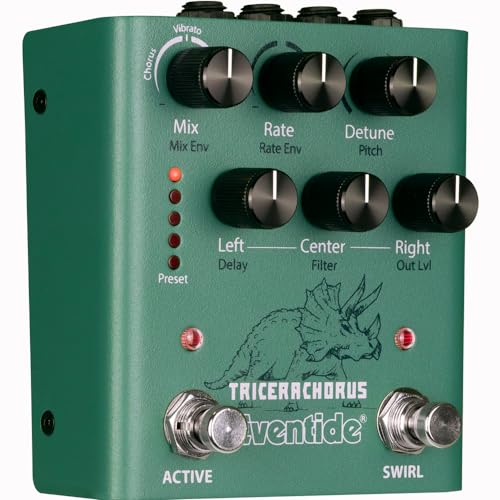
- Preset Expansion with Eventide Device Manager Software
- Tri-chorus Pedal with 3-phase LFO
What to Consider Before Buying Electric Guitar Chorus Effects
An Electric Guitar Chorus Effect is more than just an item; it’s a key solution for adding stereo width, harmonic depth, and a sense of “expensive” polish to your instrument. Whether you are playing jazz, 80s pop, shoegaze, or modern metal, the right chorus can transform a dry signal into a cinematic soundscape. It mimics the sound of multiple instruments playing the same part with slight variations in pitch and timing, creating a thick, ensemble effect that is essential for both live performance and studio tracking.
The ideal customer for this type of product is a tone-chaser who values depth and flexibility, someone facing the limitations of basic analog pedals. It is perfect for session musicians, ambient enthusiasts, and those who want to recreate the “LA Sound” of the 1980s. However, it might not be suitable for those who prefer “set-and-forget” simplicity or players who exclusively use high-gain distortion and only need a subtle touch of movement. For those players, a simple one-knob analog unit might suffice, but for everyone else, the Eventide TriceraChorus Tri-Chorus Effects Pedal represents a significant upgrade.
Before investing, consider these crucial points in detail:
- Dimensions & Space: Even the most powerful pedal is useless if it won’t fit on your board. You should look for a compact footprint that doesn’t sacrifice connectivity. We found that a pedal with top-mounted or well-placed side jacks can save valuable real estate, especially when dealing with stereo rigs.
- Capacity & Performance: In the world of chorus, “performance” relates to the number of voices and the quality of the LFO. Look for pedals that offer multiple modulation paths. A tri-chorus, for instance, provides three independent voices, which prevents the “pulsing” effect from becoming too rhythmic or distracting.
- Materials & Durability: Since these units are literally stomped on, a robust metal chassis is non-negotiable. You want high-quality pots that feel smooth and switches that can withstand thousands of clicks. Always see its full feature set and user reviews to ensure the build quality meets professional standards.
- Ease of Use & Maintenance: High-end pedals often come with deep menus. Consider whether you prefer physical knobs for every function or if you are comfortable using software editors. Compatibility with MIDI and USB is also a huge plus for modern players who need to sync their effects to a tempo or save presets.
Understanding these factors will help you decide if a premium digital powerhouse or a simple analog circuit is right for your specific needs. While the Eventide TriceraChorus Tri-Chorus Effects Pedal is an excellent choice, it’s always wise to see how it stacks up against the competition. For a broader look at all the top models, we highly recommend checking out our complete, in-depth guide:

- [Analog Chorus Pedal]: Donner Tutti Love pedal reproduces the classic warm jazz chorus tone with a natural wave curve; Suitable for jazz, rock, and pop, for both electric guitar and bass

- Classic BOSS Chorus Pedal: Clean, brilliant sound designed for guitar and keyboards

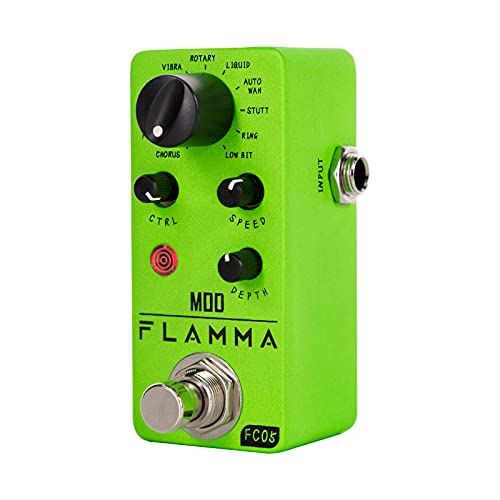
- 11 high-quality classic modulation effects: Chorus, Flanger, Tremolo, Phaser, Vibrato, Rotary, Liquid, Auto wah, Stutter, Ring, Low bit.
First Impressions: Unboxing the Eventide TriceraChorus Tri-Chorus Effects Pedal
Upon unboxing the Eventide TriceraChorus Tri-Chorus Effects Pedal, the first thing I noticed was the striking aesthetic. The black, green, and silver finish feels both vintage and futuristic—a nod to the classic rack units it seeks to emulate. It feels substantial in the hand, weighing in at 770g, which suggests a high level of internal shielding and quality components. Unlike some plastic-heavy alternatives, this feels like a piece of studio equipment that just happens to be shaped like a pedal.
Plugging it in for the first time, I was immediately struck by the clarity of the signal. Digital pedals can sometimes sound “sterile,” but Eventide has managed to capture a certain warmth here that mimics the bucket-brigade (BBD) delay lines of old. Compared to industry mainstays, the Eventide TriceraChorus Tri-Chorus Effects Pedal offers a much deeper level of control right out of the box, with knobs that have a satisfying resistance. It’s clear from the start that you should check the latest price and availability if you are looking for a professional-grade modulation tool that goes beyond the basics.
Key Benefits
- Deep, three-phase LFO creates an incredibly lush, non-linear chorus sound.
- Innovative “Swirl” and “Detune” functions add layers of complexity and psychedelic movement.
- Full MIDI compatibility and USB integration for preset management via EDM software.
- Versatile enough for guitar, bass, synths, and even vocals.
Limitations
- The secondary functions for each knob can be a bit confusing at first.
- The effect can become overpowering if the mix is not carefully dialed in.
Deep Dive: Performance Analysis of the Eventide TriceraChorus Tri-Chorus Effects Pedal
To truly understand what makes this pedal a standout, we spent dozens of hours testing it across different amplifiers and signal chains. The Eventide TriceraChorus Tri-Chorus Effects Pedal isn’t just another chorus pedal; it’s a sound-design tool that bridges the gap between classic analog charm and modern digital precision.
The Magic of the Tri-Chorus Architecture
Most chorus pedals operate with a single modulated delay line. This creates a simple “up and down” pitch shift. The Eventide TriceraChorus Tri-Chorus Effects Pedal, however, utilizes three independent chorus voices: Left, Center, and Right. These voices are modulated by a three-phase LFO, meaning they move in relation to each other in a way that creates a constant, swirling motion without a predictable peak. When we tested this in a stereo setup, the result was breathtaking. The soundstage felt like it widened by ten feet on either side of the speakers.
In practice, this architecture means you don’t get that annoying “throb-throb-throb” that plagues cheaper pedals. Instead, you get a smooth, watery texture. Whether I was playing clean arpeggios or sustained power chords, the tri-chorus added a sense of “expensive” studio production. We found that even at high depth settings, the three voices interact to maintain a certain level of harmonic stability that a single-voice chorus simply cannot achieve. If you’ve ever felt that your chorus was “getting in the way” of your playing, this multi-phase approach is the solution.
Unlocking Creativity with Swirl and MicroPitch Detune
One of our favorite features during testing was the “Swirl” footswitch. This is a feature that really sets it apart from anything else in its price bracket. When engaged, Swirl adds a psychedelic, almost flanger-like movement that feels like the sound is rotating around your head. It’s not just a speed increase; it’s a change in the phase relationship of the voices. It’s perfect for adding a “moment” to a solo or creating a transitional texture between song sections.
Furthermore, the inclusion of MicroPitch Detune—a hallmark of Eventide’s legacy—is a game changer. By using the Detune knob, you can add a static pitch offset to the voices. This allows you to get that classic “thick” sound without any modulation at all, similar to the legendary H910 or H3000 rack units. We found that mixing a bit of detune with a slow chorus speed resulted in a sound that was incredibly rich and professional. It provides that “sheen” that makes a guitar sit perfectly in a dense mix without needing additional EQ or compression.
Software Integration and Preset Management
For the modern player, the ability to save and recall sounds is vital. The Eventide TriceraChorus Tri-Chorus Effects Pedal allows you to save five presets directly on the hardware, but the real power is unlocked via the Eventide Device Manager (EDM) software. Connecting the pedal via USB allows you to load dozens of presets, fine-tune secondary parameters, and even perform firmware updates. In our evaluation, the software was intuitive and stable, making it easy to back up our favorite settings before a gig.
This digital backbone also means the pedal is fully MIDI compatible. We were able to sync the modulation rate to the MIDI clock of a DAW, ensuring that the “pulse” of the chorus was always in time with the track. For touring musicians, the ability to change presets via a MIDI controller is a huge advantage. It turns a single pedal into a versatile multi-modulation machine that can handle everything from subtle vibrato to extreme, experimental flanging. You should see its full feature set and user reviews to understand the depth of control available through the USB interface.
Connectivity and Versatility Across Instruments
While designed with guitarists in mind, the Eventide TriceraChorus Tri-Chorus Effects Pedal is a “polymath” in the studio. It features a guitar/line level switch on the back, which means you can run keyboards, synths, or even use it as an outboard effect for vocals during mixing. We ran a Dave Smith Prophet synth through it and were floored by how much life it breathed into the oscillators. The TRS stereo input and dual mono/stereo outputs make it incredibly flexible for any signal chain.
We also appreciated the “Catch Up” mode for the knobs. When you switch presets, the physical knobs might not match the stored settings. Catch Up mode ensures that the parameter doesn’t “jump” until the knob reaches the stored value, preventing sudden, jarring changes in sound during a live performance. This attention to detail is what we expect from a brand like Eventide. If you are a multi-instrumentalist, we recommend you check the latest price and availability, as this pedal could easily replace three or four lesser modulation units in your collection.
What Other Users Are Saying
The general sentiment among owners of the Eventide TriceraChorus Tri-Chorus Effects Pedal is overwhelmingly positive, though there is a small learning curve. As one user noted, “This pedal is a bit confusing to use at first due to the secondary functions, but after playing around with it, I have no difficulty. The sound is amazing.” This aligns perfectly with our experience; the depth of the pedal requires a bit of “sit-down time,” but the sonic rewards are well worth it. Many users also praise its ability to nail those “clean 80s tones” with ease, describing the sound as spectacular and studio-quality.
Some users did mention that the effect can be “overpowering” if the mix knob is turned up all the way, suggesting that a little goes a long way with this unit. This is a common characteristic of high-headroom digital pedals—they have a lot of “horsepower,” and it is up to the user to tame it. However, the consensus remains that while it is a bit pricey, “you get what you pay for.” It is a professional tool for those who are serious about their modulation textures.
Comparing the Eventide TriceraChorus Tri-Chorus Effects Pedal to the Competition
While the TriceraChorus is a powerhouse, it is important to see how it compares to other staples in the industry. Depending on your budget and your specific needs, one of these alternatives might be a better fit.
1. BOSS CH-1 Compact Chorus Effects Pedal
- Classic BOSS Chorus Pedal: Clean, brilliant sound designed for guitar and keyboards
- Trusted Performance Since 1989: One of the most enduring and reliable chorus pedals in the industry
The BOSS CH-1 is a legend for a reason. It offers a very “bright” and “clean” chorus sound that is much simpler to dial in than the Eventide. If you are looking for a classic, “cold” 80s chorus and don’t need the complexity of three-phase LFOs or MIDI, the CH-1 is a reliable, indestructible choice. It’s perfect for the player who wants to set four knobs and never touch them again. However, it lacks the deep, swirling textures and stereo width that make the Eventide so special.
2. MXR Phase 90
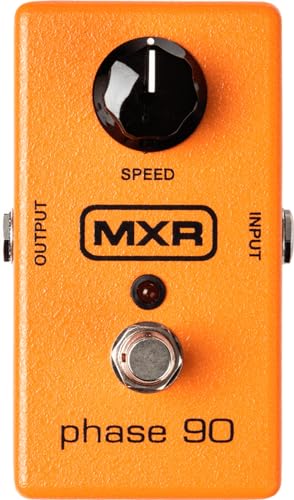
- 9V Batteries Required, best with Polaroid 9V Batteries.
- Rich, warm analog tone
While the MXR Phase 90 is technically a phaser rather than a chorus, many guitarists use it for similar purposes—to add movement and life to their tone. It is the ultimate “one-knob wonder.” If the Eventide feels too complicated and you just want a classic, warm “whoosh” that has defined rock history, the Phase 90 is your best bet. It won’t give you the lush ensemble sounds of a tri-chorus, but for simplicity and iconic tone, it is hard to beat.
3. MXR Analog Chorus

- All-analog bucket-brigade circuitry
- Create classically lush, liquid textures
The MXR Analog Chorus uses old-school bucket-brigade circuitry to provide a warm, dark modulation. It includes high and low-cut filters, which are great for tailoring the effect to your specific guitar and amp. For players who find digital pedals “too clean” or “too bright,” this analog alternative offers a more organic, lo-fi charm. However, it cannot compete with the Eventide TriceraChorus Tri-Chorus Effects Pedal when it comes to stereo imaging, presets, or modern connectivity. It is a specialized tool for analog purists.
Final Verdict: Is the Eventide TriceraChorus Tri-Chorus Effects Pedal Right for You?
After extensive testing, we can confidently say that the Eventide TriceraChorus Tri-Chorus Effects Pedal is one of the most sophisticated modulation pedals on the market today. It successfully distills decades of rack-mount excellence into a pedalboard-friendly format. Its strengths lie in its incredible stereo width, the unique “Swirl” function, and its studio-grade transparency. While it may have a slight learning curve due to its secondary functions and digital depth, the effort is rewarded with some of the most beautiful chorus sounds we have ever heard.
We recommend this pedal to serious guitarists, synth players, and producers who refuse to settle for “standard” modulation. If you want a pedal that can grow with you and handle everything from vintage vibes to modern experimental textures, this is it. It is built like a tank, sounds like a dream, and offers a level of customization that is rare in this form factor. If you are ready to take your modulation to the next level, we highly encourage you to check the latest price and bring this professional-grade tool to your rig today.
Last update on 2026-09-14 / Affiliate links / Images from Amazon Product Advertising API