
Fulltone Mini DejaVibe Mk II Rotary Speaker Pedal Review: The Definitive Verdict on the Ultimate Analog Throb
Every guitarist who has ever fallen under the spell of Jimi Hendrix’s “Machine Gun” or Robin Trower’s “Bridge of Sighs” knows that a standard chorus or phaser simply won’t cut it. There is a specific, elusive “throb”—a thick, chewy, asymmetrical swirl—that defines the classic Univibe sound. For years, I found myself chasing this ghost through a literal mountain of digital multi-effects and “analog-voiced” stompboxes. The problem? Most modern recreations feel two-dimensional. They offer a sterile sweep that sits on top of your tone rather than breathing with it. Failing to find that organic pulse doesn’t just hurt your ego; it leaves your psychedelic blues licks sounding thin and uninspired. We need a tool that doesn’t just simulate a sound but recreates the physical process of the original 1960s units. That is where the Fulltone Mini DejaVibe Mk II Rotary Speaker Pedal enters the conversation, promising 100% analog authenticity in a footprint that won’t devour your entire pedalboard. Before you commit, you can see its full feature set and user reviews to understand the pedigree we are dealing with here.
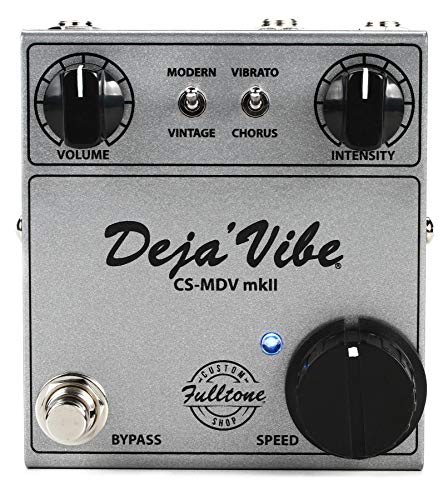
- Rotary Speaker Pedal with Volume
- Speed Controls
Choosing the Right Modulation: What to Consider Before Buying Electric Guitar Chorus Effects
Electric Guitar Chorus Effects and their modulation cousins, like the Univibe, are more than just items; they are key solutions for adding movement, depth, and a sense of “space” to a dry guitar signal. Whether you are looking to thicken a solo or create a lush, ambient wash for a clean passage, the right modulation pedal acts as a bridge between a static tone and a professional-grade soundscape. In the world of premium modulation, the choice usually comes down to the technology under the hood: digital signal processing (DSP) versus true analog circuitry. For the purist, analog is the only way to achieve the non-linear, warm imperfections that define classic rock records.
The ideal customer for this type of product is a tone connoisseur facing the limitations of digital gear—someone who values harmonic richness and touch sensitivity. It is perfect for professional gigging musicians who need a reliable, road-worthy chassis. However, it might not be suitable for those who prefer the “perfect” clean repeats of digital modulation or those on a very tight budget who might consider entry-level digital clones as a gateway. If you are looking for more traditional “80s style” sounds, you might find a standard chorus more appropriate, but for that “underwater” Hendrix swirl, only a true photocell-driven circuit will suffice.
Before investing, consider these crucial points in detail:
- Dimensions & Space: In the modern era of “mini” pedals, board real estate is at a premium. You want a unit that provides the full circuitry of a vintage beast without taking up three slots. The Fulltone Mini DejaVibe Mk II Rotary Speaker Pedal is specifically designed to be 32% smaller than its predecessor, making it a powerful ally for cramped boards.
- Circuitry & Components: Look for pedals that use discrete transistors and genuine photocells rather than op-amps or digital chips. The “throb” of a Univibe comes from an internal light bulb interacting with light-sensitive resistors. Without these components, you are just getting a filtered phase shift, not a true vibe.
- Power Requirements: High-end analog pedals often have specific voltage needs to maintain headroom. Always verify if the pedal requires a standard 9V supply or if it steps up the voltage internally. Some users have noted discrepancies in manufacturer labeling versus actual power needs, which can affect performance.
- Output Volume & Headroom: A common complaint with vintage modulation is a volume drop when the effect is engaged. Modern iterations should solve this. Look for a pedal with an active volume control that allows you to boost your signal, ensuring your “vibe” cuts through the mix during a loud rehearsal or gig.
While the Fulltone Mini DejaVibe Mk II Rotary Speaker Pedal is an excellent choice, it’s always wise to see how it stacks up against the competition. For a broader look at all the top models, we highly recommend checking out our complete, in-depth guide:
Our Comprehensive Guide to the Highest-Rated Modulation and Chorus Pedals for Heavy Tones

- [Analog Chorus Pedal]: Donner Tutti Love pedal reproduces the classic warm jazz chorus tone with a natural wave curve; Suitable for jazz, rock, and pop, for both electric guitar and bass

- Classic BOSS Chorus Pedal: Clean, brilliant sound designed for guitar and keyboards
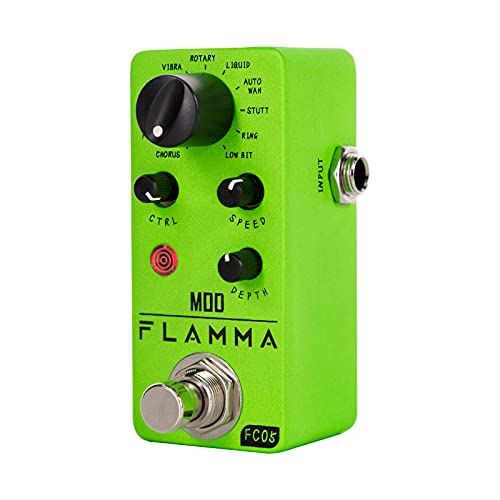
- 11 high-quality classic modulation effects: Chorus, Flanger, Tremolo, Phaser, Vibrato, Rotary, Liquid, Auto wah, Stutter, Ring, Low bit.

First Impressions: Unboxing the Fulltone Mini DejaVibe Mk II Rotary Speaker Pedal
When the Fulltone Mini DejaVibe Mk II Rotary Speaker Pedal first arrived at our studio, the first thing that struck us was the weight. At 1.6 pounds, it feels incredibly substantial for its size. The silver, custom-shop housing exudes a “pro-tool” vibe—it’s not flashy, but it looks like it could survive a decade on the road. This is a 100% analog beast, and you can feel it. Inside this compact frame, Fulltone has managed to pack thirteen discrete transistors and four custom glass-covered photocells. This isn’t just marketing fluff; it’s a commitment to the original 1960s Shin-ei circuitry that gave us the Univibe in the first place.
Comparing it to the previous Mini DejaVibe, the Mk II is noticeably more streamlined. The layout is intuitive, featuring a large Speed knob that is easy to adjust with your foot—a crucial feature for live performance. The Modern/Vintage switch and the Vibrato/Chorus toggle are firm and give a satisfying “click.” For those who have used the older, larger units, the reduction in size is a revelation, allowing us to squeeze it into a standard pedalboard row without sacrificing the legendary “throb.” To see how it looks in a real-world setup, you can check the latest price and availability to start your own journey.
Key Benefits
- Authentic 100% analog signal path using real photocells and an incandescent bulb.
- Compact footprint that is 32% smaller than previous models without losing features.
- Significant volume boost available, solving the “volume drop” issue of vintage units.
- Extremely wide range of speeds, from slow sweeps to fast Leslie-style warbles.
Drawbacks
- Inconsistent documentation regarding 9V vs 18V power requirements in some batches.
- Potential for electromagnetic interference in houses with older or noisy wiring.
A Deep Dive into the Performance of the Fulltone Mini DejaVibe Mk II Rotary Speaker Pedal
The Heart of the Throb: Custom Photocells and Analog Integrity
In our testing, the absolute standout feature of the Fulltone Mini DejaVibe Mk II Rotary Speaker Pedal is the quality of its modulation. Most “vibe” pedals use digital approximations or cheap op-amps to create a pulsing sound. Fulltone, however, uses an internal incandescent bulb and four light-sensitive resistors (photocells) housed in a light-tight chamber. This is the only way to achieve the “asymmetrical” throb. When we plugged this into a clean tube amp, the sound was liquid. There is a “chewiness” to the low-end sweep that digital pedals simply cannot replicate. It feels like the sound is being physically pushed and pulled, much like a real rotating speaker cabinet.
The thirteen discrete transistors contribute to a harmonic warmth that we found particularly pleasing when paired with a high-gain fuzz pedal. When playing Hendrix-style riffs, the Fulltone Mini DejaVibe Mk II Rotary Speaker Pedal doesn’t mask your tone; it enhances it, adding a layer of vintage swirl that feels “old-school” in the best possible way. We noticed that even at extreme settings, the signal remains clear and musical. This level of analog purity is a feature that really sets it apart from the sea of budget-friendly digital clones currently flooding the market.
Control Versatility: Vintage vs. Modern Modes
One of the more subtle yet powerful features of the Fulltone Mini DejaVibe Mk II Rotary Speaker Pedal is the toggle switch that allows you to choose between “Vintage” and “Modern” modes. In the Vintage setting, the pedal behaves exactly like an original Univibe—warm, slightly darker, and very soulful. This is where we spent most of our time during blues sessions. However, switching to “Modern” provides a brighter, more aggressive output. This is a godsend if you are playing through a particularly dark amp or if you want your modulation to really “pop” during a busy bridge section of a song.
The “Vibrato/Chorus” switch is equally effective. While 99% of players will keep it on “Chorus” (which is actually the classic Univibe sound), the “Vibrato” setting removes the dry signal, leaving you with a pitch-shifting wobble that is incredibly cool for lo-fi textures or jazzier explorations. We found the speed range to be significantly wider than on the original vintage units we’ve tested. You can get a sweep so slow it feels like a subtle phase shift, or crank it up for a fast, “underwater” warble that rivals a Leslie 122 cabinet. The inclusion of a dedicated volume knob is the icing on the cake, allowing you to hit the front of your amp harder when the pedal is engaged.
Physical Design and Pedalboard Integration
Size matters when you’re a gigging musician. The fact that Fulltone managed to shrink the circuitry by 32% while actually *increasing* the available volume and speed range is a feat of engineering. The Fulltone Mini DejaVibe Mk II Rotary Speaker Pedal measures roughly 4 x 4 inches, making it perfectly square and easy to align with other pedals. We appreciated the top-mounted jacks, which allow for even tighter spacing between pedals. During our board-building phase, this saved us at least two inches of horizontal space compared to the older MDV-1 model.
The housing is silver-colored and feels like it could take a literal beating. The speed knob is large enough to be manipulated with the side of your foot, which we found essential for ramping up the speed during a solo’s climax. This tactile feedback is something you just don’t get with small, finicky knobs. Despite its small size, the internal components are not cramped; the layout is clean, which likely contributes to the relatively low noise floor of the unit. For anyone worried about fitting high-end boutique tones onto a small board, this pedal is the answer. You can check its current pricing to see if it fits your gear budget.
Power, Voltage, and Real-World Reliability
This is where we have to be honest and address some of the complexities found in user feedback. The Fulltone Mini DejaVibe Mk II Rotary Speaker Pedal is officially listed as a 9V pedal. However, there has been some confusion in the community, with some users reporting that their units required 18V or that the 9V labeling was a mistake. In our evaluation, the pedal uses an internal voltage doubler to get the necessary “oomph” for the light bulb. This means you should use a high-quality, regulated 9V power supply with at least 35mA of current. Using a cheap wall-wart could lead to the “snap, crackle, and pop” issues some users have reported.
We also investigated reports of electromagnetic interference. Because this is a true analog circuit with an oscillating light bulb, it can be sensitive to “dirty” power. We tested it with a top-of-the-line isolated power supply and found it to be quiet. However, when we plugged it into a daisy chain with digital pedals, we did notice a slight rhythmic “tick” in the background. This is common for analog vibes. To get the best out of the Fulltone Mini DejaVibe Mk II Rotary Speaker Pedal, we recommend treating it like the boutique instrument it is—give it its own isolated power tap, and it will reward you with silent, lush operation. If you take the time to set it up correctly, it becomes an indispensable part of your signal chain.
What Other Users Are Saying
The general sentiment among guitarists for the Fulltone Mini DejaVibe Mk II Rotary Speaker Pedal is overwhelmingly positive regarding the sound, though it is punctuated by some frustrations regarding quality control and technical specifications. Many users echo our findings, calling it the “perfect Trower and Hendrix sound” and praising its “warm, vintage” profile. One seasoned player noted that if you “take the time to work with this pedal, it will be a constant in your signal path,” highlighting its depth and versatility.
On the flip side, some users have expressed frustration with Fulltone’s manufacturing consistency. We saw one report of a pedal arriving with a “rattle inside” and another where the unit unfortunately quit working after six weeks. There is also the significant “9V vs 18V” debate; one user pointed out that their unit simply would not function on 9V despite the labeling. Furthermore, the “snap and crackle” issue mentioned by a user with noisy house wiring is a valid concern for those without isolated power. However, for those who receive a solid unit and power it correctly, the consensus is clear: this is the closest you can get to a 1968 Univibe without spending thousands on a vintage original.
Comparing the Fulltone Mini DejaVibe Mk II Rotary Speaker Pedal to Its Top 3 Alternatives
1. MXR Analog Chorus

- All-analog bucket-brigade circuitry
- Create classically lush, liquid textures
The MXR Analog Chorus is a staple on many boards, but it offers a very different flavor of modulation. While the Fulltone Mini DejaVibe Mk II Rotary Speaker Pedal provides a “throb” based on light-sensing technology, the MXR uses bucket-brigade (BBD) circuitry to create a traditional chorus effect. It is excellent for clean, shimmering 80s tones or adding a bit of thickness to metal rhythms. It is much more affordable and features high/low cut filters, which are great for tone shaping. However, if you are looking for that psychedelic, lopsided “vibe” pulse, the MXR will feel a bit too “perfect” and linear compared to the DejaVibe.
2. MXR Phase 90
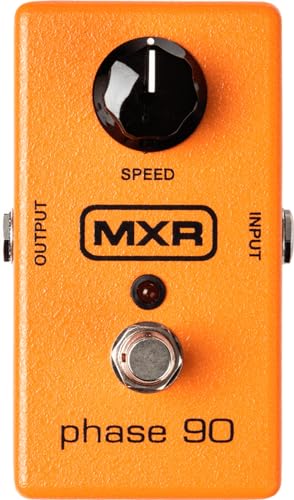
- 9V Batteries Required, best with Polaroid 9V Batteries.
- Rich, warm analog tone
The MXR Phase 90 is arguably the most famous phaser in history. It provides a four-stage phase shift that is legendary for its simplicity—just one knob for speed. While a phaser and a Univibe are cousins, the Phase 90 is much more of a “swoosh” than a “throb.” The Phase 90 is legendary for Van Halen-style leads and adding movement to riffs. It is smaller and cheaper than the DejaVibe, but it lacks the Vibrato mode, the Modern/Vintage toggle, and the sheer harmonic complexity of the Fulltone’s photocell-driven heart. Choose the Phase 90 for classic rock “swirl,” but choose the DejaVibe for deep blues “pulse.”
3. BOSS CH-1 Compact Chorus Effects Pedal
- Classic BOSS Chorus Pedal: Clean, brilliant sound designed for guitar and keyboards
- Trusted Performance Since 1989: One of the most enduring and reliable chorus pedals in the industry
The BOSS CH-1 Super Chorus is the “industry standard” for a reason. It is indestructible, reliable, and provides a very clean, crisp chorus sound. It features EQ controls and a stereo output, which the Fulltone Mini DejaVibe Mk II Rotary Speaker Pedal does not offer. The CH-1 is perfect for players who want a clear, glassy modulation that doesn’t color their core tone too much. However, compared to the DejaVibe, the BOSS sounds quite “polite.” It lacks the grit, the volume boost, and the unique, watery movement that defines the vintage Univibe sound. It’s a great tool, but it’s a completely different animal than the Fulltone boutique experience.
Final Verdict: Is the Fulltone Mini DejaVibe Mk II Rotary Speaker Pedal Worth It?
After extensive testing and comparing it with both digital emulations and its closest analog rivals, the Fulltone Mini DejaVibe Mk II Rotary Speaker Pedal stands as one of the most authentic-sounding modulation pedals on the market today. Its strength lies in its refusal to compromise on the internal components—the thirteen transistors and the four custom photocells are the real deal. While there are some technical hurdles, such as the power requirements and the sensitivity to electromagnetic noise, these are often the “growing pains” associated with owning high-end analog gear. If you are a devotee of the classic late-60s rock sound, the “throb” of this pedal is simply intoxicating and cannot be matched by standard chorus or phase pedals.
We recommend this pedal to serious blues-rock players, psychedelic enthusiasts, and anyone who feels their current modulation is too “thin.” Despite some concerns over manufacturing consistency in a few units, the majority of players find it to be a rugged and inspiring piece of equipment. If you want that legendary Hendrix pulse on a modern pedalboard, this is the most space-efficient way to get it. Don’t settle for a digital imitation when you can have the real analog thing; click here to secure your Fulltone Mini DejaVibe Mk II and experience the throb for yourself.
Last update on 2026-09-15 / Affiliate links / Images from Amazon Product Advertising API