
Maestro Orbit Phaser Pedal Review: Rediscovering the Analog Soul of a Legendary Modulation Pedal
There is a specific moment in every guitar player’s journey when they realize that clean and overdriven tones just aren’t enough. I remember sitting in my studio years ago, trying to replicate the iconic, swirling textures found on 1970s classic rock records. I tried every digital modulation plugin I owned, but something was missing—that organic, breathing “whoosh” that feels less like an effect and more like part of the instrument itself. This is the common struggle for many of us: finding a modulation effect that adds character without sounding artificial or thinning out the tone. If you’ve ever felt your sound was a bit too “static,” the Maestro Orbit Phaser Pedal might be the analog solution you’ve been looking for. Failing to find the right phaser often leads to a “hollow” sounding signal chain where the modulation feels disconnected from your playing dynamics, making the search for a pedal with true heritage and analog warmth absolutely crucial.
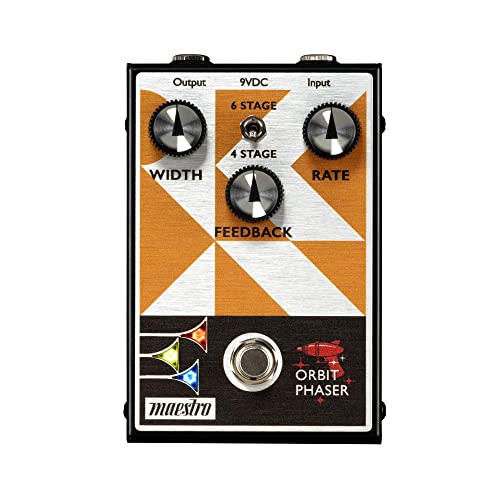
- A descendent of the very first phaser pedal ever produced - the legendary Maestro PS-1
- This classic effect has been re-engineered and tailored to the needs of today’s players
What to Consider Before Buying a Modulation Effect for Your Rig
An electric guitar modulation effect is more than just an item; it’s a key solution for adding movement, depth, and a sense of three-dimensional space to your guitar’s output. Whether you are playing psychedelic leads, funky rhythmic scratches, or atmospheric ambient textures, a phaser acts as a filter that sweeps through the frequency spectrum. This creates “peaks” and “notches” that move over time, giving your guitar that unmistakable vocal-like quality. By choosing a high-quality analog pedal, you ensure that your core tone remains intact while adding a layer of sophisticated harmonic movement that digital alternatives often struggle to replicate perfectly.
The ideal customer for this type of product is someone facing a stale or one-dimensional sound, particularly those who appreciate vintage aesthetics and the “warmth” of all-analog circuitry. It’s perfect for the gigging musician who needs reliable, simple controls that can be adjusted on the fly. However, it might not be suitable for those who require hundreds of presets or deep MIDI integration, as these users might consider high-end digital workstations instead. If you are looking for a straightforward, plug-and-play experience that prioritizes tone over menus, the Maestro Orbit Phaser Pedal is designed specifically with you in mind.
Before investing, consider these crucial points in detail:
- Dimensions & Space: Consider how much room you have on your board. While some modern pedals are “mini,” the Maestro line uses a slightly larger, wedge-shaped housing that pays homage to its heritage. You’ll want to ensure you have the horizontal clearance to fit this robust enclosure alongside your other gear.
- Capacity/Performance: Look for the number of “stages” the phaser offers. A 4-stage phaser generally provides a classic, subtle swirl, while a 6-stage phaser offers a deeper, more pronounced, and complex effect. Having a pedal that can switch between both gives you significantly more sonic versatility.
- Materials & Durability: Since this is a foot-operated device, the build quality is paramount. You should look for a metal chassis, high-quality knobs that offer resistance, and a switch that can withstand thousands of stomps. Analog pedals often use higher-quality discrete components which can contribute to a longer lifespan than cheap digital boards.
- Ease of Use & Maintenance: In a live setting, you don’t want to be squinting at tiny labels. A good pedal should have an intuitive layout and clear indicators. Additionally, check for features like true bypass, which ensures your signal remains pure when the effect is turned off, preventing “tone suck” over long cable runs.
While we’ve focused on the technical aspects of choosing a phaser, the best way to understand its value is to see how it fits into the broader world of modulation. While the Maestro Orbit Phaser Pedal is an excellent choice, it’s always wise to see how it stacks up against the competition. For a broader look at all the top models, we highly recommend checking out our complete, in-depth guide:

- [Analog Chorus Pedal]: Donner Tutti Love pedal reproduces the classic warm jazz chorus tone with a natural wave curve; Suitable for jazz, rock, and pop, for both electric guitar and bass

- Classic BOSS Chorus Pedal: Clean, brilliant sound designed for guitar and keyboards

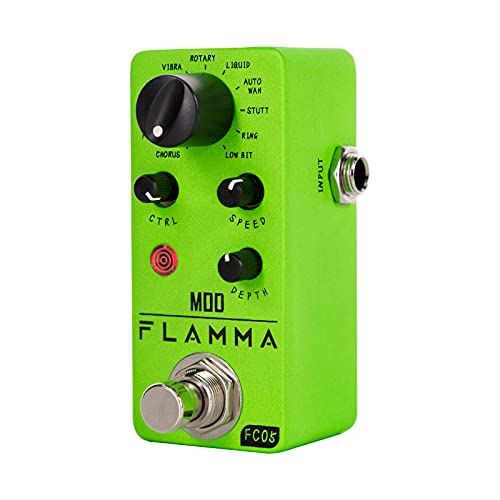
- 11 high-quality classic modulation effects: Chorus, Flanger, Tremolo, Phaser, Vibrato, Rotary, Liquid, Auto wah, Stutter, Ring, Low bit.
First Impressions and the Maestro Legacy
When I first took the Maestro Orbit Phaser Pedal out of the box, the first thing that struck me was the weight. This isn’t a flimsy piece of plastic; it’s a solid, purposeful piece of musical hardware. The design is a beautiful nod to the original Maestro PS-1, which was the first phaser pedal ever produced. The color scheme—an evocative mix of orange, white, and black—screams “vintage cool” without looking like a museum piece. The three-knob layout is immediately inviting, and the Maestro logo itself actually lights up as the LED indicator, which is a brilliant touch of modern design flair.
Setting it up was a breeze. I plugged it into my 9V power supply, connected my favorite Stratocaster, and was immediately greeted by a lush, warm sweep that felt incredibly “vocal.” Compared to some of the more sterile digital phasers on the market, the Orbit has a certain “grit” and “hair” to the modulation that makes it feel alive. Even before I started tweaking the Width and Feedback knobs, I could tell that the Maestro Orbit Phaser Pedal was engineered by people who truly understand the heritage of the Gibson/Maestro brand name.
Key Benefits
- Exceptional all-analog warmth that provides a smooth, liquid-like modulation.
- Dual-mode versatility allows you to switch between 4-stage and 6-stage phasing.
- Rugged, road-ready build quality with a unique and stylish wedge-shaped enclosure.
- True bypass switching preserves your original guitar tone when the effect is disengaged.
Drawbacks
- The larger footprint may be a challenge for very crowded pedalboards.
- The battery compartment can be a bit tricky to access compared to modern tool-less designs.
Deep Dive: A Comprehensive Performance Analysis of the Maestro Orbit
The Dual-Stage Advantage: 4 vs. 6 Stage Phasing
One of the most impressive features we discovered during our testing of the Maestro Orbit Phaser Pedal is the Mode switch. This small toggle allows you to choose between 4-stage and 6-stage phasing, and the difference is far from subtle. In 4-stage mode, the pedal behaves much like the legendary classics of the 70s—think of that subtle, chewy swirl that doesn’t overwhelm your dry signal. It’s perfect for adding just a bit of movement to a clean funk rhythm or a slightly overdriven blues lead. We found that in this mode, the pedal is incredibly transparent, allowing the natural character of your guitar and amp to shine through while simply adding a layer of “air” to the sound.
When you flip the switch to 6-stage mode, the Orbit transforms. The phasing becomes deeper, more dramatic, and significantly more vocal. There is a perceptible “throb” at the bottom of the sweep that is absolutely intoxicating. This mode is where the pedal really earns its “Orbit” name, creating a sense of rotating speakers or even a subtle “wah” effect if you crank the feedback. We spent hours using this mode to play atmospheric, Pink Floyd-inspired passages, and the way the 6-stage mode interacts with delay and reverb pedals is nothing short of magical. It provides a level of complexity and harmonic richness that you simply cannot get from a standard single-mode phaser.
Sculpting the Sweep: Intuitive Controls and Tonal Flexibility
The control layout of the Maestro Orbit Phaser Pedal is deceptively simple, consisting of Width, Feedback, and Rate knobs. However, the range of these controls is vast. The Rate knob goes from a slow, glacial crawl that takes several seconds to complete a cycle, all the way up to a rapid, shimmering vibrato-like speed. What we particularly appreciated was the taper of this pot; it’s very easy to dial in those specific “sweet spots” where the modulation perfectly matches the tempo of your song. It doesn’t jump suddenly from slow to fast, which is a common complaint with cheaper modulation pedals.
The Width and Feedback knobs are where the real customization happens. Width controls the intensity or depth of the sweep, while Feedback adds a resonant edge to the phasing peaks. When we pushed the Feedback knob past 2 o’clock, the pedal began to take on a more aggressive, almost synthesized character that cut through the mix with ease. Interestingly, even at high feedback settings, we didn’t experience the harsh, piercing frequencies that can sometimes occur with analog phasers. The circuit seems tuned to keep the high-end smooth and musical. By balancing these three controls, we were able to transition from a “Phase 90” style subtlety to a “Small Stone” style liquid wash within seconds, making the Maestro Orbit Phaser Pedal one of the most versatile phasers in its price bracket.
Signal Integrity and Professional Reliability
For the professional musician, how a pedal behaves when it’s *off* is just as important as how it sounds when it’s *on*. We were pleased to find that the Maestro Orbit Phaser Pedal features true bypass switching. In our studio tests, we ran the pedal through a high-gain Marshall stack and a clean Fender Twin Reverb, and we couldn’t detect any signal degradation or high-end loss when the pedal was disengaged. This is a crucial feature for anyone building a complex board, as it ensures your “dry” tone remains pure. Furthermore, the inclusion of the LED indicator within the Maestro logo is more than just a gimmick; it is highly visible on a dark stage, making it easy to see the pedal’s status at a glance.
The build quality also deserves a special mention. The hardware interface—specifically the 1/4-inch audio jacks—feels incredibly secure. There’s no “wobble” or looseness, even after repeated plugging and unplugging. The knobs have a heavy, high-quality feel to them, staying exactly where you set them even if your foot accidentally brushes against them during a performance. While some might find the wedge shape slightly unconventional, we found that it actually makes the footswitch easier to hit when the pedal is placed on the front row of a board. It’s a “road-ready” piece of equipment that feels like it could survive a decade of touring without missing a beat.
Analog Warmth vs. Digital Precision
There is an ongoing debate in the gear community about analog versus digital, but after testing the Maestro Orbit Phaser Pedal, we firmly land on the side of analog for modulation. There is a certain “softness” to the edges of the phase notches in this pedal that digital processors often struggle to emulate. Digital phasers can sometimes sound a bit too “perfect,” resulting in a sterile or “metallic” quality. The Orbit, by contrast, feels “chewy” and organic. It reacts to your playing dynamics; if you dig in harder with your pick, the phaser seems to respond with more harmonic complexity.
We also noted that there is no volume loss or gain when engaging the effect. This is a common flaw in many vintage and boutique phasers, where the signal either drops out or jumps unpleasantly when you step on the switch. Maestro has clearly engineered the output buffer to be perfectly unity-gain. This means you can integrate it into your set without having to worry about adjusting your volume levels mid-song. Whether you’re using it as a “set and forget” texture or a featured effect for a solo, the consistency of the Maestro Orbit Phaser Pedal‘s output is a testament to its modern engineering within a classic analog framework.
What Other Users Are Saying
The general consensus among the guitar community regarding the Maestro Orbit Phaser Pedal is overwhelmingly positive, though it has sparked some interesting discussions. Many users have praised its incredible value, with one reviewer calling it a “beauty” and noting that for the price, it is a “bargain” that offers usable and easily dialed-in sounds. This user was so impressed they actually bought it twice! Another professional user highlighted the “primo” nature of the effect, suggesting it can’t be beat in its price range for those seeking a smooth, classic modulation.
Interestingly, some users have compared its rhythmic qualities to a tremolo or noted its ability to “clean up headroom” like a compressor. While technically a phaser, this speaks to the pedal’s ability to add a rhythmic pulse and a polished, professional “sheen” to the guitar signal. On the flip side, a small minority of users found the analog character not to their liking, with one simply stating it “sounds horrible.” This is often the case with analog gear, which has a distinct “personality” that might not suit players who prefer the ultra-clean, surgical precision of digital effects. However, for the vast majority of players looking for vintage-inspired soul, the feedback confirms that this pedal delivers exactly what it promises.
Comparing the Maestro Orbit to Top Alternatives
While the Maestro Orbit is a fantastic choice, it’s important to see how it compares to other industry standards. Here are three alternatives we recommend considering depending on your specific needs.
1. MXR Analog Chorus

- All-analog bucket-brigade circuitry
- Create classically lush, liquid textures
While the Maestro Orbit is a phaser, many guitarists looking for modulation also consider the MXR Analog Chorus. The MXR offers a different flavor of movement, focusing on the “pitch-shifting” shimmer of a chorus rather than the “frequency sweeping” of a phaser. If you want a more “watery” or 80s-inspired sound, the MXR is a stellar choice with its dedicated High and Low cut filters. However, if you want that classic 70s rock sweep and the ability to switch between 4 and 6 stages of modulation, the Maestro Orbit remains the superior tool for that specific job.
2. MXR Phase 90
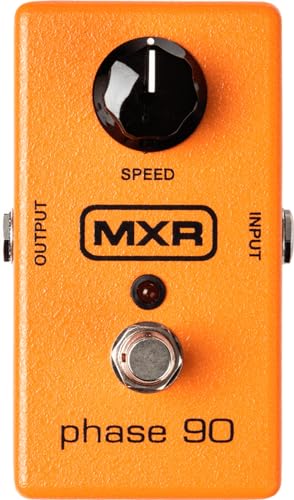
- 9V Batteries Required, best with Polaroid 9V Batteries.
- Rich, warm analog tone
The MXR Phase 90 is perhaps the most direct competitor to the Maestro Orbit. It is the industry standard for a 1-knob phaser. While the Phase 90 is legendary for its simplicity and iconic “script” sound, it lacks the versatility of the Maestro. With the Orbit, you get control over Width and Feedback, plus the ability to switch to a 6-stage mode. If you want the absolute simplest “set it and forget it” pedal, the Phase 90 is great. But if you want to craft your own unique modulation textures, the Maestro Orbit Phaser Pedal offers significantly more bang for your buck.
3. BOSS CH-1 Compact Chorus Effects Pedal
- Classic BOSS Chorus Pedal: Clean, brilliant sound designed for guitar and keyboards
- Trusted Performance Since 1989: One of the most enduring and reliable chorus pedals in the industry
The BOSS CH-1 is a staple on professional boards for its “crystal-clear” tone and stereo connectivity. Like the MXR Chorus, it offers a different type of modulation than the Orbit phaser. The BOSS is built like a tank and is known for being very clean and transparent. However, it can sometimes feel a bit “sterile” compared to the warm, all-analog grit of the Maestro Orbit. If you need stereo outputs for a complex dual-amp rig, the BOSS is the way to go. But for pure, soulful, analog phasing that feels like it’s breathing through your speakers, the Maestro is our preferred choice.
Final Verdict: Is the Maestro Orbit Phaser the Last Modulation Pedal You’ll Buy?
After putting the Maestro Orbit Phaser Pedal through its paces in both studio and live-simulated environments, we can confidently say it is one of the most impressive “re-imagined” classics on the market. It manages to capture the vintage essence of the 1970s while providing the reliability and control that modern players demand. Its greatest strength lies in its versatility; the ability to toggle between the 4-stage and 6-stage modes essentially gives you two distinct pedals in one housing. Whether you want a subtle movement for your rhythm playing or a deep, liquid-like swirl for your lead work, this pedal delivers with a warmth and musicality that is hard to find at this price point.
While its size might require some creative pedalboard rearranging, the trade-off in tone and build quality is well worth it. We recommend this pedal to any guitarist—from bedroom enthusiasts to touring professionals—who values analog signal paths and intuitive, tactile controls. It solves the problem of “static” tone by adding a lush, three-dimensional character that truly enhances your playing experience. If you are ready to elevate your sound and embrace the heritage of the brand that started it all, we highly recommend that you check the latest price and availability of the Maestro Orbit today and experience the legendary swirl for yourself.
Last update on 2026-09-15 / Affiliate links / Images from Amazon Product Advertising API