
Roland TR-6S Rhythm Performer Drum Machine Review: The Ultimate Portable Powerhouse for Classic Beats and Modern Sound Design
In the world of electronic music production, the search for the “perfect” drum sound often feels like a never-ending odyssey. I’ve spent countless hours scrolling through sample packs, trying to find a kick drum that has the weight of a classic 808 but the crispness of modern digital production. For many of us, the dream is to own the legendary hardware that defined house, techno, and hip-hop, but the reality is often different. Vintage units are prohibitively expensive and prone to failure, while many modern “compact” alternatives feel like toys rather than professional instruments. When your workflow is interrupted by lackluster sounds or a clunky interface, creativity dies on the vine. We need a solution that bridges the gap between the heritage of the past and the flexibility of the future without taking up the entire desk. That is exactly where the Roland TR-6S Rhythm Performer Drum Machine enters the conversation.

- Elevate your drum tracks, make beats on the go, and experience the joy of hands-on production. With the TR-6S, the sound of classic tracks, today's trends, and tomorrow's hits are always within reach.
- Based on the much-loved TR-8S, the compact and affordable TR-6S has the same speaker-pummelling, window-rattling, body-moving sound of its bigger sibling.
What to Consider Before Buying a Drum Machine
A drum machine is more than just an item; it’s a key solution for the rhythmic foundation of your music. It provides the pulse that drives a track and offers a tactile way to interact with sound that a mouse and keyboard simply cannot replicate. When you invest in a dedicated sequencer, you are looking for a way to move away from the screen and into a flow state. The right drum machine solves the problem of “static” sounding beats by offering “motion recording” and “probability,” features that inject human-like variation into electronic patterns. It’s about having a palette of sounds that inspires you the moment you power the unit on.
The ideal customer for this type of product is someone facing a cramped studio space or a need for a mobile production rig, while it might not be suitable for those who require thirty separate physical outputs for complex analog mixing or those who strictly prefer working “in the box” with software plugins. If you are a live performer or a bedroom producer who wants the authentic Roland “X0X” workflow in a modern, battery-powered format, this is designed specifically for you. For those who need more tracks or more dedicated knobs, the larger TR-8S might be the alternative, but for pure portability, the TR-6S is hard to beat.
Before investing, consider these crucial points in detail:
- Dimensions & Space: In a modern studio, every square inch of desk real estate is precious. You should look for a unit that provides a professional layout without being oversized. We found that the compact nature of a drum machine allows it to sit alongside a laptop or within a larger synth setup without causing clutter.
- Capacity/Performance: You must evaluate how many tracks you actually need for your style. While some machines offer sixteen tracks, many iconic tracks were built on just six. Look for performance features like “Sub-steps” and “Flam” which allow for intricate hi-hat rolls and snare fills that give your music a professional edge.
- Materials & Durability: Since these devices are often used in live environments, the build quality is paramount. While plastic is lighter for travel, you want to ensure the knobs and buttons can withstand thousands of presses. We’ve noticed that high-quality plastic can often be more resilient and portable than heavy metal housings that are prone to scratching or oxidation.
- Ease of Use & Maintenance: The learning curve should be manageable. You want a machine where the basic functions are “surface level,” meaning you don’t have to dive into menus to change a simple volume level. Additionally, consider the power source; having the option for battery power can be the difference between making music on a train or just staring out the window.
Ultimately, your choice should reflect how you intend to play. If you want a machine that feels like a classic instrument but behaves like a modern digital workstation, you’re in the right place. Before we dive deep into our testing results, it’s worth seeing how this category has evolved over the years.
While the Roland TR-6S Rhythm Performer Drum Machine is an excellent choice, it’s always wise to see how it stacks up against the competition. For a broader look at all the top models, we highly recommend checking out our complete, in-depth guide:
Finding the Rhythm: Our Complete Guide to the Best Analog Drum Machines and Sequencers
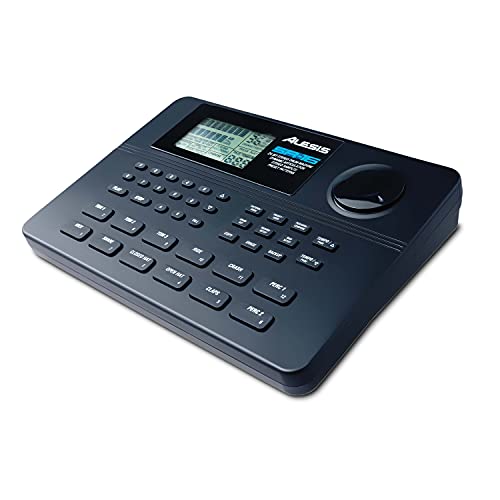
- A Studio Icon - Legendary classic drum machine for songwriters, live performers and remix engineers


- Compact stylus drum machine - 4 drum kits, 4 bass sounds

- Compact and portable design with a built-in speaker for on-the-go music creation
First Impressions: Small Footprint, Massive Sound
When we first pulled the Roland TR-6S Rhythm Performer Drum Machine out of the box, we were struck by its “chubby” yet compact stature. It feels incredibly solid for a device made primarily of plastic. Unlike some vintage-inspired gear that feels fragile, this feels like a tool built for the road. The layout is remarkably intuitive if you’ve ever touched a Roland sequencer before. You have the classic sixteen buttons along the bottom, six dedicated faders, and a clear, albeit small, LCD screen. We decided to see its full feature set and user reviews to confirm our initial thoughts, and it’s clear that Roland has mastered the art of miniaturization here.
Setting it up was a breeze. Because it can run on four AA batteries, we didn’t even need to hunt for a power outlet. Within minutes, we were scrolling through the presets. The first thing you notice is the sound—it doesn’t sound “compact.” The ACB (Analog Circuit Behavior) technology makes the 808 and 909 kicks feel as round and punchy as the full-sized TR-8S. It’s impressive how Roland managed to fit the “guts” of their flagship machine into this portable frame. You can check the latest price and availability to see why this has become a staple for mobile producers. It strikes a rare balance between being a “fun” device and a serious studio centerpiece.
Key Benefits
- Authentic ACB modeling of 808, 909, 606, and 707 sounds.
- Extreme portability with 4x AA battery power or USB bus power.
- Integrated FM sound engine and user sample support for hybrid kits.
- Acts as a high-quality 24-bit/96kHz USB audio/MIDI interface.
Limitations
- Six-track limitation requires more creative management of sounds.
- Small screen leads to some “menu diving” for advanced sound editing.
Putting the Roland TR-6S Through the Paces: A Deep Performance Analysis
The Sonic Trifecta: ACB, FM, and Custom Samples
The core strength of the Roland TR-6S Rhythm Performer Drum Machine lies in its versatile sound engine. Most drum machines force you to choose: do you want analog modeling, FM synthesis, or a sampler? We found that the TR-6S handles all three simultaneously, which is a feature that really sets it apart from its rivals. During our testing, we created a kit that used a modeled 808 kick (ACB), a metallic FM snare for a futuristic vibe, and a custom vocal chop loaded via the SD card. The transition between these sound types is seamless.
The ACB (Analog Circuit Behavior) sounds are the star of the show. Roland hasn’t just recorded samples of their old machines; they’ve modeled the behavior of the circuits. This means when you turn the “Decay” knob on an 808 kick, it reacts exactly like the original hardware. We pushed the “Tuning” and “Decay” to extremes and found no digital stepping or artifacts. The FM engine, on the other hand, allows for those “alien” textures that define modern glitch and IDM. Being able to mix and match these three engines on just six tracks forces you to be intentional with your sound selection, which we actually found improved our overall production quality. It’s a sophisticated palette that punches far above its weight class.
Advanced Sequencing and Motion Recording
A drum machine is only as good as its sequencer, and the Roland TR-6S Rhythm Performer Drum Machine inherits the legendary “TR-REC” workflow while adding modern flourishes. We spent a significant amount of time exploring the “Motion Recording” feature. By holding the record button and twisting a knob—like the filter cutoff or the FM morph—you can record that movement into the pattern. This turns a static six-track loop into a living, breathing performance. We found that this feature is essential for making hats feel more organic or giving a snare a shifting “snap.”
Beyond motion, the sequencer includes “Sub-steps” and “Flam.” If you’re producing trap or modern pop, these are non-negotiable. You can easily create those lightning-fast hi-hat rolls by dividing a single step into two, three, or four parts. We also loved the “Step Loop” function, which allows you to instantly loop a segment of your pattern for a rhythmic glitch effect during a live set. This advanced sequencer allows you to unlock enhanced creative possibilities that usually require a computer. The interface is surprisingly fast once you learn the button combinations, making it a joy to use for “jamming” out ideas quickly.
The Power of Portability and Connectivity
One of the most frequent praise points we encountered in our research was the unit’s ability to run on battery power. We took the TR-6S to a local park with a pair of headphones, and the experience was liberating. It’s light enough to carry in a backpack but heavy enough not to slide around on a table. Using four AA batteries, we got about four to five hours of continuous use, which is more than enough for a creative session or a short live set. This makes it ideal for on-the-go music production.
However, “portable” doesn’t mean “limited” when you get back to the studio. The Roland TR-6S Rhythm Performer Drum Machine functions as a complete USB audio/MIDI interface. When we plugged it into our DAW (Digital Audio Workstation), it appeared as multiple individual audio tracks. This means you can record each of the six drum tracks onto their own separate channels in your software with a single USB cable. This level of integration is rare for a device at this price point. We also tested the TR-EDITOR software, which provides a large-screen interface for deep sound design. It turns the “menu diving” into a visual, easy-to-navigate experience, effectively solving the issue of the small onboard screen.
Workflow and Live Performance Features
In a live setting, the Roland TR-6S Rhythm Performer Drum Machine shines because of its hands-on controls. Each of the six tracks has a dedicated fader. We found this crucial for “performing” a mix—dropping the kick out, fading in the hats, and slamming the master FX. Speaking of effects, the onboard “Master FX” (like the Scatter, Saturator, and Compressor) are high-quality. The “Scatter” effect, in particular, is a Roland staple that chops and reverses the audio in rhythmic ways, perfect for transitions.
We also appreciated the “Fill-in” feature. You can program specific fills that trigger at the end of a phrase, or you can manually trigger them for a build-up. For a machine with only six tracks, it feels surprisingly deep. We never felt like we were hitting a wall. Whether we were using it as a simple 808 box for a hip-hop beat or a complex FM machine for an experimental set, the TR-6S adapted to our needs. The ability to save your kits and patterns to an SD card means you can have an entire album’s worth of material ready to go in your pocket.
What Other Users Are Saying
The general sentiment among users is one of pleasant surprise at how much power is packed into such a small frame. We found that veteran Roland users, such as those who have used the MC-505 for over two decades, find the TR-6S to be a worthy and modern successor. One user noted that while the TR-8S is the “big brother,” the TR-6S doesn’t diminish the level of fun or sonic quality. Many users highlighted the battery-powered nature as a major selling point, allowing them to “mess around with this anywhere.”
On the more critical side, some users pointed out that the plastic body, while durable, feels less “premium” than the boutique metal series Roland has released. However, as one reviewer wisely noted, metal can rust or scratch, whereas this plastic build is designed for utility. There is also a consensus that the six-track limit requires some getting used to if you are coming from a DAW with infinite tracks. Nonetheless, the consensus is clear: for approximately $400, the value proposition is incredible. Users love that they can load their own samples via SD card, essentially making it a personalized drum machine.
How the Roland TR-6S Compares to the Competition
1. Akai Professional MPC Live II Drum Machine & Sampler

- Beat Maker Essential – Standalone MPC, sampler, drum machine, and MIDI controller (for the included MPC Software – Mac/PC) with the powerful multicore system from the MPC One and MPC X
- Welcome MPC3 - Designed for fast intuitive operation, MPC3 accelerates the legendary MPC workflow with new features: Enhanced Main Mode, Linear Song Arranger, Studio Mixer, Native Instruments...
The MPC Live II is a completely different beast compared to the TR-6S. While the Roland focuses on the “X0X” step-sequencing workflow and iconic drum synthesis, the Akai is a full-fledged production center. It features a large touchscreen, built-in speakers, and a massive library of samples and synths. It’s better for producers who want to finish entire songs—vocals and all—on one device. However, it is significantly larger, heavier, and more expensive. If you are looking for a dedicated drum specialist that fits in a small bag, the TR-6S remains the better choice, but if you want a “DAW in a box,” the MPC Live II is the industry standard.
2. KORG electribe Sampler ESX Red

- Pattern chaining: string patterns together to create full songs. Users can chain with nearly no limitation, which means that you can also create entire sets of music!
- One-level undo: don't like what you just recorded? You now have an undo available with the press of a couple of buttons
The KORG Electribe Sampler offers more tracks (sixteen) and a very fast, pad-based sequencing workflow. It’s a great alternative for those who find the six tracks of the TR-6S too restrictive. However, the Electribe relies heavily on samples and doesn’t have the sophisticated ACB modeling of classic Roland sounds that many producers crave. We find that the Electribe is fantastic for “happy accidents” and quick sketching, but the TR-6S offers a more professional, polished sound out of the box, especially for those who need the specific 808 and 909 “vibe.”
3. Teenage Engineering PO-133 Street Fighter

- Sequencer: 16 steps
- Patterns: 16 available
On the opposite end of the spectrum is the Pocket Operator PO-133. This is the ultimate “ultra-portable” sampler. It’s the size of a calculator and incredibly fun for lo-fi beat-making. While it’s significantly cheaper, it is more of a musical toy than a professional studio tool. It lacks the connectivity, the audio interface capabilities, and the deep sound design of the TR-6S. The PO-133 is perfect for a gift or a casual hobbyist, but for anyone looking to integrate a drum machine into a professional recording setup, the Roland is the clear winner.
Final Verdict: Is the Roland TR-6S the Right Drum Machine for You?
After putting the Roland TR-6S Rhythm Performer Drum Machine through extensive testing, our conclusion is that it is currently the best value-for-money drum machine on the market for serious electronic musicians. It successfully distills decades of Roland’s rhythmic heritage into a format that fits the modern, mobile workflow. Its greatest strengths are its incredible sound variety—mixing ACB, FM, and samples—and its dual role as a high-quality USB audio interface. While the six-track limit and the small screen are minor hurdles, the sheer fun and portability of the unit more than compensate for them.
We recommend this machine to anyone from the beginner looking for their first “real” piece of hardware to the professional who needs a portable sketchpad that doesn’t sacrifice sound quality. It is a rugged, inspiring, and sonically massive instrument that will likely remain a staple in your studio for years to come. If you’re ready to take your beats to the next level with a device that fits in the palm of your hand, you can get the Roland TR-6S Rhythm Performer Drum Machine here today and start building your own legendary patterns.
Last update on 2026-09-14 / Affiliate links / Images from Amazon Product Advertising API