
Best Acoustic Guitar Preamps: Our Top 4 Picks & Reviews
Introduction
We’ve spent countless hours on stage and in the studio testing various signal chains, and we can confidently say that the right preamp is the single most important tool for achieving a natural acoustic tone. After evaluating several top-tier options, we have selected the Fishman Platinum Pro EQ DI Preamp Pedal as our top pick. Its combination of a high-headroom analog signal path, precision 5-band EQ, and built-in compression provides a level of control that transformed our test instruments. Whether you are dealing with a quacky piezo or a dull magnetic pickup, this pedal offers the professional-grade features needed to sit perfectly in any mix.
Best Choice Fishman Platinum Pro EQ DI Preamp Pedal |
Best Price LR Baggs Element Active System |
 Fishman Prefix Plus-T Acoustic Preamp – Narrow | |
|---|---|---|---|
| Preamplifier Type | Analog Preamp Pedal | Active Endpin Preamp | Onboard Preamp |
| Equalization | 5-band EQ w/ sweepable mids | Fixed Low Cut Filter (45Hz) | Semi-parametric Contour, Bass, Treble |
| Onboard Tuner | Yes | No | Yes |
| Feedback Control | Phase Control | Low Cut Filter | Phase Switch & Notch Filter |
| Power Source | 9V Battery | 9V Battery | Corded Electric |
| Additional Features | DI Out, Compression, Boost, Effects Loop | High signal-to-noise ratio | Ultra-quiet electronics, Brilliance control |
| Buy Now | See latest price | See latest price | See latest price |
Our Top 4 Picks for Best Acoustic Guitar Preamps
#1 Fishman Platinum Pro EQ DI Preamp Pedal – Perfect for: Professional gigging musicians who need a comprehensive stage command center.

- Balanced XLR out with Pre/Post EQ Switch
- Footswitchable Boost with Level Control

When we took the Fishman Platinum Pro EQ DI Preamp Pedal out for a soundcheck, the first thing we noticed was the incredible headroom. It manages to deliver a pristine, high-fidelity sound that makes even standard factory pickups sound like premium studio microphones. The 5-band EQ is exceptionally musical, and the sweepable mid-control allowed us to dial out that annoying “honky” midrange that often plagues acoustic guitars in live settings. We found the onboard one-knob compressor to be a lifesaver for smoothing out aggressive strumming without sacrificing the instrument’s natural dynamics.
Our experience was confirmed by several users who noted that it sounds significantly better than running straight into a standard mixer. We also loved the integrated footswitchable boost, which is essential for making lead lines pop during a performance. While testing the unit, we found the tuner to be fast and accurate, effectively removing another pedal from our board. As one user pointed out, the EQ options are remarkably effective, and the sound remains clean and true to the instrument’s character. Whether you’re playing a guitar or even an octave mandolin, this preamp handles the frequency range with ease.
Key Benefits
- Comprehensive 5-band EQ with sweepable mids for precise tone shaping.
- Built-in soft-knee compressor and high-quality DI output.
- Integrated chromatic tuner and footswitchable volume boost.
Limitations
- Larger footprint compared to minimalist “set and forget” systems.
- Requires a 9V power source (battery or adapter).
#2 LR Baggs Element Active System – Ideal for: Players seeking a minimalist, high-fidelity internal solution that preserves the guitar’s aesthetic.
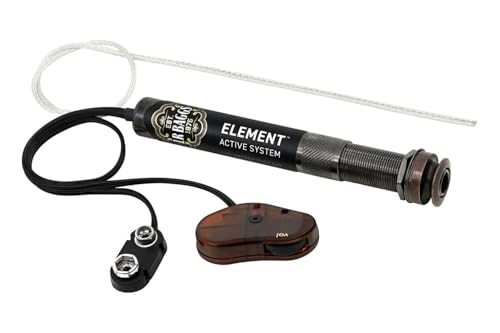
- Battery Type: Single 9V
- Current Consumption: 0.5mA
The LR Baggs Element Active System is a masterclass in “less is more.” We found the installation process to be refreshingly non-invasive, as it doesn’t require cutting a giant hole into the side of your precious instrument. Once installed, the Class A endpin-mounted preamp provides a signal that is remarkably quiet and full-bodied. During our testing, we were particularly impressed by the under-saddle transducer’s ability to track the movement of the soundboard, resulting in a more “air-like” quality compared to typical rigid piezo pickups.
What we really appreciate is the fixed low-cut filter set at 45Hz. This subtly removes low-end rumble and stage feedback before it even reaches your amp, which we found saved us a lot of trouble when playing at higher volumes. The removable volume control sits tucked away just inside the soundhole, giving you tactile control without cluttered knobs on the body. This is a “plug-and-play” dream for the minimalist guitarist. We found the signal-to-noise ratio to be exceptionally high, making it a reliable choice for both live work and home recording where floor noise can be a dealbreaker.
Key Benefits
- Class A electronics for a warm, transparent acoustic signal.
- Inconspicuous soundhole volume control for quick adjustments.
- Impressive battery life exceeding 1,000 hours.
Limitations
- No onboard EQ adjustments other than the fixed low-cut.
- Under-saddle installation might require professional setup for optimal string balance.
#3 Fishman Prefix Plus-T Acoustic Preamp – Narrow – Suits: Acoustic-electric players who prefer immediate, tactile onboard access to tone and feedback controls.

- Volume control as well as Bass, Treble, Brilliance control, and a wide-range semi-parametric EQ to isolate certain frequencies, and boost or cut them as needed
- Feedback-fighting Notch filter and Phase switch
For those who prefer their controls right on the guitar’s upper bout, the Fishman Prefix Plus-T Acoustic Preamp – Narrow is an industry standard for a reason. We found the semi-parametric contour control to be the star of the show; it allows you to target and cut (or boost) very specific frequencies, which is vital for finding your guitar’s “sweet spot.” The addition of a brilliance control also allowed us to add that high-end shimmer that helps an acoustic guitar cut through a dense band mix without sounding harsh.
A minor issue we also encountered, which some users pointed out, was the importance of choosing the correct size (Narrow vs. Wide format) for your specific bridge. One user noted they used this to replace an older Martin preamp and it worked perfectly with the original ribbon pickup, but stressed the importance of a proper fit. We found the built-in notch filter to be incredibly effective at killing feedback on the fly—a must-have feature for any gigging professional playing in varied venues. The chromatic tuner is also bright and easy to read, even under stage lights.
Key Benefits
- Powerful notch filter for quick feedback suppression.
- Semi-parametric contour control for professional-grade tone sculpting.
- Brilliance control adds clarity and “air” to the signal.
Limitations
- Requires a permanent cutout in the guitar body if not already equipped.
- Installation is more complex than pedal or endpin systems.
#4 GRAPH TECH GUITAR LABS Acousti-Phonic Preamp PD-0240-00 – Best for: Electric guitarists who want to achieve realistic acoustic tones from their solid-body instruments.

- GraphTech PE-0240-00 Ghost Preamp Kits
- The Graphetch Ghost modular pickup system. Get studio quality acoustic tone or MIDI compatible output at the flick of a switch.
The GRAPH TECH GUITAR LABS Acousti-Phonic Preamp PD-0240-00 is a unique beast in this roundup. We tested this system as a solution for electric guitar players who need to switch between high-gain riffs and lush acoustic passages without changing instruments. It is a solid-state internal preamp designed to work with Ghost piezo saddles. In our experience, the “Acousti-Phonic” circuitry does a fantastic job of filtering the harsh transients of a piezo, leaving behind a warm, believable acoustic-like voice.
This system is incredibly lightweight and durable. While it doesn’t offer the external EQ knobs of a pedal, it serves as a high-quality “engine” for your guitar’s internal electronics. We found that it handles signal split duties beautifully, allowing you to send your magnetic pickups to a tube amp and your piezo signal to the PA system simultaneously. For the DIY-inclined guitarist looking to upgrade their electric’s versatility, this preamp provides a robust, professional foundation for an “acoustic” signal in a solid-body world.
Key Benefits
- Enables realistic acoustic tones on electric guitars.
- Compact, durable construction designed for internal mounting.
- Supports dual-channel output for versatile signal routing.
Limitations
- Requires specific piezo saddles (Ghost system) to function.
- Zero external controls; relies on your guitar’s pots or external EQ.
The Ultimate Buyer’s Guide
Key Factors to Consider
When searching for the best acoustic guitar preamp, the first decision is the format: Pedal vs. Onboard. Pedal preamps, like the Fishman Platinum Pro, offer the most features and can be used with multiple guitars. Onboard preamps offer convenience and immediate access to controls during a song. You should also consider the EQ options. A basic 3-band EQ is fine, but having sweepable mids or a “contour” control allows you to fix specific tonal issues inherent to your guitar’s body shape or pickup type.
The Importance of Impedance Matching
A primary function of a preamp is to match the high impedance of a piezo pickup to the low impedance of a mixer or amplifier. Without this matching, your guitar will sound thin, brittle, and lacking in bass. A high-quality preamp ensures that the full frequency spectrum of your instrument is preserved, providing the “weight” and “warmth” that we expect from a high-end acoustic recording.
Common Mistakes to Avoid
- Ignoring Feedback Control: If you play live, don’t buy a preamp without a phase switch or a notch filter. These are your only defenses against the low-end howl that happens on loud stages.
- Over-complicating the Signal: Sometimes, a simple internal preamp like the LR Baggs Element is better than a complex pedal if you want to maintain your instrument’s natural response without over-processing.
- Forgetting the DI: If you plan to plug directly into a PA system, ensure your preamp has a balanced XLR (DI) output to avoid signal loss over long cable runs.
Frequently Asked Questions
What is the difference between an acoustic guitar preamp and an amplifier?
A preamp is designed to take the weak, high-impedance signal from your pickup and prepare it for further amplification, often providing EQ and DI functions. An amplifier is a complete system that includes a preamp, a power amp, and a speaker to produce audible sound. You often plug your preamp into an amplifier or a PA system.
How do I choose the right acoustic guitar preamp for my needs?
Consider where you play most. If you are a gigging professional, a pedal with a DI and tuner is best. If you want a discrete setup for a vintage guitar, an endpin preamp is ideal. If you want maximum control at your fingertips while playing, look for an onboard system.
What are the essential features to look for in an acoustic guitar preamp?
We recommend looking for at least a 3-band EQ, a phase switch for feedback control, a gain control to prevent clipping, and a high-quality DI output for connecting to professional sound systems.
Can an acoustic guitar preamp improve my sound quality?
Absolutely. A good preamp removes the “quack” associated with piezo pickups, balances the frequencies, and provides the necessary gain to ensure your signal is clear and robust before it reaches the speakers.
What is a DI box and do I need one with my preamp?
A DI (Direct Injection) box converts your guitar’s unbalanced signal to a balanced signal for long cable runs to a mixer. Many high-end preamps, like the Fishman Platinum Pro, have a DI built-in, so you don’t need a separate unit.
How do I connect an acoustic guitar preamp to my PA system or amp?
For a PA system, use a balanced XLR cable from the preamp’s DI output. For an acoustic amplifier, use a standard 1/4″ instrument cable from the preamp’s output to the amp’s input.
Are there any affordable acoustic guitar preamps that offer great sound?
Yes, systems like the LR Baggs Element provide professional-grade sound at a more accessible price point by focusing on high-quality internal components rather than an array of external knobs and switches.
Conclusion: Our Final Recommendation
After putting these units through their paces, the Fishman Platinum Pro EQ DI Preamp Pedal remains our definitive recommendation for the serious acoustic musician. Its “command center” approach solves nearly every problem a guitarist faces on stage, from feedback and tuning to tone shaping and volume boosts. While minimalist internal systems have their place, the sheer versatility and professional-grade analog circuitry of the Platinum Pro ensure that your acoustic guitar will sound its absolute best in any environment. We found it to be a transformative addition to any signal chain, providing the clarity and punch that truly brings an acoustic performance to life.
Last update on 2026-09-14 / Affiliate links / Images from Amazon Product Advertising API