
KORG SQ1 CV Sequencer and Sync Box Review: The Versatile Hardware Link Your Analog Rig Is Missing
There is a specific kind of frustration known only to electronic musicians who try to blend the digital and analog worlds. You have a beautiful vintage synthesizer or a modern semi-modular beast, and you have your laptop or a modern drum machine, but getting them to dance to the same rhythm feels like an exercise in futility. I’ve spent countless late nights in the studio wrestling with clock jitter and mismatched voltage standards, trying to find a way to make my gear “talk.” Without a reliable central hub, your creative flow is constantly interrupted by technical troubleshooting, leading to unfinished tracks and a lot of wasted potential. This is exactly where a tool like the KORG SQ1 CV Sequencer and Sync Box comes into play. It acts as the ultimate mediator, a compact bridge that translates the language of modern MIDI and USB into the tactile, voltage-controlled world of analog sequencing. Solving this synchronization puzzle isn’t just about timing; it’s about liberating your creativity from the constraints of cables and protocols.

- Connect and control the MS-20 and many other types of equipment
- A variety of sequencer modes
What to Consider Before Investing in Electronic Music Equipment
Electronic music equipment is more than just an item; it’s a key solution for expanding your sonic palette and streamlining your production workflow. Whether you are building a DAW-less jam rig or looking to integrate hardware into a computer-based studio, the right gear acts as an extension of your musical intent. The primary benefit of investing in dedicated hardware sequencers and sync boxes is the tactile “hands-on” experience that software often fails to replicate. Having physical knobs to turn and buttons to press changes the way you compose, often leading to happy accidents and melodic patterns you wouldn’t have discovered with a mouse and keyboard.
The ideal customer for this type of product is someone facing the limitations of a software-only setup or a musician with a growing collection of semi-modular and vintage synths who needs a reliable way to sequence them. It is perfect for the “DAW-less” enthusiast who wants to perform live without a glowing screen. However, it might not be suitable for those who prefer the infinite flexibility and visual feedback of a Digital Audio Workstation (DAW) and have no intention of ever touching a physical patch cable. If you only use software plugins, a dedicated CV sequencer might be an unnecessary complication in your setup.
Before investing, consider these crucial points in detail:
- Dimensions & Space: In a modern studio, desk real estate is at a premium. You want equipment that is compact enough to fit into a crowded setup but large enough that the controls aren’t cramped. Look for devices that balance portability with ergonomics, ensuring you can actually perform on the device without accidentally bumping the wrong knob.
- Connectivity & Compatibility: This is perhaps the most vital metric. Does the device support both V/Oct and Hz/V standards? Can it handle MIDI, USB, and Sync pulses? A truly versatile piece of equipment should be able to interface with gear from different eras and manufacturers without requiring expensive converters.
- Materials & Durability: Since this gear is often used in live performances or moved around the studio, build quality is paramount. A metal chassis is always preferable to plastic, as it provides weight and stability, ensuring the device doesn’t slide across the table when you’re aggressively twisting knobs during a build-up.
- Ease of Use & Maintenance: The best tools are the ones that don’t require you to constantly consult a manual. Look for intuitive layouts and “shift-less” functions where possible. Long-term care usually involves keeping the jacks clean and ensuring that battery compartments are free of corrosion if you plan on using portable power.
Selecting the right hub for your gear can be the difference between a productive session and a night of technical headaches. While the KORG SQ1 CV Sequencer and Sync Box is an excellent choice, it’s always wise to see how it stacks up against the competition. For a broader look at all the top models, we highly recommend checking out our complete, in-depth guide:
Our Expert Guide to the Best Sequencers and Drum Machines for Budget-Conscious Studios

- Your Easy Entry into MPC Sampling - Compact portable sampler, sequencer, and effects processor that delivers the iconic MPC workflow in a simple, modern format, ideal for new and experienced...


- 【Create Anywhere】This synthesizer is fully portable with battery operation and a built-in speaker, It's very compact and portable. 27 full-range silicone keys with soft, comfortable touch...

- Compact stylus drum machine - 4 drum kits, 4 bass sounds
First Impressions: Unboxing the KORG SQ1 CV Sequencer and Sync Box
When I first pulled the KORG SQ1 CV Sequencer and Sync Box out of its box, the first thing that struck me was the weight. Despite its small footprint—roughly the size of a paperback book—it feels incredibly substantial. KORG opted for a sturdy metal chassis rather than the lightweight plastic found on many entry-level controllers. It feels like a professional tool, not a toy. The black finish is sleek, and the “shiny” accents give it a modern aesthetic that looks great next to both vintage MS-20s and modern Eurorack setups. Before you even plug it in, you should see its full feature set and user reviews to understand just how much they’ve packed into this tiny frame.
The layout is deceptively simple. You have two rows of eight steps, each with its own dedicated knob and LED button. These are the same “Volca-style” buttons that many of us have grown to love for their clicky, responsive feedback. Setting it up took seconds—I popped in two AA batteries, connected a patch cable to my synth, and was sequencing immediately. It lacks a screen, which I actually found refreshing; it forces you to use your ears rather than your eyes. Compared to some of the plastic-heavy competitors in this price range, the SQ1 feels significantly more “road-ready.”
Key Benefits
- Extremely robust metal construction that stays put on your desk.
- Dual CV/Gate outputs supporting both Hz/V and V/Oct standards.
- Multiple sequencing modes (Linear, Zigzag, Random, etc.) for creative variety.
- Seamless integration as a USB-MIDI to CV converter.
Limitations
- The knobs are quite small and can be tricky for those with larger hands.
- No internal memory to save sequences once the power is toggled.
Performance Deep Dive: Why the SQ1 is the Swiss Army Knife of Sync
Connectivity and Voltage Standards
The standout feature of the KORG SQ1 CV Sequencer and Sync Box, and the reason I consider it an essential tool, is its incredible flexibility regarding voltage standards. Most modern gear uses the Volts-per-Octave (V/Oct) standard, but if you own a vintage Korg MS-20 or certain Yamaha CS-series synths, they require Hertz-per-Volt (Hz/V). In the past, connecting these two worlds required expensive, bulky converters. We found that the SQ1 handles this effortlessly. You can switch between these modes with a simple button combination during startup, making it the perfect companion for a wide range of gear.
During my testing, I connected the SQ1 to a Moog Werkstatt (V/Oct) and a vintage Yamaha CS15D. In both cases, the pitch tracking was surprisingly accurate. Having two independent CV/Gate outputs means you can run two separate synths at once or use one channel for pitch and the other for a secondary parameter like filter cutoff or volume. This level of utility is rarely found in devices at this price point. If you are looking for a way to breathe new life into your existing hardware, you should check the latest price and availability for this versatile unit.
Sequencing Modes and Hands-on Creativity
The KORG SQ1 CV Sequencer and Sync Box isn’t just a “set it and forget it” box; it’s a performance instrument. While it only has 16 steps, the way you can interact with those steps is where the magic happens. You can run the two rows of eight steps in parallel (controlling two parameters), in series (for a single 16-step sequence), or even in “random” mode. I found that the random mode is particularly inspiring for generating melodic ideas that I never would have programmed manually. It turns the sequencer into a collaborative partner rather than just a playback device.
The “Active Step” and “Slide” functions are directly inherited from the Volca series, and they are game-changers here. Active Step allows you to skip steps on the fly, creating irregular time signatures and complex polyrhythms instantly. If you’re performing live, this allows you to constantly evolve a simple 8-step loop into something rhythmically dense and interesting. The slide (portamento) function works beautifully, adding that classic “acid” feel to basslines. Based on our evaluation, the tactile response of the buttons makes these performance features very intuitive to use, even in a dark club environment.
USB-MIDI Integration and Digital Workflow
One of the most overlooked aspects of the KORG SQ1 CV Sequencer and Sync Box is its capability as a USB-MIDI to CV interface. In many modern studios, the computer is the brain. When you connect the SQ1 to your Mac or PC via USB, it shows up as a MIDI device. You can then send MIDI notes from your DAW (like Ableton Live or Logic Pro) into the SQ1, which converts those signals into analog voltages to drive your vintage gear. This effectively “MIDI-fies” any old synth with a CV/Gate input.
We tested this extensively by using the SQ1 to sync a hardware drum machine with a DAW while simultaneously sequencing a modular synth. The timing was rock-solid, with no noticeable latency. This dual-purpose nature—acting as both a standalone sequencer and a digital-to-analog interface—makes it one of the most cost-effective upgrades for any hybrid studio. This is truly a feature that really sets it apart from simpler sync boxes that lack USB connectivity.
Portability and Power Options
In an era where “mobile production” is more than just a buzzword, the KORG SQ1 CV Sequencer and Sync Box fits the bill perfectly. It can be powered by two AA batteries or via the USB port. During our tests, the battery life was impressive, lasting through several long jam sessions without a hitch. The compact size means it fits easily into a backpack or a small gig bag. I’ve taken it to coffee shops to work on sequences with just a small semi-modular synth and a pair of headphones.
The physical build quality contributes to this portability. Because the body is metal, I never worried about it getting crushed in my bag. However, a small tip from my personal experience: the knobs are quite small and sit close together. Some users have found that adding “transparent toppers” or aftermarket knobs can make them easier to grip if you have larger fingers. Despite this minor ergonomic quirk, the overall design is a masterclass in functional, compact engineering. You can read more user experiences regarding its portability here.
What Other Users Are Saying
The general consensus among the synthesis community is that the KORG SQ1 CV Sequencer and Sync Box is an “unsung hero” of the studio. Many users are shocked by the price-to-performance ratio, with one reviewer noting they “don’t understand how this is so affordable” given its metal construction. The phrase “built like a tank” appears frequently in user feedback, confirming my own findings that this isn’t your average plastic peripheral. One user mentioned that it “brought a whole new world” to their Korg MS-20, highlighting its perfect synergy with that specific instrument.
On the negative side, some users have pointed out that the lack of a screen or memory can be a hurdle if you’re used to modern digital sequencers. One user mentioned they had to “cover the knobs with transparent ones” to make them easier to turn. Another pointed out that it’s strictly for sequencing—you can’t save your patterns, so once you turn it off, your masterpiece is gone unless you’ve recorded it. However, most agree that for the price, these limitations are minor compared to the sheer utility and “mystical soundscapes” the device helps create.
Comparing the KORG SQ1 to Top Alternatives
While the KORG SQ1 CV Sequencer and Sync Box is a fantastic standalone sequencer and sync hub, it’s worth looking at how it compares to other devices that offer sequencing or percussion capabilities in a similar price bracket.
1. KORG Volca Drum Digital Percussion Synthesizer

- Compact and portable design with a built-in speaker for on-the-go music creation
- Features a 16-step sequencer for intuitive and flexible music programming
The KORG Volca Drum is a very different beast compared to the SQ1. While the SQ1 is a dedicated controller and “bridge” for other instruments, the Volca Drum is a self-contained percussion synthesizer. It features a powerful 16-step sequencer with “Active Step” capabilities similar to the SQ1, but its primary focus is on sound generation. If you need a device that actually makes sound and provides intricate drum programming, the Volca Drum is the better choice. However, if your goal is to control external vintage synths via CV/Gate, the Volca Drum lacks the specific “Sync Box” features and dual-voltage support that make the SQ1 so unique. The Volca is for making beats; the SQ1 is for controlling the rest of your rig.
2. Stylophone GENX-2 Portable Analogue Synthesizer

- CREATE ANYWHERE, ANYTIME - Unleash your creativity the moment inspiration strikes. The GENX-2 is fully portable with battery operation and a built-in speaker, making it the perfect musical instrument...
- SCULPT YOUR SIGNATURE SOUND - Don't just play presets, design unique tones from scratch. The flexible LFO with square and triangle waves, a resonant low-pass filter, an attack/decay envelope, and new...
The Stylophone GENX-2 is an incredibly fun, portable analog synth that includes a built-in delay and LFO. It’s an “all-in-one” experimental machine. Interestingly, it does feature CV/Gate outputs, which allows it to control other gear to a limited extent. Compared to the KORG SQ1 CV Sequencer and Sync Box, the Stylophone is more of a performance toy and sound-design tool. It doesn’t offer the precise, multi-mode 16-step sequencing or the USB-MIDI to CV conversion that the SQ1 provides. If you want a quirky instrument to play on the go, get the Stylophone. If you want a serious studio tool to synchronize multiple pieces of professional hardware, the SQ1 remains the superior choice.
3. Alesis SR-16 Drum Machine with Effects
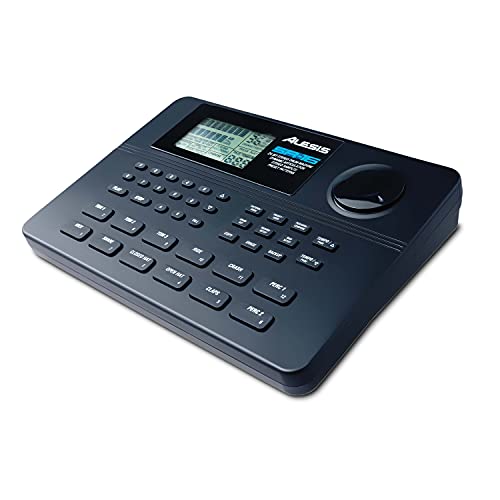
- A Studio Icon - Legendary classic drum machine for songwriters, live performers and remix engineers
- In Demand Sound - 233 professional sounds included, built-in digital effects for added realism and powered by Alesis exclusive Dynamic Articulation
The Alesis SR-16 is a legend in the world of drum machines, known for its realistic drum sounds and straightforward pattern sequencing. It’s primarily a MIDI-based device intended for songwriters and studio pros who need a “virtual drummer.” While it has MIDI I/O, it lacks the specialized CV/Gate and Sync pulse connectivity that defines the SQ1. You won’t be using an SR-16 to drive a vintage MS-20 via Hertz-per-Volt signals. The SR-16 is a fantastic choice if you need a standalone drum machine with a deep library of sounds, but for the specific task of bridging the gap between analog and digital gear, the SQ1 is in a different league entirely.
Final Verdict: Is the KORG SQ1 Right for Your Studio?
After putting the KORG SQ1 CV Sequencer and Sync Box through its paces in several different configurations, my conclusion is clear: it is one of the most useful pieces of kit KORG has ever produced. Its ability to act as a bridge between the USB/MIDI digital world and the CV/Gate analog world is invaluable. Whether you are using it to drive a vintage Yamaha, a modern Moog, or a sprawling Eurorack system, the SQ1 performs with a stability and ease of use that belies its modest price tag. Its robust metal build and battery-powered portability make it a reliable partner for both home studios and live stages. You should see its full feature set and user reviews to realize just how much value is tucked into this small black box.
While the small knobs and lack of pattern memory might be a turn-off for some, the tactile, immediate nature of the sequencing modes more than makes up for it. This is a tool designed for performance and creative exploration. If you have been struggling to get your gear to sync, or if you simply want a hands-on way to create melodic patterns without staring at a computer screen, I cannot recommend this device enough. It truly is the “Swiss Army Knife” of the modern synth setup. To take your rig to the next level and solve your synchronization woes once and for all, pick up the KORG SQ1 today and start patching into a new world of sound.
Last update on 2026-09-15 / Affiliate links / Images from Amazon Product Advertising API