
Best Electronic Music Equipment: Our Top 10 Picks & Reviews
Introduction
In our journey through the evolving landscape of audio production, we have tested countless devices, from massive studio consoles to pocket-sized gizmos. Finding the right gear can be overwhelming, but after extensive hands-on evaluation, we have identified a clear standout. We have crowned the KORG Volca Drum Digital Percussion Synthesizer as our top pick. Its unique six-part DSP engine and incredible waveguide resonator offer a level of sound design depth that is rarely seen in portable hardware. Whether you are a seasoned professional or a curious beginner, the items on this list represent the pinnacle of modern music technology.
Best Choice KORG Volca Drum Digital Percussion Synthesizer |
Best Price Teenage Engineering PO-33 K.O.! Micro Sampler & Drum Machine |
 Stylophone GENX-2 Portable Analogue Synthesizer with Speaker | |
|---|---|---|---|
| Type | Digital Percussion Synthesizer | Micro Sampler & Drum Machine | Analogue Synthesizer |
| Dimensions | 7.6 x 4.53 x 1.54 inches | N/A (Pocket Operator) | 5.12 x 1.57 x 7.28 inches |
| Weight | 0.37 kg | 91 grams | 339 grams |
| Key Feature | 6-part DSP synth engine, Active Step sequencer | Built-in microphone, 40-second sample memory | LFO, Resonant low-pass filter, CV/Gate output |
| Connectivity | Auxiliary in/out | Auxiliary in/out | Auxiliary in/out, CV/Gate outputs |
| Built-in Speaker | Yes | Yes | Yes |
| Buy Now | See latest price | See latest price | See latest price |
Our Top 10 Picks for Best Electronic Music Equipment
#1 KORG Volca Drum Digital Percussion Synthesizer – Ideal for: Deep Percussive Sound Design

- Compact and portable design with a built-in speaker for on-the-go music creation
- Features a 16-step sequencer for intuitive and flexible music programming
The KORG Volca Drum Digital Percussion Synthesizer is not your standard sample-based drum machine; it is a full-blown synthesizer dedicated to rhythm. In our studio sessions, we were immediately struck by the power of its six-part DSP engine. Unlike the Volca Beats, which relies on analog circuits, the Volca Drum allows you to sculpt sounds from the ground up using various waveforms and a brilliant waveguide resonator. This adds a metallic, physical dimension to the audio that we found absolutely intoxicating.
Our experience with the build quality was positive, noting a durable plastic shell that feels ready for travel. This sentiment was echoed by many users who praised its “matched” quality and durability. While the built-in speaker is convenient for quick sketches, we found that to truly appreciate the low-end frequencies this unit is capable of, you must connect it to a proper monitor system. We did encounter some minor menu diving due to the compact screen, but the randomized functions are a stroke of genius for breaking through creative blocks. It is a “beast” of a device that rewards those who take the time to learn its intricacies.
Key Benefits
- Unique waveguide resonator for rich, physical resonances.
- Deep 6-part DSP engine allows for sounds far beyond traditional drums.
- Highly portable with battery power and built-in sync.
Limitations
- Internal speaker lacks the bass needed for full sound appreciation.
- Steep learning curve compared to simple sample players.
#2 Teenage Engineering PO-33 K.O.! Micro Sampler & Drum Machine – Perfect for: Lo-Fi Sampling Anywhere

- pocket-sized sound – with PO-33 K.O.! you can sample any sound source using 3.5 mm line in or the built in microphone. melodic mode lets you play chromatic melodies and drum mode lets you to create...
- 40 second sample memory – the built-in microphone lets you easily sample any sound source, making for a convenient and versatile sampling experience. from environmental sounds to vocals, you can...
The Teenage Engineering PO-33 K.O.! Micro Sampler & Drum Machine is a marvel of miniaturization. We spent hours capturing sounds with the built-in microphone—from snapping fingers to clinking glasses—and turning them into gritty, 8-bit masterpieces. It reminds us of the early days of phrase samplers, offering a tactile, immediate workflow that modern software often lacks. With 40 seconds of sample memory and 16 effects, it is a surprisingly capable production tool.
We found the design to be incredibly clever, though it does feel somewhat fragile. We noticed that some users have experienced issues with the delicate LCD or protruding knobs if not handled with care, so we highly recommend investing in a protective case. Despite its small size, the “studio quality” sound through the line-out is impressive. As one user noted, it is a “Swiss Army knife for music production” that fits right in your pocket. It is the ultimate tool for capturing inspiration the moment it strikes, provided you treat it with a bit of delicacy.
Key Benefits
- Instant sampling via built-in microphone or line-in.
- 16 punch-in effects add great character to performances.
- Ultra-portable design with long battery life.
Limitations
- Hardware feels delicate and susceptible to damage without a case.
- Limited memory means you can only hold a few projects at once.
#3 Stylophone GENX-2 Portable Analogue Synthesizer with Speaker – Suits: Experimental Retro Textures

- CREATE ANYWHERE, ANYTIME - Unleash your creativity the moment inspiration strikes. The GENX-2 is fully portable with battery operation and a built-in speaker, making it the perfect musical instrument...
- SCULPT YOUR SIGNATURE SOUND - Don't just play presets, design unique tones from scratch. The flexible LFO with square and triangle waves, a resonant low-pass filter, an attack/decay envelope, and new...
The Stylophone GENX-2 Portable Analogue Synthesizer with Speaker is a brilliant evolution of a classic. We found the addition of the LFO and the analog delay to be game-changers, transforming what was once a “toy” into a legitimate sound design tool. The stylus-based keyboard is as fun as ever, but the new expression strip allows for much more fluid, theremin-like performances that we found incredibly expressive during our testing.
We did observe that the stylus wire can be a potential point of failure; we noticed a few users reported wear and tear on the cord after intense use. Furthermore, while the snazzy cool sounds are endless, the sensitivity of the tiny knobs means it can be difficult to replicate a specific sound exactly once you have changed the settings. However, for those looking to introduce themselves to the world of analog synthesis without a massive investment, this is a fantastic entry point. It creates a “mystical soundscape” that is both nostalgic and forward-thinking.
Key Benefits
- Genuine analog synthesis with a built-in delay and LFO.
- Expression strip offers unique performance capabilities.
- CV/Gate outputs allow for integration with modular gear.
Limitations
- Stylus wire can be prone to fraying over time.
- Lacks patch memory, making it hard to recall specific sounds.
#4 Alesis SR-16 Drum Machine with Effects – Ideal for: Reliable Studio Backing Tracks
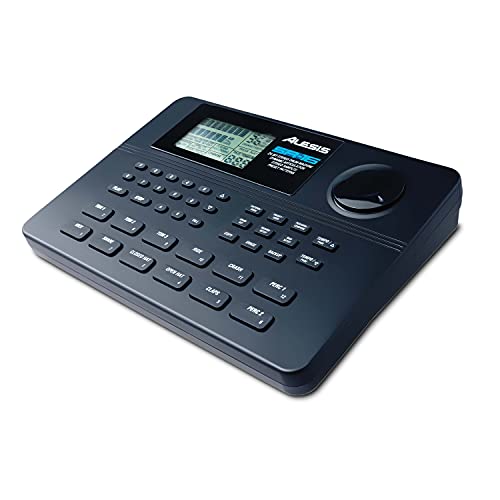
- A Studio Icon - Legendary classic drum machine for songwriters, live performers and remix engineers
- In Demand Sound - 233 professional sounds included, built-in digital effects for added realism and powered by Alesis exclusive Dynamic Articulation

The Alesis SR-16 Drum Machine with Effects is a legend for a reason. In our evaluation, we found its sounds to be remarkably “authentic” compared to modern digital counterparts, making it a favorite for guitarists and songwriters who need a reliable drummer that never gets tired. The 233 professional sounds cover a vast range of genres, and the 12 velocity-sensitive pads feel sturdy and responsive under the fingers.
We found the menu navigation to be straightforward, though it does feel a bit dated compared to modern touchscreens. Users have confirmed our findings, noting that it is a “rugged instrument” with professional studio build quality. One minor issue we encountered was a slight noise floor when using the instrument input, but the main outputs remain clean, especially when battery-powered. It is a workhorse that has stayed in production for decades because it simply works, providing a solid rhythmic foundation for any project.
Key Benefits
- Classic, high-quality drum sounds suitable for many genres.
- Dynamic Articulation changes tone based on how hard you hit the pads.
- Extensive I/O including four outputs and footswitch jacks.
Limitations
- Interface feels a bit antiquated by modern standards.
- The sound library, while classic, hasn’t changed in years.
#5 Novation Circuit Rhythm Sampler and Groovebox – Perfect for: Complete Standalone Beat Creation
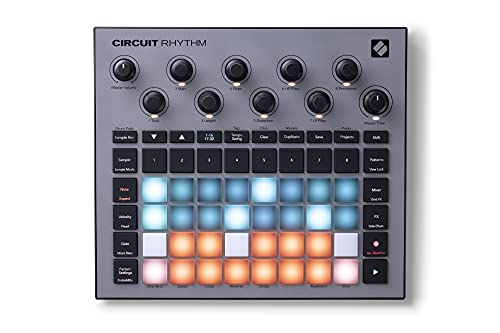
- Slice, sculpt and resample your sounds effortlessly: plug your phone, turntable or synths into Circuit Rhythm and record sounds directly to the machine, then process and resample them, or make beats...
- Whether you’re chopping straight from vinyl, making basslines and melodies, or punching in drums, you can playback samples however you choose with eight flexible sample tracks
The Novation Circuit Rhythm Sampler and Groovebox is perhaps the most intuitive piece of gear we have tested in recent years. Its screenless workflow encourages you to use your ears rather than your eyes, which we found incredibly refreshing. Sampling directly from a turntable or phone is seamless, and the eight tracks allow for complex, textured arrangements. The “performance FX” like lo-fi tape and beat repeats are perfect for live sets.
We found the build quality to be premium, featuring a sleek grey finish and responsive pads. While we were impressed with the battery life and portability, some users noted that setting up the microSD card can be a bit finicky if you aren’t using the proprietary software components. However, once configured, it is a “geniale” machine. It effectively removes the “DAW-wall” that prevents many beginners from making music, allowing for rapid experimentation and song building.
Key Benefits
- Incredibly intuitive, screen-free workflow.
- Powerful sampling and resampling capabilities.
- Comprehensive performance effects for live use.
Limitations
- Requires a microSD card for serious sample storage.
- Workflow may take a day or two to fully master without a screen.
#6 Teenage Engineering Pocket Operator PO-20 Arcade Synthesizer – Best for: Chiptune and 8-Bit Nostalgia

- pocket-sized sound – start rapid beat making with chiptune improvisation synthesized arcade sounds, all in one tiny pocket synthesizer.
- sequence and add effects – sequence your beats. the nano sized PO-20 also includes 16 punch-in effects to enhance and modify your sounds, get creative and tweak your compositions in any direction...
The Teenage Engineering Pocket Operator PO-20 Arcade Synthesizer is pure, unadulterated fun. We found its sounds to be instantly reminiscent of classic arcade games, and the chord control function makes it surprisingly easy to build full tracks. The “punch-in” effects allow for real-time manipulation that makes every performance feel unique. It blurs the line between a toy and a “real” instrument in the best way possible.
A minor issue we encountered, which some users also pointed out, was the fragility of the LCD screen. We have seen reports of screens failing or arriving damaged, so handling it with care is paramount. However, for the price, the learning curve is “extremely simple.” Within an hour of picking it up, we were already chaining patterns and creating complex chiptune melodies. It is a fantastic gift for any music lover or a great addition to a larger hardware setup.
Key Benefits
- Authentic 8-bit arcade sounds and drum kits.
- Chord sequencing makes songwriting very accessible.
- Syncs easily with other Pocket Operators and Volcas.
Limitations
- The screen is quite fragile and lacks a protective cover.
- Sound palette is specifically limited to the “arcade” aesthetic.
#7 KORG SQ1 CV Sequencer and Sync Box – Suits: Mastering Analog Connectivity

- Connect and control the MS-20 and many other types of equipment
- A variety of sequencer modes
The KORG SQ1 CV Sequencer and Sync Box is often called the “unsung hero” of the synth world, and we have to agree. We used it to drive everything from an MS-20 mini to modern semi-modular gear, and its versatility is unmatched for the price. Unlike many budget sequencers, the SQ1 is built like a tank—its metal chassis feels incredibly sturdy and professional. The ability to switch between Hz/V and Oct/V makes it compatible with almost any analog gear on the market.
We found the step edit buttons, inherited from the Volca series, to be very intuitive for live tweaking. While it lacks a display, the physical knobs provide immediate feedback. Users have confirmed that it “brought a whole new world” to their synths by allowing for complex sequencing without a computer. Whether you are using it as a MIDI-to-CV converter or a standalone step sequencer, it is an essential piece of kit for anyone moving away from a laptop-only setup.
Key Benefits
- Ultra-sturdy metal construction for professional use.
- Compatible with both Hz/V and Oct/V analog standards.
- Can function as a USB-MIDI to CV converter.
Limitations
- Knobs are very small and can be finicky to adjust precisely.
- No internal memory to save your sequences.
#8 Roland TR-8S Rhythm Performer Drum Machine – Ideal for: Professional Live Performance
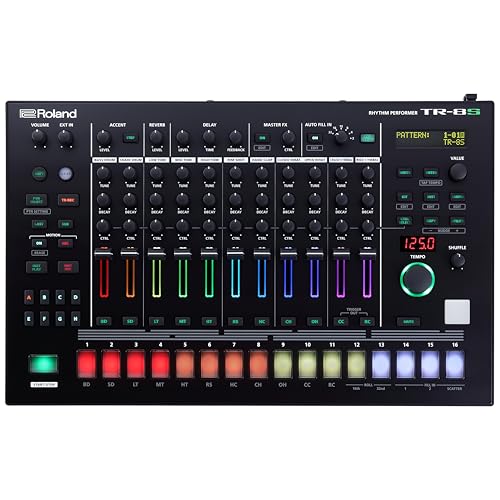
- The TR-8S combines the best of its Roland heritage with modern production techniques and professional sound design
- Design Kits with Authentic TR Drums, Sampled Sounds, and Effects
The Roland TR-8S Rhythm Performer Drum Machine is a powerhouse that combines the legendary sounds of the 808, 909, and 707 with modern sampling. In our testing, the ACB (Analog Circuit Behavior) technology felt remarkably close to the original hardware, providing that “warm” and “punchy” sound that defined electronic music. The addition of customizable effects and the ability to import your own samples makes it an incredibly versatile “rhythm performer.”
We found that while it is an incredibly powerful tool, it does require some “menu diving” to access deeper features. This sentiment was echoed by users who noted that while it sounds amazing, multi-tracking into a DAW can have some drawbacks depending on your setup. However, as an instrument that inspires the writing process, it is “excellence” personified. It feels like a premium piece of gear that belongs at the center of a professional stage or studio rig.
Key Benefits
- Faithful recreation of classic TR-series drum machines.
- Support for custom samples via SD card.
- In-depth hands-on control with faders and knobs for every track.
Limitations
- A significant investment compared to other drum machines.
- Can be overwhelming for beginners due to its feature density.
#9 KORG microKORG Analog Synthesizer with Vocoder – Best for: Iconic Synth Leads and Vocals

- Features 37 full-size keys, providing an expressive and dynamic playing experience
- Equipped with Korg's XMT Sound Engine, it delivers authentic analog modeling synthesis for rich sound creation
The KORG microKORG Analog Synthesizer with Vocoder is a living legend. After 20 years on the market, it remains a staple in both home studios and professional stages. We still love its “crunchadellic” arpeggiator and the incredibly fun built-in vocoder. The XMT sound engine produces thick, rich textures that cut through a mix with ease. Its compact size makes it a “secret weapon” for traveling musicians who need big sounds in a small footprint.
Some critics point to the “cheap” feel of the mini-keys, but we found them to be perfectly playable for synth leads and bass lines. We noticed many users have owned theirs for over five years, testifying to its “incredible durability.” Whether you are looking for retro 80s pads or modern robotic vocal transformations, the microKORG delivers. It is a versatile classic that continues to earn its place in the modern music landscape.
Key Benefits
- Legendary sound engine that has defined hits for two decades.
- Built-in vocoder with included microphone.
- Extremely durable and portable for life on the road.
Limitations
- Small keys may be difficult for traditional pianists.
- Editing sounds through the matrix interface can be slow.
#10 Singular Sound BeatBuddy 10th Anniversary Edition Drum Machine – Perfect for: Solo Artists and Realistic Practice

- Hands-Free Drumming Control – The first-ever drum machine in a pedal format, allowing musicians to control beats live and in real time with physical foot controls.
- Massive Sound Library & Customization – Includes 200+ songs across 24 genres and 10 ultra-realistic drum kits, with storage for 3.2 million songs and 300 drum sets. Easily download new content or...
The Singular Sound BeatBuddy 10th Anniversary Edition Drum Machine is a game-changer for solo performers. Unlike most drum machines that feel “robotic,” the BeatBuddy uses high-quality samples of real drummers, resulting in a sound that is genuinely “human.” We found the foot-control interface to be incredibly intuitive; adding fills or transitioning from a verse to a chorus feels natural during a live performance. It effectively turns you into a “one-man band.”
We did encounter one minor hurdle during our test: the SD card slot can be a bit tight, a frustration also mentioned by a few users who received units with finicky slots. However, once up and running, the quality of the material is top-notch. It isn’t just a “jam toy”; it is a professional-grade tool for those who want realistic percussion without the complexity of a traditional sequencer. It adds an “element of realism” that most digital rhythm boxes simply cannot match.
Key Benefits
- Studio-quality samples of real drummers for a “human” feel.
- Hands-free control specifically designed for guitarists and vocalists.
- Massive library of 200+ songs across 24 genres.
Limitations
- Pricey for a pedal-based drum machine.
- Requires an external footswitch for the most fluid control.
The Ultimate Buyer’s Guide
Key Factors to Consider
When selecting your next piece of electronic music equipment, the first question to ask is: Standalone or Controller? Gear like the Novation Circuit Rhythm allows you to make music without ever touching a computer, whereas MIDI controllers require a laptop. Consider your preferred workflow. Additionally, look at Connectivity. If you plan to expand your setup, ensure your gear has MIDI In/Out or CV/Gate options to talk to other devices. Finally, Portability is a major factor; battery-powered devices are excellent for on-the-go inspiration but may sacrifice some features found in larger, mains-powered units.
Understanding Analog vs. Digital Synthesis
Analog gear (like the Stylophone GENX-2) uses physical circuits to create sound, often resulting in “warm” or “gritty” tones that vary slightly with temperature and voltage. Digital gear (like the KORG Volca Drum) uses DSP (Digital Signal Processing) to simulate sounds. Digital is typically more versatile and offers precise control and patch saving, whereas analog is prized for its organic, tactile feel.
Common Mistakes to Avoid
- Ignoring the Speakers: Many portable units have weak internal speakers. Always budget for a good pair of headphones or studio monitors to hear the true quality of your gear.
- Skipping the Manual: Especially with devices like the Volca Drum or TR-8S, deep features are often hidden behind button combinations. Taking an hour to read the manual will significantly improve your creative output.
- Over-investing Too Early: You don’t need a thousand-dollar setup to start. Begin with a versatile piece like a Pocket Operator or a used microKORG to learn the basics first.
Frequently Asked Questions
What are the essential electronic music equipment for beginners?
For beginners, we recommend a “Groovebox” or a simple synthesizer with a built-in sequencer. These allow you to create full loops and rhythms immediately. An audio interface and a decent pair of studio headphones are also essential if you plan to record into a computer.
What is the difference between a synthesizer and a drum machine?
A synthesizer is generally designed to create melodic sounds like leads, basses, and pads. A drum machine is specialized for percussive sounds and rhythms. However, modern gear like the Volca Drum often blurs these lines by allowing you to create melodic textures using a percussion engine.
How do I choose the right MIDI controller for my setup?
Choose based on your “input” preference. If you are a pianist, look for 49 or 61 full-sized keys. If you are a beatmaker, look for a controller with 16 high-quality pads. Ensure it has the right ports (USB vs. 5-pin MIDI) for your existing gear.
What are the best budget-friendly electronic music production tools?
The Teenage Engineering Pocket Operator series and the KORG Volca series are the gold standard for budget-friendly hardware. They offer professional-grade sound engines at a fraction of the cost of full-sized workstations.
Can I start making electronic music with just a laptop?
Absolutely. Most modern electronic music is produced using DAWs (Digital Audio Workstations) and VST plugins. However, adding physical hardware like the gear on this list can provide a tactile inspiration that “clicking and dragging” with a mouse cannot replicate.
What are the most innovative electronic music equipment currently available?
We believe the Roland TR-8S and the Novation Circuit Rhythm are currently leading the way in combining classic “feel” with modern digital flexibility, allowing for seamless integration between live performance and studio recording.
How important is audio interface quality for electronic music production?
It is very important once you begin recording. A high-quality interface ensures that the “warmth” of your analog gear or the “detail” of your digital synths is captured accurately without adding unwanted noise or latency.
Conclusion: Our Final Recommendation
After thoroughly testing the market, we confidently recommend the KORG Volca Drum Digital Percussion Synthesizer as the best choice for most users. Its six-part DSP engine and unique waveguide resonator allow for a range of sounds that simply cannot be found in other devices at this price point. While the Roland TR-8S offers more professional-grade features, the Volca Drum’s portability, affordability, and deep sound-sculpting potential make it the most versatile tool in our arsenal. Whether you’re adding it to a massive studio rig or using it as your first piece of hardware, it is a creative powerhouse that will inspire you for years to come.
Last update on 2026-08-01 / Affiliate links / Images from Amazon Product Advertising API