
Behringer FLOW 8 Digital Mixer with Bluetooth Review: The Compact Powerhouse for Modern Creators
For years, our studio setup felt like a constant tug-of-war between the tactile simplicity of analog gear and the surgical precision of digital processing. We’ve all been there: a desk cluttered with interfaces, external compressors, and a rat’s nest of cables just to get a clean vocal and a backing track running simultaneously. The problem isn’t just the space; it’s the workflow friction. When inspiration strikes, the last thing you want to do is spend twenty minutes troubleshooting gain stages or menu-diving on a tiny, non-backlit screen.
We searched for a solution that could bridge the gap—something small enough to fit in a gig bag but powerful enough to handle a multi-mic podcast or a live acoustic set. Failing to find a “smart” mixer usually means settling for a bulky traditional board or a basic 2-channel interface that lacks real-time physical control. That’s where the Behringer FLOW 8 Digital Mixer with Bluetooth entered our radar. We needed a “brain” for our setup that didn’t require a PhD in audio engineering to operate, and after putting it through its paces, we’ve discovered exactly where it shines and where it demands a bit of caution. Before you commit, you can see its full feature set and user reviews to see if it matches your specific creative needs.

- Ultra-low noise, high headroom digital mixer with wireless remote control
- FLOW App for Bluetooth remote control from iOS/Android mobile phones or tablets

What to Consider Before Investing in Unpowered Recording Mixers
An Unpowered Recording Mixers is more than just an item; it’s a key solution for any creator who needs to blend multiple audio sources—like microphones, instruments, and computer audio—into a cohesive professional stream or recording. Unlike powered mixers, which are designed to drive heavy passive speakers, these units focus entirely on signal integrity and routing. They are the essential “command centers” for podcasters, streamers, and home studio musicians who want to ensure their levels are perfect before the sound ever hits the recording software.
The ideal customer for this type of product is someone facing limited desk space but requiring high-level features like onboard compression, EQ, and effects. It is perfect for the solo musician who performs at small venues or the content creator who needs a reliable USB interface with physical faders. However, it might not be suitable for those who need to power large PA speakers directly or those who require dozens of inputs for a full drum kit or a large band. In those cases, a larger digital console or a high-end rackmount interface would be a better alternative.
Before investing, consider these crucial points in detail:
- Dimensions & Space: In a modern workspace, every square inch matters. You want a mixer that offers a small footprint without sacrificing the spacing between knobs and faders. A compact design allows for portability, but ensure the unit is heavy enough to not slide around when cables are plugged in.
- Capacity & Performance: Look beyond the number of “channels.” Evaluate how many of those channels have high-quality preamps (like Midas) and how many are dedicated to stereo line inputs or Bluetooth. The bit-depth and sample rate of the USB interface are also vital for recording clarity.
- Materials & Durability: While plastic is light, a metal chassis provides shielding against electromagnetic interference and survives the rigors of travel. Pay close attention to the quality of the faders; 60mm faders are generally the gold standard for precise manual control in a small format.
- Ease of Use & Maintenance: Digital mixers can be complex. Check if the unit offers “assistive” features like automatic gain setting (EZ-Gain) or a remote control app. Long-term maintenance often involves firmware updates, so ensure the manufacturer provides consistent software support.
Choosing the right mixer is a balance of features, price, and reliability. To help you make the best decision, you should check the latest price and availability of the FLOW 8. While the Behringer FLOW 8 Digital Mixer with Bluetooth is an excellent choice, it’s always wise to see how it stacks up against the competition. For a broader look at all the top models, we highly recommend checking out our complete, in-depth guide:

- 12-channel compact effects mixer with proven high-headroom, low-noise performance
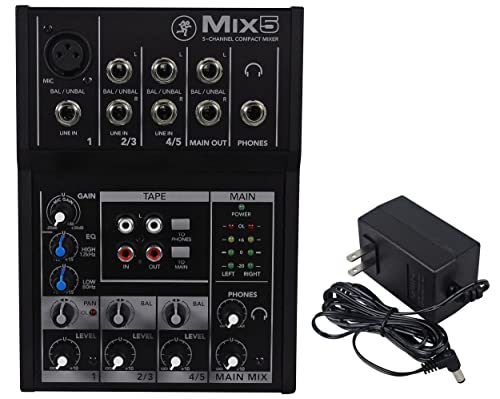
- 5-channel compact mixer with proven high-headroom, low-noise performance
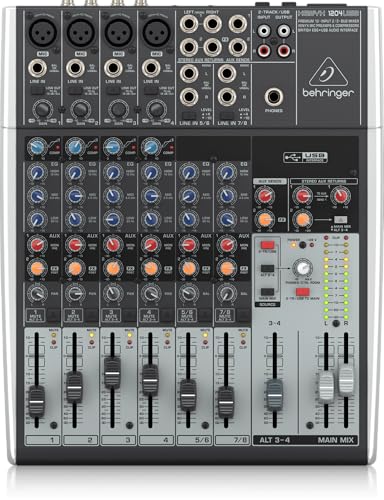
- Premium ultra-low noise, high headroom analog mixer
First Impressions: Unboxing the Behringer FLOW 8 Digital Mixer with Bluetooth
When we first pulled the Behringer FLOW 8 Digital Mixer with Bluetooth out of its packaging, the first thing that struck us was the weight. At just 1400 grams, it feels incredibly light, yet the build quality is surprisingly rigid. It doesn’t feel like a toy; it feels like a precision instrument. The layout is remarkably clean for an 8-input device. The inclusion of 60mm channel faders—a rarity on mixers this small—is a feature that really sets it apart from the rotary-heavy competition.
The aesthetic is modern, with a master rotary control surrounded by a crisp LED collar that gives immediate visual feedback. Setting it up was a breeze; we had it connected to our DAW via USB and paired with a smartphone for app control within minutes. Unlike older analog boards that require a separate interface, the FLOW 8 acts as its own 10-out/2-in audio interface. Compared to previous Behringer XENYX models, the FLOW 8 feels like a leap into the future, trading dozens of dedicated physical knobs for a streamlined, app-integrated experience that prioritizes clean signal paths over “knob-per-function” clutter.
Key Benefits
- EZ-Gain Function: Automatically analyzes your input signal and sets the gain for optimum headroom—perfect for beginners.
- Hybrid Control: Combines physical 60mm faders with a comprehensive iOS/Android remote control app via Bluetooth.
- Premium Preamps: Features two Midas microphone preamps with 48V phantom power and programmable gain settings.
- Dual FX Engines: Two independent studio-grade effects processors with 16 presets each, including reverbs and delays.
Limitations
- Micro-USB Power Port: The power connection is a Micro-USB port, which we found to be somewhat fragile and prone to disconnecting if moved.
- App Dependency: To access deep EQ settings and advanced routing, you absolutely must use the mobile app.
Deep Dive: The Professional Verdict on Performance
The App Ecosystem and Wireless Control
In our testing, the “FLOW App” wasn’t just a gimmick; it was the backbone of the entire experience. While you can perform basic mixing using the physical faders and the main rotary knob, the app unlocks the true power of the Behringer FLOW 8 Digital Mixer with Bluetooth. We found the Bluetooth connection to be remarkably stable, allowing us to step away from the desk and adjust the monitor mix from across the room. This is a game-changer for solo performers who need to tweak their sound during a soundcheck without running back and forth to the stage.
The interface of the app is intuitive, offering a “Stage Assist” mode that guides you through the setup. We particularly loved the visual EQ—a 4-band parametric EQ on every channel that is simply impossible to fit physically on a mixer of this size. Users in the community have noted that while the physical faders are great, “you can basically do everything with the app,” which mirrors our findings. However, we did notice that if the Bluetooth disconnects, you still have physical control over the main volumes, which is a crucial safety net for live use. You can explore the app capabilities further by checking out the latest software updates and user feedback online.
Audio Engineering and the EZ-Gain Innovation
One of the biggest hurdles for novice audio engineers is setting the gain correctly. Too low, and you have a noisy signal; too high, and you get digital clipping. We were skeptical of the EZ-Gain function at first, but it proved its worth immediately. By engaging the function and simply speaking or playing into the mic, the mixer analyzes the peaks and automatically sets the gain. We found this to be incredibly accurate, providing a clean signal with plenty of headroom.
The audio quality itself is bolstered by the two Midas preamps. Midas is a legendary name in high-end consoles, and having that technology in a $300 mixer is impressive. We found the noise floor to be exceptionally low, even when using gain-hungry dynamic microphones. One user mention that “the clarity alone” was a massive step up from their previous setup, and we have to agree. The 10-out/2-in USB interface also allows for multitrack recording, which means you can record each input to a separate track in your DAW—a feature usually reserved for much more expensive hardware.
Effects Processing and Routing Flexibility
The Behringer FLOW 8 Digital Mixer with Bluetooth features two independent FX engines. We put these through a series of “stress tests,” using lush hall reverbs on vocals and a subtle slapback delay on an acoustic guitar. The quality of the effects is high-end; they don’t sound “metallic” or “cheap” like some entry-level built-in FX. With 16 presets per engine, there is enough variety to cover everything from a dry podcast to a spacey ambient session.
Routing is another area where this mixer punches above its weight. You can create a main mix for your audience and a completely different monitor mix for yourself. We tested this by sending a “minus-one” track to the headphones while keeping the full mix going to the speakers, and the process was seamless through the app. The Bluetooth audio input also has its own dedicated channel, complete with EQ, which is perfect for playing backing tracks or taking “phone-in” guests during a live stream. To see how these routing options look in practice, you can view detailed specifications on the official listing.
Build Quality and the Power Port Dilemma
We need to talk about the physical design, specifically the power input. While the metal chassis and 60mm faders feel premium, the choice of a Micro-USB port for power is a point of contention. In our studio, it worked perfectly, but we can see why users who take this on the road are concerned. As one user noted, “its port for power disconnects at the slightest movement.” We recommend using a high-quality cable with a secure fit and perhaps a bit of cable management to ensure it doesn’t budge during a show.
Aside from that single point of failure, the rest of the unit is a tank. The knobs have a satisfying resistance, and the faders move smoothly without any “grittiness.” The 6.3mm jacks are secure, though some users have mentioned slight alignment variations. In our unit, everything was perfectly centered. The inclusion of two XLR/TRS combo jacks and two dedicated XLR inputs gives you the flexibility to plug in almost anything. It’s a professional-feeling piece of gear that happens to be small enough to fit in the palm of your hand.
What Other Users Are Saying
The general consensus among owners of the Behringer FLOW 8 Digital Mixer with Bluetooth is one of pleasant surprise. Most users are blown away by the “small but powerful” nature of the device. One user shared that this was their first digital mixer and they “didn’t know what they were missing out on,” specifically citing the sound clarity as a major highlight. Another professional user praised the “extraordinary efficiency” and “simplicity of use,” which aligns with our experience of the EZ-Gain and App integration.
However, the feedback isn’t without its warnings. The Micro-USB power port is the most frequently cited “Achilles’ heel.” One user mentioned they had to physically modify their unit to an AC port because the Micro-USB was too fragile for live use. Another user pointed out that while the EQs and compressors are functional, they might feel “poor” compared to high-end dedicated rack gear, though they admitted that for a $300 mixer, the value is still unbeatable. We believe these critiques are relevant for anyone planning to use the mixer in a rugged, mobile environment, whereas studio users will likely never encounter these issues.
Comparing the Behringer FLOW 8 Digital Mixer with Bluetooth to Its Top Alternatives
1. TC Helicon GoXLR MINI Broadcast Mixer with Audio Interface

- “Go live” desktop rig for online broadcasters gives you instant control over your audio
- Flexible and intuitive USB-based mixing for all of your audio - simple, easy-to-use controls get you up and running quickly
The GoXLR Mini is a direct competitor for streamers and content creators. While the FLOW 8 is a versatile “all-rounder” for live music and recording, the GoXLR Mini is laser-focused on the Windows gaming and streaming ecosystem. It features Midas preamps similar to the FLOW 8, but lacks the 8-input flexibility and the Bluetooth remote control app. If you are strictly a PC gamer who needs a “set it and forget it” solution for Twitch, the GoXLR Mini is a fantastic choice. However, if you need to plug in a guitar, a guest’s microphone, and a tablet for backing tracks simultaneously, the FLOW 8 is the superior tool.
2. Behringer XENYX 1204USB 12-Input Mixer with USB Interface
- Premium ultra-low noise, high headroom analog mixer
- Neo-classic "British" 3-band EQs for warm and musical sound. Maximum input level plus12 dBu @ plus10 dB gain Maximum input level 30 dBu
For those who find the idea of an app-controlled mixer intimidating, the XENYX 1204USB is the classic “old school” alternative. It offers more physical inputs and dedicated knobs for every single function, including 3-band EQs and compressors. The trade-off is the size—it is much larger and heavier than the FLOW 8—and the lack of digital “smart” features like EZ-Gain or programmable FX presets. We recommend the XENYX 1204USB for permanent installations where you want “knob-per-function” control and don’t care about portability or wireless mixing.
3. TC Helicon GoXLR 4-Channel Mixer Broadcast Platform

- Multi-channel mixer: Motorized faders let you control mic, game, music, chat, and more for the perfect Broadcast mix
- Studio quality MIDAS preamp: Make your XLR mic sound great with 48V phantom power, equalizer, compressor, limiter, de-esser, and Gate
The full-sized GoXLR is the “big brother” to the Mini and a powerhouse for broadcasters. It features motorized faders and a dedicated soundboard for samples, which the FLOW 8 lacks. However, it is significantly more expensive and is also locked into the PC ecosystem. The FLOW 8 wins on portability and its ability to function as a standalone mixer without a computer connected. If you are a high-end broadcaster who needs motorized faders for complex scene changes, the GoXLR is the gold standard, but for the traveling musician or the multi-platform creator, the FLOW 8 offers better value and versatility.
The Final Verdict: Is the Behringer FLOW 8 Digital Mixer with Bluetooth Right for You?
After weeks of testing and comparing it with both its analog predecessors and its digital competitors, our verdict is clear: the Behringer FLOW 8 Digital Mixer with Bluetooth is a masterclass in modern, compact audio engineering. It successfully shrinks the power of a digital console into a format that fits in a backpack. The Midas preamps provide a professional sheen to any recording, and the EZ-Gain feature makes it accessible to those who are just starting their audio journey. While the Micro-USB power port requires a bit of extra care, the sheer amount of functionality—from the dual FX engines to the multitrack USB interface—makes it an incredible value for the price.
If you are a podcaster, a solo performer, or a home studio owner looking to declutter your desk without sacrificing sound quality, this is the mixer you’ve been waiting for. It bridges the gap between the physical and digital worlds with style and efficiency. Ready to elevate your audio game? We highly recommend that you secure your own Behringer FLOW 8 today and experience the freedom of wireless mixing for yourself.
Last update on 2026-09-14 / Affiliate links / Images from Amazon Product Advertising API