
Donner DEP-1S 88-Key Digital Piano with Stand & Pedal Review: The Ultimate Gateway for Aspiring Pianists?
When you decide to finally take the plunge and learn the piano, you are immediately met with a daunting hurdle: the equipment. For many of us, the dream of a grand piano sitting in the living room is quickly dampened by the reality of cramped apartments, thin walls, and a limited budget. I remember when I first started looking for a keyboard; I was paralyzed by choice. Do I get a cheap “toy” that feels like plastic, or do I drop thousands on a professional workstation I don’t even know how to turn on? This is the central conflict for every beginner. If you choose a keyboard that is too basic, you won’t develop the proper finger strength or technique. If you choose something too complex, the learning curve becomes a wall. Solving this problem is crucial because those first six months of practice determine whether you’ll be a lifelong player or if the instrument will just gather dust. That is why we spent weeks evaluating the Donner DEP-1S 88-Key Digital Piano with Stand & Pedal, a product that claims to bridge the gap between “beginner-friendly” and “performance-ready.”

- 【AESTHETIC & COMPACT】Beauty meets convenience, unleashing your musical masterpiece. Immerse yourself in the world of music with the exquisite acoustic digital piano, which can be seamlessly...
- 【REALISTIC PIANO SOUNDS】Authentic piano voices from grand piano to electric piano are faithfully reproduced with smooth sound technology for an expressive and natural playing experience
What to Consider Before Buying a Digital Piano: A Comprehensive Buyer’s Guide
A Digital Piano is more than just an item; it’s a key solution for bridging the gap between traditional acoustic feel and modern technological convenience. Unlike a standard synthesizer or a 61-key portable keyboard, a full-size digital piano is designed to replicate the experience of playing a real piano. It provides the necessary real estate—all 88 keys—required to play classical repertoire and modern pop alike. The main benefit here is consistency; you aren’t learning on a truncated scale, meaning your muscle memory translates perfectly to any piano you encounter in the wild.
The ideal customer for this type of product is someone facing space constraints or budget limitations who still wants a “real” piano experience, while it might not be suitable for those who are professional touring musicians or concert pianists requiring high-end graded hammer action. For a total novice, a digital piano with velocity sensitivity is a must-have to learn expression. If you find yourself in a situation where you need to practice silently at midnight without waking the neighbors, this is your solution. However, if you are looking for a device primarily for EDM production, a MIDI controller might be a better alternative. To make the best choice, you should see its full feature set and user reviews to understand how it fits into your specific living situation.
Before investing, consider these crucial points in detail:
- Dimensions & Space: Measure your room before you buy. Even “compact” 88-key pianos are nearly 50 inches wide. You need to ensure you have enough clearance for the stand and the player’s bench without obstructing walkways. This specific model is designed to be sleek, but the footprint is still significant.
- Capacity/Performance: Look for “polyphony” and “velocity sensitivity.” Polyphony determines how many notes can ring out at once without cutting off, while velocity sensitivity ensures that the piano responds to how hard or soft you hit the keys. This is the difference between a musical instrument and a beep-machine.
- Materials & Durability: Digital pianos are made of everything from high-grade polymers to MDF wood. While plastic models are lighter and more portable, wood-style finishes often offer better acoustic resonance and look more like furniture. Pay attention to the stand’s stability, as a wobbling piano is a nightmare to play.
- Ease of Use & Maintenance: As a beginner, you don’t want to navigate through fifty menus just to change the volume. Look for intuitive button layouts. Maintenance is generally low for digital units (no tuning required!), but you should look for a model that includes a dust cover or is easy to wipe down.
Choosing the right instrument is a personal journey, but keeping these metrics in mind will prevent buyer’s remorse. While the Donner DEP-1S 88-Key Digital Piano with Stand & Pedal is an excellent choice, it’s always wise to see how it stacks up against the competition. For a broader look at all the top models, we highly recommend checking out our complete, in-depth guide:

- Acoustic Piano Feel - Touch-sensitive keys allow for true expression and dynamic performance. The weighted action replicates the acoustic piano experience


- 🎹【Weighted Digital Piano】- The digital piano with 88 SEMI-Weighted Keys simulates the real touch of playing the piano. Half-weighted keys reduce the sense of strength than full-weighted keys...

- The Ultimate Practice Keyboard for Beginners - Portable, lightweight, and easy-to-use music keyboard with built-in speakers delivering rich sound for an authentic and inspiring playing experience
First Impressions: Unboxing the Retro Aesthetics of the Donner DEP-1S
When the Donner DEP-1S 88-Key Digital Piano with Stand & Pedal arrived at our studio, the first thing that struck us was the weight. At roughly 8 kilograms, it is incredibly manageable for a full-size instrument. Unboxing was a straightforward affair; Donner has a knack for packaging things logically. The “Retro Wood” color is a standout feature—it’s a reddish-brown hue that looks far more expensive than the price tag suggests. It doesn’t scream “cheap plastic keyboard,” but rather “elegant home addition.”
Setting up the included X-style stand took us about ten minutes. It’s sturdy enough for home use, though aggressive players might notice a slight sway if the floor isn’t perfectly level. We were also pleased to see the “complete kit” approach—the sustain pedal and piano stickers were included right in the box. Compared to market leaders like Yamaha’s entry-level series, the Donner feels more like a lifestyle choice; it’s designed to look good in a modern living room while providing the tech features (like Bluetooth) that younger or tech-savvy students crave. You can check the latest price and availability here to see if this bundle is currently the best value on the market.
Key Benefits
- Beautiful Retro Wood finish that integrates seamlessly into home decor.
- Comprehensive bundle includes everything a beginner needs to start immediately.
- Bluetooth MIDI and Audio connectivity for use with learning apps.
- Lightweight and portable design for easy movement around the house.
Limitations
- Keys are velocity-sensitive but not fully weighted, which may feel “light” to experienced players.
- Some users have reported volume drop-off in the highest octaves.
Deep Dive: Putting the Donner DEP-1S 88-Key Digital Piano with Stand & Pedal to the Test
The Keyboard Action: Understanding Velocity Sensitivity
The heart of any piano is the feel of the keys. We spent hours running through scales and dynamic exercises on the Donner DEP-1S 88-Key Digital Piano with Stand & Pedal. It is important to clarify that this keyboard features 5-level velocity sensitivity rather than a fully weighted hammer action. In our testing, we found that the keys have a springy, responsive feel that is excellent for beginners who haven’t yet developed significant finger strength. When you strike a key softly, the volume is appropriately whispered; strike it hard, and it barks with the expected resonance. This responsiveness is a feature that really sets it apart from the non-sensitive keyboards found in toy aisles.
However, we noticed that while the action is consistent, it lacks the “thunk” and resistance of an acoustic piano. For a student, this is a double-edged sword. It makes playing for long periods less fatiguing, which is great for building initial interest. On the other hand, if you transition to a grand piano at a teacher’s house, you might find the keys there feel much “heavier.” One user mentioned that the “weight is perfect,” and for a portable unit, we tend to agree. It strikes a balance between portability and functionality that is hard to find at this price point. We highly recommend you read more about the technical specs of the keybed to see if it meets your technical needs.
Sound Quality and the High-Octave Nuance
Donner has utilized “smooth sound technology” in this model, and the primary grand piano sample is surprisingly rich. When playing in the middle of the keyboard, the tones are warm and have a decent decay. We were particularly impressed by the built-in speakers; for an 8kg unit, they push a fair amount of air without distorting at 75% volume. We also tested the “Dual Headphones” mode, which is a lifesaver for parents or teachers who want to sit next to the student and listen in without disturbing the rest of the household.
That said, we did encounter a quirk that was echoed in some user feedback: the volume drop-off in the higher octaves. As you move toward the very top of the 88-key range, the samples seem slightly thinner and less loud than the bass and mid-tones. For a beginner playing basic melodies, this is almost unnoticeable. However, if you are playing complex classical pieces that utilize the full range of the keyboard, you might find yourself wanting a bit more “bite” from those high notes. Despite this, the overall sound quality remains a massive step up from older digital keyboards. To hear the difference for yourself, you can find detailed video demos and sound samples through the official product page.
Modern Connectivity: Bluetooth and MIDI Integration
The feature that truly modernizes the Donner DEP-1S 88-Key Digital Piano with Stand & Pedal is the Bluetooth connectivity. In our evaluation, we paired the piano with an iPad in seconds. This allows you to use the piano as a Bluetooth speaker (playing along to your favorite tracks) or, more importantly, as a MIDI controller. This is a game-changer for modern learners. Using apps like Simply Piano or Flowkey becomes an interactive experience where the app “listens” to what you play via the Bluetooth connection and provides real-time feedback.
We also tested the USB port for recording. If you’re a songwriter, being able to record your practice sessions directly or save a song to a computer is invaluable. This takes the Donner DEP-1S 88-Key Digital Piano with Stand & Pedal from being just a “practice tool” to a “creative tool.” We found the connection to be stable with minimal latency, which is often a concern with Bluetooth MIDI. This level of tech integration is rarely seen in “retro-styled” instruments, making it a unique hybrid in the current market. This connectivity makes it an excellent choice for the modern, tech-integrated student. You can learn more about the compatible apps and software here.
Design and Portability: The Furniture Factor
Most digital pianos are either eyesores or massive pieces of furniture that require two people to move. The Donner DEP-1S 88-Key Digital Piano with Stand & Pedal occupies a “Goldilocks” zone. Its slim profile (less than 4 inches deep) means it can lean against a wall or tuck under a bed if you aren’t using the stand. But you probably will want to keep it on display. The reddish-brown finish is genuinely attractive. In our test room, it looked more like a piece of mid-century modern furniture than a piece of electronics.
The inclusion of the piano stickers is a thoughtful touch for absolute beginners. We found that they adhere well and are easy to remove once the student has memorized the notes. One user noted that their husband used these to help himself learn, and we agree that they lower the barrier to entry significantly. The portability factor cannot be overstated; we were able to move the piano from the living room to a bedroom for a “silent practice session” without breaking a sweat. If you live in a multi-story home or an apartment where space is at a premium, this design is a major selling point. It’s an investment in both your musical future and your home’s aesthetic. To see how the “Retro Wood” color looks in different lighting, we suggest you take a look at the customer-uploaded photos.
What Other Users Are Saying
The consensus among the community for the Donner DEP-1S 88-Key Digital Piano with Stand & Pedal is overwhelmingly positive, especially regarding value for money. One user enthusiastically stated they “got more than what I paid for,” while another highlighted that the “functions are easier to use” compared to other brands. This aligns with our findings that the interface is remarkably intuitive for a beginner.
However, no product is without its critics. We saw a few reports of quality control issues, such as one user who received a package where “one key did not have sound” due to shipping damage. Another user expressed concerns about the longevity of the key construction, jokingly suggesting it be used “as decoration” because they felt the keys were lightly attached. While our test unit was robust and stood up to several hours of vigorous playing, these reviews remind us that this is an entry-level instrument. It is built for learning and home enjoyment, not for the rigors of a world tour. Most users, however, find it “pretty cool” and “fun,” particularly for families where multiple generations are trying to learn together.
Comparing the Donner DEP-1S to the Competition
1. Donner DEP-20 88-Key Weighted Digital Piano
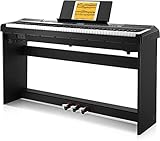
- 🎹 【Full-Weighted 88 key keyboard】The digital electric piano is constructed by 88 full-sized hammer action keys with adjustable touch response. This 88-key weighted keyboard allows to adjust...
- 🎹 【238 Tones & 128 Polyphony】 The 88-key weighted keyboard loaded with 238 types of tone like Ukulele, drum, bass, etc. vividly presenting voices of different instruments, arousing your keen to...
If you find that the velocity-sensitive keys of the DEP-1S are too light for your taste, the Donner DEP-20 is the logical next step. Unlike the DEP-1S, the DEP-20 features a fully weighted hammer action, which much more closely mimics the physical resistance of an acoustic grand piano. It also comes with a more substantial 3-pedal unit and a furniture-style stand. We recommend this for students who are serious about taking formal piano exams, as the weighted keys are essential for developing professional-grade finger strength. However, it is significantly heavier and less portable than the DEP-1S.
2. Yamaha P71 88-Key Weighted Digital Piano
- Acoustic Piano Feel - Touch-sensitive keys allow for true expression and dynamic performance. The weighted action replicates the acoustic piano experience
- Elevated Sound - Choose from 10 unique Voices, including the richness and resonance of a Yamaha grand piano, with full dynamic sound and deep bass
The Yamaha P71 is often considered the “gold standard” for entry-level digital pianos. It features Yamaha’s Graded Hammer Standard (GHS) action, which is renowned for its realism. In comparison to the Donner DEP-1S, the Yamaha has a more “industrial” and minimalist look. While it lacks the Bluetooth features and the stylish wood finish of the Donner, its core piano sound is arguably more refined. This is the choice for the “purist” beginner who wants the most realistic touch possible and doesn’t care about extra bells and whistles like stickers or a retro color scheme.
3. Yamaha Arius YDP105R 88-Key Digital Piano with Bench

- Essential Grand Piano Sound - Enjoy the rich, dynamic sound of an acoustic piano plus 9 other instrument Voices
- Acoustic Piano Touch - Experience the natural feel of an acoustic piano with the Graded Hammer Standard keyboard with Touch Response
For those who have a dedicated space and want a permanent fixture in their home, the Yamaha Arius YDP105R is a significant upgrade. This is a console-style piano that comes with an integrated bench and a full cabinet. The sound engine is superior to both the Donner and the P71, offering a much more immersive and dynamic range. While it is several times more expensive than the Donner DEP-1S, it is an instrument that a student could use from day one through their intermediate years. If the DEP-1S is a “gateway,” the Arius is a “destination.”
The Final Verdict: Is the Donner DEP-1S 88-Key Digital Piano with Stand & Pedal Right for You?
After our extensive testing, we can confidently say that the Donner DEP-1S 88-Key Digital Piano with Stand & Pedal is one of the most attractive and user-friendly options for someone just starting their musical journey. Its greatest strengths lie in its visual design, its lightweight portability, and its modern Bluetooth integration. It solves the primary problem for beginners: providing a full 88-key experience that feels like a real instrument without the massive footprint or price tag of a traditional piano. While more advanced players might find the lack of fully weighted keys and the high-octave volume drop-off limiting, these are minor trade-offs for the incredible value provided in this bundle.
If you are looking for a beautiful, tech-forward, and comprehensive kit to get you or your child playing today, this is an outstanding choice. It makes the daunting task of learning the piano feel accessible, fun, and stylish. We recommend this piano to any adult beginner or hobbyist who values aesthetics and modern connectivity. Ready to start your musical journey? We suggest you check out the Donner DEP-1S 88-Key Digital Piano with Stand & Pedal today and see why so many new players are making it their first instrument.
Last update on 2026-10-16 / Affiliate links / Images from Amazon Product Advertising API