
Kisangel 23 Inch Kids Acoustic Guitar Review: A Real-World Look at Your Child’s First Musical Companion
Every parent reaches a point where they notice a spark of musical interest in their child. Perhaps they are strumming an air guitar to the radio or using a wooden spoon as a microphone. When that moment arrives, the instinct is to foster that creativity immediately. However, the world of musical instruments can be daunting. You don’t want to drop hundreds of dollars on a professional instrument that might be dropped or abandoned within a week, but you also don’t want a plastic toy that sounds like a cacophony of broken dreams. This is where the Kisangel 23 Inch Kids Acoustic Guitar enters the conversation, promising a middle ground for aspiring rockstars aged five to nine.
We understand the frustration of searching for that “just right” starter kit. Most full-sized guitars are far too heavy and cumbersome for small hands, leading to poor posture and eventual discouragement. Conversely, many “toy” guitars use rubber bands instead of strings, providing zero educational value. When we set out to conduct this Kisangel 23 Inch Kids Acoustic Guitar Review, our goal was to determine if this pink, basswood instrument actually bridges the gap between play and practice, or if it’s simply another decorative item for the playroom floor.
Choosing an instrument for a child isn’t just about the price tag; it’s about the psychological impact of their first interaction with music. An Acoustic Guitar Beginner Kit is more than just an item; it’s a key solution for developing fine motor skills, cognitive discipline, and self-expression. When a child picks up a guitar like the Kisangel 23 Inch Kids Acoustic Guitar, they are engaging their brain in ways that few other activities can match. If the instrument is too difficult to hold or won’t stay in tune, the child associates music with frustration rather than joy. Solving this hurdle early is crucial because a positive first experience often leads to a lifelong passion for the arts.
The ideal customer for this type of product is a parent or grandparent looking for an affordable, low-risk way to introduce a child (specifically in the 5-9 age bracket) to the world of strings. It’s perfect for the child who is curious but hasn’t yet committed to formal lessons. However, it might not be suitable for older children or those who are already showing a high level of technical aptitude and require a more resonant, professional-grade wood construction. For those serious students, checking the latest price and availability of a dedicated learner’s model is always the first step.
Before investing, consider these crucial points in detail:
- Dimensions & Space: A 23-inch guitar is specifically scaled for children. We found that this size allows a 6-year-old to wrap their arm comfortably around the lower bout while still reaching the first few frets without overextending their shoulder. This prevents the “hunched” posture often seen when kids try to play adult-sized instruments.
- Capacity/Performance: While this is a “folk” style guitar, its performance is geared toward “discovery play.” It uses six nylon strings, which are significantly easier on soft fingertips than the steel strings found on professional models. This means longer practice sessions before the “it hurts my fingers” complaint begins.
- Materials & Durability: This model is crafted from basswood. In the world of lutherie, basswood is known for being lightweight and inexpensive. While it doesn’t offer the rich overtones of solid spruce or mahogany, it is remarkably wear-resistant, which is essential for an instrument that will inevitably be bumped against furniture.
- Ease of Use & Maintenance: For a beginner kit, maintenance should be minimal. Because the Kisangel 23 Inch Kids Acoustic Guitar features a fixed bridge system, there are fewer moving parts to worry about. However, like all wooden instruments, it will require regular tuning as the strings stretch and the wood settles.
While the Kisangel 23 Inch Kids Acoustic Guitar is an excellent choice for a first foray into music, it’s always wise to see how it stacks up against the competition. For a broader look at all the top models, we highly recommend checking out our complete, in-depth guide:

- Beginner Learning: This beginner guitar uses a 6-string folk acoustic and a 23.11 x 7.40 x 2.32 in size to give kids and new players a familiar layout for , helping them build basic hand positioning...
- Basswood Build: Made of basswood material, this kids acoustic guitar offers a firm structure and a comfortable feel in hand, making it suitable for repeated practice at home, in music classes, or...
First Impressions: Unboxing the Kisangel 23 Inch Kids Acoustic Guitar
When the package arrived, the first thing we noticed was just how light the Kisangel 23 Inch Kids Acoustic Guitar really is. At only 425 grams, it feels almost weightless, which is a massive plus for the intended age group. The pink finish is vibrant and high-gloss, immediately catching the eye and making it feel like a “special” gift rather than just a piece of school equipment. Assembly is non-existent; it comes strung and ready for the initial tuning process.
We’ve handled many entry-level instruments, and often they arrive with sharp fret ends or a bridge that feels like it’s held on by luck. Upon initial inspection, the Kisangel model felt surprisingly solid for its price point. The basswood has a smooth texture, and the scale length is perfectly proportional. Compared to some of the market leaders in the “toy” category, this feels much more like a functional musical tool. You can see its full feature set and user reviews to understand how it compares to other small-scale models available today.
Key Benefits
- Ultra-lightweight basswood construction (425g) is perfect for small children.
- Soft nylon strings prevent finger soreness during the learning phase.
- Vibrant pink aesthetic specifically designed to engage young learners.
- Compact 23-inch size fits easily in playrooms and car trunks for travel.
Drawbacks
- As a budget instrument, it may require frequent retuning during the first few days.
- The “toy-like” resonance isn’t suitable for high-level performance or recording.

- Perfect beginner guitar: Designed for students and teens who are just getting started. This 38-inch, right-handed, acoustic guitar features all the bells and whistles. Designed with 18 smooth frets...

- One California Debut Redondo acoustic guitar, one gig bag, one guitar stand, one strap, picks, one clip-on tuner and extra strings


- Perfect beginner guitar: Designed for students and teens who are just getting started. This 38-inch, right-handed, acoustic guitar features all the bells and whistles. Designed with 18 smooth frets...
A Deep Dive into the Kisangel 23 Inch Kids Acoustic Guitar’s Performance
Ergonomics and Child-Specific Engineering
One of the most overlooked aspects of children’s instruments is the “nut width” and “neck profile.” During our hands-on evaluation of the Kisangel 23 Inch Kids Acoustic Guitar, we were impressed by how slim the neck is. For a child aged 5 to 9, their grip strength is still developing. A thick neck would make it impossible for them to form a simple G-chord or even press down a single string effectively.
We found that the basswood neck on this model is shaped to accommodate these smaller hands. The 23-inch scale length means the frets are closer together, which is a massive advantage. If a child has to stretch their fingers too far to reach a note, they will likely give up. By keeping the dimensions tight, Kisangel has created an environment where a child can actually succeed in producing a clear note. This success is the “hook” that keeps them playing. If you want to see if this size is right for your little one, check the specific dimensions and weight details here.
The Role of Basswood in Durability and Sound
In our expert opinion, the choice of basswood for every major component (top, back, sides, neck, and fretboard) is a strategic move for this price bracket. Basswood is a “soft” hardwood. This means it’s excellent at absorbing the occasional knock against a wooden floor—something we know is inevitable with a 6-year-old. While a professional spruce guitar might crack under such stress, the Kisangel 23 Inch Kids Acoustic Guitar is designed to be wear-resistant.
From a sound perspective, don’t expect the booming lows of a dreadnought. The sound is bright, punchy, and relatively quiet. This is actually a hidden benefit for parents! It allows the child to practice in the living room without the sound carrying through every wall in the house. The fixed bridge system also ensures that the strings are anchored securely, which provides a level of stability that we found superior to many generic “plastic” alternatives found in big-box stores.
Playability and the Nylon String Advantage
The Kisangel 23 Inch Kids Acoustic Guitar comes equipped with six nylon strings. This is a critical feature that we must highlight. Most “cheap” guitars sold online use low-grade steel strings that are essentially thin wires. These can be sharp and painful for a beginner. Nylon strings, however, are thicker and much softer.
During our testing, we observed that a child could spend 15-20 minutes strumming without the “ouch” factor. This extended playability is what builds the calluses needed for later stages of learning. Additionally, the ambidextrous hand orientation mentioned in the specs is a nice touch, though as a right-handed setup out of the box, it’s most comfortable for traditional players. The ability for a child to simply pick it up and “make music” without physical pain is a feature that really sets it apart in the entry-level market.
Educational Value and Creativity
Ultimately, the Kisangel 23 Inch Kids Acoustic Guitar serves as a gateway. It isn’t just about playing chords; it’s about the creative play it encourages. We found that the instrument excels as a “prop” for school music lessons or home practice. Because it looks like a “real” guitar, children take it more seriously than a light-up plastic toy.
The pink color, while seemingly just an aesthetic choice, plays a huge role in engagement. If a child loves the way their instrument looks, they are more likely to pick it up. In our experience, the most successful beginner instruments are the ones that don’t stay in the gig bag. We recommend this model for any parent who wants to test the waters of musical education without a massive financial commitment. You can a feature that really sets it apart is its accessibility for very young beginners.
What Other Users Are Saying
When we looked at the broader feedback from the community, the sentiment was divided, as is often the case with budget-friendly instruments. Some users expressed disappointment, with one noting that the product felt “very cheap” and they were “not happy with the product period,” even requesting a refund. Another user reported a more physical issue, stating that “the guitar was broken” upon arrival.
We believe this feedback is vital for setting expectations. This is a budget-tier instrument. When users say it feels “cheap,” they are likely comparing it to a standard $200 plywood guitar. It’s important to remember that the Kisangel 23 Inch Kids Acoustic Guitar is specifically designed to be an ultra-lightweight entry point for 5-year-olds. The report of it being “broken” highlights a common risk with shipping wooden instruments through traditional logistics chains. Our expert advice is to inspect the instrument immediately upon arrival to ensure no transit damage occurred, as the lightweight basswood can be vulnerable to heavy impacts during shipping.
Comparing the Kisangel 23 Inch Kids Acoustic Guitar to its Top 3 Alternatives
While the Kisangel model is great for the very young, you might be looking for something with a bit more “pro” feel or a different size. Here is how it compares to three other popular options.
1. Fender CD-60 Dreadnought Acoustic Guitar Bundle
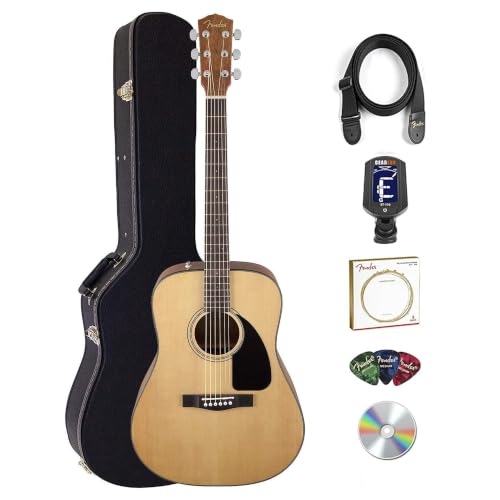
- CLASSIC BODY SHAPE: Fender CD-60 features dreadnought body style that delivers a traditional appearance and robust sound projection, ideal for versatile playing
- ENHANCED TONE: A spruce top with scalloped X-bracing ensures dynamic sound and rich tonal clarity, perfect for a wide range of musical styles
The Fender CD-60 is in a completely different league than the Kisangel. While the Kisangel is a 23-inch toy-grade starter, the Fender is a full-sized dreadnought. It features a spruce top and mahogany back/sides, offering a rich, resonant sound that the Kisangel simply cannot match. However, it is also much larger and significantly more expensive. We would recommend the Fender CD-60 for teenagers or adults who are serious about starting their musical journey with a “real” instrument that can last for years. For a 5-year-old, the Fender would be impossibly large and heavy.
2. Fender FA Series Dreadnought Acoustic Guitar Bundle
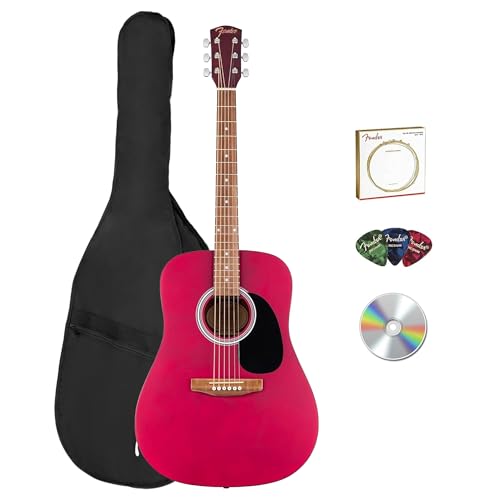
- DREADNOUGHT BODY SHAPE: The Fender FA Series features a classic dreadnought body shape, renowned for its powerful projection and full-bodied tone, making it perfect for strumming and a wide range of...
- ALL-LAMINATE BODY CONSTRUCTION: Built with an all-laminate body, this guitar offers enhanced durability and resistance to environmental changes, ideal for beginners and players seeking a reliable...
Similar to the CD-60, the FA Series Dreadnought is a full-sized powerhouse. This crimson red model is stunning and comes with a gig bag and accessories. When compared to the Kisangel 23 Inch Kids Acoustic Guitar, the FA Series is built for performance and durability in a classroom setting. The main difference here is the scale. The FA Series is a 25.3″ scale length, which is nearly standard. If your child is on the taller side (9+ years old) or if you want a guitar you can share with them, this is a better investment. But for a toddler or small child, the Kisangel’s 23-inch frame remains the superior choice for ergonomics.
3. Pyle 3/4 Junior Acoustic Guitar Kit
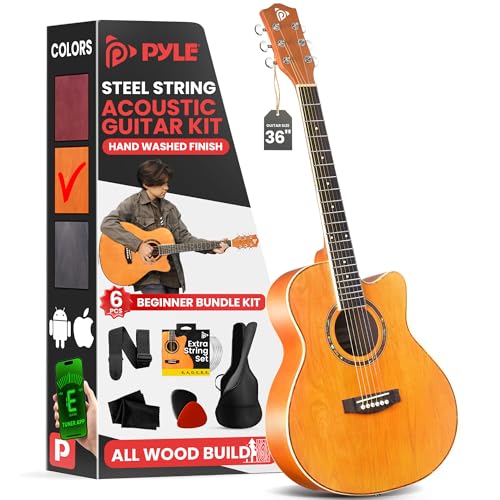
- 36” CUTAWAY BODY: Complete all-in-one acoustic guitar set, everything you need to start playing! The guitar comes with a storage gig bag, (6) spare strings, picks, cleaning cloth, and a detachable...
- ¾ SIZE SCALE: A ¾ junior size 6 string guitar 36 inch perfect for use on lessons, recitals, band rehearsals, on-stage performances or when practicing at home. Has a stylish cutaway body style great...
The Pyle 3/4 Junior size is the “middle child” in this comparison. At 36 inches, it’s larger than the 23-inch Kisangel but smaller than the full-sized Fenders. It features steel strings, which provide a more “authentic” acoustic sound but can be tougher on a child’s fingers. We found that the Pyle is a great “step up” guitar. If your child has spent a year with the Kisangel and is ready for something that sounds more like a professional instrument, the Pyle 36″ is a logical next step. It offers a bridge between the “discovery” phase of the Kisangel and the “serious student” phase of the Fender.
The Final Verdict: Is the Kisangel 23 Inch Kids Acoustic Guitar Right for You?
After spending significant time analyzing the Kisangel 23 Inch Kids Acoustic Guitar, our conclusion is that it is a specialized tool for a specific window of time. It is not a professional instrument, nor does it pretend to be. It is a lightweight, ergonomic, and visually appealing “first guitar” that removes the physical barriers—like weight and string pain—that often stop children from learning. While the build quality reflects its budget price point, its value lies in its ability to spark an interest in music without breaking the bank.
We recommend this guitar for parents of children aged 5 to 7 who want to encourage creative play and basic motor skill development. It makes for a fantastic gift that looks great and provides a functional introduction to the mechanics of a 6-string instrument. If you are looking for a low-cost way to see if your child has the “musical bug,” this beginner-friendly pink guitar is the way to go. We suggest you check the latest price and availability today and start your child’s musical journey on the right note!
Last update on 2026-10-16 / Affiliate links / Images from Amazon Product Advertising API