
Line 6 HX Effects Review: The Ultimate Command Center for Your Pedalboard
If you are anything like me, your journey as a guitarist has been a perpetual cycle of buying, selling, and swapping individual stompboxes. We’ve all been there: the “pedalboard dance” where you’re trying to hit three switches at once while maintaining a straight face for the audience. The problem isn’t just the physical clutter; it’s the signal loss from ten different patch cables, the power supply headaches, and the sheer weight of a board that feels like a lead slab. We search for a solution that offers the high-fidelity sounds of boutique pedals with the streamlined logic of a digital processor. This is where the Line 6 HX Effects enters the conversation, promising to be the brain of your rig without sacrificing the soul of your tone. Failing to find a central “brain” for your gear often leads to inconsistent live performances and a messy creative process in the studio. To see if this unit can finally end your search, you can check its full feature set and user reviews to understand its standing in the current market.

- 100+ HX effects for your pedalboard—run up to 9 simultaneously
- Additional legacy effects library from M13 , M9 , M5 , DL4TM, MM4 TM, FM4 TM, and DM4 TM

What to Consider Before Buying an Electric Guitar Multieffects
An Electric Guitar Multieffects is more than just an item; it’s a key solution for modern musicians who demand versatility without the logistical nightmare of a massive analog board. In the past, “multi-effects” often meant a compromise in sound quality—thin distortions and plastic-sounding reverbs. However, the current generation of processors has closed that gap entirely. These devices solve the problem of portability, signal integrity, and preset management. Instead of manually turning knobs between songs, you can reconfigure your entire signal chain with a single tap. This allows you to focus on the performance rather than the hardware.
The ideal customer for this type of product is the “hybrid” player—someone who loves their physical tube amplifier and perhaps a few “must-have” analog drive pedals but wants a world-class library of modulations, delays, and utilities. It’s perfect for the gigging professional who needs a reliable, compact rig. Conversely, it might not be suitable for the absolute purist who refuses to let any digital conversion touch their signal, or for the beginner who might find the sheer depth of routing options overwhelming. Those individuals might prefer a simpler, three-knob analog delay or a basic starter processor.
Before investing, consider these crucial points in detail:
- Dimensions & Space: Consider how much room you have on your existing board or if you intend to use the unit as a standalone. The Line 6 HX Effects is designed to fit into tight spaces while still offering enough footswitch clearance for accurate “stomping” during a frantic set. Measuring your board beforehand is essential to ensure a clean setup.
- Capacity/Performance: Look at the DSP (Digital Signal Processing) limits. You want a unit that can run multiple high-quality effects simultaneously without “lag” or audio dropouts. The ability to run up to nine effects at once is a benchmark for professional-grade units, ensuring you never run out of sonic horsepower.
- Materials & Durability: Since this unit will be on the floor and subjected to heavy-duty use, all-metal construction is non-negotiable. Look for high-quality switches and “scribble strips” (small OLED screens) that won’t fail after a few months of touring. The longevity of the hardware is just as important as the software inside.
- Ease of Use & Maintenance: A great multi-effects pedal should have an intuitive hardware interface and, ideally, a robust PC/Mac editor. Long-term care involves keeping the firmware updated and ensuring the capacitive switches remain clean, as these are vital for the touch-and-edit workflow.
While the Line 6 HX Effects is an excellent choice, it’s always wise to see how it stacks up against the competition. For a broader look at all the top models, we highly recommend checking out our complete, in-depth guide:

- 71 EFFECTS AND 13 AMP MODELS TO EXPLORE – Explore 71 built-in effects and 13 amp models to craft everything from clean tones to high-gain distortion, perfect for practice, recording, and live play.
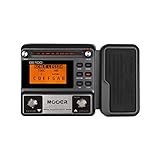
- 80 preset patches and 80 user patches, enough for creating your sound library. You can save any preferred tones by simply pressing down the SAVE button.

- GE150 Pro Series, is designed based on MOOER’s updated GE series design language and MNRS modelling technology. Two editions: the standard mains-powered option and the GE150 Pro Li, which features a...
First Impressions and the “Command Center” Philosophy of the Line 6 HX Effects
Unboxing the Line 6 HX Effects, I was immediately struck by the professional weight and “polished black” finish. Unlike many competitors that feel like plastic toys, this unit feels like a piece of high-end studio equipment meant for the floor. There is no assembly required—you simply plug it in and go—but the real magic happens when you see the “Scribble Strips” light up. These individual OLED screens above each footswitch eliminate the need for masking tape and markers, clearly labeling every effect in your chain. It’s a massive leap forward from the “LCD-menu-diving” days of the early 2000s.
Compared to previous iterations like the M13 or M9, the Line 6 HX Effects is significantly more streamlined yet infinitely more powerful. It utilizes the same HX modeling engine found in the flagship Helix floorboards, but it strips away the amp and cab modeling. This is a deliberate design choice for players who already have an amp they love. I found that it integrates into a rig with an almost “invisible” transparency, thanks to its 123dB of dynamic range. Before you even play a note, the build quality tells you this is a serious tool. To see how it looks in a real-world setup, you can view the latest price and availability to see if it fits your current budget.
Key Benefits
- Unrivaled HX-quality effects library including legacy favorites like the DL4.
- Capacitive-touch footswitches allow for incredibly fast, hands-free editing.
- Massive 123dB dynamic range ensures your original guitar tone remains pure.
- Extensive I/O options including MIDI, dual FX loops, and expression pedal inputs.
Limitations
- No dedicated headphone output, which requires a separate interface or amp for silent practice.
- Learning curve for advanced routing (like the 4-cable method) can be steep for newcomers.
A Deep Dive into the Performance of the Line 6 HX Effects
The Sound Library: From Vintage Grit to Futuristic Textures
When we sat down to put the Line 6 HX Effects through its paces, the first thing we evaluated was the sheer quality of the over 100 onboard effects. Using the same DSP architecture as the Helix, the “HX” models are stunningly accurate. The drives feel responsive to your guitar’s volume knob—a feat many digital units struggle with. Whether it’s the “Teemah!” (based on the Timmy) or the “Minotaur” (Klon-style), the clipping feels organic and “hairy” rather than fizzy. We found that the distortion models don’t just sit on top of your sound; they integrate with your amp’s preamp in a way that feels authentic.
Beyond the newer models, the inclusion of the “Legacy” library is a stroke of genius. For those of us who grew up with the green DL4 delay or the blue MM4 modulation, having those exact algorithms in a modern, reliable chassis is fantastic. During our testing, the delays—especially the “Adriatic Swell” and the vintage tape echoes—provided a depth and “width” that filled the room. The 123dB dynamic range is evident here; even with nine effects running at once, the noise floor remained whisper-quiet. This is a professional-grade signal path that respects the nuances of your instrument. For those looking for world-class delays, this unit is a feature that really sets it apart from mid-range competitors.
Workflow Innovation: The Power of Capacitive Touch and Scribble Strips
The interface is where the Line 6 HX Effects truly wins the “Best in Class” title for us. Most pedals require you to bend over and scroll through menus to change a parameter. Here, Line 6 has implemented capacitive-touch footswitches. If you want to edit a specific effect, you don’t even have to press the switch—you just touch it with your finger, and the parameters instantly appear on the main screen. It sounds like a gimmick until you use it in a rehearsal and realize you’ve saved ten minutes of menu-diving.
The Scribble Strips are equally revolutionary for live use. We’ve all played on dark stages where you can’t see your settings. With the Line 6 HX Effects, each switch is clearly labeled with its function and color-coded by effect type (e.g., green for delay, blue for modulation, purple for synth). During our deep-dive testing, we found that the HX Edit software for PC/Mac is one of the most stable and user-friendly platforms we’ve used. It allows you to drag and drop effects, backup your presets, and even load custom IRs (Impulse Responses) if you want to use the pedal for direct-to-PA applications with an external preamp. This level of customization makes it an incredible investment for your long-term tone journey.
Rig Integration: The 4-Cable Method and MIDI Mastery
Where the Line 6 HX Effects separates itself from standard “multi-effects” pedals is its ability to act as the command center for your entire rig. With two dedicated effects loops, you can use the “4-Cable Method” (4CM). This allows you to place some effects (like wah and drives) before your amp’s preamp and others (like delays and reverbs) in your amp’s effects loop. In our evaluation, this setup was flawlessly executed, with no noticeable tone suck or phase issues. It effectively turns a single-channel tube amp into a versatile multi-channel monster.
Furthermore, the unit’s MIDI capabilities are extensive. It can send program changes (PC) and control changes (CC) to other pedals or even switch the channels on your amplifier. We tested this by pairing it with a MIDI-enabled preamp, and the synchronization was instantaneous. It also features “Command Center” functionality, allowing you to assign any switch to trigger external gear or software. This makes it more than just a pedal; it’s a sophisticated controller. For anyone running a complex setup, this unit is a powerful unit you should consider for simplifying your stage footprint.
True Bypass and Signal Integrity
A major concern with digital processors is what happens when the unit is “off.” Many digital pedals convert your signal even when no effects are active, which can lead to a loss of “sparkle.” The Line 6 HX Effects offers true analog bypass. When we bypassed the unit during our studio tests, the signal was identical to plugging directly into the amp. This is a critical feature for tone purists who only want the digital processing active when they actually need an effect.
Alternatively, you can choose DSP bypass with trails. This allows your delay and reverb tails to decay naturally after you switch the effect off, rather than being cut off abruptly. We found the implementation of these trails to be smooth and musical. The internal headroom is also worth noting; we threw high-output active pickups and hot boost pedals at the input, and the Line 6 HX Effects handled the signal without any digital clipping or artifacts. This reliability is why we consider it one of the most “pro” options on the market. You can check the current pricing to see how this professional headroom fits into your equipment budget.
What Other Users Are Saying
The general consensus among the community is overwhelmingly positive, with many users praising the Line 6 HX Effects for its “analog-like” sound quality and incredible flexibility. One user noted that it is an “excellent product with multiple sound options” and specifically highlighted the delays and the loop station as standout features. Another seasoned player mentioned that the effects sound “almost identical to analog,” which is high praise for a digital unit. The ease of use through the PC software for creating presets is another frequently mentioned “win” for Line 6.
However, no product is without its critics. A common point of feedback involves the lack of a dedicated headphone jack, which one user pointed out requires a workaround if you aren’t using an amp or interface. Some users also noted that the manual could be more extensive, especially regarding the 4-cable method, though they acknowledged that online tutorials quickly fill that gap. We also saw one report of a unit arriving with minor cosmetic issues from a retailer, though this appears to be an isolated shipping/handling incident rather than a manufacturing flaw. Overall, the feedback confirms our findings: this is a top-tier tool that delivers exactly what it promises, provided you understand its specific role in a rig. To see more detailed testimonials, you can read more user reviews here.
Comparing the Line 6 HX Effects to Its Top 3 Alternatives
1. MOOER P2 Multi-Effects Guitar Pedal with Touchscreen

- AI Tones – Built with MOOER's exclusive MNRS technology and AI preset generation. Simply input keywords and context, and the AI delivers up to 9 custom tones in one go – eliminating endless...
- Amps, Effects & IR – Features 52 high-quality guitar/bass amp models, 25 cab sims, and 57 classic and experimental effects. Recent updates add 10 new OD effects, 10 bass amp models, 10 bass cabinet...
The MOOER P2 is a vastly different beast compared to the Line 6 HX Effects. While the Line 6 unit focuses on being the “brain” of a pedalboard without amp modeling, the MOOER P2 is an all-in-one “pocket” solution that includes amp models and IR slots. It features a modern touchscreen and is incredibly portable, making it a great choice for practice or as a backup rig that fits in a gig bag. However, it lacks the rugged build, the 4-cable method flexibility, and the professional-grade I/O of the Line 6. It’s better suited for hobbyists or travelers who need maximum portability over the Line 6’s professional control.
2. Valeton GP-200 Multi-Effects Guitar Pedal with Expression
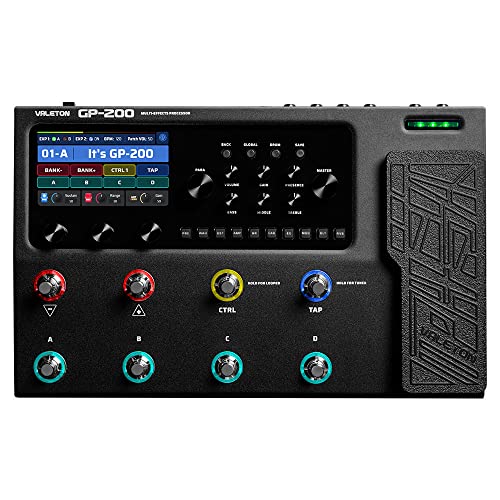
- The Multi Effects Processor Has 240+ Built-in Guitar/Bass/Acoustic Effects with 140 Legendary Amplifiers&Cabinets Simulations and 100 Renowned Stompbox Effect Pedals; Supporting 20 3rd Party IRs...
- 100 Built-in Drum Rhythms and 180 Seconds Looper, 256 Presets, Equipped with the New-Gen HD Modeling Technology On this Multi Effects Pedal, Adjustable Signal Chain with Maximum 11 Simultaneous Effect...
The Valeton GP-200 is a direct competitor to the Helix LT rather than the Line 6 HX Effects, as it includes full amp and cab simulation along with a built-in expression pedal. It’s an excellent value-for-money option for players who want a standalone unit to plug directly into a PA system. While its effects are very good, they don’t quite reach the level of the HX modeling engine’s nuance. For the player who wants to keep their physical amp and just needs world-class effects, the Line 6 is the superior choice for signal integrity. If you need a full “rig in a box” on a budget, the Valeton is a strong contender.
3. BOSS GT-1 Compact Guitar Effects Processor
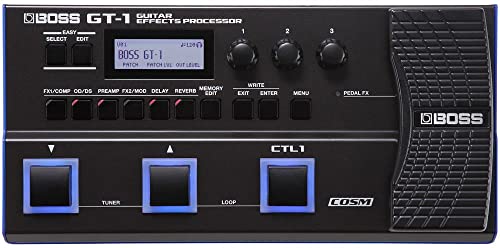
- Flagship-Class Sound Engine: BOSS sound engine squeezed into a light and compact floor unit
- Ultra-Portable Design: Delivers pro-level tones everywhere you play with easy-to-use interface
The BOSS GT-1 is a legendary entry-level unit. It is lightweight, can be battery-powered, and offers the classic BOSS “sound” that has defined decades of music. It is significantly more affordable than the Line 6 HX Effects, making it the perfect choice for beginners or for those who need a simple, portable unit for small jams. However, it lacks the scribble strips, the capacitive touch switches, and the sophisticated routing options (like dual FX loops) of the Line 6. For a professional who needs rig integration and high-fidelity DSP, the Line 6 is a significant and necessary step up.
The Final Verdict on the Line 6 HX Effects
After extensive testing, it’s clear that the Line 6 HX Effects is one of the most well-thought-out products in the Line 6 catalog. It identifies a specific type of player—the one who loves their amp but hates their pedalboard mess—and solves their problems with surgical precision. Its strengths lie in its “no-compromise” sound quality, its brilliant user interface that makes editing a breeze, and its ability to manage a complex rig via MIDI and 4CM. While the lack of a headphone jack is a minor inconvenience for some, it doesn’t detract from the unit’s primary mission as a live performance powerhouse.
If you are ready to stop fighting with patch cables and start enjoying a streamlined, world-class tone, this is the unit for you. It bridges the gap between old-school analog feel and modern digital convenience better than almost anything else on the market. Whether you’re a touring pro or a weekend warrior, this is an investment that will pay dividends in every set you play. We highly recommend that you check the latest price and secure your own Line 6 HX Effects today to take your rig to the next level.
Last update on 2026-10-16 / Affiliate links / Images from Amazon Product Advertising API