
Line 6 HX One Multieffects Processor Review: The Ultimate Helix Solution for Your Pedalboard?
I have spent years agonizing over my pedalboard layout. Every guitarist knows the struggle: you have your favorite drive pedals and your go-to boutique delay, but there is always that one song that requires a specific phaser, a weird glitchy synth sound, or a high-quality pitch shifter that you just don’t have room for. We often find ourselves searching for a “Swiss Army Knife” that doesn’t compromise on sound quality. The problem with many small multi-effects is that they either sound “digital” in the worst way or are so complicated to navigate that you spend more time menu-diving than playing. Failing to find a solution usually means carrying a massive, heavy board or simply settling for a less-than-ideal tone. This is where the Line 6 HX One Multieffects Processor enters the conversation, promising the legendary power of the Helix ecosystem in a footprint that fits almost anywhere.

- 250+ Effects taken from the HX family processors and intuitive controls that make selecting and editing effects easy
- Flux Controller for automating parameter changes

What to Consider Before Buying an Electric Guitar Multieffects Processor
An Electric Guitar Multieffects unit is more than just an item; it’s a key solution for modern musicians who need versatility without the physical clutter of dozens of individual stompboxes. Whether you are a weekend warrior playing covers or a session pro needing specific textures on demand, these devices bridge the gap between tradition and technology. The main benefit is having an entire library of classic and modern sounds at your feet, allowing for creative exploration that would otherwise cost thousands of dollars in individual pedals.
The ideal customer for this type of product is someone facing limited pedalboard space but unwilling to sacrifice the high-end audio fidelity of professional-grade processors. It is perfect for the player who already has a core tone they love but needs a “wildcard” slot. On the other hand, it might not be suitable for those who want a “brain” for their entire rig—meaning those who need simultaneous amp modeling, cab simulation, and multiple effects running at once. If you are looking to replace your entire rig, a full-floor processor would be a better choice.
Before investing, consider these crucial points in detail:
- Dimensions & Space: When adding a multi-effect to an existing board, every millimeter counts. You should look for a compact enclosure that uses standard power requirements so it can integrate seamlessly with your current power supply without needing a dedicated wall wart.
- Capacity/Performance: Consider how many effects the unit can run simultaneously and the depth of the library. For a single-slot replacement, the quality of the individual algorithms is more important than the quantity of simultaneous blocks.
- Materials & Durability: Since this will be stepped on repeatedly, a metal chassis and high-quality footswitches are non-negotiable. Look for a build that can withstand the rigors of touring and beer-soaked stages.
- Ease of Use & Maintenance: The interface should be intuitive enough to make quick adjustments during a soundcheck. If you have to connect it to a computer just to change the delay time, it may become a hindrance in a live environment.
While the Line 6 HX One Multieffects Processor is an excellent choice, it’s always wise to see how it stacks up against the competition. For a broader look at all the top models, we highly recommend checking out our complete, in-depth guide:
Our Comprehensive Guide to the Best Electric Guitar Multi-Effects Pedals for Every Budget
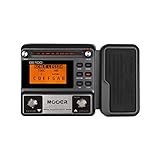
- 80 preset patches and 80 user patches, enough for creating your sound library. You can save any preferred tones by simply pressing down the SAVE button.

- 71 EFFECTS AND 13 AMP MODELS TO EXPLORE – Explore 71 built-in effects and 13 amp models to craft everything from clean tones to high-gain distortion, perfect for practice, recording, and live play.

- GE150 Pro Series, is designed based on MOOER’s updated GE series design language and MNRS modelling technology. Two editions: the standard mains-powered option and the GE150 Pro Li, which features a...
First Impressions and Key Features of the Line 6 HX One Multieffects Processor
When I first pulled the Line 6 HX One Multieffects Processor out of the box, I was immediately struck by how “Line 6” it felt—and I mean that in the best way possible. It has that rugged, professional-grade black finish and a weight that suggests it’s built like a tank. At just under two pounds, it feels substantial without being a brick. The unboxing experience is straightforward, though as some users have noted, you’ll want to ensure all accessories like the rubber feet are included in the packaging. After plugging it in, the OLED screen is crisp and clear, providing immediate feedback on which of the 250+ effects you have selected. It doesn’t feel like a “budget” version of the Helix; it feels like a concentrated dose of it. You can see its full feature set and user reviews to get a sense of just how much technology is packed into this small frame.
Key Benefits We Discovered
- Massive library of 250+ HX-grade effects with stunning audio fidelity.
- Incredible “Flux” controller for real-time parameter automation without an expression pedal.
- Adjustable input impedance that preserves the natural character of your guitar’s pickups.
- Compact footprint that runs on standard 9V DC power (500mA).
Limitations to Consider
- Can only run one effect at a time (it is a pedal replacement, not a multi-chain rig).
- Reports of occasional quality control issues where units arrive non-functional.
Deep Dive: Putting the Line 6 HX One Multieffects Processor to the Test
To truly understand the value of the Line 6 HX One Multieffects Processor, we put it through its paces in various scenarios—from studio tracking to live rehearsals. Here is our detailed breakdown of how it performs where it matters most.
The Sonic Engine: Helix Power in a Single Stomp
The heart of the Line 6 HX One Multieffects Processor is the HX modeling engine. If you have ever used a Helix Floor or the Native plugin, you know that Line 6 has mastered the art of digital recreation. During our testing, we focused heavily on the “legacy” effects and the “HX” originals. The reverbs, particularly the “Glitz” and “Ganymede” settings, provide a lush, expansive space that rivals boutique standalone pedals. What makes this special is the bit-depth and sample rate; the tails of the delays don’t “crackle” or fade out unnaturally. We found that the polyphonic pitch shifting is incredibly tracking-accurate—something that usually requires a dedicated, expensive pedal. By choosing to invest in this specific processing power, you are essentially getting the best parts of a $1,500 flagship unit for a fraction of the cost. User feedback confirms that for long-time Helix users, the transition is seamless because the algorithms are identical.
Workflow and the Flux Controller
One of the most innovative features we explored is the Flux Controller. Usually, to change a parameter like delay feedback or chorus depth during a song, you would need an external expression pedal. With the Line 6 HX One Multieffects Processor, you can map any number of parameters to the Flux switch. When you hit it, the values “warp” from one setting to another at a speed you define. We used this to create dramatic swells and to oscillate a delay into self-destruction, all with a single tap. It is a feature that really sets it apart from other single-effect units. The three-knob interface is also surprisingly deep. While it looks simple, the knobs are touch-capacitive, meaning you can see the values just by resting your finger on them. This intuitive workflow is a crucial benefit for the user who hates deep menus; we were able to dial in a perfect “scripted” phaser in under thirty seconds.
Impedance Matching and Signal Integrity
A common complaint with digital pedals is how they interact with the guitar’s electronics, often “choking” the high end or making the pickups feel sterile. The Line 6 HX One Multieffects Processor solves this with adjustable input impedance. We tested this with both high-output active humbuckers and vintage-style single coils. By adjusting the impedance to match the instrument, we found the “feel” of the pedal changed—it responded to the volume knob on the guitar much more like an analog circuit. Furthermore, the inclusion of both True Bypass and Buffered DSP Bypass is a massive win for signal purists. If you have a long cable run after the pedal, the high-quality buffer keeps your signal strong. If you want it completely out of the circuit when off, True Bypass has you covered. You should check the latest price and availability to see how this fits into your gear budget, as these “pro” features are often missing in this price bracket.
Connectivity and Integration
The Line 6 HX One Multieffects Processor is clearly designed to be a team player. We integrated it into a MIDI-controlled rig, and it responded perfectly to Program Change (PC) messages, allowing us to switch between 128 different presets instantly. This transforms it from a “one-trick pony” into a versatile chameleon that changes with every song in your setlist. The USB-C port is another highlight; using the “HX One Librarian” app made organizing our presets a breeze. We also tested it with an external expression pedal, and the setup was plug-and-play. In our expert evaluation, the stereo I/O is the icing on the cake, making it a perfect end-of-chain processor for wide, immersive stereo delays and reverbs. It is rare to find such a complete set of I/O in a pedal this size.
What Other Users Are Saying
The general sentiment surrounding the Line 6 HX One Multieffects Processor is overwhelmingly positive, especially among those who are already familiar with the Line 6 ecosystem. One long-time user noted that this pedal “has all the great effects of Helix and has a smaller footprint,” highlighting its role as a perfect “replacement for a single effects pedal” rather than a full rig replacement. Many users praise the 9V power compatibility, which makes it much easier to integrate than older Line 6 units that required higher voltages.
However, it is important to address the negative feedback to provide a balanced view. A few users have reported receiving units that were “not working at all,” suggesting that while the design is robust, there can be occasional duds in the manufacturing line. Another user mentioned receiving a unit where the packaging had been opened and the rubber feet were missing. While these seem to be isolated incidents related to shipping and handling or rare factory defects, they serve as a reminder to buy from a reputable source where returns are handled easily. Despite these minor complaints, the majority of the community views the Line 6 HX One Multieffects Processor as the gold standard for “utility” pedals on a modern board.
Comparing the Line 6 HX One Multieffects Processor to Top Alternatives
While we believe the Line 6 HX One Multieffects Processor is a top-tier choice, it’s important to see how it compares to other popular options in the market.
1. Line 6 POD Go Guitar Multi-Effects Pedal

- Simple interface with large color display
- Compact, ultra-portable, lightweight design
The POD Go is a very different beast compared to the HX One. While they share some of the same DNA, the POD Go is a full-featured floorboard designed to be your entire rig. It includes amp and cabinet modeling, a built-in expression pedal, and the ability to run multiple effects at once. If you are looking to show up to a gig with nothing but a guitar and one pedal, the POD Go is the better choice. However, if you already have an amp and pedals you love, the POD Go is far too large and redundant. The Line 6 HX One Multieffects Processor is for the player who wants to add to their board, whereas the POD Go is for the player who wants to replace it.
2. Donner Arena 2000 Guitar Multi-Effects Pedal

- [Rich and Delicate Sound] With FAVCM technology and high-precision 24 bit/44.1 kHz audio processing, Arena2000 Multieffects Processors greatly reduce the "plastic taste" of the digital effect, making...
- [278 Effect Types] 100 classic effect simulations, 80 amp simulations, and 50 cabinet simulations, which provide a wide range of legendary guitar tones from music history. Whether it's fresh urban pop...
The Donner Arena 2000 is an entry-level powerhouse that offers a surprising amount of features for its price point, including IR support and a built-in drum machine. It’s a great “learning” tool for beginners or a budget-friendly option for home practice. However, when it comes to the sheer quality of the effects—specifically the delays, modulations, and pitch effects—the Line 6 HX One Multieffects Processor is in a completely different league. The algorithms in the Line 6 unit are professional-grade, used on world tours and in major studios. The Donner is a fun, versatile tool, but it doesn’t offer the sonic depth or the rugged reliability that a pro-level player requires from their gear.
3. BOSS GT-1 Compact Guitar Effects Processor
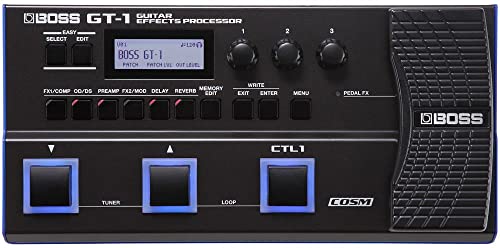
- Flagship-Class Sound Engine: BOSS sound engine squeezed into a light and compact floor unit
- Ultra-Portable Design: Delivers pro-level tones everywhere you play with easy-to-use interface
The BOSS GT-1 is a classic “all-in-one” portable processor. It’s battery-powered, lightweight, and incredibly durable. For decades, BOSS has been the standard for reliability. The GT-1 is excellent for practice on the go or for students. However, its interface feels a bit dated compared to the sleek OLED and touch-capacitive knobs of the Line 6 HX One Multieffects Processor. Additionally, while BOSS effects are legendary, the HX engine offers more modern, high-fidelity options and better MIDI integration. If you need a “beater” pedal to throw in a backpack for practice, the GT-1 is great; if you want a high-fidelity addition to a professional pedalboard, the HX One wins every time.
The Final Verdict: Is the Line 6 HX One Multieffects Processor Right For You?
After extensive testing and comparison, our verdict on the Line 6 HX One Multieffects Processor is clear: it is a masterpiece of utility. It successfully takes the “greatest hits” of the Helix world and shrinks them down into a package that respects your pedalboard real estate. Its strengths lie in its world-class audio quality, its innovative Flux controller, and its “it just works” integration with MIDI and expression pedals. While the limitation of running only one effect at a time might be a dealbreaker for some, for the majority of guitarists, this is exactly what we’ve been waiting for—a high-quality “fill-in-the-blank” pedal that can be a world-class reverb one minute and a boutique fuzz the next.
We highly recommend the Line 6 HX One Multieffects Processor to any guitarist who feels like their current board is “missing something” but doesn’t have the space or the desire to start over. It is a professional tool that delivers professional results. If you are ready to stop compromising and start exploring a nearly infinite world of tones, upgrade your rig today and see why the HX family continues to dominate the industry.
Last update on 2026-10-17 / Affiliate links / Images from Amazon Product Advertising API