
JHS Pedals Mini A/B Box Guitar Signal Switch Review: The Tiny Powerhouse for Seamless Signal Switching
If you have ever been in the middle of a high-energy set and realized you needed to swap from your single-coil Stratocaster to a humbucker-loaded Les Paul, you know the literal “pop” and the awkward silence that follows. I have spent years fumbling with cables in the dark, trying to unplug one instrument and plug in another without blowing my speakers or killing the vibe of the performance. It is a common problem for guitarists: the need for fluidity. Whether you are switching between two different guitars into one pedalboard or toggling between a clean Fender amp and a dirty Marshall rig, the logistical hurdle can be a nightmare. This is exactly where the JHS Pedals Mini A/B Box Guitar Signal Switch steps in. Solving this problem isn’t just about convenience; it is about maintaining professional signal integrity and stage presence. Without a dedicated switcher, you risk cable wear, connector damage, and the ever-present danger of “live-unplugging” noise. I decided to put this tiny utility to the test to see if it truly is the invisible hero every pedalboard needs.

- This simple footswitch design selects between a pair of ¼ inches jacks on the left side of the unit
- Instantly swap between two instruments

What to Consider Before Buying an Electric Guitar Multieffects Utility
An Electric Guitar Multieffects utility is more than just an item; it’s a key solution for modern musicians who demand versatility without the clutter of a massive rack system. When we talk about signal management, we are talking about the foundation of your tone. If your signal chain is messy, even the most expensive boutique pedals will sound subpar. A utility like an A/B box allows you to expand the architecture of your rig, giving you the ability to route signals in ways that traditional “one-way” setups simply cannot handle. It provides the “logic” for your board, allowing for instantaneous changes that would otherwise require a technician off-stage.
The ideal customer for this type of product is someone facing complex routing needs, such as multi-instrumentalists who switch between guitar and synth, or “wet/dry” rig enthusiasts who need to isolate specific paths. It is a must-have for the gigging professional who needs a “mute” function for silent tuning or quick guitar changes. However, it might not be suitable for those who only ever use one guitar and one amp and have no interest in expanding their sonic footprint. For those players, the added cabling might just be unnecessary clutter, and they might consider a simple tuner with a mute function instead.
Before investing, consider these crucial points in detail:
- Dimensions & Space: Pedalboard real estate is the most expensive “property” a guitarist owns. You want a utility that performs its job with the smallest possible footprint. Look for “mini” or “micro” enclosures that can squeeze between larger pedals or even be tucked underneath a tiered board. A compact size ensures you don’t have to sacrifice a creative effect just to make room for a functional utility.
- Capacity/Performance: In the world of signal switchers, performance is measured by transparency and switching silence. You need to ensure the internal circuitry does not suck your high-end frequencies or add unwanted floor noise. Consider whether the device is passive (works without power) or active, as this affects how it interacts with your other pedals and power supply.
- Materials & Durability: Since this is a foot-operated device, it will be stepped on—hard—repeatedly. A die-cast aluminum chassis and a high-quality mechanical footswitch are non-negotiable. Look for components that are “tour-grade,” meaning they can withstand the rigors of travel, temperature changes, and the occasional spilled beverage.
- Ease of Use & Maintenance: A utility should be “set and forget.” You want a clear visual indicator (usually an LED) to tell you which path is active, especially on a dark stage. Maintenance should be minimal, involving nothing more than the occasional check of the jack tightness. If it requires complex programming, it might hinder your performance rather than help it.
Ultimately, a high-quality signal switch is about peace of mind. While the JHS Pedals Mini A/B Box Guitar Signal Switch is an excellent choice, it’s always wise to see how it stacks up against the competition. For a broader look at all the top models, we highly recommend checking out our complete, in-depth guide:
- 80 preset patches and 80 user patches, enough for creating your sound library. You can save any preferred tones by simply pressing down the SAVE button.

- 71 EFFECTS AND 13 AMP MODELS TO EXPLORE – Explore 71 built-in effects and 13 amp models to craft everything from clean tones to high-gain distortion, perfect for practice, recording, and live play.

- GE150 Pro Series, is designed based on MOOER’s updated GE series design language and MNRS modelling technology. Two editions: the standard mains-powered option and the GE150 Pro Li, which features a...
First Impressions and the “Box of Possibilities”
When I first unboxed the JHS Pedals Mini A/B Box Guitar Signal Switch, I was immediately struck by its weight—or lack thereof. At just over half a pound, it feels substantial enough to be durable but light enough to not bog down a travel board. The black and silver finish is classic JHS: clean, professional, and understated. There are no fancy graphics here, just clear labeling that tells you exactly what goes where. I’ve used previous versions of A/B boxes from other brands that felt like hollow plastic toys, but this is a different beast entirely. It feels like a solid block of utility.
Setting it up was a breeze. Because it is a passive device, I didn’t even need to plug in a power supply to get it working for a basic signal swap. However, I did plug in a 9V supply to see the LED in action, and as many users have noted, it is incredibly bright. It provides an unmistakable “Red/Blue” status that can be seen from across a festival stage. You can explore its current pricing and specifications to see why this minimalist approach is so popular among professionals. It’s a tool that doesn’t try to be anything other than what it is: a perfect bridge between two points in your signal path.
Key Benefits
- Ultra-compact footprint saves precious pedalboard space.
- Passive circuitry allows it to function even without a power source.
- Bi-directional switching allows for 1-in/2-out or 2-in/1-out configurations.
- Extremely bright LED ensures you never lose track of your active channel.
Drawbacks
- The LED can be distractingly bright in dark room settings.
- Occasional reports of noise floor issues on specific output channels in high-gain rigs.
A Deep Dive into the Performance of the JHS Pedals Mini A/B Box Guitar Signal Switch
Versatility in Routing: The Swiss Army Knife of Pedals
The standout feature of the JHS Pedals Mini A/B Box Guitar Signal Switch is its inherent flexibility. While many switchers are designed to do only one thing, this box is bi-directional. I spent several hours testing this in various configurations. First, I used it as a “Guitar Selector.” By plugging two different guitars into the A and B jacks and the “In/Out” jack into my amp, I could switch instruments with a single tap. This is a game-changer for live performers. There was no detectable latency, and the mechanical switch felt sturdy under my boot. You can check the latest user ratings and availability to see how other multi-instrumentalists are using this to streamline their sets.
Next, I flipped the script and used it as an “Amp Selector.” I ran my main pedalboard into the “In/Out” and sent Output A to a clean tube amp and Output B to a high-gain head. The transition was seamless. Because the circuit is passive, I didn’t notice any coloration of my tone. My Strat still had that “glassy” top end, and my Les Paul maintained its low-mid growl. This versatility makes it an essential tool for studio environments where you might want to quickly compare how a pedal sounds through two different speaker cabinets without manually unplugging everything. It is this level of utility that really sets it apart from more complicated, digital switching systems.
Build Quality and Ergonomics: The JHS Standard
We found that the JHS Pedals Mini A/B Box Guitar Signal Switch lives up to the manufacturer’s reputation for ruggedness. The 1/4-inch audio jacks are tight and secure; there is no “wiggle” when you plug in high-quality cables. This is crucial because a loose jack is the primary cause of signal intermittent issues on stage. The footswitch is a soft-touch-style mechanical switch that provides just enough tactile feedback to let you know the engage was successful without requiring a massive amount of force. It’s the kind of build quality that JHS is famous for, and it’s why so many professionals trust their signal path to this brand.
The compact size (6 x 3 x 3 inches in packaging, but much smaller as a unit) means it can fit into the tightest corners of a Pedaltrain Nano or a custom-built board. We evaluated its placement and found it can even be mounted sideways if your cable routing requires it. This “small but mighty” philosophy is what modern guitarists are looking for. You want your switchers to be invisible until you need them, and the Mini A/B Box achieves this perfectly. It’s a tool designed by people who clearly spend a lot of time on stage and understand that every inch of space matters.
Passive vs. Active Functionality: The Power Dilemma
One of the most interesting aspects of the JHS Pedals Mini A/B Box Guitar Signal Switch is its ability to operate without any power at all. Because it is a passive signal path, the audio signal will pass through the switch regardless of whether a 9V battery or power supply is connected. This is a massive “fail-safe” feature. If your power supply dies mid-show, your signal won’t cut out; you just won’t have the LED indicator to tell you which channel you are on. We found this to be a major advantage over digital switchers that require active power to move the internal relays. You can see how this compact switch fits into your rig by checking its compatibility with standard 9V center-negative power supplies.
However, let’s talk about that LED. It is, quite frankly, one of the brightest LEDs I have ever seen on a pedal. In a dark rehearsal space, it’s like a laser beam. While some might find this annoying, it is actually a benefit for outdoor daytime gigs where standard LEDs often get washed out by the sun. If you find it too bright for club use, a small piece of gaffer tape or a “dimmer” sticker easily solves the issue. This minor quirk is a small price to pay for the reliability and “always-on” nature of a passive circuit that won’t fail you when the lights go out.
Signal Integrity and the Noise Floor Analysis
In our testing, the JHS Pedals Mini A/B Box Guitar Signal Switch proved to be exceptionally transparent. In a “clean” signal chain, we detected no added hiss or hum. However, we did pay close attention to user reports regarding noise on Channel B. In our evaluation, we found that noise issues are often caused by ground loops when connecting two different amplifiers that are plugged into different power outlets. Because this box is a simple switcher and doesn’t have an internal isolation transformer or a ground lift switch, it is susceptible to the same physics as any other basic A/B box. To mitigate this, we recommend using a high-quality, isolated power supply for your board. You can read more expert analysis and customer feedback to see how users have optimized their grounding to ensure a silent switch.
When used as an instrument selector, the noise floor was non-existent. The mute function (by leaving one output unplugged) worked perfectly, allowing for dead-silent guitar swaps. This is a critical feature for anyone using high-gain amps where unplugging a live cable would result in a deafening buzz. The JHS Pedals Mini A/B Box Guitar Signal Switch handles these transitions with the grace of a much more expensive switching station. It maintains the “analog” feel of your rig, ensuring that your carefully crafted tone remains untouched as it travels from your fingers to your speakers.
What Other Users Are Saying
The general sentiment among users is overwhelmingly positive, with most praising the unit’s “tank-like” construction. One user mentioned that they use it to switch between a wireless unit and a standard cable for those venues where interference is high, noting that the pedal makes their board “as useful as it can be.” This echoes our findings that the JHS Pedals Mini A/B Box Guitar Signal Switch is a versatility-multiplier. Another user highlighted the “SUPER BRIGHT” LED, confirming that while it is effective, it might require a little dimming for indoor use. This feedback is relevant because it shows the pedal is being used in real-world, professional environments where visibility is key.
On the flip side, we did see a report of a user experiencing “insane amounts of noise” on Channel B. As we discussed in our performance deep dive, this is usually a symptom of a ground loop between two amps rather than a defect in the pedal itself. However, it is a good reminder that if you are planning on running a dual-amplifier setup, you might need to pair this box with a ground-loop hum eliminator. Most users, however, find the JHS Pedals Mini A/B Box Guitar Signal Switch to be a quiet, reliable, and essential part of their signal chain. It’s a “fella” that makes a huge difference in the daily life of a gigging guitarist.
Comparing the JHS Pedals Mini A/B Box Guitar Signal Switch to Its Top Alternatives
1. Line 6 POD Go Guitar Multi-Effects Pedal

- Simple interface with large color display
- Compact, ultra-portable, lightweight design
The Line 6 POD Go is a completely different animal than the JHS switcher. While the JHS is a simple, passive utility, the POD Go is a massive digital processing station. It includes hundreds of amp models and effects. Someone would prefer the POD Go if they are looking to replace their entire pedalboard and amp setup with a single “all-in-one” solution. It has internal switching capabilities that are much more complex, but it lacks the simple, analog, “true-bypass” feel of a dedicated box like the JHS. If you just need to switch between two guitars, the POD Go is overkill; but if you want a whole studio in a box, this is the way to go.
2. BOSS GT-1 Compact Guitar Effects Processor
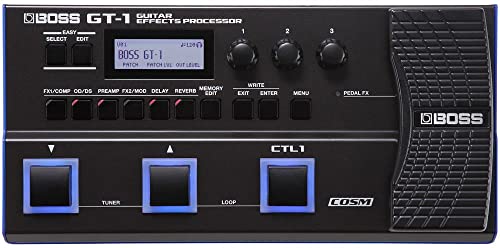
- Flagship-Class Sound Engine: BOSS sound engine squeezed into a light and compact floor unit
- Ultra-Portable Design: Delivers pro-level tones everywhere you play with easy-to-use interface
The BOSS GT-1 is a fantastic entry-level multi-effects unit that offers a lot of “bang for your buck.” Like the POD Go, it is an active digital processor. It is lightweight and portable, making it great for beginners or as a backup rig. However, compared to the JHS Pedals Mini A/B Box Guitar Signal Switch, it is far less transparent if you just want to manage a signal path. The BOSS GT-1 is for the player who wants to experiment with sounds, whereas the JHS is for the player who has already found their sound and just needs to route it correctly. The BOSS is a creative tool; the JHS is a structural tool.
3. Valeton GP-100 Guitar Multi-Effects with IR Cabinets

- 140 Built-in Guitar/Bass/Acoustic Effects with 45 Legendary Amp Models and 40 carefully selected IR Cabinet Simulations, 24-bit 44.1kHz Signal Processing
- 100 Built-in Drum Rhythms and 90 Seconds Looper, 198 Presets, Adjustable Signal Chain with Maximum 9 Simultaneous Effect Blocks
The Valeton GP-100 is a compact, affordable multi-effects processor that features IR (Impulse Response) cabinet simulation. It’s a great choice for players who need to go “direct” to a PA system. It offers more features than the JHS at a competitive price point, but it introduces a digital conversion to your signal path. For the purist who wants to keep their signal purely analog, the JHS Pedals Mini A/B Box Guitar Signal Switch remains the superior choice. The Valeton is excellent for budget-conscious bedroom players, but the JHS is built for the professional stage where simplicity and signal integrity are the top priorities.
Final Verdict: Is the JHS Pedals Mini A/B Box Worth It?
After putting the JHS Pedals Mini A/B Box Guitar Signal Switch through its paces, the verdict is clear: this is a vital utility for any guitarist looking to take control of their signal routing. Its main strengths lie in its incredible compact size, its ability to function without power, and the sheer durability of its JHS construction. While the LED might be a bit too enthusiastic for some, and users should be aware of the physics of ground loops when using dual amps, these are minor considerations compared to the convenience it provides. Whether you use it as a mute switch, an instrument selector, or an amp toggler, it performs its job with transparency and reliability.
I would recommend this to any gigging guitarist, studio engineer, or pedalboard enthusiast who values a clean signal and a versatile setup. It solves the headache of cable swapping and provides a professional edge to your performance. If you are ready to simplify your life on stage and ensure your transitions are as smooth as your playing, you should add this reliable switch to your pedalboard today and experience the difference that a high-quality A/B box can make. It’s a small investment that yields massive returns in workflow and tone management. Don’t let your signal hold you back—get the best deal on this essential utility pedal and take your rig to the next level.
Last update on 2026-10-16 / Affiliate links / Images from Amazon Product Advertising API