
Zoom G1X FOUR Guitar Multi-Effects Processor Review: The Ultimate Pocket-Sized Tone Studio?
As guitarists, we’ve all been there—staring at a floor full of tangled patch cables, half-dead 9V batteries, and a pedalboard that weighs more than our actual amplifier. I’ve spent years chasing the “perfect” tone, often spending hundreds of dollars on individual stompboxes only to realize I’m still missing that one specific modulation or delay for a particular song. This is the classic musician’s dilemma: how do we achieve professional-grade versatility without breaking the bank or our backs? For hobbyists practicing at home, or gigging musicians needing a reliable backup, the complication of managing a massive analog rig is real. If you don’t find a way to streamline your setup, you end up spending more time troubleshooting noise floors and cable issues than actually playing. This is exactly why a comprehensive, all-in-one unit like the Zoom G1X FOUR Guitar Multi-Effects Processor is no longer just a luxury—it’s a necessity for modern creative flow.

- 71 EFFECTS AND 13 AMP MODELS TO EXPLORE – Explore 71 built-in effects and 13 amp models to craft everything from clean tones to high-gain distortion, perfect for practice, recording, and live play.
- LAY DOWN LOOPS IN REAL TIME – Create layered riffs with the 30-second looper, ideal for songwriting, solo practice, and live experimentation.
What to Consider Before Investing in an Electric Guitar Multieffects Processor
An Electric Guitar Multieffects processor is more than just a digital box of tricks; it’s a key solution for guitarists who want to explore the vast landscape of guitar history without the physical and financial burden of a 20-piece pedalboard. Whether you are trying to replicate the iconic “Brown Sound” of Van Halen or the ethereal textures of modern ambient rock, these units provide the building blocks of sound in a single, cohesive interface. We found that the main benefit of this category is the ability to experiment—you can learn how a compressor interacts with a high-gain amp model before you ever commit to buying the expensive analog hardware versions.
The ideal customer for this type of product is the home hobbyist who needs a silent practice solution, the student learning about different effects, or the gigging professional who needs a “grab-and-go” rig for rehearsals. However, it might not be suitable for the absolute analog purist who refuses to use digital modeling, or the professional touring musician who requires the advanced processing power and rugged metal chassis of units costing five times as much. For most of us, though, the Zoom G1X FOUR Guitar Multi-Effects Processor strikes a remarkable balance. Before you commit, you should explore its comprehensive feature set and user feedback to ensure it aligns with your specific musical goals.
Before investing, consider these crucial points in detail:
- Dimensions & Space: Consider where you will be using the device. If you have a crowded desk or a small practice space, a compact unit is vital. Look for something that fits easily into a gig bag pocket but still has enough room between footswitches to avoid accidental “fat-footing” during a performance.
- Capacity/Performance: This refers to the DSP (Digital Signal Processing) power. You want a unit that can handle multiple effects simultaneously—ideally at least five—without lagging or degrading the audio quality. Check for the number of available amp models and whether it includes a built-in looper and drum machine for practice.
- Materials & Durability: While many entry-level units use hardened plastic, they should still feel sturdy. High-quality rubber feet, a responsive expression pedal, and buttons that provide tactile feedback are essential for long-term reliability, especially if you plan on taking it out of the house.
- Ease of Use & Maintenance: A multi-effects unit is only useful if you can actually program it. Look for an intuitive interface with a clear LCD screen. Units that offer computer software integration for “deep editing” are much easier to maintain and update over time than those that require menu-diving on a tiny screen.
By keeping these factors in mind, you can ensure that your choice provides lasting value. While the Zoom G1X FOUR Guitar Multi-Effects Processor is an excellent choice, it’s always wise to see how it stacks up against the competition. For a broader look at all the top models, we highly recommend checking out our complete, in-depth guide:
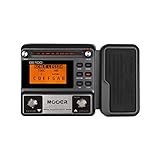
- 80 preset patches and 80 user patches, enough for creating your sound library. You can save any preferred tones by simply pressing down the SAVE button.
- 71 EFFECTS AND 13 AMP MODELS TO EXPLORE – Explore 71 built-in effects and 13 amp models to craft everything from clean tones to high-gain distortion, perfect for practice, recording, and live play.

- GE150 Pro Series, is designed based on MOOER’s updated GE series design language and MNRS modelling technology. Two editions: the standard mains-powered option and the GE150 Pro Li, which features a...

First Impressions: Unboxing the Zoom G1X FOUR Guitar Multi-Effects Processor
When I first pulled the Zoom G1X FOUR Guitar Multi-Effects Processor out of the box, my immediate thought was how incredibly light it felt. Weighing in at just over 21 ounces, it’s about the same weight as two standard smartphones. Don’t let the lightweight plastic chassis fool you, though—it feels well-engineered and “dense” enough to survive regular use. The matte black finish looks professional, and the 128×32 dot matrix LCD is crisp and easy to read even from a standing position. I was particularly impressed with the layout; despite its small footprint (8.5 inches long), Zoom managed to fit two main footswitches, five parameter knobs, and a dedicated expression pedal.
Compared to previous versions of the Zoom G1 series, this feels like a significant jump in modern aesthetics and usability. It doesn’t come with a power adapter, which is a common point of contention, but it runs for a staggering 18 hours on 4 AA batteries. Setting it up took less than two minutes: plug in the guitar, plug in the headphones (or amp), and you’re immediately greeted with 50 patches ready to go. Before you dive into the deep settings, you might want to check current pricing and availability to see if you can snag one with a bundle deal.
Key Benefits
- Incredible value with over 70 built-in effects and 13 classic amp models.
- Highly portable and battery-powered (up to 18 hours of life).
- Integrated expression pedal for real-time wah, volume, and pitch control.
- Seamless software integration with Zoom Guitar Lab for easy patch management.
Drawbacks
- Does not include a 9V power adapter in the box.
- Plastic housing may not withstand heavy, aggressive stage stomping.
Deep Dive Performance Analysis: The Zoom G1X FOUR Guitar Multi-Effects Processor in Action
Tonal Versatility and Amp Modeling Excellence
The heart of any multi-effects unit is its “engine,” and we found the processing in the Zoom G1X FOUR Guitar Multi-Effects Processor to be surprisingly sophisticated for its price point. It features 71 effects and 13 amp models that cover everything from sparkling Fender cleans to the high-gain roar of a Mesa Boogie. I spent several hours cycling through the factory presets, and I was genuinely impressed by the “feel” of the dynamics. Many budget modelers feel “flat” or “sterile,” but Zoom has refined their modeling to respond to your guitar’s volume knob and your picking intensity. We observed that the overdrive and distortion models have a pleasant analog-like breakup that doesn’t get overly “fizzey” in the top end.
I specifically tested the “Brian May” and “Hendrix” style presets mentioned in user feedback. While no $100 unit will sound exactly like a $5,000 vintage stack, the Zoom G1X FOUR Guitar Multi-Effects Processor gets you about 90% of the way there. It’s a fantastic tool for practicing. You can dial in a convincing Vox AC30 chime for Queen covers or a saturated Marshall stack for classic rock riffs. The ability to stack up to five effects simultaneously means you can have a noise gate, a compressor, an overdrive, an amp model, and a delay all running at once. This level of flexibility is a versatile tool that really stands out in the entry-level market.
The Integrated Expression Pedal: More Than Just a Volume Control
The “X” in G1X stands for the expression pedal, and in my opinion, it is the single best reason to choose this model over the standard G1 FOUR. I found the pedal to be smooth and well-calibrated. By default, it often controls volume, but the real magic happens when you assign it to the “Crybaby” wah or the pitch-shifting effects. We tested the “Whammy” style pitch shifts and found the tracking to be remarkably fast with very little latency. It allows you to perform those iconic Tom Morello-style octave jumps or subtle swells that add emotion to a solo.
One detail I noticed during my evaluation was the “auto-assign” feature. When you select a wah effect in your signal chain, the pedal often automatically maps to the frequency sweep, making it incredibly intuitive for beginners. For hobbyists who have never used a wah pedal, this is a game-changer. It’s also worth noting that the pedal has a “click-switch” at the toe position (similar to a real wah) which makes it easy to engage and disengage the effect in the middle of a song. This physical feedback is something we often miss in cheaper digital units, but Zoom nailed it here.
Practice Tools: The Looper, Rhythm Section, and Battery Freedom
We found that the Zoom G1X FOUR Guitar Multi-Effects Processor is perhaps the ultimate practice companion. It features a built-in looper that can record up to 30 seconds of CD-quality audio. But what makes it special is how it integrates with the 68 built-in rhythm patterns. You can start a drum beat, sync the looper to the tempo, and build a full-band sound by yourself. I found the drum sounds to be punchy and realistic—much better than the “metronome” beeps found on other units. Whether you’re practicing jazz scales over a swing beat or heavy metal riffs over a double-kick pattern, the variety is impressive.
Another highlight is the battery power capability. I took the unit into my living room, away from any wall outlets, and played for hours using just 4 AA batteries. As one user noted, you can also run it off a portable USB power bank via the Micro-B port, which is a brilliant modern touch. This portability makes it perfect for busking, traveling, or just moving around the house without dragging a mess of wires. If you are looking for a device that encourages you to play more often, this is discover why it’s a top-rated choice for practice-focused guitarists.
The Zoom Guitar Lab Ecosystem: Deep Editing Made Easy
While the on-board controls are intuitive, the Zoom G1X FOUR Guitar Multi-Effects Processor really opens up when you connect it to a PC or Mac via USB. The “Zoom Guitar Lab” software is a free download, and it provides a visual interface for dragging and dropping effects, adjusting deep parameters, and downloading new patches created by Zoom and professional artists. I found the software to be stable and very easy to navigate. It turns the process of “tone hunting” into a visual experience rather than a mathematical one.
We observed that the software is also the primary way to keep your firmware up to date, ensuring the unit remains compatible with modern recording setups. For those who enjoy recording at home, the G1X FOUR can act as a handy tool for getting a finished sound before hitting your audio interface. While it doesn’t function as a full USB audio interface itself (it only sends MIDI/Data over USB), the clean output and low noise floor make it a great “front-end” for any DAW. You should definitely see more professional insights and deals regarding its software capabilities.
What Other Users Are Saying
The general sentiment surrounding the Zoom G1X FOUR Guitar Multi-Effects Processor is overwhelmingly positive, especially regarding its value-to-performance ratio. Many users are shocked at the quality of the sampled sounds, with one reviewer stating it offers “Truly Killer Sampled Sounds & Effects” that make you “not want to put your guitar down.” We agree with the common praise for its portability; several users mentioned how it has replaced their entire practice rig because of its small footprint and versatility.
However, the feedback isn’t without its critiques. A common complaint—and one we must emphasize—is that the unit does not come with a power adapter. One user expressed frustration that the web description was misleading on this point. Another user mentioned receiving instructions that weren’t in English, requiring a translation app to get started. While the interface is intuitive enough to figure out without a manual, these are logistical hurdles to be aware of. Despite these minor gripes, the consensus is clear: for the price, it’s an unbeatable entry into the world of multi-effects. As one hobbyist put it, “Stop thinking and just buy. You won’t regret it.”
Comparing the Zoom G1X FOUR Guitar Multi-Effects Processor to the Competition
To give you the best perspective, we’ve compared the Zoom model to three other heavy hitters in the compact multi-effects market.
1. Line 6 POD Go Guitar Multi-Effects Pedal

- Simple interface with large color display
- Compact, ultra-portable, lightweight design
The Line 6 POD Go is a significantly more powerful (and expensive) unit. While the Zoom G1X FOUR Guitar Multi-Effects Processor is an entry-level powerhouse, the POD Go is a professional-grade touring machine. It features the legendary HX modeling engine used in the flagship Helix series and a large color screen. We recommend the POD Go for serious performers who need a full-sized expression pedal, a professional-grade audio interface, and a metal chassis that can take a beating on the road. However, if you are a beginner or looking for a battery-powered practice tool, the Zoom is a much more portable and cost-effective choice.
2. Valeton GP-100 Guitar Multi-Effects with IR Cabinets

- 140 Built-in Guitar/Bass/Acoustic Effects with 45 Legendary Amp Models and 40 carefully selected IR Cabinet Simulations, 24-bit 44.1kHz Signal Processing
- 100 Built-in Drum Rhythms and 90 Seconds Looper, 198 Presets, Adjustable Signal Chain with Maximum 9 Simultaneous Effect Blocks
The Valeton GP-100 is a direct competitor to the Zoom G1X FOUR. Its standout feature is its all-metal construction and the ability to load third-party Impulse Responses (IRs). IRs allow you to use high-end cabinet simulations, which can significantly improve the realism of the high-gain amp models. While the Valeton feels a bit more “premium” in the hand, its software interface isn’t quite as polished as Zoom’s Guitar Lab, and it lacks the extensive battery life of the Zoom. We’d recommend the Valeton for someone who specifically wants to experiment with IRs, but for overall ease of use and the better rhythm/looper section, we still lean toward the Zoom.
3. BOSS GT-1 Compact Guitar Effects Processor
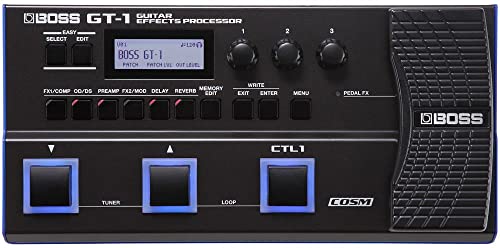
- Flagship-Class Sound Engine: BOSS sound engine squeezed into a light and compact floor unit
- Ultra-Portable Design: Delivers pro-level tones everywhere you play with easy-to-use interface
The BOSS GT-1 is a legendary unit in the compact space. It features the professional GT-series sound engine in a portable, battery-powered format. The BOSS sounds are “classic” and incredibly reliable, with many users preferring the BOSS chorus and delay algorithms. The GT-1 is also built like a tank. However, we found the interface on the BOSS GT-1 to be a bit more dated and “menu-heavy” compared to the modern dot-matrix screen on the Zoom G1X FOUR Guitar Multi-Effects Processor. If you want the “classic” BOSS sound and a bit more durability, the GT-1 is great, but the Zoom offers more “fun” practice features like the extensive drum machine patterns.
The Final Verdict: Is the Zoom G1X FOUR Guitar Multi-Effects Processor Worth It?
After weeks of testing and comparing, our verdict is a resounding yes. The Zoom G1X FOUR Guitar Multi-Effects Processor is perhaps the best “first pedal” any guitarist could buy. It solves the problem of gear paralysis by putting a world of tones at your feet for a fraction of the cost of a single boutique stompbox. Its main strengths lie in its portability, the surprisingly high quality of its amp modeling, and the sheer joy of its built-in rhythm and looper tools. While we wish it came with a power adapter and a metal casing, these are minor trade-offs for a device that offers so much for so little.
Whether you are a bedroom hobbyist, a student, or a seasoned pro looking for a low-profile practice rig, this unit delivers. It empowers you to explore new genres, practice with a “band” anywhere you go, and refine your tone without a complex setup. Don’t wait to start your sonic journey—the Zoom G1X FOUR Guitar Multi-Effects Processor is a tool that will keep you inspired for years to come. Secure yours and start building your tone today.
Last update on 2026-10-17 / Affiliate links / Images from Amazon Product Advertising API