
SAMSON Pair M50 5′ Powered Studio Monitors Review: Precision Engineering Meets Incredible Value for Modern Creators
In the world of content creation, whether you are mixing a podcast, editing a 4K video, or simply trying to climb the ranks in a competitive shooter, audio is often the most overlooked component. For years, I struggled with generic “desktop speakers” that sounded muddy, lacked any real low-end definition, and made it nearly impossible to hear the subtle nuances in my recordings. The problem with standard consumer audio is that it’s designed to “flatter” sound rather than reveal it. If you can’t hear the mistakes in your mix, you can’t fix them. This realization led me on a journey to find a compact yet powerful solution that wouldn’t break the bank but would provide the accuracy needed for semi-professional work. This is exactly where the SAMSON Pair M50 5′ Powered Studio Monitors enter the conversation, promising to bridge the gap between casual listening and professional reference monitoring.
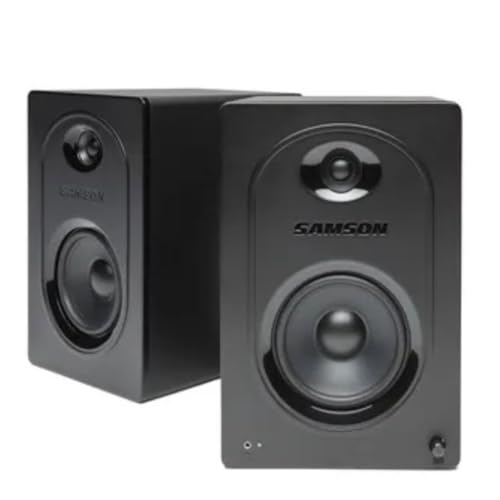
- Compact powered studio monitors perfect for multimedia, mixing, recording, and gaming applications
- Powered by an internal 80-watt studio-grade amplifier that produces robust, detailed sound
What to Consider Before Investing in Studio Audio Monitors
Choosing a pair of studio monitors is more than just an item; it’s a key solution for anyone looking to achieve “critical listening.” Unlike Hi-Fi speakers that boost bass and treble to make music sound more exciting, a dedicated studio monitor is designed to have a flat frequency response. This ensures that the sound coming out of the speakers is an accurate representation of the raw audio file. If you are producing music or editing dialogue, this accuracy is non-negotiable. Without it, your final product might sound great in your room but completely fall apart when played in a car or on a smartphone.
The ideal customer for this type of product is someone facing a cramped desk setup but requiring a step up in audio fidelity—think home studio producers, YouTubers, and high-end gamers. It is perfect for those who need a multi-purpose tool that can handle a Zoom call in the morning and a logic-defying mixing session at night. However, it might not be suitable for those who are working in massive, acoustically treated professional studios where 8-inch or 10-inch drivers are required to fill the space with high-pressure sound. For those users, a larger investment in midfield monitors would be the logical next step.
Before investing, consider these crucial points in detail:
- Dimensions & Space: Consider where these will sit. 5-inch monitors like the SAMSON Pair M50 5′ Powered Studio Monitors are the “Goldilocks” size—large enough to provide real bass response but small enough to fit on a standard desk without crowding your monitors. Always measure your desk depth to ensure you have enough room to keep them a few inches away from the wall.
- Capacity/Performance: Look at the wattage and driver materials. An 80-watt peak output is generally plenty for near-field listening (sitting 3-4 feet away). Polypropylene woofers are preferred over paper ones because they are stiffer and provide a much tighter, more “punchy” low end that doesn’t distort at higher volumes.
- Materials & Durability: The enclosure material matters immensely. You want high-density wood or specialized polymers that minimize cabinet resonance. If the cabinet vibrates, it colors the sound, defeating the purpose of a “reference” monitor. The SAMSON Pair M50 5′ Powered Studio Monitors use a robust construction designed to keep the focus on the air moving through the drivers, not the box itself.
- Ease of Use & Maintenance: Check the connectivity options. Does it have RCA for your interface? A 1/8-inch jack for your phone? A headphone output for late-night sessions? Maintenance is usually minimal for powered monitors, but having accessible front-panel controls for volume can be a massive quality-of-life improvement during daily use.
While the SAMSON Pair M50 5′ Powered Studio Monitors is an excellent choice, it’s always wise to see how it stacks up against the competition. For a broader look at all the top models, we highly recommend checking out our complete, in-depth guide:
Our Definitive Analysis of the Best Budget-Friendly Studio Monitors for Home Recording

- TRUSTED STUDIO-QUALITY SOUND: True studio sound for music production, gaming, movies, streaming, and everyday audio. Sold as a complete stereo pair.


- Hi-Res Audio Certified – Experience superior sound with Hi-Res Audio certification, delivering a flat response across 52Hz to 40kHz for precise and accurate monitoring, music creation, or everyday...
- Bring ADAM Audio sound quality to your desk with the fully active D3V monitoring system. Designed for songwriters, producers, and music lovers, the stylish monitors can be directly connected to...
First Impressions: Unboxing the SAMSON Pair M50 5′ Powered Studio Monitors
When the SAMSON Pair M50 5′ Powered Studio Monitors arrived at our studio, the first thing that struck me was the weight. At roughly 6.5 kilograms for the pair, they feel substantial and well-built, avoiding the “plastic” feel common in many speakers at this price bracket. Unboxing was a straightforward affair, with the speakers securely nestled in foam. The sleek black finish is professional and understated, fitting perfectly into a modern office or a cluttered creative cave. Before you even plug them in, you can see its full feature set and user reviews to understand the engineering that went into this compact frame.
The setup took less than five minutes. Since these are powered (active) monitors, you don’t need an external amplifier. You simply connect the passive speaker to the active one using the included speaker wire, plug in your power cable, and connect your source. Compared to the previous MediaOne generations, the M50 feels like a significant aesthetic and functional step up, especially with the inclusion of the Bass Boost switch and the dedicated sub output—features often reserved for much more expensive gear.
Key Benefits We Loved
- Exceptional clarity in the mid-range, making vocal editing a breeze.
- Compact footprint that maximizes desk real estate without sacrificing 5.25″ woofer power.
- Versatile connectivity including a dedicated 1/8″ sub output for future expansion.
- The 80-watt amplifier provides plenty of headroom for dynamic music genres.
Limitations to Consider
- Lacks XLR inputs, which some professional audio interfaces may require (RCA only).
- The Bass Boost can be a bit overwhelming if the speakers are placed too close to a corner.
Deep Dive: Putting the SAMSON Pair M50 5′ Powered Studio Monitors to the Test
Audio Performance and Driver Synergy
The heart of the SAMSON Pair M50 5′ Powered Studio Monitors lies in the relationship between the 5.25-inch polypropylene woofer and the 3/4-inch silk-dome tweeter. In our testing, this combination proved to be remarkably balanced. Polypropylene is a fantastic choice for a woofer in this price range because it is lightweight yet incredibly rigid. When we threw a bass-heavy electronic track at it, the lows remained “tight.” You could feel the kick drum without it blurring into the bass synth—a common failing of cheaper 3-inch or 4-inch monitors. It’s an impressive feat that you can check the latest price and availability for a speaker that handles transients this well.
The silk-dome tweeters are equally impressive. Many budget monitors use metal or hard plastic tweeters that can sound “harsh” or “brittle” after an hour of listening, leading to what we call ear fatigue. These silk domes, however, offer a much smoother roll-off in the high frequencies. We spent a full six-hour day editing a podcast and found that our ears didn’t feel tired or “fried” by the end of it. The stereo imaging is surprisingly wide for speakers of this size; when positioned correctly in an equilateral triangle relative to the listener, the “phantom center” (the illusion that sound is coming from the middle of your screen) is rock solid.
Versatility in Connectivity and Expansion
One of the standout features we discovered during our evaluation is the thoughtful input/output layout. While many monitors in this category give you a single pair of RCA inputs and call it a day, the SAMSON Pair M50 5′ Powered Studio Monitors offer much more. The back panel features stereo RCA inputs for your primary audio interface or mixer, but it also includes a 1/8″ stereo input. This is a lifesaver for quickly plugging in a smartphone or a tablet to check a reference track without unhooking your main system. You can even a feature that really sets it apart is the dedicated sub output, which allows you to turn this 2.0 system into a 2.1 system with ease.
The front panel is equally user-centric. Having the volume knob and a headphone jack right on the front of the active speaker is a major convenience. If you live in an apartment and need to switch to silent monitoring at 11 PM, you don’t have to fumble around the back of the speakers or dive into your computer’s software settings. You just plug in your headphones, and the speakers automatically mute. It’s this kind of intuitive design that makes the M50 feel like it was designed by people who actually spend time in a studio environment.
Real-World Utility: From Gaming to Podcasting
We didn’t just test these with music production; we put them through the ringer in everyday multimedia scenarios. For gaming, the SAMSON Pair M50 5′ Powered Studio Monitors provided a level of immersion that a headset simply cannot match. In tactical shooters, the clarity of the high-mids meant we could pinpoint footsteps with startling accuracy. In cinematic RPGs, the 80-watt amplifier delivered enough power to make orchestral scores feel grand and impactful. If you’re looking for an upgrade, you should consider this model for your gaming setup.
For podcasting and YouTube creation, these monitors are a dream. The mid-range is where the human voice lives, and the M50 reproduces it with a natural, uncolored tone. We were able to hear mouth clicks and background hiss that we previously missed on our laptop speakers. This allowed for much cleaner edits and a more professional final product. The “Bass Boost” EQ switch on the back is also a handy tool here. While we kept it off for mixing, flipping it on for a casual movie night or a gaming session provided that extra “thump” that makes entertainment more engaging without requiring a separate bulky subwoofer.
Build Quality and Thermal Management
One concern with compact powered monitors is heat. Driving 80 watts of power in a small wooden enclosure can sometimes lead to thermal throttling or electronic hum. However, we found that even after hours of high-volume use, the backplate of the active SAMSON Pair M50 5′ Powered Studio Monitors remained only slightly warm to the touch. The internal studio-grade amplifier is clearly well-matched to the drivers. The enclosure itself is made of a dense wood composite with a polypropylene finish, which feels much more “dead” (in a good way) than cheap plastic shells. This lack of vibration means you are hearing the music, not the speaker cabinet rattling.
The speaker wire terminals on the back are robust, and the included 1/8″ to RCA cable is of decent quality, though we eventually swapped it for a shielded cable to minimize interference in our high-EMI environment. The overall footprint of 10.5″D x 16.6\”W x 18.7\”H (packaged) translates to a speaker that sits comfortably alongside a 27-inch monitor. For creators who need every inch of desk space for MIDI controllers or drawing tablets, the M50 offers a professional sound without the professional “bulk.” We highly recommend you take a closer look at the dimensions to see how they’ll fit your workflow.
What Other Users Are Saying
The general consensus among the user community mirrors our own findings: these speakers are a “sleeper hit” in the budget studio monitor world. One user recently shared an update after receiving a replacement pair, noting that the “service was fast” and that once they had the speakers dialed in, they sounded “KILLER.” This matches our experience with the 5.25-inch woofer’s ability to punch above its weight class. Another user pointed out that they loved the “speedy” response of the drivers, which is critical for genres like metal or intricate electronic music where slow drivers can make the music feel “lazy.”
There have been a few mentions of users wanting even more connectivity, such as Bluetooth (though a Bluetooth version does exist), but for those prioritizing a wired, low-latency connection for mixing, the M50 is preferred. The common thread in almost all feedback is the value-to-performance ratio. People are consistently surprised that such a full, detailed sound can come from a pair of monitors at this price point. It confirms our belief that Samson has focused their budget on the components that matter—the drivers and the internal amp—rather than flashy, unnecessary gimmicks. You can read more user testimonials here to see how they perform in different room environments.
Comparing the SAMSON Pair M50 5′ Powered Studio Monitors to the Competition
1. JBL 305P MkII Powered Studio Monitors
- PACKAGE INCLUDES: (2) 305P MkII 5 2-Way Powered Studio Reference Monitor Monitoring Speaker
- CRYSTAL-CLEAR IMAGING: 305P MkII’s patented Image Control Waveguide delivers precise, immersive sound with a wide sweet spot, ideal for music production and podcasting.
The JBL 305P MkII is often considered the industry standard for entry-level professional monitors. Compared to the SAMSON Pair M50 5′ Powered Studio Monitors, the JBLs offer a wider soundstage thanks to their patented “Image Control Waveguide.” However, the JBLs are significantly larger and usually more expensive. They also feature rear-ported bass, which means they are much more sensitive to room placement—if you put them too close to a wall, the bass can become boomy. We recommend the JBLs for those who have a dedicated, treated room and more desk space, whereas the Samson M50 is better for versatile, multi-use desktop environments.
2. Yamaha HS8 8-Inch Studio Monitor

- 8 inch cone woofer and 1 inch dome tweeter; Produce low distortion sound with a well-defined bottom end at any output level.Waterproof : No
- 38Hz to 30kHz frequency response; Power consumption: 60 watts
The Yamaha HS8 is in a completely different weight class. With an 8-inch woofer, these provide much deeper bass extension and are capable of much higher volumes. However, they are massive. You cannot reasonably put a pair of HS8s on a standard computer desk without them dominating the entire room. They are also sold individually, making a pair much more of a financial commitment. If you are building a professional recording studio from the ground up, the Yamahas are the way to go. If you are a creator working from a bedroom or small office, the 5-inch Samson M50 is a far more practical and space-efficient choice.
3. IK Multimedia iLoud Micro Monitor Portable Bluetooth Studio Speakers
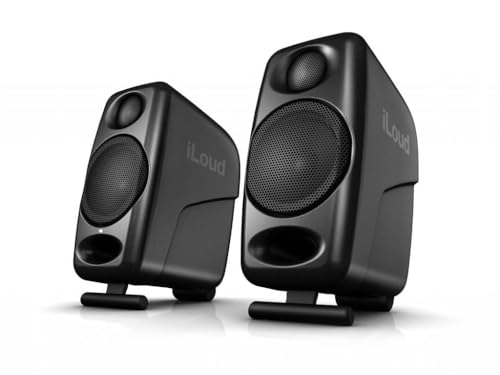
- The smallest active studio reference monitoring system in the world, iLoud Micro Monitor provides you with ultra-accurate true linear frequency response with no coloration, and does so in every...
- Whether you’re recording, editing, mixing or mastering audio, editing video, sound designing or gaming, iLoud Micro Monitor ensures your production will translate well to the huge variety of...
The iLoud Micro Monitors are the direct opposite of the Yamahas—they are ultra-portable and surprisingly powerful for their tiny size. They use advanced DSP to make a 3-inch woofer sound much larger than it is. While they are great for traveling producers, they lack the raw physical “push” of the 5.25-inch woofer found in the SAMSON Pair M50 5′ Powered Studio Monitors. The M50s feel more like “real” speakers with more natural low-end resonance, while the iLouds rely heavily on software processing. For a permanent desk setup, we prefer the more traditional, robust build of the Samson M50.
The Final Verdict: Are the SAMSON Pair M50 5′ Powered Studio Monitors Right for You?
After extensive testing, it’s clear that the SAMSON Pair M50 5′ Powered Studio Monitors are a powerhouse in the compact monitor market. They provide a level of clarity and frequency balance that is genuinely difficult to find at this price point. By combining a generous 5.25-inch woofer with a smooth silk-dome tweeter and 80 watts of clean power, Samson has created a tool that is equally at home mixing a soundtrack as it is playing a blockbuster game. The build quality is rugged, the connectivity is versatile, and the inclusion of a sub output shows that this system can grow with your needs.
If you are tired of the muddy sound of consumer speakers and want to finally hear your audio “the way it was meant to be heard,” this is one of the smartest upgrades you can make for your creative space. Whether you’re a podcaster, a budding music producer, or a gamer who demands high-fidelity audio, these monitors deliver the goods. Don’t let poor audio hold your projects back any longer; grab your pair of SAMSON Pair M50 5′ Powered Studio Monitors today and experience the difference that true reference monitoring makes.
Last update on 2026-10-16 / Affiliate links / Images from Amazon Product Advertising API