
Yamaha Hs5 Powered Studio Monitor Pair Review: The Unvarnished Truth for Your Home Studio
There is a specific, sinking feeling that every home producer knows all too well. You spend eight hours meticulously crafting a track in your bedroom, balancing the kick drum just right and making the vocals shimmer. You’re convinced it’s a masterpiece. Then, you take it to your car or play it through a Bluetooth speaker, and suddenly, the bass is a muddy mess, the vocals are buried, and the high-end is piercingly sharp. This “translation” problem occurs because your speakers are coloring the sound, hiding flaws rather than revealing them. We have all been there, searching for a way to hear the real audio without the artificial bass boosts or “sweetened” highs common in consumer electronics. This is exactly why we turned to the Yamaha Hs5 Powered Studio Monitor Pair. In the world of audio production, you don’t want speakers that sound “good”—you want speakers that sound “honest.” Failing to solve this accuracy issue means your music will never sound professional across different playback systems, and the Yamaha Hs5 Powered Studio Monitor Pair is designed specifically to be the solution to that frustration.

- Includes (2) Yamaha HS5 studio monitors
- 2 Way bass reflex bi amplified near field studio monitor with 5 inch Cone woofer and 1 inch dome tweeter
What to Consider Before Investing in Professional Studio Audio Monitors
A Studio Audio Monitors is more than just an item; it’s a key solution for anyone serious about sound, providing the high-fidelity transparency needed to make informed mixing decisions. Unlike hi-fi speakers designed to make music enjoyable to listen to, studio monitors are surgical tools. They are designed to have a “flat frequency response,” meaning they don’t emphasize any particular frequency over another. This allows you to hear the raw, naked truth of your recording. If a mix sounds good on a pair of accurate monitors, it is much more likely to sound good everywhere else.
The ideal customer for this type of product is someone facing the challenges of a home or project studio, such as a songwriter, podcaster, or aspiring mix engineer who needs professional-grade accuracy on a budget. These are perfect for those working in smaller rooms where larger 8-inch monitors would overwhelm the space with uncontrolled bass. However, it might not be suitable for those who primarily listen to music for pleasure and want a “thumping” bass response, or for those working in massive commercial rooms who require much higher SPL (Sound Pressure Level) and deep sub-bass extension. In those cases, looking at larger drivers or adding a dedicated subwoofer would be the necessary alternative.
Before investing, consider these crucial points in detail:
- Dimensions & Space: Consider the size of your desk and your room’s acoustics. Near-field monitors like these are designed to be placed 3 to 5 feet away from your ears. If your room is tiny, a 5-inch driver is often more manageable than a 7 or 8-inch driver which can cause significant standing wave issues in the low end.
- Capacity/Performance: Look at the wattage and the amplification style. Bi-amplified systems, which use separate internal amplifiers for the woofer and the tweeter, offer much better clarity and less distortion than single-amplifier designs. This ensures that a heavy bass hit doesn’t “clamp down” on the clarity of your high-end frequencies.
- Materials & Durability: The enclosure material matters immensely. High-quality MDF or specialized wood composites help eliminate unwanted resonances. Cheaper plastic housings can vibrate and add “chatter” to your sound, which ruins the accuracy you are paying for in a studio monitor.
- Ease of Use & Maintenance: Check the rear-panel controls. Professional monitors should offer “Room Control” or “High Trim” switches. These allow you to adjust the speaker’s output based on whether they are placed against a wall or in the middle of a room, which is a vital part of long-term maintenance of your acoustic environment.
While the Yamaha Hs5 Powered Studio Monitor Pair is an excellent choice, it’s always wise to see how it stacks up against the competition. For a broader look at all the top models, we highly recommend checking out our complete, in-depth guide:
FULL ANALYSIS
Finding the Best Studio Monitors for High-Fidelity Audio and Gaming

- TRUSTED STUDIO-QUALITY SOUND: True studio sound for music production, gaming, movies, streaming, and everyday audio. Sold as a complete stereo pair.


- Hi-Res Audio Certified – Experience superior sound with Hi-Res Audio certification, delivering a flat response across 52Hz to 40kHz for precise and accurate monitoring, music creation, or everyday...
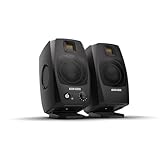
- Bring ADAM Audio sound quality to your desk with the fully active D3V monitoring system. Designed for songwriters, producers, and music lovers, the stylish monitors can be directly connected to...
First Impressions: Unboxing the Iconic White Cones
When the Yamaha Hs5 Powered Studio Monitor Pair arrived at our studio, the first thing we noticed was the weight. At over 16 pounds per speaker, these feel incredibly substantial. The build quality is immediately apparent; the dense wood enclosure is finished in a smooth, professional matte black that feels like it could survive a decade of daily use. But the real star is the iconic white cone woofer—a visual nod to the legendary Yamaha NS-10s that have sat atop consoles in world-class studios for forty years. Before even plugging them in, you can see its full feature set and user reviews to understand the pedigree behind this design.
The setup was remarkably straightforward. We appreciated the inclusion of both XLR and TRS inputs, allowing us to connect directly from our audio interface using balanced cables to minimize noise. Initial power-up revealed the glowing Yamaha logo on the front, which doubles as a power indicator—a classy touch. Compared to the previous HS50M series, these feel more refined, with a cleaner aesthetic and a more robust feel to the rear switches. While they aren’t the smallest 5-inch monitors on the market, their vertical orientation makes them easy to fit onto most standard monitor stands or even a sturdy desk.
What We Like
- Exceptional mid-range clarity that makes vocal mixing and EQing much easier.
- Incredible build quality with high-density MDF enclosures that minimize resonance.
- Room Control and High Trim switches for tailoring the sound to your specific workspace.
- Honest, “flat” sound profile that ensures your mixes translate well to other systems.
What We Didn’t Like
- Low-end response rolls off around 54Hz, which may require a subwoofer for bass-heavy genres.
- The “honest” sound can be fatiguing for casual listening if you are used to “hyped” consumer speakers.
Deep Dive: Putting the Yamaha Hs5 Powered Studio Monitor Pair to the Test
Sonic Purity and Mid-Range Dominance
The most striking aspect of the Yamaha Hs5 Powered Studio Monitor Pair is its commitment to sonic purity. When we first ran a well-known reference track through these, we were floored by the separation. In many monitors in this price bracket, the mid-range—where the “meat” of the vocals, guitars, and snares live—can get crowded or muddy. The HS5s do the opposite; they push the mid-range forward just enough that you can hear every subtle breath in a vocal take or the slight fret noise on an acoustic guitar. This isn’t necessarily “pretty” sound, but it is highly functional. We found that we could identify frequency clashes between a synth and a vocal much faster than we ever could on our previous setup.
This clarity is largely due to the bi-amplified design. With 45W dedicated to the LF (Low Frequency) driver and 25W to the HF (High Frequency) driver, the 70W total power is distributed efficiently. We noticed that even at higher volumes, the speakers didn’t lose their composure. There was no “pumping” or distortion when the kick drum hit, which is a testament to Yamaha’s engineering. If you are a producer who focuses on vocal-heavy tracks, singer-songwriter material, or podcasting, you can check the latest price and availability to see how these can upgrade your vocal processing chain.
Low-End Response and the Near-Field Experience
We need to address the elephant in the room: the bass. A 5-inch woofer has physical limitations. The Yamaha Hs5 Powered Studio Monitor Pair is rated down to 54Hz. In our testing, the bass is tight, punchy, and incredibly accurate, but it doesn’t “shake the room.” For us, this was actually a benefit. In our smaller testing room, larger monitors often create a muddy “build-up” in the corners. The HS5s provided a clear representation of the low-end without masking the rest of the frequency spectrum. We could hear exactly where the bass guitar was sitting in relation to the kick drum, which is often a “guessing game” on cheaper speakers.
However, if you are producing EDM, Trap, or Cinematic scores that rely on sub-bass below 50Hz, you will likely feel the need for a matching subwoofer. But for general mixing, we found the low-end to be perfectly adequate for making critical decisions. As one user noted in their feedback, these speakers replaced their 3-inch monitors and the difference in bass “fullness” was night and day. It’s all about context—for a near-field setup where you are sitting close to the speakers, the Yamaha Hs5 Powered Studio Monitor Pair provides exactly the amount of low-end detail you need without the “bloat” that ruins a mix.
Acoustic Tuning and Rear-Panel Control
One of the most valuable features we discovered during our evaluation was the Room Control and High Trim functionality. Most home studios are not perfectly treated with acoustic foam or bass traps. Often, speakers have to be placed near a wall, which artificially boosts the bass. The HS5s have a “Room Control” switch that allows you to attenuate the low end by -2dB or -4dB. We placed our pair quite close to the back wall and flipping that switch to -2dB immediately cleared up the “boxiness” we were hearing. This is a feature that really sets it apart from basic “plug-and-play” monitors that don’t allow for environmental compensation.
The High Trim switch is equally useful. If your room is very “bright” with a lot of hard surfaces (like windows or hardwood floors), you can drop the high frequencies by 2dB to prevent ear fatigue. Conversely, if your room is “dead” with lots of carpets and curtains, you can boost the highs. We found these controls to be surprisingly surgical. They didn’t just change the volume; they changed the character of the speaker to better fit our specific workspace. This level of customization ensures that you aren’t fighting your room while you’re trying to mix your music.
Build Integrity and Heat Management
Long sessions can be taxing on electronics, but the Yamaha Hs5 Powered Studio Monitor Pair is built like a tank. The enclosure is made from high-density MDF with a 3-way mitered-joint technique. This might sound like marketing jargon, but in practice, it means the cabinet is incredibly rigid. We noticed a complete lack of “cabinet ring” or unwanted vibrations even when we pushed the volume. The air-flow design for the rear port is also well-executed; even during intense sessions, the backplate remained remarkably cool to the touch. This suggests that the internal components are not being stressed, which bodes well for the long-term reliability of the bi-amp system.
We also want to highlight the connectivity. Having both XLR and TRS inputs is essential for a professional workflow. We tested them with several different audio interfaces and even a smartphone (using an adapter), and the signal remained clean and buzz-free. This reliability is why so many professionals recommend the Yamaha Hs5 Powered Studio Monitor Pair as the “first real set” of monitors for any aspiring engineer. You can view the technical specs and wiring options to see how they would integrate into your current studio rack.
What Other Users Are Saying
The general sentiment among the community for the Yamaha Hs5 Powered Studio Monitor Pair is overwhelmingly positive, with a strong emphasis on their accuracy. One user described them as “100% beautifully crafted” and noted that the sound is “clear, pure, and 100% neutral.” This aligns perfectly with our findings—they are “truth-tellers.” Another reviewer mentioned that these monitors helped them hear nuances in mixes they had listened to for years, revealing details they had previously missed on consumer-grade gear. This “re-discovery” of music is a common experience when moving to the HS series.
However, the feedback isn’t without its warnings. A few users mentioned shipping issues where they only received one monitor despite ordering the “Pair,” so it’s vital to check your delivery immediately. Additionally, one international reviewer raised concerns about counterfeit versions in their local market, though this is easily avoided by purchasing through reputable online retailers. Some users also noted that if you’re switching from “bass-heavy” speakers like certain Audioengine models, the HS5s might feel “thin” at first. This is simply the sound of accuracy, and as most users eventually realized, it’s a necessary adjustment for better mixing. One producer even mentioned they got theirs for a significant discount during a sale, making the value proposition even stronger.
Comparing the Yamaha Hs5 Powered Studio Monitor Pair to the Competition
While we are big fans of the HS5s, it’s important to see how they compare to other industry standards. Depending on your specific needs—portability, bass response, or budget—one of these alternatives might suit you better.
1. JBL 305P MkII Powered Studio Monitors
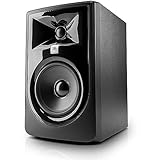
- PACKAGE INCLUDES: (2) 305P MkII 5 2-Way Powered Studio Reference Monitor Monitoring Speaker
- CRYSTAL-CLEAR IMAGING: 305P MkII’s patented Image Control Waveguide delivers precise, immersive sound with a wide sweet spot, ideal for music production and podcasting.
The JBL 305P MkII is the most direct competitor to the HS5. In our comparison, the JBLs offer a slightly wider “sweet spot” thanks to their Image Control Waveguide. This means you can move your head around more without the sound changing significantly. The JBLs also tend to have a bit more “energy” in the low-end, which some might find more pleasant for casual listening. However, the Yamaha Hs5 Powered Studio Monitor Pair still wins in the mid-range clarity department. If you find the Yamahas a bit too “stark” or “clinical,” the JBLs are a fantastic, slightly more “forgiving” alternative that still offers great professional accuracy.
2. IK Multimedia iLoud Micro Monitor Portable Bluetooth Studio Monitors
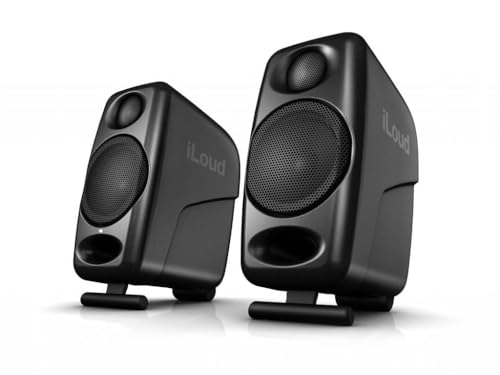
- The smallest active studio reference monitoring system in the world, iLoud Micro Monitor provides you with ultra-accurate true linear frequency response with no coloration, and does so in every...
- Whether you’re recording, editing, mixing or mastering audio, editing video, sound designing or gaming, iLoud Micro Monitor ensures your production will translate well to the huge variety of...
If you are working in a truly cramped space—like a dorm room or a mobile laptop setup—the IK Multimedia iLoud Micro Monitors are a revelation. Despite their tiny size, they pack a surprising punch and even include Bluetooth for casual listening. However, they cannot compete with the Yamaha Hs5 Powered Studio Monitor Pair when it comes to raw power and cabinet stability. The HS5s feel like “real” studio furniture, whereas the iLouds feel like a high-end travel accessory. For a permanent home studio, we would choose the Yamahas every time for their superior build and more “open” soundstage, but for the traveling producer, the iLouds are the clear winner.
3. ADAM Audio T5V Studio Monitor Single
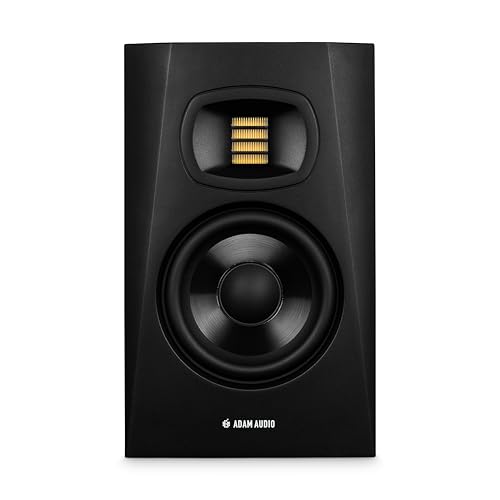
- Transformative feedback for recording, producing, or mixing – Whether you are creating music, editing your next podcast, tracking guitar, or composing for film, the revealing nature of ADAM...
- High resolution audio designed in Berlin – The HPS waveguide and U-ART tweeter combine to deliver detailed sound across the high frequency spectrum
The ADAM Audio T5V is famous for its U-ART accelerated ribbon tweeter. This gives the T5Vs a very “airy” and detailed high-end that extends up to 25kHz. Compared to the Yamaha Hs5 Powered Studio Monitor Pair, the ADAMs sound a bit more modern and “expensive” in the treble. They also have a rear-firing bass port, which can provide a bit more low-end “thump” but makes them harder to place near walls. The Yamahas remain the standard for mid-range honesty, but if you find yourself struggling specifically with high-frequency details or want a more “hi-fi” experience in a studio monitor, the ADAM T5Vs are an incredible choice.
The Final Verdict: Is the Yamaha Hs5 Powered Studio Monitor Pair Right for You?
After weeks of testing and comparing, our conclusion is clear: the Yamaha Hs5 Powered Studio Monitor Pair remains the gold standard for entry-to-mid-level studio monitoring. They are not designed to flatter your ego or make your rough demos sound like finished radio hits. Instead, they act as a magnifying glass, exposing every flaw in your EQ, every mistake in your compression, and every clash in your arrangement. This “tough love” approach is exactly what you need to grow as a producer and ensure your music sounds professional on any system. Their build quality is legendary, and their ability to adapt to small, untreated rooms via the Room Control switches makes them incredibly versatile for the modern home studio.
We highly recommend these for podcasters who need vocal clarity, electronic producers who want a tight (if not earth-shaking) low end, and any songwriter tired of their mixes not “translating” to the car. While you might eventually want to add a subwoofer as your studio grows, these are the perfect foundation for your sonic journey. If you are ready to stop guessing and start hearing the truth, we suggest you grab your pair of Yamaha HS5s today and take the first step toward professional-grade audio production.
Last update on 2026-10-17 / Affiliate links / Images from Amazon Product Advertising API