
StewMac Sun Fuzz DIY Guitar Pedal Kit Review: A Real User’s Verdict on the Ultimate DIY Fuzz Project
There is a specific kind of frustration that every guitar player knows: the “Tone Chase.” We spend countless hours scouring forums, watching demo videos, and eyeing boutique pedals that cost more than some of our first guitars. For years, I found myself obsessed with the legendary Analogman Sun Face. It is the gold standard of fuzz—creamy, responsive, and capable of cleaning up beautifully with a simple turn of the guitar’s volume knob. However, the wait times and the secondary market prices can be daunting. I wanted that sound, but I also wanted the satisfaction of knowing exactly how that sound was made. That is what led me to the StewMac Sun Fuzz DIY Guitar Pedal Kit.
Searching for a project like this usually stems from a desire for customization and a bit of “bench-side” pride. You want a professional-grade effect, but you also want to learn the alchemy behind the circuit. The complication for most of us is the fear of failure. No one wants a box of expensive, half-melted components that doesn’t make a sound. Solving this problem requires a kit that bridges the gap between a raw schematic and a polished, finished product. In this StewMac Sun Fuzz DIY Guitar Pedal Kit Review, I will dive into whether this kit truly delivers on its promise of boutique tone and a stress-free building experience.

- Inspired by Analogman's Sun Face
- 32 Page Step-by-step Instructions Written For The First Time Builder
Choosing the Right DIY Distortion & Overdrive Effects Kit
A Guitar Distortion & Overdrive Effects kit is more than just a box of resistors and capacitors; it’s a key solution for any guitarist looking to personalize their signal chain. Instead of being stuck with the “baked-in” EQ of a mass-produced unit, a kit allows you to understand the gain stages and clipping diodes that define your sound. By building it yourself, you gain the ability to troubleshoot and modify the circuit in the future, effectively making you the master of your own tone. The main benefit is the sheer value—you are essentially getting a $200+ boutique-sounding pedal for a fraction of the price, provided you have the patience to see its full feature set and user reviews before diving in.
The ideal customer for this type of product is the “tinkerer”—someone who isn’t afraid of a soldering iron and enjoys the process as much as the result. It is perfect for the player who wants to understand “why” a fuzz sounds the way it does. Conversely, it might not be suitable for those who need a pedal immediately for a gig tomorrow night, or those with zero patience for fine-motor tasks. If you are looking for a “plug and play” experience without any work, you should probably look at pre-built boutique options or digital modelers instead.
Before investing, consider these crucial points in detail:
- Dimensions & Space: Consider the footprint of the enclosure. The StewMac Sun Fuzz DIY Guitar Pedal Kit uses a standard-sized, rugged metal enclosure, but you need to ensure the rear-mounted jacks fit your current pedalboard cable routing. Some boards are tight, and top-mounted jacks are a lifesaver for saving horizontal space.
- Circuit Complexity & Component Quality: Not all kits are created equal. You want to look for high-quality PCBs (printed circuit boards) and reliable switches. The 3PDT breakout boards used here are excellent for reducing “spaghetti wiring,” which is the leading cause of noise and failure in DIY builds.
- Instructions & Documentation: For a DIY kit, the manual is the most important “component.” A 32-page guide is a massive advantage over a simple one-page schematic. Look for kits that provide step-by-step photos, especially if this is your first time wielding a soldering iron.
- Ease of Use & Maintenance: Consider the long-term. Is the enclosure pre-drilled? Does it include labels? A kit that requires you to drill your own holes and paint the box can quickly become a multi-week project. The StewMac Sun Fuzz DIY Guitar Pedal Kit comes with a powder-coated, pre-drilled enclosure, which significantly lowers the barrier to entry.
While the StewMac Sun Fuzz DIY Guitar Pedal Kit is an excellent choice for those wanting to roll their own tone, it’s always wise to see how it stacks up against the competition in the wider world of gain. For a broader look at all the top models, we highly recommend checking out our complete, in-depth guide:
The Definitive Guide to the Best Guitar Distortion and Overdrive Pedals on the Market Today

- Legendary Distortion Heritage: Used by guitarists everywhere since 1978, establishing the standard for distortion pedals

- Legendary BOSS Overdrive Pedal: Genre-defining sound and feel that has shaped guitar tones across multiple decades


- 3-Mode Distortion: Toggle between Lo/Hi Boost or bypass for dynamic tone shaping.
Unboxing and First Impressions: The StewMac Experience
When the StewMac Sun Fuzz DIY Guitar Pedal Kit arrived, the first thing that struck me was the organization. StewMac has a reputation in the lutherie world for precision, and that clearly carries over to their electronics kits. Everything is individually bagged and labeled, which is a godsend. If you’ve ever spent an hour trying to read the tiny color bands on a resistor, you’ll appreciate that StewMac does a lot of the heavy lifting for you. The white enclosure has a smooth, professional powder-coated finish that feels “road-worthy” right out of the box.
The initial feel is one of quality. The 3PDT switch has a satisfying mechanical click, and the potentiometers turn with a smooth, heavy resistance that suggests they won’t fail after a few months of use. Comparing this to some of the “cheap” kits I’ve seen online, the difference is night and day. The instructions are printed in full color on high-quality paper—it feels more like a textbook than a pamphlet. It’s clear that this kit was designed to ensure a successful build, even for a novice. You can check the latest price and availability to see how this value proposition compares to buying a pre-built boutique fuzz.
Key Benefits
- Incredibly detailed 32-page instructional manual that is perfect for beginners.
- High-quality, pre-drilled metal enclosure with a professional powder-coated finish.
- Includes a 3PDT breakout board which makes wiring the foot-switch much easier and cleaner.
- Internal trim pots allow for fine-tuning the bias and tone of the fuzz circuit.
Drawbacks
- Requires a steady hand and a decent soldering iron; some components are quite small.
- The color coding on some capacitors may differ slightly from the manual, requiring a quick check.
The Deep Dive: Building and Playing the StewMac Sun Fuzz DIY Guitar Pedal Kit
In this section, we’re going to break down exactly what it’s like to live with and build this kit. From the first drop of solder to the final sound test, I’ve put this unit through its paces to see if it lives up to the Analogman inspiration.
Assembly: A Masterclass in Educational DIY
The building process for the StewMac Sun Fuzz DIY Guitar Pedal Kit is where the product truly shines. I have built several pedals from scratch using “stripboards,” and I can tell you that the PCB design here is exceptionally well-thought-out. The traces are thick and well-defined, which makes the board more forgiving of a little extra heat if you’re still perfecting your soldering technique. We found that following the 32-page manual was a breeze. It doesn’t just tell you where to put a part; it often explains what that part is doing, which adds a layer of educational value that other kits lack.
One user mentioned that they had “NO electronics or soldering skills” and were still able to complete the build successfully. I found this to be a common theme. The inclusion of the 3PDT breakout board is a “feature that really sets it apart.” Traditionally, wiring the foot-switch is the most frustrating part of a pedal build—the wires are cramped and easy to short out. By using a small secondary PCB for the switch, StewMac has eliminated about 80% of the potential for human error. It results in a very “low noise” operation because the signal paths are kept short and tidy. If you’ve been hesitant to try a DIY project, you should a feature that really sets it apart and see how the breakout board simplifies the entire process.
Sonic Performance: That Classic Sun Face Growl
Once the build was complete, it was time for the “smoke test.” I plugged it in, and the StewMac Sun Fuzz DIY Guitar Pedal Kit roared to life. This circuit is inspired by the Analogman Sun Face, which itself is a highly refined version of the classic Dallas Arbiter Fuzz Face. The result is a fuzz that is remarkably touch-sensitive. With the gain cranked, you get that thick, woolly saturation that defines 60s psychedelic rock. But the magic happens when you roll back your guitar’s volume knob. It cleans up into a sparkly, “glassy” overdrive that sounds like a vintage tube amp on the edge of breakup.
We found that the internal trim pots are crucial for this performance. Fuzz circuits, particularly those using germanium-style designs, are very sensitive to voltage. The ability to “bias” the transistors using the internal pots means you can dial in the exact “texture” of the fuzz—from a smooth, singing sustain to a “velcro-like” gated sputter. One user reported that their pedal “lacked fuzz” initially, which is almost certainly a biasing issue. Once you dial in those trim pots, the pedal transforms. It’s an “amazing tone” that punches way above its price point, especially if you take a look at the internal components and board layout.
Hardware and Durability: Built for the Stage
Let’s talk about the physical build of the StewMac Sun Fuzz DIY Guitar Pedal Kit. Many DIY pedals feel like “toys” once they are finished, but this feels like a professional piece of gear. The enclosure is heavy-duty metal, and the rear-mounted jacks (Input, Output, and Power) are a modern touch that makes cable routing on a pedalboard much cleaner. Most vintage-style fuzzes have side-mounted jacks, which can be a nightmare for space. By moving them to the rear, StewMac has modernized a classic design without sacrificing the vintage tone.
The true bypass switching is another highlight. When the pedal is off, your signal remains completely unaffected, preserving the high-end clarity of your guitar. We also appreciated the inclusion of custom labels. It’s a small detail, but having a professional-looking “Sun Fuzz” label on the face of the pedal makes it feel “finished.” It doesn’t look like a science project; it looks like something you’d see on a pro’s touring board. This level of detail is why many users say it’s “worth way more than what it cost.”
Troubleshooting and Support: What Happens When Things Go Wrong?
No DIY project is without its risks. During our evaluation, we looked into what happens when a builder hits a snag. One user mentioned that their enclosure had “incorrectly spaced” holes. While this seems to be a rare manufacturing defect, it highlights why a kit from a reputable company like StewMac is better than a random kit from an unbranded source. Their “limited lifetime warranty” is almost unheard of in the DIY world. If a component is missing or faulty, their customer service is generally quick to respond.
Another common hurdle is component identification. As one reviewer noted, “a multimeter is a must to assemble properly.” We agree. While the kit is beginner-friendly, having a cheap digital multimeter to verify resistor values before soldering will save you hours of headache. The kit teaches you these “best practices,” which are essential if you want to get deeper into the hobby. It’s a fun, rewarding experience that results in a high-caliber tool for your musical arsenal. Before you start your build, make sure to read through the latest user tips and assembly advice.
What Other Users Are Saying
The general sentiment surrounding the StewMac Sun Fuzz DIY Guitar Pedal Kit is overwhelmingly positive, especially regarding the instructions and the final sound. Most users are surprised by just how “boutique” the pedal sounds once it’s finished. One builder shared, “This was my first pedal kit. I’m going to do another soon since this one was so successful. Instructions were excellent.” This sentiment is echoed by many who found the process “fun for not much money.”
However, it isn’t all perfect. Some users with less experience noted that “parts are very small, magnifiers help.” This is a fair warning—if you have poor eyesight, a desk-mounted magnifying glass will be your best friend. There was also a mention of a “bad sounding” unit, which we suspect was due to a lack of proper biasing or a cold solder joint. One critical review mentioned a spacing issue with the enclosure holes, which made the breakout board difficult to mount. While this appears to be an outlier, it’s worth checking the alignment of your parts before you start soldering everything down. Overall, the consensus is that for the price of a standard mass-produced pedal, you get a premium boutique experience and the pride of having built it yourself.
Comparing the StewMac Sun Fuzz DIY Guitar Pedal Kit to Alternatives
If you aren’t sure if a DIY kit is right for you, or if you want a different type of gain, let’s look at how the StewMac Sun Fuzz DIY Guitar Pedal Kit compares to some popular pre-built alternatives.
1. MOOER E7 Polyphonic Guitar Synth Pedal

- E7 the pocket-sized guitar synthesizer pedal. 7 smoother SYNTHS tones, easy to use by adding 7 LED indicators on the right side of the housing. Recommended 9V DC power supply.
- Versatile synth tones. 7 different custom synth tones, you can adjust any synth tone as you like. Synth types include trumpet, organ, ocean wave, Weeyo, saw wave, 8-bit, EDM, pad.
The MOOER E7 is a completely different beast. While the Sun Fuzz is an analog, vintage-inspired circuit designed for pure organic grit, the E7 is a digital polyphonic synthesizer. It offers seven different synth tones and built-in arpeggiators. If you are looking to transform your guitar into a keyboard-like instrument, the E7 is fantastic. However, it lacks the “soul” and touch-sensitivity of the Sun Fuzz. Someone who wants the StewMac Sun Fuzz DIY Guitar Pedal Kit is looking for classic rock tones, whereas the MOOER E7 is for the experimentalist who wants modern, digital textures.
2. Fulltone OCD Overdrive Pedal with HP/LP Switch
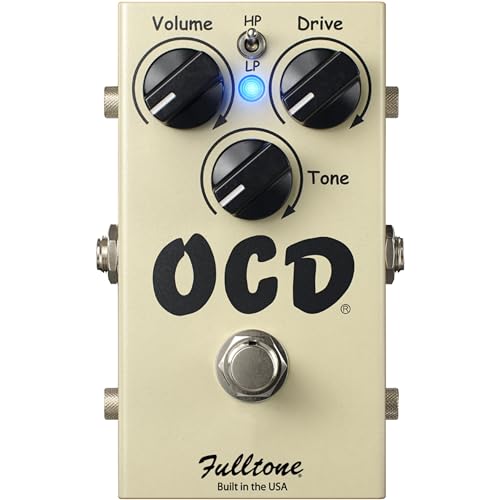
- Overdrive Guitar Pedal with Volume
- HP/LP Controls
The Fulltone OCD is a modern classic in the world of overdrive. It offers a much tighter, more “modern” distortion than the Sun Fuzz. While the Sun Fuzz is saggy, woolly, and vintage, the OCD is punchy and works great for hard rock. The OCD is a “buy it and forget it” pedal—it’s incredibly reliable and made in the USA. If you don’t want to solder and you want a drive that can handle everything from blues to metal, the OCD is a safer bet. But if you want that specific, legendary Fuzz Face cleanup, the Sun Fuzz kit is the way to go.
3. JHS Pedals Morning Glory V4 Overdrive Pedal

- Designed to be one of the most transparent overdrives out there
- Adds mid to low level grit to Your crystal clean tone and tube like touch response to a less than ideal amp
The JHS Morning Glory is often cited as one of the best “transparent” overdrives ever made. It is designed to add “grit” without changing the core tone of your amp. Comparing it to the StewMac Sun Fuzz DIY Guitar Pedal Kit is a study in contrasts. The Sun Fuzz is an “effect”—it takes over your sound and gives it that massive 60s personality. The Morning Glory is a “utility” that makes your existing sound better. If you want a subtle boost, go JHS. If you want a pedal that can scream and sing with Hendrix-style authority, the Sun Fuzz is the winner. Plus, you get the satisfaction of building it yourself.
Final Verdict: Is the StewMac Sun Fuzz DIY Guitar Pedal Kit Worth It?
After spending time with the StewMac Sun Fuzz DIY Guitar Pedal Kit, I can confidently say it is one of the best ways to enter the world of pedal building. It successfully demystifies the process of creating a high-end boutique effect. The strengths of this kit lie in its exceptional documentation and the clever hardware choices, like the 3PDT breakout board and the pre-drilled enclosure. While you do need some basic tools and a bit of patience, the reward is a pedal that sounds like it should cost three times as much as it does.
We recommend this kit to anyone who loves the “Sun Face” style of fuzz and wants a fun weekend project. It’s a perfect gift for a guitar player or a great treat for yourself. Just remember to take your time, use a multimeter, and don’t be afraid to tweak those internal trim pots to find your signature sound. If you’re ready to start your tone-building journey, you should check out the StewMac Sun Fuzz kit here and join the ranks of players who don’t just buy their tone—they build it.
Last update on 2026-10-16 / Affiliate links / Images from Amazon Product Advertising API