
EROK Bass Fuzz Pedal Dynamic Filter Review: The Secret Weapon for Funk-Infused Low-End Grit
If you have ever stepped on a distortion pedal during a live set only to feel the entire low-end of the mix vanish into thin air, you know the specific frustration of the “disappearing bassist.” For years, I struggled with standard guitar fuzz boxes that sounded massive on a six-string but turned my Precision Bass into a buzzy, thin mess. The problem is fundamental: most drive circuits aren’t designed to handle the massive frequency swings and subsonic weight of a bass guitar. We need something that doesn’t just clip the signal but respects the fundamental notes while adding character. This is exactly why we went looking for a specialized solution, and it led us directly to our hands-on evaluation of the EROK Bass Fuzz Pedal Dynamic Filter. Solving this tonal dilemma isn’t just about “sounding cool”; it’s about maintaining the rhythmic foundation of the band while still carving out a unique sonic space. Without the right gear, you’re either stuck with a boring clean tone or a muddy mess that lacks definition.
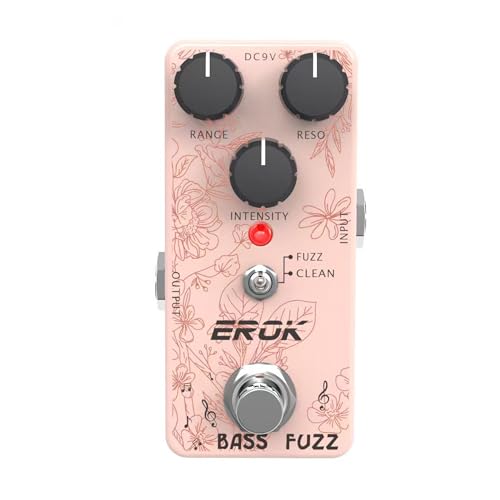
- Bass-Specific Design: Specifically engineered for bass guitars, it accurately adapts to the unique frequency range and sonic characteristics of bass, effectively optimizing and transforming bass tones
- Analog Dynamic Band-Pass Filter: Utilizing analog circuit technology, it functions as a dynamic band-pass filter, precisely shaping the frequency components of the bass signal to deliver a wide range...
What to Consider Before Buying a Bass Distortion & Overdrive Effects Pedal
A Bass Distortion & Overdrive Effects unit is more than just an item; it’s a key solution for bassists who need to bridge the gap between rhythmic support and melodic aggression. Unlike guitar pedals, these units are specifically tuned to preserve the “meat” of your sound—the 40Hz to 100Hz range—while adding harmonics further up the spectrum. When you choose the right pedal, like the EROK Bass Fuzz Pedal Dynamic Filter, you are investing in the ability to cut through a dense mix of loud drums and distorted guitars without losing your place in the pocket.
The ideal customer for this type of product is someone facing a lack of “attitude” in their tone, particularly players in rock, funk, or experimental genres who want more than just a standard “thump.” It is perfect for the player who wants to emulate the synth-like growl of 70s funk or the aggressive bite of modern punk. However, it might not be suitable for those who strictly play jazz, folk, or genres requiring a 100% transparent, acoustic-like bass reproduction. If you are looking for a subtle “always-on” tube warmth, a dedicated preamp might be a better alternative than a specialized fuzz-filter hybrid.
Before investing, consider these crucial points in detail:
- Dimensions & Space: Your pedalboard real estate is precious. We found that looking for a “mini” or standard-sized enclosure is vital if you already have a crowded board. A compact design ensures you don’t have to sacrifice your tuner or compressor just to fit a new fuzz effect.
- Capacity/Performance: In the world of bass effects, “capacity” refers to headroom and frequency retention. You want a pedal that can handle active bass pickups without clipping unpleasantly, while also ensuring that the “dry” signal or the low-end frequencies remain untouched by the high-frequency distortion.
- Materials & Durability: Since these units are literally designed to be stepped on, metal housing is non-negotiable. We always look for sturdy footswitches and knobs that don’t feel “wobbly,” as these are the first points of failure during a rigorous touring schedule.
- Ease of Use & Maintenance: While deep-dive menus are great for studio rack gear, on stage, you want intuitive knobs. A good bass pedal should allow you to dial in a usable tone in seconds, with clearly labeled functions like “Range” or “Intensity” that respond predictably to your touch.
While the EROK Bass Fuzz Pedal Dynamic Filter is an excellent choice, it’s always wise to see how it stacks up against the competition. For a broader look at all the top models, we highly recommend checking out our complete, in-depth guide:
IN-DEPTH GUIDE
Our Definitive Review of the Best Bass Overdrive Pedals Under $100

- BLEND CONTROL — RETAIN LOW-END PUNCH WHILE ADDING GRIT: The DOUBLE THRUSTER features a dedicated Blend knob that mixes your clean bass signal with the overdriven signal. Dial it back to retain full...


- Based on a classic distortion circuit famous for its nasty sound
First Impressions and Key Features of the EROK Bass Fuzz Pedal Dynamic Filter
Unboxing the EROK Bass Fuzz Pedal Dynamic Filter was a pleasant surprise. Right away, the weight (6.7 ounces) and the solid analog feel suggested a build quality that punches above its price point. It’s a specialized analog effect processor, and you can tell the engineers at EROK weren’t just trying to make another “me-too” fuzz. The dual-mode operation—toggling between “Fuzz” and “Clean”—is the standout feature here. Most pedals in this category force you into one camp or the other, but the inclusion of a dynamic band-pass filter means this functions more like a specialized synth-wah than a traditional distortion box.
We noticed the controls—RANGE, RESO, and INTENSITY—are laid out logically. During our initial setup, the “Type Bypass” mechanism proved its worth, keeping our signal path clean and transparent when the effect was disengaged. Compared to market leaders, this pedal feels like a boutique “clone” of classic envelope filters but with an added fuzz circuit that gives it a much more aggressive edge. To see how these features translate to your specific rig, you should check the latest price and availability here.
Key Benefits We Discovered
- Distinctive “Auto-Wah” fusion that creates unique, synth-like bass textures.
- Solid analog circuitry that preserves the warmth of the bass signal.
- Compact and lightweight design (6.7 oz) perfect for mobile pedalboards.
- Dual-mode versatility allows for both heavy fuzz and filtered clean tones.
Limitations to Consider
- The fuzz can feel “weak” or niche if you are expecting a standard Big Muff style wall of sound.
- The envelope filter has a “choking” effect on the sustain which may not suit all playing styles.
A Deep Dive into the EROK Bass Fuzz Pedal Dynamic Filter’s Performance
The Magic of the Analog Dynamic Band-Pass Filter
The heart and soul of the EROK Bass Fuzz Pedal Dynamic Filter is its analog dynamic band-pass filter. Unlike digital emulations that can sound sterile or “step-like” as the filter sweeps, this analog circuit provides a smooth, liquid transition. When we first plugged in, the “sweep” was immediately noticeable. It responds directly to your playing dynamics—hit the string harder, and the filter opens up with a bright “quack”; play softly, and it stays dark and mellow. We found this to be incredibly expressive for funk lines. One user review mentioned that it has a lot of “snap” on the beginning end, and we can confirm that the initial attack is very pronounced. This makes it an excellent choice for slap bass players who want to add a percussive, vocal quality to their thumb pops. However, it is important to note that this is a “dynamic” filter, meaning it is sensitive. If your technique is inconsistent, the pedal will highlight those inconsistencies. We spent hours tweaking the “RESO” (Resonance) knob to find the sweet spot where the filter peaks without becoming piercing. It’s a feature that really sets it apart from standard dirt pedals, and you can see its full feature set and user reviews to see how others have dialed in their sweep.
Dual Mode Versatility: Fuzz vs. Clean
The EROK Bass Fuzz Pedal Dynamic Filter offers a toggle switch that completely changes the personality of the pedal. In “CLEAN” mode, the fuzz circuit is bypassed, but the dynamic filter remains active. This turns the pedal into a high-quality envelope filter/auto-wah. We found this mode particularly useful for adding “stank” to rhythmic grooves without introducing any grit. It’s “sassy,” as one user aptly put it. When you flip the switch to “FUZZ,” the pedal transforms. It injects a thick, harmonically rich distortion into the filter sweep. This isn’t your standard “always-on” fuzz; it’s a “fuzzed-up wah-wah rodeo.” The fuzz is specifically tuned for bass, so it doesn’t completely eat your low-end, though it does inherently compress the signal. We found that in Fuzz mode, the pedal excels at creating those “chugging” synth-bass sounds found in industrial or experimental rock. If you are looking for a pedal that can do double duty as a funky filter and a mean distortion unit, this dual-mode capability is a massive selling point. It’s rare to find this level of flexibility in such a small footprint, making the EROK Bass Fuzz Pedal Dynamic Filter a highly efficient addition to any rig.
Precision Control: Range, Reso, and Intensity
Control is everything when dealing with filters, and the EROK Bass Fuzz Pedal Dynamic Filter provides three knobs that interact in complex ways. The “RANGE” knob adjusts the frequency floor of the filter sweep. We found that keeping this lower helped maintain the sub-bass frequencies, while turning it up moved the effect into the “honky” midrange. The “RESO” knob controls the sharpness of the filter’s peak. At high settings, it creates a very narrow, “whistling” filter that can get quite aggressive—perfect for punk or noise rock. Finally, the “INTENSITY” knob modulates how much the filter reacts to your playing. This is essentially the sensitivity control. We found that for active basses with high output, we had to back the Intensity off to prevent the filter from staying “open” all the time. For passive basses, cranking the Intensity was necessary to get the full wah effect. We noticed that some users felt the pedal “choked” itself after the initial pluck; we found that this is usually a result of having the Intensity or Reso set too high for the input signal. Learning how these three knobs dance together is the key to mastering this pedal. It’s a deeply rewarding process for those who love to “tone-wrangle.”
Signal Integrity and Real-World Reliability
One of our biggest concerns with budget-friendly analog pedals is noise floor and bypass transparency. We were pleasantly surprised to find that the EROK Bass Fuzz Pedal Dynamic Filter features a high-quality bypass mechanism. When the pedal is off, our dry tone remained crisp and unaffected—there was no noticeable “tone suck.” The 100 mA current consumption is standard for an analog pedal of this type, and it ran perfectly off our standard 9V power supply. The physical build is impressive; the 6.7-ounce weight gives it enough heft to stay put on a stage floor, but it’s light enough that it won’t weigh down your gig bag. We tested it with both a Fender Telecaster (as one adventurous user did) and a Precision Bass. While it certainly “talks back” on a guitar, it truly “growls” on a bass. The engineering is clearly bass-centric, optimizing the frequency range where a bass guitar lives. For those who are tired of pedals that feel like toys, this unit offers a professional feel that inspires confidence during a performance. It’s a niche sound, certainly, but for that specific niche, it performs with remarkable consistency. You can get a closer look at the build quality here.
What Other Users Are Saying
The consensus among the community is that the EROK Bass Fuzz Pedal Dynamic Filter is a “unique tone” that serves a “very niche sound.” Many users have compared it to a clone of the legendary EHX Bassballs, but with the added benefit of having the internal trim pots moved to the outside as accessible knobs (Range, Reso, Intensity). This is a huge win for usability. One user noted that while they had a hard time dialing in a “usable” tone initially, they appreciated the intuitive nature of the controls once they understood the pedal’s personality.
On the positive side, players love the “sassy little wah-wah drawl” and the “smooth growl” it produces on a Precision Bass. The “Clean” mode is frequently cited as a “Ton of Fun” for those who want a pure envelope filter. On the negative side, some guitarists found the fuzz to be “weak” when used with a standard guitar, which reinforces the fact that this is truly a bass-specific tool. Additionally, a few users mentioned the “choking” effect on the sustain, which is a common characteristic of this specific circuit design (the twin-filter envelope). Understanding that this pedal is an envelope filter first and a fuzz second is crucial to satisfying the user’s expectations.
Comparing the EROK Bass Fuzz Pedal Dynamic Filter to its Top Alternatives
While the EROK is a fantastic specialized tool, it’s important to see how it fits into the wider landscape of bass effects. Here are three alternatives that offer different takes on the bass drive and signal management experience.
1. SMD Distortion Detector DD-1

- Distortion detector/analyzer (dd1)
- Distortion detector's circuitry is 100% analog
The SMD Distortion Detector DD-1 isn’t actually a “pedal” in the traditional sense, but rather a specialized tool for setting gain overlap and detecting clipping in your signal chain. We include it here because many bassists who are looking for a “fuzz” are actually struggling with gain staging. If your goal is to ensure your amp and pedals are performing at their peak without “bad” distortion, the DD-1 is an essential bench tool. It’s perfect for the technical bassist or the DIY pedalboard builder who wants to scientifically optimize their signal-to-noise ratio. However, if you want to actually *create* funky sounds, the EROK is the way to go.
2. Behringer Bod400 Bass Overdrive Pedal

- Get tube-like distortion, smooth sustain and super-fat tone
- Unique Balance control to blend between overdriven and dry bass sound for maximum punch
The Behringer BOD400 is a classic “budget king” that focuses on authentic tube-sound overdrive. Unlike the EROK Bass Fuzz Pedal Dynamic Filter, which is a wild, filtered fuzz-wah, the BOD400 is much more traditional. It’s designed to give you that slightly overdriven, “gritty” tube amp sound. It features a “Balance” knob that allows you to blend your dry signal with the overdrive, which is great for maintaining low-end. We recommend the Behringer for players who want a standard rock tone, whereas the EROK is for those who want to experiment with more “out-there” synth and funk textures.
3. Electro-Harmonix Bass Big Muff Pi Fuzz Pedal

- Tailor your drive/distortion sound with sustain, tone and volume knobs
- A dry switch that mixes your dry bass with the Bass Big Muff Pi's distortion
If you find the fuzz on the EROK too “weak” or “niche,” the Electro-Harmonix Bass Big Muff Pi is the industry standard for a reason. It provides a massive, sustained wall of fuzz that can fill a room. It doesn’t have the dynamic envelope filter of the EROK, but it does have a “Bass Boost/Dry” switch to help keep your fundamentals intact. We’d suggest the Big Muff for the bassist in a stoner-rock or doom-metal band who needs pure, unadulterated power. The EROK remains the superior choice for funk, fusion, and those looking for a vocal-like “quack” in their signal.
Final Verdict: Is the EROK Bass Fuzz Pedal Dynamic Filter Right for You?
After our extensive testing, the EROK Bass Fuzz Pedal Dynamic Filter stands out as a specialized, high-character tool that offers something truly different in a sea of generic distortion pedals. Its greatest strength lies in the marriage of a responsive analog filter with a gritty fuzz circuit, allowing for synth-like tones that are both expressive and aggressive. While it may have a learning curve—and its “choking” sustain won’t suit every genre—it is an absolute blast for funk, punk, and experimental music. If you are looking for a standard, smooth overdrive, you might look elsewhere; but if you want your bass to “talk,” “growl,” and “quack,” this is a fantastic investment. We were particularly impressed by the “Clean” mode’s transparency and the “Fuzz” mode’s sheer attitude. For the price, it’s a remarkably well-built piece of gear that brings boutique-style filter control to the average player’s board. Ready to transform your low-end into a funky, fuzzed-out powerhouse? We highly recommend you click here to add the EROK Bass Fuzz Pedal Dynamic Filter to your collection today.
Last update on 2026-10-23 / Affiliate links / Images from Amazon Product Advertising API