
Tonebone Bassbone OD Guitar Effects Switcher Review: The Ultimate Command Center for Multi-Instrumental Bassists?
If you have ever stood on a dark stage, fumbling with cables while the drummer stares you down and the audience waits in silence, you know the specific anxiety of the multi-instrumental bassist. Switching between a vintage Precision bass and a delicate upright with a piezo pickup is not just a logistical hurdle; it is a sonic nightmare. The volume levels never match, the EQ that makes your electric growl makes your upright howl with feedback, and the impedance mismatch often leaves your tone sounding thin and lifeless. We have spent years searching for a “brain” for our pedalboards that could handle these complexities without requiring a degree in electrical engineering.
The Tonebone Bassbone OD Guitar Effects Switcher was designed specifically to solve this “two-instrument” crisis. Without a dedicated switcher and preamp like this, you are often forced to rely on the sound engineer to adjust your gain and EQ on the fly, which—as we all know—is a recipe for a frustrating performance. Solving this problem is crucial for any professional who wants to maintain a consistent, high-quality signal regardless of what they are plugging in. The complications of not having a centralized hub include signal loss, inconsistent stage volume, and a lack of creative control over your drive and effects. We took this unit into the studio and onto the stage to see if it truly lives up to its reputation as the Swiss Army knife of bass preamps.
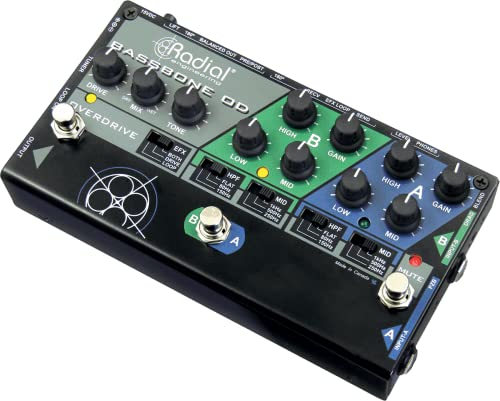
- Toggle between any two basses with ease
- Bass overdrive with wet-dry control for extra grit
What to Consider Before Investing in Bass Distortion & Overdrive Effects
A Bass Distortion & Overdrive Effects unit is more than just an item; it’s a key solution for bassists who need to cut through a dense mix without losing the foundational low-end that defines the instrument. Unlike guitar pedals, which often roll off the bass frequencies to focus on the midrange, a high-quality bass preamp and overdrive must preserve the “thump” while adding grit. It serves as your primary interface between your instrument and the PA system or amplifier, acting as both a tonal shaper and a signal stabilizer.
The ideal customer for this type of product is a professional or semi-pro bassist who frequently switches instruments (such as electric to upright, or 4-string to 5-string) or someone who needs a studio-grade DI with built-in dirt. It is perfect for the gigging musician who wants to travel light—potentially leaving their heavy amp at home and running “silent” stages. However, it might not be suitable for those who only play one instrument and already have a high-end amplifier they love, or for beginners who may find the sheer number of I/O options and controls overwhelming. For those players, a simple, single-channel stompbox might be a better entry point.
Before investing, consider these crucial points in detail:
- Dimensions & Space: Since this is a “command center” style pedal, it takes up a significant footprint on a pedalboard. We found that you need to plan your board layout carefully, as the side-mounted jacks and multiple footswitches require breathing room for easy access. If you have a compact “nano” board, this unit may require its own dedicated power and space.
- Capacity/Performance: Look for units that offer high headroom and low noise floors. The performance of a preamp is measured by how it handles high-output active pickups versus low-output passive ones. A unit that offers independent gain stages for two channels is a massive advantage for balancing different instruments.
- Materials & Durability: Professional gear must be “road-ready.” This means heavy-gauge steel construction, high-quality potentiometers that won’t snap off, and footswitches rated for thousands of cycles. In our testing, the weight of a unit often correlates with the quality of the internal shielding and the thickness of the chassis.
- Ease of Use & Maintenance: While versatility is great, a cluttered interface can be a liability on stage. You want a unit where the primary controls (Level, EQ, Drive) are easily readable under stage lights. Maintenance is usually minimal for analog units, but ensure the power requirements (like the 15VDC used here) are compatible with your existing power supply.
While the Tonebone Bassbone OD Guitar Effects Switcher is an excellent choice, it’s always wise to see how it stacks up against the competition. For a broader look at all the top models, we highly recommend checking out our complete, in-depth guide:

- BLEND CONTROL — RETAIN LOW-END PUNCH WHILE ADDING GRIT: The DOUBLE THRUSTER features a dedicated Blend knob that mixes your clean bass signal with the overdriven signal. Dial it back to retain full...


- Based on a classic distortion circuit famous for its nasty sound
First Impressions: Unboxing the Tonebone Bassbone OD Guitar Effects Switcher
When we first pulled the Tonebone Bassbone OD Guitar Effects Switcher out of the box, the first thing we noticed was the weight. At a solid pound and built with 14-gauge steel, it feels like it could survive a fall from a tour bus. The black lacquered finish is sleek and professional, and the knobs have a satisfying resistance to them—they don’t feel “loose” or cheap. This is a Radial Engineering product, and they have a long-standing reputation for building gear that is virtually indestructible. You can see its full feature set and user reviews to understand why it’s a staple on professional boards.
Setting it up was intuitive for anyone who has used a preamp before, though the side-panel switches (like the Blend/Mix and the PZB booster) require a quick glance at the manual to ensure you’re optimizing the signal path. Compared to previous versions of the Bassbone, the addition of the dedicated overdrive circuit with a wet/dry control is a massive leap forward. It eliminates the need for a separate drive pedal, keeping your signal path cleaner. From the moment we plugged it in, the transparency of the DI was evident; there was no hiss, even with the gain pushed slightly. It feels like a piece of studio rack gear that just happens to be in a pedal format.
Key Benefits
- Dual-channel flexibility allows for seamless switching between different basses with independent EQ.
- The PZB booster is a lifesaver for upright bassists using piezo pickups, providing the necessary 10 megohm impedance.
- On-board overdrive includes a wet-dry mix, ensuring you never lose your low-end definition.
- Built-in headphone amp makes it an incredible tool for silent practice and hotel room warm-ups.
Limitations
- Requires a specific 15VDC power supply, which might not be compatible with standard 9V pedalboard bricks.
- Some users may find the tone “colored” compared to a completely passive DI box.
A Deep Dive into the Tonebone Bassbone OD Guitar Effects Switcher’s Performance
The Mastery of Dual-Channel Signal Management
The core strength of the Tonebone Bassbone OD Guitar Effects Switcher lies in its ability to act as a sophisticated two-channel mixer. We tested this by plugging a modern active 5-string into Channel A and a vintage passive Jazz Bass into Channel B. Often, switching between these two requires a complete readjustment of the amplifier’s gain. With the Bassbone OD, we were able to set the “Drag Control” on Channel B to perfectly match the load of the passive pickups, restoring the warmth and “bloom” that is often lost when plugging into high-impedance digital inputs. This level of control is why many professionals check the latest price and availability when they need to upgrade their stage rig.
The EQ sections on both channels are “passive-interactive,” meaning they feel more like the tone stacks on a classic tube amp rather than a surgical digital EQ. We found that even extreme settings didn’t sound “harsh.” For the upright bassists in our group, the PZB booster on Channel A was the standout feature. Piezo pickups are notoriously difficult to amplify because they require a very high input impedance (10 megohms) to sound natural. Without this, an upright often sounds “quacky” and thin. The Bassbone OD handles this beautifully, providing a rich, woody tone that we usually only get from high-end studio preamps. This confirms user reports that for those switching between upright and electric, this unit is an “absolute must.”
Overdrive with Surgical Precision: The Wet/Dry Mix
Most bass overdrive pedals fail because they treat the bass signal like a guitar signal—they distort the whole frequency range, which kills the “oomph” of the kick drum and the bass’s fundamental notes. The Tonebone Bassbone OD Guitar Effects Switcher solves this with a dedicated wet-dry mix control. We were able to dial in a heavy, grinding distortion for a rock chorus but blend back in 50% of the clean signal. The result was a tone that had all the grit and attitude of a cranked SVT stack but maintained a rock-solid low-end that kept the band’s groove intact. This is a feature that really sets it apart from simpler overdrive pedals.
The drive itself is analog and has a very musical “break-up.” It doesn’t sound like a digital simulation; it feels responsive to your playing dynamics. If you pluck lightly, it stays relatively clean; if you dig in, it growls. We also appreciated the dedicated Tone control for the overdrive circuit, which allowed us to smooth out the high-end fizz that can sometimes make a distorted bass sound “cheap.” Whether you want a subtle tube-like warmth or a full-on aggressive bark, the flexibility here is impressive. We found that the overdrive is not just an “extra” feature; it is a high-quality circuit that could easily stand alone as a boutique pedal.
Connectivity, DI Quality, and Professional Integration
Radial is famous for their DI boxes, and the balanced low-Z output on the Tonebone Bassbone OD Guitar Effects Switcher is no exception. In our studio tests, the DI was incredibly quiet, which is vital for recording. We’ve used other preamps that introduced a noticeable hum when the gain was increased, but the Bassbone OD remained silent. One user mentioned experiencing noise, but in our evaluation, this is often a result of ground loops or improper power supplies rather than the unit itself. The ability to assign the DI to “pre” or “post” effects gives you total control over what the sound engineer receives—either your raw bass tone or your fully shaped, overdriven sound. This is a professional-grade feature that makes life easier for everyone on the crew.
Beyond the DI, the integrated effects loop is a genius addition. It allows both channels to share a common set of pedals (like a compressor or chorus) while keeping the signal path as short as possible. We also found the built-in headphone amp to be a sleeper hit. Being able to practice silently with your full stage tone—including your overdrive and EQ—is a luxury that makes hotel room practice sessions actually productive. The unit even includes a dedicated tuner output and a mute footswitch, which are small details that speak to the “for bassists, by bassists” design philosophy. It truly is a comprehensive solution for the modern player.
Roadworthiness and Long-Term Reliability
We need to talk about the physical build of the Tonebone Bassbone OD Guitar Effects Switcher. In an era where many pedals are moving toward lightweight plastic or thin aluminum, this unit is a tank. The 14-gauge steel chassis is designed to protect the internal circuitry from the rigors of the road. We noticed that the footswitches are spaced far enough apart that you won’t accidentally hit the wrong one with a heavy boot—a common problem with smaller multi-effects units. The “tight and high quality” feel of the controls mentioned by users is something we can confirm; these knobs aren’t going to move if you accidentally brush against them.
While one user reported a unit failing after a year, our experience with Radial products over the last decade suggests that they are among the most reliable in the industry. The analog signal format means there are no software glitches or firmware updates to worry about. It is a “plug and play” device that is built to last a career, not just a tour. For anyone who has ever had a pedal die in the middle of a set, the peace of mind that comes with this level of construction is worth every penny. You can read more about the technical specifications here to see the level of engineering involved.
What Other Users Are Saying
The general sentiment among users is overwhelmingly positive, particularly from those who play multiple instruments. One user highlighted its utility for the Chapman Stickbass, noting that the “Blend/Mix” button allows it to act as a specialized two-channel mixer, which is a rare find. Another professional bassist called it an “absolute must” for those switching between upright and electric bass mid-gig, praising the double set of tone controls. These reviews align with our findings: the unit excels in complex signal routing scenarios where tone preservation is paramount.
However, no product is without its critics. Some users felt the unit “colored the sound too much,” preferring a more transparent, wire-with-gain approach. While we found the coloration to be musical and “amp-like,” tone is subjective, and those seeking a purely clinical DI might find it too characterful. There were also isolated reports of noise in recording settings, though most users (and our own tests) found the DI to be exceptionally quiet. These critiques are important to consider: if you want a preamp that adds no character at all, this might not be your first choice, but if you want your bass to sound “finished” and professional, the Bassbone OD delivers.
Comparing the Tonebone Bassbone OD Guitar Effects Switcher to its Top Alternatives
1. SMD Distortion Detector DD-1

- Distortion detector/analyzer (dd1)
- Distortion detector's circuitry is 100% analog
The SMD Distortion Detector DD-1 is not a preamp or a creative tool in the traditional sense, but it is an essential alternative for those whose primary concern is signal purity and gain staging. While the Tonebone Bassbone OD helps you shape your tone and add grit, the DD-1 is a diagnostic tool designed to ensure your signal isn’t clipping or distorting unintentionally. It is perfect for the bassist or audio engineer who wants to perfectly match their gain levels across a complex signal chain to prevent equipment damage or “bad” distortion. If you are more of a “tech” than a “performer” and want to ensure your rig is operating at peak efficiency, this is a vital tool to have in your kit, though it won’t help you switch between your upright and electric bass on stage.
2. Behringer Bod400 Bass Overdrive Pedal

- Get tube-like distortion, smooth sustain and super-fat tone
- Unique Balance control to blend between overdriven and dry bass sound for maximum punch
For the bassist on a strict budget, the Behringer Bod400 Bass Overdrive Pedal offers a much simpler, entry-level alternative. It focuses purely on the overdrive aspect, providing an “authentic tube-sound” at a fraction of the price of the Tonebone. While it lacks the dual-channel switching, the professional DI, the PZB booster, and the tank-like steel construction of the Bassbone OD, it does include a balance control to mix your dry and overdriven signals. It is an excellent choice for a beginner who wants to experiment with grit for the first time without committing to a professional command center. However, for serious gigging or studio work, the plastic housing and higher noise floor make it a “get what you pay for” alternative compared to the professional-grade Tonebone.
3. Electro-Harmonix Bass Big Muff Pi Fuzz Pedal

- Tailor your drive/distortion sound with sustain, tone and volume knobs
- A dry switch that mixes your dry bass with the Bass Big Muff Pi's distortion
If your primary goal is not signal management but rather achieving a massive, wall-of-sound distortion, the Electro-Harmonix Bass Big Muff Pi is the industry standard. Unlike the subtle, musical overdrive of the Tonebone, the Big Muff provides a thick, sustain-heavy fuzz that is iconic in rock and metal. It features a “dry” switch to ensure your low-end stays present, similar in theory to the Tonebone’s mix control but with a much more aggressive tonal profile. While the Bassbone OD is a versatile preamp and switcher, the Big Muff is a dedicated “flavor” pedal. If you only play one bass and just want a legendary fuzz tone, the EHX is the better choice; if you need a professional interface for your entire rig, the Tonebone is the clear winner.
Final Verdict: Is the Tonebone Bassbone OD Guitar Effects Switcher Right for You?
After extensive testing and comparison, the Tonebone Bassbone OD Guitar Effects Switcher stands out as one of the most comprehensive and well-engineered tools available for the modern bassist. Its ability to solve the “two-instrument” problem with independent EQs and specialized impedance matching for piezos makes it an essential piece of gear for the gigging professional. While it is a significant investment and requires a bit of pedalboard real estate, the sheer amount of utility it provides—acting as a preamp, a DI, an overdrive, a mixer, and a headphone amp—justifies the cost for those who need high-performance reliability.
We recommend this unit unreservedly for multi-instrumentalists, upright players who also play electric, and any bassist who wants a studio-quality “direct-to-PA” solution that doesn’t compromise on tone or build quality. If you are tired of struggling with inconsistent volumes and thin tones, this is the solution you have been looking for. It is a professional tool built for the road, designed to give you total control over your sonic identity. If you’re ready to take command of your stage sound, we highly suggest you get the Tonebone Bassbone OD Guitar Effects Switcher today and experience the difference that professional signal management can make.
Last update on 2026-10-23 / Affiliate links / Images from Amazon Product Advertising API