
MXR Bass Fuzz Deluxe Review: The Ultimate Solution for Cutting Low-End Fuzz
Every bass player who has ever stepped on a traditional fuzz pedal knows the sudden feeling of disappointment that usually follows. You stomp the switch expecting a massive wall of thunderous sound, but instead, your low-end fundamental frequencies completely collapse. Your punchy, room-shaking tone instantly disappears behind a cloud of fizzy mid-range noise, leaving the mix thin and washing out your band’s low end. For years, we struggled with this exact dilemma during live gigs and recording sessions, forcing us to constantly compromise between gritty aggressive drive and foundational bass presence.
The core of this issue stems from traditional fuzz circuits designed primarily for electric guitars, which roll off deep sub-bass frequencies to prevent clipping. When you run a four- or five-string bass guitar through these vintage designs, the pitch definition vanishes, making fast passages or complex chordal work sound like an unarticulated mud bath. To solve this problem without resorting to bi-amping setups—which require carrying two separate amplifiers and complex routing splitters—we turned our attention to a dedicated bass solution. When you see its full feature set and user reviews, it becomes clear why the MXR Bass Fuzz Deluxe was specifically engineered to eradicate this tone-sucking problem once and for all.

What to Consider Before Buying a Bass Distortion & Overdrive Effects Pedal
A Bass Distortion & Overdrive Effects pedal is more than just an item on your pedalboard; it’s a key solution for establishing your instrument’s identity in a high-energy mix while providing essential tonal flexibility across different musical genres. Adding dirt to a bass guitar requires a delicate balance between harmonic saturation and fundamental low-frequency retention. If a pedal lacks the proper architecture to preserve lower octaves, your bass will lose its impact the moment the rest of the band kicks in.
The ideal customer for this type of pedal is a bassist performing in rock, metal, funk, or experimental genres who needs cutting distortion without sacrificing the foundational weight of their instrument. It is especially suited for players who want the sonic impression of a bi-amped rig—combining a clean, punchy amplifier with a roaring, heavily distorted secondary amp—contained within a single compact stompbox. Conversely, this pedal might not be ideal for purists seeking strictly ultra-clean jazz tones or players who prefer soft, tube-like low-gain transparent overdrive without any aggressive fuzz texture. Those seeking purely vintage tube saturation without fuzz might look toward traditional preamp pedals or warm optical compressors instead.
Before investing, consider these crucial points in detail:
- Dimensions & Space: Consider the overall footprint on your pedalboard. A compact standard MXR-style chassis saves critical real estate compared to massive vintage units, allowing you to easily fit power supplies, tuners, and modulation pedals on a modest board without requiring an upgrade to a larger rig setup.
- Capacity/Performance: Look closely at how the pedal handles input gain, pitch definition, and high-output active pickups. High-performing bass dirt boxes maintain tight transient response and note clarity even when pushed into extreme saturation, ensuring that complex bass lines remain completely legible.
- Materials & Durability: Bass equipment takes a beating on stage. Heavy-duty aluminum housing, rugged stomp switches, and firm potentiometer shafts are essential components that guarantee your stompbox will withstand years of rigorous touring and aggressive foot pressure during live performances.
- Ease of Use & Maintenance: The control layout should be intuitive enough for quick on-stage adjustments under dim lighting. Independent, simple knobs for wet and dry signals give you instantaneous control over your mix without forcing you to wade through confusing digital sub-menus or complex multi-button combinations.
Evaluating these factors will ensure that your chosen pedal seamlessly integrates into your existing rig while delivering dependable performance night after night. By understanding how gain staging affects your overall frequency spectrum, you can make an educated choice that elevates your low-end presence.
While the MXR Bass Fuzz Deluxe is an excellent choice for players seeking massive grit with clean punch, it is always wise to see how it stacks up against the competition. For a broader look at all the top models on the market today, we highly recommend checking out our complete, in-depth guide:

- BLEND CONTROL — RETAIN LOW-END PUNCH WHILE ADDING GRIT: The DOUBLE THRUSTER features a dedicated Blend knob that mixes your clean bass signal with the overdriven signal. Dial it back to retain full...


- Based on a classic distortion circuit famous for its nasty sound
First Impressions and Key Features of the MXR Bass Fuzz Deluxe
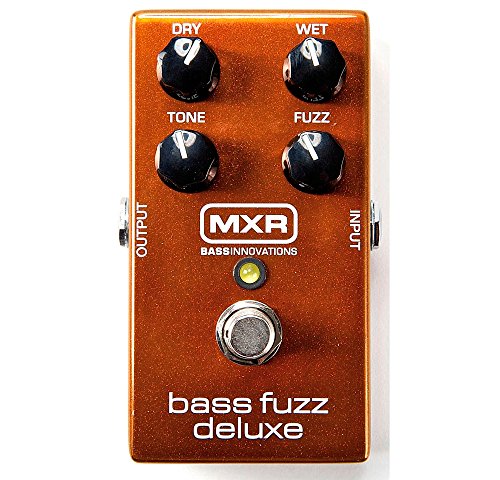
Straight out of the packaging, the MXR Bass Fuzz Deluxe exudes the classic, rock-solid reliability that the Dunlop/MXR Bass Innovations line is famous for. Housed in a compact, durable die-cast aluminum enclosure finished in a eye-catching metallic dark flake paint, it immediately feels like a professional-grade tool. The four control knobs—Dry, Wet, Tone, and Fuzz—are firm with smooth rotational resistance, preventing accidental bumps on stage while offering precise adjustments. The bright red LED status light ensures clear visibility on dark stages, and the heavy-duty mechanical foot switch engages with a satisfying tactile click.
In our initial bench testing, what immediately stood out was how MXR engineered this pedal’s architecture. Rather than relying on a basic single blend knob—which forces a direct trade-off between clean tone and fuzz level—this unit features separate Dry and Wet volume controls. This architectural choice mimics running a parallel dual-amplifier rig. Before diving deeper into our extensive sonic testing, you can check the latest price and availability to see how accessible this pedal is for your board setup.
Key Benefits
- Independent Dry and Wet controls allow complete, uncompromising low-end blend customization.
- Modified vintage fuzz circuit retains excellent pitch definition across all strings.
- Tone and Fuzz controls affect only the wet signal, keeping clean low frequencies intact.
- True hardwire bypass ensures absolute signal purity when the effect is disengaged.
Drawbacks
- High fuzz levels can introduce a subtle operational noise or background hum.
- Lacks an internal noise gate or master overall volume control knob.
Deep Dive: Performance & In-Depth Feature Analysis of the MXR Bass Fuzz Deluxe
Dual Wet and Dry Level Controls: The Secret to Low-End Preservation
The single most impressive feature we discovered during our testing of the MXR Bass Fuzz Deluxe is its dual-level control system. Traditional fuzz boxes often use a single “Mix” or “Blend” knob. The problem with a single blend control is that as you turn up the fuzz, you automatically lower your clean signal, forcing you into a constant compromise between wet saturation and clean punch. MXR bypassed this limitation by giving the player two totally independent volume pots: one for the unbuffered Dry signal and one for the heavily distorted Wet signal.
In practice, this functional design operates like a dual-channel mixing console. We were able to crank the Dry control to unity gain (or slightly boosted) to maintain every ounce of our bass guitar’s natural low-end fundamental, attack, and cabinet thump. From there, we slowly dialed in the Wet control until the fuzzy harmonics sat perfectly on top of the clean sound. Whether we wanted just a subtle hint of hair around the edges of a classic rock groove or a raging wall of synth-like fuzz for heavy riffs, the clean low end remained 100% solid underneath. This setup ensures that your bass never gets buried in a loud band setting, making it a feature that really sets it apart from standard distortion stompboxes on the market today.
Modified Vintage Fuzz Circuit and Tone Shaping Capabilities
At the heart of the MXR Bass Fuzz Deluxe lies a modified vintage fuzz circuit, inspired by rare, highly sought-after vintage fuzz pedals from the 1970s, but retuned specifically for bass frequencies. Standard guitar fuzzes chop off extreme low-end frequencies, creating a thin, raspy buzzy effect. The M84 circuit, however, broadens the frequency window, allowing sub-harmonics to pass through smoothly before clipping the upper midrange and treble spectrum.
The Fuzz knob controls the amount of drive applied strictly to the wet signal path. At lower settings (around 9 o’clock to 11 o’clock), the pedal produces a warm, muscular breakup that responds beautifully to touch dynamics. When turned past 1 o’clock, the pedal transforms into a raging, thick, aggressive beast capable of producing modern industrial metal textures and classic heavy rock tones. Meanwhile, the dedicated Tone knob operates exclusively on the wet fuzz signal. Turning the Tone knob counterclockwise cuts high-frequency sizzle for a smooth, woolly, vintage muff-style roar, while rolling it clockwise boosts high-end bite, allowing slap techniques, fingerstyle attacks, and fast picking to slice through dense guitar mixes with laser-like precision.
Dynamic Response, Pitch Definition, and Rig Integration
One common headache with aggressive fuzz pedals is the loss of note articulation. When playing fast scalar runs, complex jazz-fusion chords, or low B-string passages on a 5-string bass, many pedals smudge the notes into an unrecognizable wash. During our evaluation using both passive Fender Jazz Basses and high-output active 5-string basses, the MXR Bass Fuzz Deluxe maintained exceptional pitch definition across every register. Notes on the low B string retained their distinct harmonic center without warbling or breaking down into muddy static.
Furthermore, the pedal behaves dynamically with your instrument’s volume knob and pickup selection. Rolling back the volume on an active bass subtly cleans up the wet drive while leaving the dry path punchy and articulate. We also tested this stompbox in tandem with other effects on our pedalboard. Placed right after an octave pedal, the MXR Bass Fuzz Deluxe produced massive synth-bass textures that tracked flawlessly. Placed before a filter pedal, the rich harmonic content generated by the fuzz gave the envelope filter incredible bite and sweep depth. For players who utilize advanced playing techniques like two-handed tapping or thumb-slapping, the clean dry signal preserves the transient snap while the fuzz layer adds sustain and sizzle, making it an indispensable tool for technical performers.
Build Quality, True Bypass Hardware, and Power Setup
A pedal can sound phenomenal, but if it cannot withstand the physical demands of constant gigging, it quickly becomes a liability. The MXR Bass Fuzz Deluxe is built like a tank. Its heavy-duty aluminum housing feels indestructible, and the internal components are meticulously laid out on a military-grade circuit board. The pedal features True Hardwire Bypass switching, meaning that when the pedal is turned off, your clean bass signal flows directly from input to output jack without passing through any active circuitry, ensuring zero tone degradation or high-frequency loss when idle.
Powering the unit is flexible; it accepts a standard 9-volt AC adapter or a 9V battery accessible via a bottom plate. During continuous testing, we found that utilizing a regulated power supply provided maximum headroom and reduced operational floor noise. While some users note a slight background hum when the Fuzz control is cranked to maximum levels—a common characteristic of high-gain analog fuzz circuits—keeping your gain staging balanced via the separate Dry and Wet knobs mitigates this issue effectively. To explore its technical specifications further, you can read more about its construction details and user reviews online.
What Other Users Are Saying
Bassists across the musical spectrum widely praise the MXR Bass Fuzz Deluxe for solving the age-old problem of low-end loss. Many players who previously relied on popular alternatives like the Bass Big Muff or vintage Fuzz Face units frequently note that this MXR model became their definitive choice. Users consistently highlight the independent Dry and Wet controls as a total “stroke of genius,” allowing them to quickly dial in their ideal tone without wrestling with complex parameter menus.
Rock and metal performers frequently commend the pedal’s pitch definition and low-bass punch, noting that even when running through massive stack setups, the low end cuts cleanly through dense drum and wall-of-guitar mixes. Some users who utilize active pickups report that the clean blend adds much-needed sensitivity and clarity to their amplifier’s front end. On the flip side, a few reviewers pointed out minor drawbacks, such as a noticeable high-gain hum when both the Fuzz and Tone knobs are pushed to extreme limits, and the lack of an overall master volume knob. However, the overwhelming majority agree that its massive versatility, rugged durability, and pristine low-end preservation make it a top-tier addition to any pedalboard.
MXR Bass Fuzz Deluxe vs. Top Alternatives
1. SMD DD-1 Distortion Detector

- Distortion detector/analyzer (dd1)
- Distortion detector's circuitry is 100% analog
While the SMD DD-1 Distortion Detector appears in sound gear searches, it serves a completely different purpose than the MXR Bass Fuzz Deluxe. The SMD DD-1 is an electronic diagnostic tool designed for car audio installers and sound engineers to detect signal clipping and distortion in amplifier gains. It is not an artistic tone-shaping effect pedal for bass guitar. If you are an audio technician looking to calibrate clean gain structure without damaging speakers, the DD-1 is an industry standard. However, if you are a bassist searching for aggressive, creative fuzz textures for your instrument, the MXR Bass Fuzz Deluxe is the actual effect stompbox you need.
2. Behringer Bod400 Bass Overdrive Effects Pedal

- Get tube-like distortion, smooth sustain and super-fat tone
- Unique Balance control to blend between overdriven and dry bass sound for maximum punch
The Behringer BOD400 Bass Overdrive is an ultra-budget alternative designed for beginners or players operating on a tight budget. It offers a soft tube-like overdrive with a basic balance knob to blend clean and driven signals. While it provides decent warm drive tones for casual practice, its plastic housing lacks the heavy-duty stage durability of MXR’s die-cast aluminum casing. Furthermore, the BOD400 provides smooth overdrive rather than the thick, saturated, harmonic fuzz generated by the modified vintage circuit of the MXR Bass Fuzz Deluxe. Serious touring bassists will prefer the superior build quality, true bypass routing, and rich fuzz voicing of the MXR.
3. Electro-Harmonix Bass Big Muff Pi Fuzz Pedal

- Tailor your drive/distortion sound with sustain, tone and volume knobs
- A dry switch that mixes your dry bass with the Bass Big Muff Pi's distortion
The Electro-Harmonix Bass Big Muff Pi is arguably the most famous competitor to the MXR Bass Fuzz Deluxe. The Big Muff delivers that classic, smooth, scooped, mid-heavy fuzz sound that defined decades of rock music. It features a basic switch to drop in clean signal, whereas the MXR provides independent control knobs for both Wet and Dry channels. We found that while the Big Muff offers that unmistakable legendary vintage tone, the MXR Bass Fuzz Deluxe offers far greater flexibility for modern players, allowing precise balance of fundamental clean punch with high-end fuzz bite. Players wanting total mixing freedom will lean strongly toward the MXR.
Final Verdict on the MXR Bass Fuzz Deluxe
After rigorous testing, the MXR Bass Fuzz Deluxe has proven itself to be one of the most practical, powerful, and versatile bass fuzz pedals available today. By addressing the fundamental flaw of traditional fuzz boxes—the loss of low-end frequencies—MXR created a stompbox that delivers massive harmonic saturation without sacrificing the clarity, weight, and punch of your original bass tone. The dual Dry and Wet control architecture is an absolute game-changer, giving you complete artistic freedom to dial in subtle warm overdrive, classic rock crunch, or aggressive synth-like fuzz walls.
While high-gain settings can introduce a minor amount of analog circuit noise, the exceptional build quality, intuitive four-knob layout, true hardwire bypass, and incredible pitch definition far outweigh any minor limitations. Whether you are gigging in small clubs, tracking in professional recording studios, or playing on massive festival stages, this pedal guarantees your bass lines remain authoritative and articulate. If you are ready to elevate your tone and eliminate thin, washed-out fuzz forever, we strongly recommend that you order your own MXR Bass Fuzz Deluxe today and experience modern low-end power firsthand.
Last update on 2026-10-23 / Affiliate links / Images from Amazon Product Advertising API