
Behringer Bod400 Bass Overdrive Effects Pedal Review: Is This Budget Stompbox Worth a Spot on Your Pedalboard?
Every bassist knows the ultimate frustration of tone hunting: you stomp on an overdrive pedal expecting a rich, aggressive roar, only to hear your low-end fundamental frequencies completely disappear from the mix. Suddenly, your deep bass presence transforms into a thin, buzzy fizzle, leaving the entire band’s sound hollow. Finding a pedal that delivers authentic, tube-style breakup while preserving the thunderous low-end punch of a bass guitar is a challenge—especially if you are working within a strict budget. High-end bass preamp and drive units can easily cost hundreds of dollars, making experiment-driven tone shaping an expensive luxury. When we set out to test affordable drive units, the Behringer Bod400 Bass Overdrive Effects Pedal immediately stood out as a candidate to solve this classic dilemma without destroying your gear budget.

- Get tube-like distortion, smooth sustain and super-fat tone
- Unique Balance control to blend between overdriven and dry bass sound for maximum punch
What to Consider Before Buying a Bass Distortion & Overdrive Effect
A Bass Distortion & Overdrive Effect is more than just a sound warmer; it’s a key solution for defining your tone in a dense live mix or studio recording. Unlike standard electric guitar overdrive pedals, which frequently cut off sub-200Hz frequencies to prevent muddy chords, bass-specific overdrive units must carefully preserve or blend the untouched low frequencies alongside harmonic saturation. Without proper signal routing or active equalizers tuned for bass instruments, an overdrive unit can destroy the solid foundation that holds an entire rhythm section together.
The ideal customer for this type of product is someone facing mix mud or looking to add punch, aggressive bite, or subtle tube warmth without breaking the bank, while it might not be suitable for those who demand heavy metal-grade aluminum enclosures for heavy touring or pristine, transparent true-bypass switching. Beginner bassists, home recording enthusiasts, and budget-conscious gigging musicians will find exceptional value in an accessible drive pedal, whereas international touring professionals who stomp heavily on stage every single night might prefer all-metal chassis options.
Before investing, consider these crucial points in detail:
- Dimensions & Space: Consider how much physical space the pedal takes up on your pedalboard. Standard compact footprints (around 2.7 inches wide by 4.8 inches long) allow you to easily integrate the pedal into existing pedalboard setups or keep it neatly in a gig bag pocket without taking up crucial space.
- Capacity/Performance: Look closely at signal blending features. Having a dedicated dry/wet balance control is critical for bass guitarists because it allows you to mix your raw, punchy bass signal directly behind the overdriven tone, preserving fundamental low frequencies regardless of how aggressive the distortion setting is.
- Materials & Durability: Evaluate the outer housing materials. Lightweight plastic enclosures keep costs low and weight minimal for home or bedroom setups, whereas cast-metal chassis offer greater durability against extreme physical impact on stage.
- Ease of Use & Maintenance: Pay attention to power requirements and battery accessibility. A versatile pedal should accept both standard 9V DC power adapters and 9V internal batteries, with controls that are clearly labeled and responsive to fine adjustments.
By balancing these considerations against your personal playing style and venue demands, you can choose a pedal that enhances your musical expression without introducing unwanted headaches down the line.
While the Behringer Bod400 Bass Overdrive Effects Pedal is an excellent choice, it’s always wise to see how it stacks up against the competition. For a broader look at all the top models, we highly recommend checking out our complete, in-depth guide:

- BLEND CONTROL — RETAIN LOW-END PUNCH WHILE ADDING GRIT: The DOUBLE THRUSTER features a dedicated Blend knob that mixes your clean bass signal with the overdriven signal. Dial it back to retain full...


- Based on a classic distortion circuit famous for its nasty sound
First Impressions and Key Features of the Behringer Bod400 Bass Overdrive Effects Pedal
Unboxing the Behringer Bod400 Bass Overdrive Effects Pedal reveals a vibrant purple unit that immediately signals its focus on low-end frequencies. Upon first inspection, the lightweight design is noticeable—weighing in at just under 15 ounces due to its high-impact plastic housing. While it lacks the sheer heft of classic cast-iron stompboxes, the finish is neat, and the control knobs offer a surprisingly firm, tactile resistance when turned. Setting it up on our test bench took only a couple of minutes, plugging into a standard 9V DC power supply and patching between a classic passive Precision Bass and a solid-state combo amplifier. You can check the latest price and availability to see how accessible this unit is for your setup.
The control panel features four concentric and dual-function knobs: Level, High and Low EQ, Gain, and a all-important Balance control. A bright blue status LED clearly indicates when the effect is engaged and doubles as a visual check for battery power. Right out of the box, the control layout feels intuitive, allowing us to immediately start tweaking settings without endlessly studying a complex manual.
Key Benefits
- Dedicated Balance knob allows effortless blending of clean signal with overdriven saturation.
- Active 2-band EQ (Bass and Treble) provides powerful tone shaping for rich bottom end.
- Incredibly low noise floor with minimal unwanted background static or hiss.
- Remarkable affordability makes it accessible for bassists of all budget levels.
Drawbacks
- High-impact plastic housing requires more care during heavy stage footwork.
- Accessing the internal 9V battery compartment requires depressing spring-loaded hinge pins.
In-Depth Performance Testing: Putting the Behringer Bod400 Bass Overdrive Effects Pedal Through Its Paces
1. Tone Shaping and Low-End Retention: The Power of the Balance Control
When evaluating any overdrive intended for bass, our primary focus is always frequency retention. We spent considerable time testing the Behringer Bod400 Bass Overdrive Effects Pedal across various playing styles, from light fingerpicking to aggressive pick attack, and the standout feature is undeniably its Balance control. In practice, this knob acts as a clean blend dial. When turned fully counter-clockwise, you hear your unadulterated clean bass tone; when turned fully clockwise, you hear only the overdriven wet signal.
We found that setting the Balance control right around 12 o’clock to 2 o’clock yields the sweet spot for modern rock and funk. At this position, the original punch, low-end thump, and clarity of the instrument remain completely intact because the dry signal passes through uncompressed, while the dirty signal sits on top to add edge, harmonics, and bite. If you want to dive deeper into its capabilities, you can see its full feature set and user reviews online. The onboard 2-band EQ further enhances this balance; boosting the Bass knob at roughly 100 Hz adds a massive sub-harmonic warmth that ensures your low-end fundamental never gets lost in a dense band mix.
2. Overdrive Character: From Tube Breakup to High-Gain Aggression
The sonic character of the Behringer Bod400 Bass Overdrive Effects Pedal spans a surprisingly wide tonal spectrum. Designed to emulate tube-style drive, it performs remarkably well when dialed in for subtle, vintage-style edge-of-breakup tones. With the Gain control set low (around 9 o’clock) and the Level pushed slightly above unity gain, the pedal adds a pleasant analog warmth, mild compression, and harmonic saturation that makes a solid-state amplifier sound remarkably like a pushing valve head.
However, as you roll the Gain knob past 12 o’clock, the pedal transforms from a smooth overdrive into a aggressive, high-gain drive that leans heavily into heavy distortion or subtle fuzz territory. The tone develops a raspy, growling upper-midrange bite that excels for aggressive rock, punk, or metal genres. Even with higher gain settings, the active Treble control allows you to tame harsh top-end sizzle or boost it for extra clarity when slicing through heavy guitar riffs. For players looking to add versatile drive textures to their rig, this pedal provides a flexible platform. Feel free to a feature that really sets it apart during live performances and recording sessions alike.
3. Signal Path Integrity and Noise Level Performance
Budget gain pedals often suffer from annoying background hum, static noise, or high-pitched hiss as soon as you engage the foot switch. Throughout our rigorous testing sessions with the Behringer Bod400 Bass Overdrive Effects Pedal, we were genuinely impressed by its signal-to-noise ratio. Using clean 9V DC isolated power, the pedal remained remarkably quiet, even with the Gain and Treble controls pushed high. It adds minimal background white noise compared to many far more expensive analog distortion pedals on the market.
The pedal utilizes high-quality analog signal processing, maintaining an authentic dynamic response. While it does not feature true-bypass switching—opting instead for Behringer’s standard buffered electronic switch—we observed no noticeable tone suck or high-end degradation when the pedal was turned off in our signal chain. Your clean bass tone passes through cleanly without lost brilliance or dulled attack, making it a reliable addition to a multi-pedal setup. You can explore the Behringer Bod400 Bass Overdrive Effects Pedal details to see how it integrates with clean buffers.
4. Build Quality, Battery Access, and Stage Practicality
Addressing the build quality of the Behringer Bod400 Bass Overdrive Effects Pedal requires an honest look at its construction materials. The outer casing is crafted from hard purple plastic rather than metal. In our studio and home rehearsal tests, the pedal proved completely sturdy and responsive to normal foot pressure. However, for touring musicians who kick their gear around aggressively on stage, long-term durability requires a bit of mindfulness. It is perfectly robust for home studios, church platforms, and gentle gigging, but it may not take absolute physical abuse like heavy steel boxes.
Another point to understand is the battery compartment design. Some users occasionally report confusion over installing a 9V battery because there is no traditional door on the bottom plate. To install a battery, you simply use a ballpoint pen or small screwdriver to depress the two spring-loaded hinge pins located on either side of the pedal footplate. Once pushed, the top footplate lifts off to reveal the inner battery compartment and heavy-duty spring. Once you know the trick, changing batteries takes only seconds, though most players will likely prefer using a standard 9V center-negative wall adapter for hassle-free power. To check current pricing on compatible power options, you can find power supply options and bundle deals online.
What Other Users Are Saying About the Behringer Bod400 Bass Overdrive Effects Pedal
Feedback from the broader bassist community strongly aligns with our findings during testing. The overwhelming majority of users highlight the astounding value for money that the Behringer Bod400 Bass Overdrive Effects Pedal offers. Many players frequently point out that achieving a punchy, tubey overdrive with a dedicated clean blend for such a low investment feels like a major win for budget musicians.
A recurring positive theme among user reviews is how well the pedal preserves low-end clarity. One user highlighted: “It takes my bass and adds punch with a hint of grit or a huge amount depending on the settings… you don’t lose your mids or lows like other drive pedals.” Synthesists and guitarists also praise the unit, noting that the active 2-band EQ and low-frequency handling make it a fantastic tool for analog synthesizers, drum machines, and down-tuned electric guitars needing deep bottom-end saturation.
On the criticism side, the main point of contention remains the plastic enclosure, with several users noting that while it is great for home practice, it requires careful foot action on live stages. Additionally, a few reviewers pointed out that the overdrive character leans towards high-gain rasp rather than ultra-transparent low-gain drive, meaning those seeking a subtle vintage valve warmth must keep the Gain control dialed well down. Nevertheless, users consistently praise its incredibly quiet operation, low noise floor, and sheer flexibility for its price tag.
How the Behringer Bod400 Bass Overdrive Effects Pedal Compares to Alternatives
1. SMD DD-1 Distortion Detector

- Distortion detector/analyzer (dd1)
- Distortion detector's circuitry is 100% analog
The SMD DD-1 Distortion Detector is an audio diagnostic tool designed primarily for car audio installation and system calibration to detect signal clipping, rather than an instrument effects pedal. While the Behringer Bod400 Bass Overdrive Effects Pedal is created specifically for bassists seeking rich tube-like overdrive and tonal shaping on stage, the SMD DD-1 serves a technical utility purpose for measuring clean output limits without distortion. Musicians looking for creative tone generation and overdrive grit should stick with the BOD400, while sound engineers setting up distortion-free audio systems will prefer the diagnostic capabilities of the SMD DD-1.
2. Electro-Harmonix Bass Big Muff Pi Fuzz Pedal

- Tailor your drive/distortion sound with sustain, tone and volume knobs
- A dry switch that mixes your dry bass with the Bass Big Muff Pi's distortion
The Electro-Harmonix Bass Big Muff Pi Fuzz Pedal is a legendary stompbox housed in a rugged, cast-metal chassis designed for thick, creamy fuzz and heavy distortion. Compared to the Behringer Bod400 Bass Overdrive Effects Pedal, the Bass Big Muff offers a much wall-of-sound fuzz profile, making it a favorite for grunge, desert rock, and heavy metal. However, the BOD400 offers more control over subtle tube-style drive and finer tone shaping via its independent 2-band EQ and fully variable Balance blend knob. Players on a tight budget who want versatile, variable overdrive rather than massive fuzz distortion will find the BOD400 far more affordable and flexible for everyday playing styles.
3. tech21 SansAmp Bass Driver DI V2
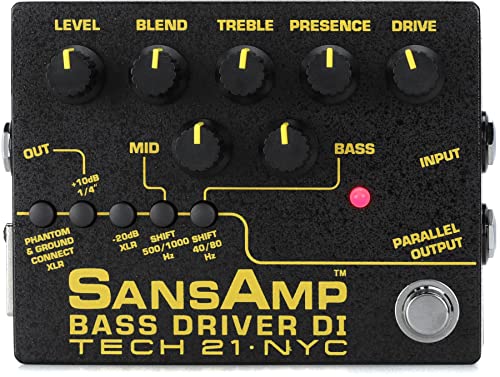
- Bass Preamp/DI Pedal with Extended Bass Control
- Selectable Midrange Frequency Control
The Tech 21 SansAmp Bass Driver DI V2 is an industry-standard direct injection box and analog preamp pedal used by touring professionals worldwide. It features a heavy-duty metal chassis, balanced XLR direct outputs for feeding directly into front-of-house PA systems, and highly refined tube-emulation circuitry. While the SansAmp offers superior build quality and direct DI functionality, it comes at a significantly higher price tag. The Behringer Bod400 Bass Overdrive Effects Pedal captures much of the core tone-shaping and drive concept—including clean signal blending and active EQ—at a tiny fraction of the cost, making it the perfect budget alternative for beginners, home studios, or as a reliable backup pedal.
Final Verdict: Is the Behringer Bod400 Bass Overdrive Effects Pedal Right for You?
In summary, the Behringer Bod400 Bass Overdrive Effects Pedal proves that you don’t need to spend a fortune to achieve punchy, growling bass distortion that respects your instrument’s low frequencies. By combining an active 2-band EQ with an essential dry/wet Balance blend control, Behringer solved the most frustrating issue common to budget overdrive units: the loss of low-end mass. Whether you want to add mild, warm valve-style compression to your clean bass tone or push your sound into aggressive high-gain distortion, this pedal delivers impressive results across the board.
While the high-impact plastic housing requires reasonable care during foot use, the low noise floor, versatile tone shaping, and incredible value make it an absolute steal for home studio recording, practice rigs, and budget pedalboards. If you are ready to elevate your bass tone and unlock versatile overdrive grit without draining your wallet, we highly recommend adding this unit to your setup today. You can click here to purchase the Behringer Bod400 Bass Overdrive Effects Pedal and take complete control of your low-end sound.
Last update on 2026-10-23 / Affiliate links / Images from Amazon Product Advertising API