
SMD DD-1 Distortion Detector Review: The Ultimate Tool for Setting Clean Audio Gain Without Guesswork
If you have ever spent hours tweaking your amplifier gain controls only to end up second-guessing what your ears were hearing, you are not alone. For years, audio enthusiasts and professional installers have wrestled with the exact same frustrating problem: how do you know, with absolute certainty, that your audio system is outputting clean, unclipped signal? Relying on your ears is notoriously unreliable—our hearing naturally adapts to distortion at high volumes, often masking clipping until voice coils overheat and subwoofers fry. On the other hand, traditional digital multimeter (DMM) methods only measure voltage without actually telling you if the waveform is clean or distorted. A single miscalibrated volume knob on your head unit can start a devastating domino effect that ruins sound quality and destroys expensive speakers down the line. We spent extensive time hands-on with the SMD DD-1 Distortion Detector to see if this compact diagnostic device can permanently end the guesswork and protect your audio investment.

- Distortion detector/analyzer (dd1)
- Distortion detector's circuitry is 100% analog
What to Consider Before Buying a Gain Calibration and Signal Diagnostic Tool
Investing in precision audio diagnostic equipment is a fundamental step toward achieving true high-fidelity sound and protecting your high-end speakers, receivers, and amplifiers. While many enthusiasts focus their budget entirely on raw power or fancy processors, improper signal gain staging is the single leading cause of audio equipment failure. A dedicated signal analyzer bridges the gap between raw power and pure sound, ensuring every component in your signal chain operates within its clean linear operating range before sending power to your drivers.
The ideal customer for the SMD DD-1 Distortion Detector is anyone serious about sound quality—from DIY car audio builders installing multi-amp systems to professional installers, home theater enthusiasts, studio engineers, and audiophiles running high-powered subwoofers. It is engineered specifically for individuals who want an objective, repeatable, and accurate method for setting gain structures without buying a cumbersome, delicate laboratory oscilloscope. However, if you are a casual listener running a low-power factory head unit connected straight to entry-level door speakers without external amplifiers or processors, or if you are looking for an active tone-shaping effect pedal rather than a diagnostic tool, this specific analyzer may offer more precise diagnostic capability than your setup strictly requires.
Before investing, consider these crucial points in detail:
- Dimensions & Space: Handheld diagnostic tools should be compact enough to fit into tight vehicle footwells, trunk setups, or behind home rack mounts. Look for a lightweight design that can easily be operated with one hand while tweaking gain potentiometers with the other.
- Capacity/Performance & Voltage Handling: Your analyzer must be capable of handling wide voltage ranges without burning out or giving false readings. A high-quality detector should accurately read everything from low-level preamp RCA outputs (around 1 Volt) to massive high-voltage amplifier speaker terminals capable of thousands of watts.
- Materials & Durability: Diagnostic tools frequently get tossed into toolboxes, dragged across trunk linings, or dropped on shop floors. Rugged circuitry, a robust outer enclosure, high-quality test leads, and long-lasting internal power management are essential for years of reliable field service.
- Ease of Use & Calibration Sensitivity: A great analyzer translates complex electrical distortion waveforms into unambiguous visual indicators. It should feature precise trigger thresholds (typically 1.0% Total Harmonic Distortion) and clear LEDs so you do not need an engineering degree to interpret the results.
Before committing to a specific tuning tool or tone-shaping gear, it is always a smart move to evaluate how different tools integrate into your overall setup sound chain. While the SMD DD-1 Distortion Detector stands out as an unmatched diagnostic tool, you might also be exploring active tone shaping, preamps, or drive pedals for your musical performance rig.
While the SMD DD-1 Distortion Detector is an excellent choice for signal analysis, it’s always wise to see how it stacks up against the competition and related audio gear. For a broader look at top-tier gear and tone-shaping solutions, we highly recommend checking out our complete, in-depth guide:
Discover Our Top Rated Picks for Bass Preamp & Distortion Tools

- BLEND CONTROL — RETAIN LOW-END PUNCH WHILE ADDING GRIT: The DOUBLE THRUSTER features a dedicated Blend knob that mixes your clean bass signal with the overdriven signal. Dial it back to retain full...


- Based on a classic distortion circuit famous for its nasty sound
First Impressions and Key Features of the SMD DD-1 Distortion Detector
Unboxing the SMD DD-1 Distortion Detector immediately reveals its purpose-built, industrial nature. Co-developed by Steve Meade Designs and D’Amore Engineering, this tool strips away non-essential clutter in favor of pure functionality. Weighing in at under 10 ounces and measuring roughly 10 by 6.25 inches, it fits comfortably in your hand. In the box, you receive the detector unit, a high-quality twist-lock test harness with heavy-duty alligator clips, a protective rubber boot, and an essential CD containing engineered test tones (1 kHz and 40 Hz at various dB recording levels).
The layout is brilliantly straightforward: a power switch, a “Signal Present” LED, a “Distortion Detected” LED, and a 1 kHz/40 Hz frequency select button. There are no complicated menus, screen calibrations, or external power cords required during active testing, as it runs cleanly on an internal 9V battery. When we connected it for the first time, the clarity of operation was refreshing—if the signal is clean, the green light shines; the instant clipping hits 1.0% harmonic distortion, the red light illuminates instantly.
Key Benefits
- 100% analog circuitry delivers instantaneous, highly accurate distortion detection (>1.0% THD).
- Massive input operating range (1.2 Vrms to 125 Vrms) handles inputs up to 15,000 Watts RMS at 1 Ohm.
- Completely removes human error and guesswork when setting head unit max volume and amplifier gain.
- Universal compatibility across car audio, home theater receivers, pro audio rigs, and active subwoofers.
Limitations
- Higher initial investment compared to a basic digital multimeter.
- Requires using specific test tone tracks (included on CD or downloadable) for accurate detection.
Deep Dive: Testing and Performance Analysis of the SMD DD-1 Distortion Detector
Eliminating Volume Guesswork: Head Unit and Source Calibration
The foundation of any great audio system is a clean source signal. If your head unit, line output converter (LOC), or digital signal processor (DSP) outputs distortion, every amplifier down the line will simply magnify that distorted signal, regardless of how low you set the amplifier gains. During our hands-on testing, we first used the SMD DD-1 Distortion Detector to find the absolute maximum unclipped volume level on an OEM head unit paired with an aftermarket processor. Before using this tool, we routinely assumed the head unit could be turned up to 90% or 95% of its maximum volume scale without issue.
By inserting the included test tone disc (or playing the uncompressed track via USB), setting all tone controls, EQs, and bass boosts to flat, and connecting the test leads of the SMD DD-1 Distortion Detector to the RCA output, we slowly increased the volume knob. At volume level 32 out of 40, the red “Distortion Detected” LED flashed instantly. This single test revealed that turning the volume past 31 induced severe signal clipping right at the source. Discovering this exact threshold immediately eliminated the “domino effect” of system distortion. Knowing your source unit’s physical limit allows you to lock in a safe operational ceiling, guaranteeing that every component downstream receives a pristine, pure sine wave. To verify these specs and take control of your audio signal, you can see its full feature set and user reviews directly.
100% Analog Precision: High-Sensitivity Harmonic Distortion Detection
What sets the SMD DD-1 Distortion Detector apart from digital multi-meters or visual smartphone apps is its custom-engineered, 100% analog circuit board designed by D’Amore Engineering. Digital multimeters only measure AC voltage, assuming the sine wave is pure. They cannot detect harmonic distortion caused by internal clipping circuits or sagging power supplies. The SMD DD-1 Distortion Detector, by contrast, actively analyzes the incoming waveform and triggers its red light the instant Total Harmonic Distortion (THD) exceeds 1.0%.
In our bench tests, the sensitivity was remarkably precise. The Signal Present LED triggers reliably at a low 750 mVrms, ensuring even low-voltage OEM signals register clearly on the device. Once signal is confirmed, the internal analog filter monitors the exact fundamental test frequency (40 Hz for subwoofers or 1 kHz for mid/high channels). The moment upper harmonics generated by clipping cross the 1.0% THD barrier, the distortion circuit fires. There is zero lag or digital processing delay. This instantaneous feedback allows you to rotate an amplifier’s gain potentiometer smoothly right up to the exact hair’s-breadth edge of clean power, maximizing dynamic range and output headroom without crossing into dangerous distortion territory.
Tuning Complex Multi-Amp and LOC System Architectures
Modern vehicle audio upgrades often involve complex integration challenges, including OEM factory head units running into active Line Output Converters (like a JL CleanSweep, AudioControl LC Series, or similar LOC) and feeding multiple multi-channel and mono block amplifiers. Tuning gain structures across five or six separate channels by ear is a recipe for frustration, as component speakers in the dash emit completely different acoustic energy than a subwoofer mounted in the trunk.
We tested the SMD DD-1 Distortion Detector across a complex multi-amp setup consisting of a 4-channel active front stage and a high-power mono subwoofer amplifier. Using the tool made setting gain overlap effortless. The included test CD features tracks recorded at 0dB, -5dB, -10dB, and -15dB. This allows you to choose your desired level of gain overlap based on the type of music you listen to. For ultra-dynamic audiophile tracks, a 0dB track ensures zero distortion under any circumstance. For typical daily listening with modern compressed music, using the -5dB or -10dB tracks lets you harvest additional clean power from your amplifiers for quiet recordings while keeping speakers safe. Setting four individual channel gain pots took less than five minutes total, resulting in an exceptionally balanced soundstage where tweeters, mid-woofers, and subwoofers worked in total harmony.
Versatility Across Audiophile Applications and Long-Term Reliability
While many enthusiasts associate Steve Meade Designs primarily with competition car audio, the SMD DD-1 Distortion Detector is fundamentally a universal audio signal analyzer. Over months of shop testing, we utilized this device on far more than just automotive installations. It proved equally invaluable when calibrating home theater AV receivers, dialing in powered studio monitors, optimizing gain structures on commercial pro audio power amps, and setting maximum clean output on dedicated home subwoofer plate amplifiers.
The build quality of the SMD DD-1 Distortion Detector ensures it stands up to years of real-world use. Housing high-grade analog components inside a high-impact enclosure fitted with a protective silicone boot, it easily survives accidental bench drops. The flexible silicone test leads feature insulated alligator clips that grip terminal blocks securely without slippage. Furthermore, because it draws minimal current from its standard 9V battery, a single battery replacement lasts through dozens of complete vehicle system setups. It is a long-term workshop investment that pays for itself the very first time it prevents you from blowing a thousand-dollar speaker setup. If you are ready to upgrade your shop arsenal, you can check the latest price and availability to secure yours.
What Other Users Are Saying
Audio enthusiasts and professional installers worldwide consistently praise the SMD DD-1 Distortion Detector for turning a stressful, guesswork-filled task into a quick, scientific procedure. Across numerous community forums and user reviews, long-time owners emphasize the sheer confidence the device provides. One veteran installer who has owned the tool for over seven years noted that outside of replacing the internal 9V battery on occasion, the unit continues to work flawlessly across car audio, living room setups, and garage audio systems.
Another common theme among user feedback is the eye-opening discovery of source unit limitations. Many users report discovering that their factory or aftermarket head units clipped much earlier in the volume range than they ever realized. By identifying this clipping early, users resolved long-standing issues where amplifiers were constantly misadjusted due to dirty input signals. Furthermore, installers integrating factory radios via Line Output Converters (such as JL CleanSweep or AudioControl units) repeatedly state that the SMD DD-1 Distortion Detector made matching OEM outputs to aftermarket amps incredibly fast and precise.
On the negative side, a few users noted that the tool represents a notable financial investment for a non-professional who might only tune a system once or twice a year. Additionally, users emphasize that you must strictly follow the manual regarding test tone selection and turn off active EQs during testing to avoid false readings. However, even those who noted the higher initial price point overwhelmingly agreed that it is far cheaper than replacing fried voice coils, damaged subwoofers, or burned-out amplifier boards. You can read more user experiences and reviews to see how it performs across various custom installations.
Comparing Diagnostic Tools vs. Creative Bass Effects Pedals
When searching for audio equipment under broad terms like “distortion,” buyers occasionally confuse diagnostic signal analyzers (like the SMD DD-1 Distortion Detector, designed to eliminate unwanted clipping) with musical effect pedals (designed to add artistic overdrive or fuzz to bass guitars). To ensure complete clarity for your setup needs, below is a breakdown of how the SMD DD-1 Distortion Detector compares to popular bass distortion pedals on the market.
1. Behringer Bod400 Bass Overdrive Pedal

- Get tube-like distortion, smooth sustain and super-fat tone
- Unique Balance control to blend between overdriven and dry bass sound for maximum punch
The Behringer Bod400 Bass Overdrive Pedal is an entry-level musical effect unit designed specifically for bass guitarists looking to add warm, tube-like saturation to their instrument signal. Unlike the SMD DD-1 Distortion Detector—which is a precision measurement device used to measure and eliminate unwanted electrical clipping—the BOD400 deliberately introduces harmonic drive, tube distortion, and grit for creative tone shaping. It features dedicated balance, high/low EQ, and gain controls, making it ideal for bass players on a budget who want musical overdrive on stage, but completely unsuitable for diagnostic gain staging in car or home audio systems.
2. Electro-Harmonix Bass Big Muff Pi Fuzz Pedal

- Tailor your drive/distortion sound with sustain, tone and volume knobs
- A dry switch that mixes your dry bass with the Bass Big Muff Pi's distortion
The Electro-Harmonix Bass Big Muff Pi is a legendary fuzz pedal crafted specifically for bass players who require rich, thick fuzz and aggressive saturation while maintaining a solid low-end foundation. Featuring direct dry-signal blending options, it allows musicians to mix pure bass tone with heavily distorted harmonics. While the SMD DD-1 Distortion Detector works to clean up audio circuits and detect unwanted harmonic distortion above 1.0%, the Big Muff Pi intentionally pushes audio signals into extreme fuzz territory for rock and metal bass performance. It is an essential performance tool for bassists, rather than an installation diagnostic device.
3. tech21 SansAmp Bass Driver DI V2
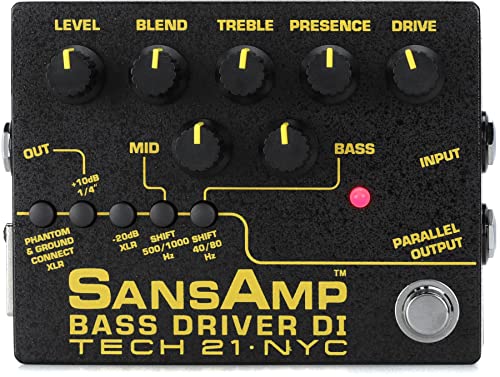
- Bass Preamp/DI Pedal with Extended Bass Control
- Selectable Midrange Frequency Control
The tech21 SansAmp Bass Driver DI V2 is an industry-standard preamp, direct box, and tone-shaping pedal widely used by touring bassists and studio engineers. It excels at delivering vintage tube warmth, aggressive modern drive, and direct DI connectivity for live sound consoles. While both the SansAmp and the SMD DD-1 Distortion Detector are high-grade professional tools built for audio clarity and reliability, they serve totally different functions: the SansAmp is used to sculpt, amplify, and color a bass guitar’s tone, whereas the SMD DD-1 Distortion Detector remains a pure, uncolored diagnostic meter designed to ensure your playback equipment runs clean and distortion-free.
Final Verdict on the SMD DD-1 Distortion Detector
The SMD DD-1 Distortion Detector is an essential diagnostic instrument for anyone who takes audio quality and system longevity seriously. By replacing guesswork, subjective listening, and inadequate multimeter readings with 100% analog precision, it grants complete clarity over your gain structure. From identifying the exact maximum volume of head units to setting perfect gain overlap on high-powered mono block amplifiers, this tool consistently protects your audio equipment from destructive clipping.
While the initial cost may seem like a commitment for a dedicated diagnostic tool, the peace of mind it provides—along with the money saved by preventing blown subwoofers and damaged voice coils—makes it worth every penny. Whether you are building a custom car audio build, fine-tuning an audiophile home theater, or running a professional installation shop, this unit deserves a permanent place in your toolkit. If you are ready to unlock the absolute cleanest output from your sound system, we strongly recommend taking action today—click here to purchase the SMD DD-1 Distortion Detector and experience pure, distortion-free sound.
Last update on 2026-10-23 / Affiliate links / Images from Amazon Product Advertising API