
tech21 SansAmp Bass Driver DI V2 Review: Is It Still the Ultimate Bass Tone Solution?
Every bass player who has ever stepped into a recording studio or onto a live stage knows the precise moment frustration sets in. You plug directly into an audio interface or direct box, hit a low E note, and hear a thin, sterile, completely lifeless sound coming through the monitors. In your bedroom amp, the tone felt massive, but inside a full mix surrounded by heavy electric guitars, sharp snare drums, and dynamic vocals, your low end turns into undefined, muddy acoustic sludge. For years, bassists were forced to drag 100-pound tube heads and giant 8×10 cabinets to every gig just to capture that sought-after analog punch, organic warmth, and harmonic saturation.
Solving this tone dilemma isn’t just about sounding better; it is about standing out in a dense mix without overpowering the rest of the band. Without proper tonal shaping, cab emulation, and precise EQ control, direct bass signals either disappear entirely or overwhelm the low-frequency spectrum with uncontrolled boominess. When we plugged the tech21 SansAmp Bass Driver DI V2 into our test rig, we were eager to see if this updated classic could truly eliminate the need for heavy amplifiers while delivering studio-grade direct tone in a single floor unit.
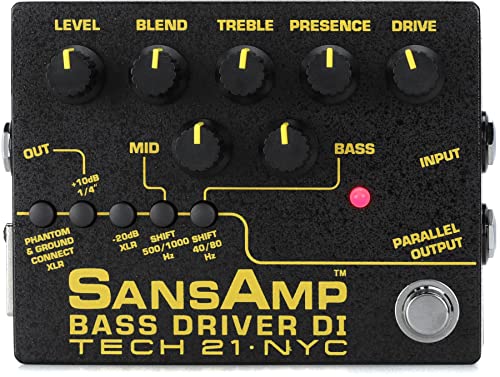
- Bass Preamp/DI Pedal with Extended Bass Control
- Selectable Midrange Frequency Control
What to Consider Before Buying a Bass Distortion & Overdrive Effects Pedal
A Bass Distortion & Overdrive Effects pedal is more than just an effect unit; it is a key solution for establishing the core voice of your instrument, controlling dynamic response, and guaranteeing consistent audio quality across any sound system. Whether you are performing live in diverse venues or tracking tracks in a home studio, an active preamp and DI pedal acts as the bridge between your bass guitar and the front-of-house PA or recording interface.
The ideal customer for this type of product is someone facing inconsistent live monitoring, muddy direct recording tones, or the burden of lugging heavy amplification. It is perfect for gigging bassists, session players, and studio producers who demand reliable analog warmth and tone-shaping power. However, it might not be suitable for those who prefer purely modern, ultra-transparent, digital impulse-response (IR) modeling systems, or those who want a digital multi-effects unit with built-in pitch shifting, delay, and modulation onboard. For bassists seeking pure analog tone sculpting and indestructible reliability, an active direct preamp remains the premier choice.
Before investing, consider these crucial points in detail:
- Dimensions & Space: Consider the overall layout of your pedalboard or gig bag before making a selection. Compact tone units allow you to travel light without sacrificing routing options, making it effortless to bring your signature sound to fly-dates, rehearsals, and studio sessions where pedalboard real estate is at a premium. Before purchasing, check the latest price and availability to ensure it fits both your rig and your budget.
- Capacity/Performance: Dynamic range, noise floor, power draw, and output headroom dictate how well a pedal handles active or passive bass pickups. A pedal with low current draw (around 6mA) and versatile power options—such as standard 9V battery, DC power supply, or phantom power directly from a mixing console—ensures seamless integration into any live or studio environment without ground loops or unwanted hiss.
- Materials & Durability: Live touring environments are notoriously tough on gear. Heavy-duty all-metal enclosures, robust footswitches, and smooth, recessed control knobs are essential to withstand years of foot stomps, cable yanks, and transport in crowded gear bags. Flmsy plastic chassis simply will not hold up to night after night of stage performance.
- Ease of Use & Maintenance: Intuitive tactile controls make on-the-fly tonal adjustments effortless during a performance. Having immediate access to active EQ knobs, drive levels, and output switches without needing to navigate complex digital menus or app interfaces allows you to adjust your tone instantly when playing in rooms with challenging acoustics.
Understanding these critical features makes selecting the right preamp simple, ensuring that your bass tone remains tight, punchy, and clear in every environment.
While the tech21 SansAmp Bass Driver DI V2 is an excellent choice, it’s always wise to see how it stacks up against the competition. For a broader look at all the top models, we highly recommend checking out our complete, in-depth guide:

- BLEND CONTROL — RETAIN LOW-END PUNCH WHILE ADDING GRIT: The DOUBLE THRUSTER features a dedicated Blend knob that mixes your clean bass signal with the overdriven signal. Dial it back to retain full...


- Based on a classic distortion circuit famous for its nasty sound
Unboxing and First Impressions of the tech21 SansAmp Bass Driver DI V2
Unboxing the tech21 SansAmp Bass Driver DI V2 immediately reveals why Tech 21 has earned such a stellar reputation in the bass community. Housed in a classic, heavy-duty black metal chassis, the pedal feels remarkably sturdy and road-ready in hand. Weighing in at roughly 14.9 ounces with compact dimensions of 4.1″ x 2.3″ x 5.7″, it strikes a great balance between portable convenience and rock-solid durability. The sleek black aesthetic with crisp white labeling makes every control easily readable, even under dim stage lighting.
Inspecting the top control panel highlights the meaningful updates in this Version 2 iteration. Alongside the beloved Drive, Presence, Blend, Level, Treble, and Bass knobs, Tech 21 introduced crucial frequency selector switches for both the Midrange and Bass controls. The build quality of the pots offers a smooth, tactile resistance that prevents accidental knob shifts on stage. Connecting the pedal via its standard 1/4-inch jack or 5-pin XLR output provides an immediate sense of professional hardware reliability. Anyone investing in a tech21 SansAmp Bass Driver DI V2 will immediately appreciate that this pedal is crafted specifically for daily professional use.
Key Benefits
- Expanded EQ versatility with selectable center frequencies (40Hz/80Hz Bass & 500Hz/1000Hz Mid)
- Incredible analog tube amp and speaker cabinet emulation for direct recording or PA routing
- Versatile output options including balanced XLR with phantom power support and 1/4″ parallel output
- Blend control allows seamless mixing of clean instrument tone with distorted tube drive
Limitations
- Lacks digital impulse response (IR) loading for custom cabinet files
- Can produce aggressive top-end bite if the Presence control is turned up too high
Hands-On Evaluation: Testing the tech21 SansAmp Bass Driver DI V2
1. Low-End Authority: 40Hz vs 80Hz Bass Control & 5-String Clarity
One of the most notable technical improvements in the tech21 SansAmp Bass Driver DI V2 is the addition of the selectable Bass frequency switch, offering center points at either 80Hz or 40Hz. In the original version of this legendary pedal, the bass control was fixed at 80Hz, which performed exceptionally well for standard four-string electric basses. However, modern bass players frequently utilize active 5-string and 6-string instruments tuned down to low B or lower. During our hands-on evaluation with both active and passive basses, switching the lower shelf to 40Hz completely transformed the extended low-end response.
At 40Hz, the sub-bass frequencies resonate with immense body and tight low-end weight without overloading the lower midrange. When executing fast passages or slapped lines on a low B string, the notes remain distinct, punchy, and fully articulated. When shifted back to 80Hz, the pedal provides that classic vintage warmth, boosting the punchy chest-thumping region that retro rock, motown, and funk tones rely on. This dual-frequency option ensures that whether you play a vintage passive Fender Precision or a modern active multi-scale 5-string, the low-end headroom can be dialed in with surgeon-like precision.
2. Midrange Sculpting: Pickup Matching and Mid Frequency Control
The lack of a dedicated midrange control on the original Bass Driver DI was often its only critique among tone purists. The tech21 SansAmp Bass Driver DI V2 directly solves this issue by incorporating an active Mid control along with a shiftable frequency switch toggling between 500Hz and 1000Hz. This addition is a feature that really sets it apart from simpler direct boxes, giving players total mastery over their position in a crowded audio mix.
Setting the mid switch to 500Hz allows you to scoop out boxy midrange frequencies often associated with acoustic woodiness, producing a sleek, modern, polished tone ideal for slap technique or heavy metal pick playing. Conversely, toggling to 1000Hz provides an upper-mid boost that cuts directly through wall-of-sound electric guitar riffs. During studio recording tests, boosting 1000Hz slightly provided fingerstyle bass lines with an energetic, vocal quality that sat beautifully right beneath the vocal track. Combined with the dedicated Presence control—which controls high-frequency harmonic attack and string noise—the midrange flexibility allows you to adapt instantly to single-coil, humbucker, or active soapbar pickup configurations.
3. Analog Drive, Harmonic Saturation, and the Power of the Blend Control
The heart and soul of the tech21 SansAmp Bass Driver DI V2 lies in its proprietary 100% analog tube amplifier circuit emulation. Far from being a flat, sterile preamp, this pedal introduces organic warmth, soft-knee compression, and musical harmonic distortion as you advance the Drive knob. At lower drive settings (between 8 o’clock and 10 o’clock), the pedal adds an undeniable analog sheen that smooths out dynamic transients, giving passive pickups a rich, record-ready feel.
As you turn the Drive knob past noon, the unit delivers aggressive tube-style overdrive reminiscent of a pushed vintage SVT rig. Crucially, the magic happens when dialing in the signature Blend control. The Blend knob determines how much clean instrument signal is combined with the internal SansAmp tube emulation circuit. By keeping the clean signal present, you retain all the pristine low-end punch and dynamics of your bass while layering grinding high-frequency saturation on top. We experimented by chaining this unit with high-gain fuzzes and overdrive pedals—including a classic ProCo Rat—and found that the SansAmp’s EQ section smoothed out high-frequency fizz, resulting in massive, heavy industrial and progressive rock tones reminiscent of Justin Chancellor’s work in Tool.
4. Studio & Live Routing Flexibility: Parallel Outputs and Cabinet Emulation
Versatility in routing is essential for modern gigging and recording musicians, and the tech21 SansAmp Bass Driver DI V2 delivers on all fronts. Featuring both a standard 1/4-inch output and a balanced 5-pin XLR output, this unit acts as a complete command center for your bass rig. The built-in speaker cabinet emulation is engineered to match the frequency curve of a multi-speaker bass cabinet, eliminating the harsh, artificial top-end frequencies inherent to direct line signals.
In our live stage setup tests, we ran the balanced XLR output straight to the front-of-house mixing console while simultaneously feeding the 1/4-inch output directly into a stage amplifier for local monitoring. Furthermore, the inclusion of an un-affected Parallel Output allows you to send a totally clean direct track to your recording interface alongside the fully processed SansAmp signal. This dual-tracking capability gives sound engineers ultimate flexibility during mixdown. The ability to run the pedal using a standard 9V battery, an external power supply, or via 48V phantom power directly from an XLR cable makes it one of the most reliable and convenient tone tools on the market. Bassists looking to streamline their setup should definitely explore current pricing and deals for this unit.
What Other Bassists Are Saying
Feedback across the bass playing community regarding the tech21 SansAmp Bass Driver DI V2 is overwhelmingly enthusiastic, with many calling it an absolute standard on pedalboards worldwide. Musicians consistently praise how effortlessly it solves the common problem of direct bass tracks sounding hollow or muddy in home recording setups. One guitarist tracking bass in his home studio noted that before buying this pedal, his direct bass lines lacked definition and got lost in the mix. After adding the SansAmp V2, the recorded bass immediately sat cleanly in the track with defined low-end presence and clear note articulation.
Other users who utilize multi-instrument pedalboards—including one-man bands and looping performers—highlight how the built-in cabinet emulation and active gain staging cured signal level issues when dropping guitar pitches with octave pedals. Bassists running active 5-string basses routinely celebrate the 40Hz EQ switch, pointing out that it keeps low B notes solid without booming out live subwoofers. Minor critiques are rare, but some players mention that setting the Presence control past 2 o’clock can introduce excessive finger noise or high-end bite depending on the freshness of their strings. Overall, community sentiment reinforces our testing: the pedal is a reliable tone transformer for studio and stage alike.
How the tech21 SansAmp Bass Driver DI V2 Compares to Top Alternatives
1. SMD DD-1 Distortion Detector

- Distortion detector/analyzer (dd1)
- Distortion detector's circuitry is 100% analog
The SMD DD-1 Distortion Detector serves a completely different role in an audio signal path compared to the tech21 SansAmp Bass Driver DI V2. While the SansAmp is an artistic tone-shaping preamp designed to create rich analog drive, warm cabinet emulation, and precise tonal equalization for instruments, the SMD DD-1 is an electronic testing tool used to detect signal clipping and harmonic distortion in car audio and amplifier installations. Audio engineers and car stereo installers will prefer the SMD DD-1 for calibrating gain structure and preventing speaker damage, whereas bass guitarists seeking musical drive and direct-box connectivity must choose the SansAmp.
2. Behringer Bod400 Bass Overdrive Effects Pedal

- Get tube-like distortion, smooth sustain and super-fat tone
- Unique Balance control to blend between overdriven and dry bass sound for maximum punch
The Behringer Bod400 Bass Overdrive Effects Pedal is an ultra-budget alternative aimed at entry-level players who want to experiment with driven bass tones without a major financial investment. It features a basic drive blend control and EQ in a lightweight plastic chassis. However, compared to the heavy-duty metal housing, advanced frequency switching (40Hz/80Hz & 500Hz/1000Hz), balanced XLR direct output, and pristine professional analog cabinet emulation of the tech21 SansAmp Bass Driver DI V2, the Bod400 is strictly a pedalboard distortion stompbox rather than a complete professional studio-grade DI preamp system.
3. Electro-Harmonix Bass Big Muff Pi Fuzz Pedal

- Tailor your drive/distortion sound with sustain, tone and volume knobs
- A dry switch that mixes your dry bass with the Bass Big Muff Pi's distortion
The Electro-Harmonix Bass Big Muff Pi Fuzz Pedal is a legendary choice for bass players looking for thick, heavy, wall-of-fuzz distortion. With its dedicated Dry/Effect switch, it preserves low-end presence while layering creamy fuzz over the instrument signal. However, while the Big Muff specializes in heavy saturation and fuzz, it lacks the clean tone-shaping flexibility, active multi-band parametric EQ, selectable center frequencies, cabinet emulation, and XLR DI output found on the tech21 SansAmp Bass Driver DI V2. Players looking for intense fuzz should go with the EHX, but those needing an all-in-one tonal foundation and professional direct box should choose the SansAmp.
Final Verdict: Is the tech21 SansAmp Bass Driver DI V2 Worth It?
After rigorous testing in both live performance and studio recording settings, the tech21 SansAmp Bass Driver DI V2 continues to hold its crown as an essential tool for modern bass players. Tech 21 took an industry-standard direct box circuit and upgraded it thoughtfully with key frequency switching options that cater directly to today’s multi-string, drop-tuned, and versatile bass styles. The ability to switch between 40Hz and 80Hz on the low end, fine-tune the midrange around 500Hz or 1000Hz, and blend clean dynamics with analog tube drive makes it an indispensable asset in any rig.
Whether you are a touring musician looking to eliminate the weight of traditional amplifiers, a home studio producer struggling to get direct bass tracks to cut through a dense mix, or a gigging bassist who demands consistent direct tone through front-of-house PA systems, this pedal delivers exceptional tone quality, durability, and versatility. To elevate your bass tone and take complete control of your signal, we highly recommend that you grab your tech21 SansAmp Bass Driver DI V2 today and experience the industry standard in analog bass preamps.
Last update on 2026-10-23 / Affiliate links / Images from Amazon Product Advertising API