
Electro-Harmonix Bass Big Muff Pi Fuzz Pedal Review: The Undisputed King of Low-End Fuzz?
If you have ever plugged a standard guitar distortion pedal into a bass rig during a full band rehearsal, you likely know the immediate disappointment that follows. The moment you step on the footswitch, your sound transforms into a razor-thin, fizzy buzz, and the foundational low-end frequencies that hold the entire song together suddenly vanish into thin air. The kick drum is left isolated, the guitarists drown you out, and your bass loses all its chest-thumping authority. We have spent years wrestling with this exact issue in studio sessions and live venues, searching for an effect that delivers blistering saturation while keeping the fundamental bass notes intact and powerful.
The solution requires a pedal designed specifically to handle low frequencies without suffocating them. That is where the Electro-Harmonix Bass Big Muff Pi Fuzz Pedal comes into play. Engineered from the ground up to cater to the unique sonic demands of the electric bass, this pedal promises to deliver legendary Russian fuzz warmth and thunderous distortion while preserving your low-end weight. In this exhaustive review, we put this iconic green box through its paces across multiple bass guitars, amplifier configurations, and musical genres to determine if it truly deserves a permanent spot on your pedalboard.

- Tailor your drive/distortion sound with sustain, tone and volume knobs
- A dry switch that mixes your dry bass with the Bass Big Muff Pi's distortion
Essential Factors to Evaluate Before Investing in Bass Distortion & Overdrive Effects
Adding a bass distortion or overdrive effect to your signal chain is a transformative decision for your overall sound. Unlike electric guitars, which thrive in the mid-range spectrum, the bass guitar occupies a critical low-frequency real estate that dictates the groove and weight of a mix. Choosing the wrong distortion pedal can completely destroy your band’s mix balance, making it vital to understand what key characteristics define a high-performance bass effect pedal.
The ideal customer for this type of effect pedal is a bassist performing in rock, metal, indie, alternative, or electronic genres who needs to add aggression, grit, harmonics, or massive wall-of-sound textures to their tone. It is also an exceptional tool for studio recording engineers looking to blend saturated bass tracks with pristine clean signals. Conversely, this effect might not be suitable for jazz purists, acoustic bassists, or players who require absolute clean headroom with zero tonal coloration. Those seeking subtle, transparent warmth without fuzz clipping might instead consider a dedicated vintage tube preamp or a light analog overdrive.
Before investing, consider these crucial points in detail:
- Dimensions & Space: Consider the physical footprint of the pedal relative to your pedalboard real estate. The Electro-Harmonix Bass Big Muff Pi Fuzz Pedal features a sturdy, die-cast chassis measuring 4.75″ x 4″ x 2.25″, making it a medium-sized unit that offers excellent stability during live performances while still fitting comfortably alongside other standard stompboxes.
- Capacity/Performance: Look closely at signal handling, noise floor, and power efficiency. A high-quality pedal should offer low current draw—in this case, an incredibly efficient 7 milliamps—to maximize battery life while maintaining clean headroom, whisper-quiet bypass operation, and massive output level potential to drive tube or solid-state amplifiers.
- Materials & Durability: Live gigging environments demand rugged hardware capable of enduring heavy foot pressure and rough transport. Look for full-metal enclosures, heavy-duty metal footswitches, firmly anchored input/output jack nuts, and robust rotary potentiometers that can withstand years of touring abuse.
- Ease of Use & Maintenance: The control layout should be intuitive enough for quick tweaks on a dark stage, while power options should accommodate both 9V batteries and standard external DC power supplies. Look for accessible battery compartments and clear labeling that streamlines setup and routine maintenance.
Selecting the right distortion mechanism directly dictates whether your bass signal sits proudly in the mix or gets buried underneath heavy guitar riffs. While evaluating your options, it pays to explore how different circuit topologies compare across various price points and performance features.
While the Electro-Harmonix Bass Big Muff Pi Fuzz Pedal is an excellent choice, it’s always wise to see how it stacks up against the competition. For a broader look at all the top models, we highly recommend checking out our complete, in-depth guide:

- BLEND CONTROL — RETAIN LOW-END PUNCH WHILE ADDING GRIT: The DOUBLE THRUSTER features a dedicated Blend knob that mixes your clean bass signal with the overdriven signal. Dial it back to retain full...


- Based on a classic distortion circuit famous for its nasty sound
First Impressions, Design Aesthetics, and Key Features
Unboxing the Electro-Harmonix Bass Big Muff Pi Fuzz Pedal immediately evokes a sense of vintage reliability. Housed in Electro-Harmonix’s classic military-green and brushed silver die-cast enclosure, the pedal feels reassuringly solid in hand, weighing in at a substantial 15.5 ounces. The graphic design pays direct homage to the famous Sovtek “Green Russian” Big Muffs of the 1990s—circuits famous among bassists for their thick, low-end heavy tone. Out of the box, it includes a pre-installed 9V battery, allowing you to plug in and play immediately without searching for an external power brick.
The layout is streamlined and clutter-free, boasting three sturdy control knobs—Volume, Tone, and Sustain—alongside a unique three-position toggle switch labeled Normal, Dry, and Bass Boost. Turning the pedal around reveals standard 1/4-inch input and output jacks, accompanied by a dedicated 1/4-inch Dry Output jack. This secondary output allows you to send an unaffected clean signal to a separate amplifier or channel, opening up sophisticated dual-rig routing options right out of the box. You can check the latest price and availability to see how accessible this premium build quality really is.
What We Like
- Exceptional low-frequency retention via the specialized Dry and Bass Boost modes
- Authentic, rich vintage fuzz tone based on the legendary Green Russian Big Muff circuit
- Dual output jacks (Effect and Dry) provide outstanding routing and recording versatility
- Rugged die-cast metal housing designed to endure rigorous gigging and touring
What We Didn’t Like
- Does not include an AC power adapter in the box (requires standard 9V DC center-negative power supply)
- Output volume jump can be severe if turned past 12 o’clock without careful adjustment
In-Depth Performance & Hands-On Feature Analysis
To thoroughly evaluate the Electro-Harmonix Bass Big Muff Pi Fuzz Pedal, we integrated it into a wide variety of signal chains over several weeks of testing. We tested the pedal using an Epiphone Thunderbird, a Fender Player Precision Bass, and a Music Man StingRay, running through both a high-headroom solid-state bass stack and an all-tube bass combo. Here is our detailed breakdown of how this pedal performs across its core design elements.
1. Tonal Heritage: The Russian Big Muff Circuit Architecture
The original Sovtek Green Russian Big Muff pedals manufactured in the 1990s achieved legendary status among bass players because their specific component values allowed far more low-end energy to pass through the clipping stages compared to standard American guitar Big Muffs. Electro-Harmonix wisely based the Electro-Harmonix Bass Big Muff Pi Fuzz Pedal directly on that iconic circuit, fine-tuning it specifically for contemporary bass setups.
When engaged in standard “Norm” mode, the pedal delivers a gorgeous, woolly, thick fuzz saturated with rich upper-harmonic overtones. It doesn’t sound like a harsh, abrasive distortion pedal; instead, it generates a creamy, singing sustain that transforms single-note basslines into massive sonic walls. Playing heavy rock riffs in the style of Cliff Burton, Muse, or Queens of the Stone Age yields immediate gratification. Harmonics leap off the fretboard with subtle finger vibrato, and sustained notes bloom into musical feedback without dying out prematurely. The analog circuit reacts dynamically to your instrument’s volume knob and picking intensity, allowing you to back off your attack for a warm, vintage breakup or dig in aggressively for absolute sonic destruction.
2. The Three-Way Mode Toggle: Solving the Mix Cut-Through Problem
The absolute crown jewel of the Electro-Harmonix Bass Big Muff Pi Fuzz Pedal is its three-position toggle switch located directly beneath the control knobs. This feature single-handedly solves the classic problem of bass distortion getting lost in a dense mix. The toggle offers three distinct operational modes:
- Norm (Normal): This setting runs the pure, unadulterated classic Big Muff fuzz circuit. It yields maximum sustain, saturation, and compression, making it ideal for solos, lead bass lines, or power-trio formats where the bass takes up significant midrange space.
- Dry: In this mode, the pedal mixes your original, clean, un-effected bass signal directly with the fuzz output. The Volume knob directly controls the level of the fuzz, while your clean bass tone remains at unity gain with pristine low-end clarity. This is an absolute game-changer for live performances. Your fundamental note maintains its punch, attack, and chest-thumping sub-bass power through the subwoofers, while a layer of filthy fuzz sits perfectly on top to slice through heavy electric guitar tracks.
- Bass Boost: When you rotate the Tone knob towards the treble side to gain brightness and pick attack, standard tone stacks naturally scoop out low frequencies. Switching to Bass Boost reintroduces a massive low-frequency EQ curve before the fuzz circuit, ensuring that even at crisp, high-treble tone settings, your tone rumbles the room.
During our testing, placing the toggle in Dry mode with the Volume at 9 o’clock, Tone at 12 o’clock, and Sustain at 12 o’clock instantly produced a record-ready bass tone that required zero corrective EQ at the mixing console. You can see its full feature set and user reviews to learn how other players utilize these mode toggles on stage.
3. Precise Control Dynamics: Volume, Tone, and Sustain Mechanics
The three-knob interface on the Electro-Harmonix Bass Big Muff Pi Fuzz Pedal may look simple, but the controls are surprisingly sensitive and interactive:
Volume Knob: This knob sets the overall output level of the effect. It is worth noting that this pedal possesses an astronomical amount of gain on tap. Setting the Volume past 12 o’clock can easily overwhelm your amplifier’s input stage or blow out quiet practice speakers if you aren’t careful. We found that setting the Volume between 9 o’clock and 10 o’clock was usually sufficient to achieve clean unity gain with our bypass signal, leaving massive headroom available to push tube preamps into natural overdrive.
Tone Knob: The tone control acts as a specialized tilt-EQ designed specifically for bass frequencies. Turning the knob counter-clockwise rolls off treble and boosts sub-bass, producing deep, muffled, synth-like sub-fuzz tones perfect for dub, hip-hop, or ambient passages. Turning the knob clockwise boosts upper-midrange and high frequencies, yielding a gritty, aggressive bite that brings out string noise, pick attack, and metallic clack—ideal for thrash metal and progressive rock.
Sustain Knob: This control adjusts the amount of gain, clipping, and distortion duration applied to your signal. At lower settings (7 to 9 o’clock), the pedal acts almost like a gritty vintage overdrive, adding subtle harmonic fuzz to your note attack. Cranking the Sustain knob past 2 o’clock converts your signal into an endless wall of thick, compressed fuzz where notes hold out indefinitely with rich, singing harmonic feedback.
4. Studio & Stage Versatility: Dual Signal Routing Capabilities
Another area where the Electro-Harmonix Bass Big Muff Pi Fuzz Pedal punches far above its weight class is hardware connectivity. In addition to the main Effect Output, Electro-Harmonix built in a completely separate 1/4-inch Dry Output jack. This feature offers immense value for both home studio owners and gigging professionals.
By connecting a second cable to the Dry Output, you can split your bass signal into two isolated paths without using an active splitter box. Path A carries the heavily distorted fuzz signal directly to a high-gain guitar amp or distortion-focused DI channel, while Path B sends your untouched, ultra-clean bass signal to a dedicated bass cabinet or primary DI box. In a recording studio environment, this enables you to track a pristine, clean bass line alongside an aggressive fuzz track simultaneously onto two separate DAW tracks. During post-production, you can blend, EQ, and compress both tracks independently to achieve a massive, multi-dimensional bass mix that sounds like two separate rigs playing in perfect synchronization.
What Real Owners and Performers Are Saying
Community feedback for the Electro-Harmonix Bass Big Muff Pi Fuzz Pedal across live music forums, gear communities, and musician reviews is overwhelmingly enthusiastic. Bassists across numerous genres consistently praise the pedal for solving the dreaded “lost low-end” issue that plagues almost all traditional guitar distortion boxes.
Multiple users note that the pedal works exceptionally well when paired with iconic bass models, such as Epiphone Thunderbirds and Fender Jazz basses. One passionate reviewer highlighted that running the pedal alongside an analog bass booster pedal literally “rumbled the house,” proving its immense sub-bass capabilities. Performers playing in bands covering artists like Tool, Metallica, Maneskin, Led Zeppelin, and Queens of the Stone Age consistently report that this pedal delivers those exact hard-hitting, album-quality fuzz textures without hassle.
On the critical side, a common complaint from buyers is the lack of an included 9V AC power adapter in the box. While the pedal comes equipped with a fresh 9V battery, players building out modern pedalboards powered by isolated power supplies will need to supply their own standard 9V DC cable. Additionally, several users issue a friendly warning regarding the output Volume knob, noting that the pedal has an enormous amount of output gain available. New users are advised to start with all knobs turned down low before engaging the foot-switch to avoid accidental speaker damage or sudden volume spikes. Overall, the consensus among working musicians is that this pedal is an indispensable staple for any serious bass player’s collection.
Comparing the Electro-Harmonix Bass Big Muff Pi Fuzz Pedal to Top Alternatives
Before making a final purchasing decision, it is helpful to understand how the Electro-Harmonix Bass Big Muff Pi Fuzz Pedal compares against other popular utility and overdrive pedals in the bass processing category.
1. SMD Distortion Detector DD-1

- Distortion detector/analyzer (dd1)
- Distortion detector's circuitry is 100% analog
The SMD Distortion Detector DD-1 is an entirely different class of device compared to the Bass Big Muff. While the Big Muff is a creative musical effect designed to add rich fuzz distortion to your tone, the SMD DD-1 is a highly specialized diagnostic measurement tool used primarily by car audio installers and sound engineers to detect signal clipping and harmonic distortion in audio systems. If you are looking to artisticly distort your bass guitar, the DD-1 is not a musical effect pedal. However, for audio technicians and mobile audio builders who need to calibrate gain structure, eliminate unwanted amplifier clipping, and set system headroom accurately without an oscilloscope, the SMD DD-1 is an invaluable piece of testing hardware.
2. Behringer Bod400 Tube-Sound Overdrive Pedal

- Get tube-like distortion, smooth sustain and super-fat tone
- Unique Balance control to blend between overdriven and dry bass sound for maximum punch
For players operating on an absolute shoestring budget, the Behringer BOD400 offers an entry-level introduction to bass overdrive. Unlike the heavy, roaring fuzz generated by the Bass Big Muff, the BOD400 is modeled to simulate warm, mild tube amp breakup and gentle overdrive. It features a plastic enclosure and a balance control to mix clean and distorted signals. While it is significantly cheaper and offers decent vintage warmth for home practice, it lacks the indestructible die-cast metal housing, pure fuzz saturation, and dual-output routing flexibility of the Electro-Harmonix unit. The Bass Big Muff remains far superior for heavy rock, metal, and touring applications where build durability and deep fuzz intensity are mandatory.
3. tech21 SansAmp Bass Driver DI V2
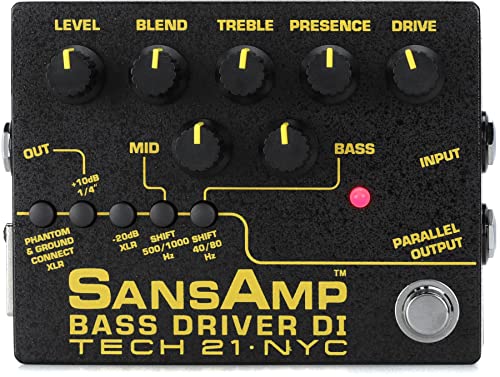
- Bass Preamp/DI Pedal with Extended Bass Control
- Selectable Midrange Frequency Control
The Tech 21 SansAmp Bass Driver DI V2 is an industry-standard tone-shaping preamp and direct injection box found on professional stages worldwide. Rather than acting strictly as a high-gain fuzz pedal, the SansAmp is designed to model classic tube amplifiers, providing total control over bass, mid, treble, and drive frequencies alongside a balanced XLR output for sending signal directly to the front-of-house PA system. While the SansAmp can achieve pleasant tube crunch and subtle drive, it cannot reproduce the explosive, thick, singing fuzz wall that the Bass Big Muff creates. Many professional bassists actually pair both pedals together: using the SansAmp as their primary clean preamp and stepping on the Electro-Harmonix Bass Big Muff Pi Fuzz Pedal when it is time to deliver heavy distortion during choruses or solos.
Final Verdict: Is the Electro-Harmonix Bass Big Muff Pi Fuzz Pedal Worth It?
After putting the Electro-Harmonix Bass Big Muff Pi Fuzz Pedal through extensive testing, it becomes instantly clear why this green box has remained a dominant force on bass pedalboards worldwide for over a decade. Electro-Harmonix took the most desirable sonic traits of the classic Green Russian Big Muff circuit and engineered smart, bass-specific solutions—most notably the revolutionary Dry signal blend and Bass Boost toggle modes—that solve the age-old problem of losing low-frequency punch when using distortion.
Whether you are looking to recreate the legendary fuzz tones of classic rock and thrash metal icons or forge innovative, synth-like textures in modern electronic and indie formats, this pedal delivers extraordinary analog tone, tour-ready durability, and dual-output versatility at an amazingly accessible price point. It earns our highest recommendation for bass players of all skill levels who refuse to compromise on low-end power.
Ready to add thunderous, mix-cutting fuzz and endless sustain to your bass rig? Take the next step in elevating your tone and a feature that really sets it apart today to transform your sound on stage and in the studio!
Last update on 2026-10-23 / Affiliate links / Images from Amazon Product Advertising API